Key Takeaways
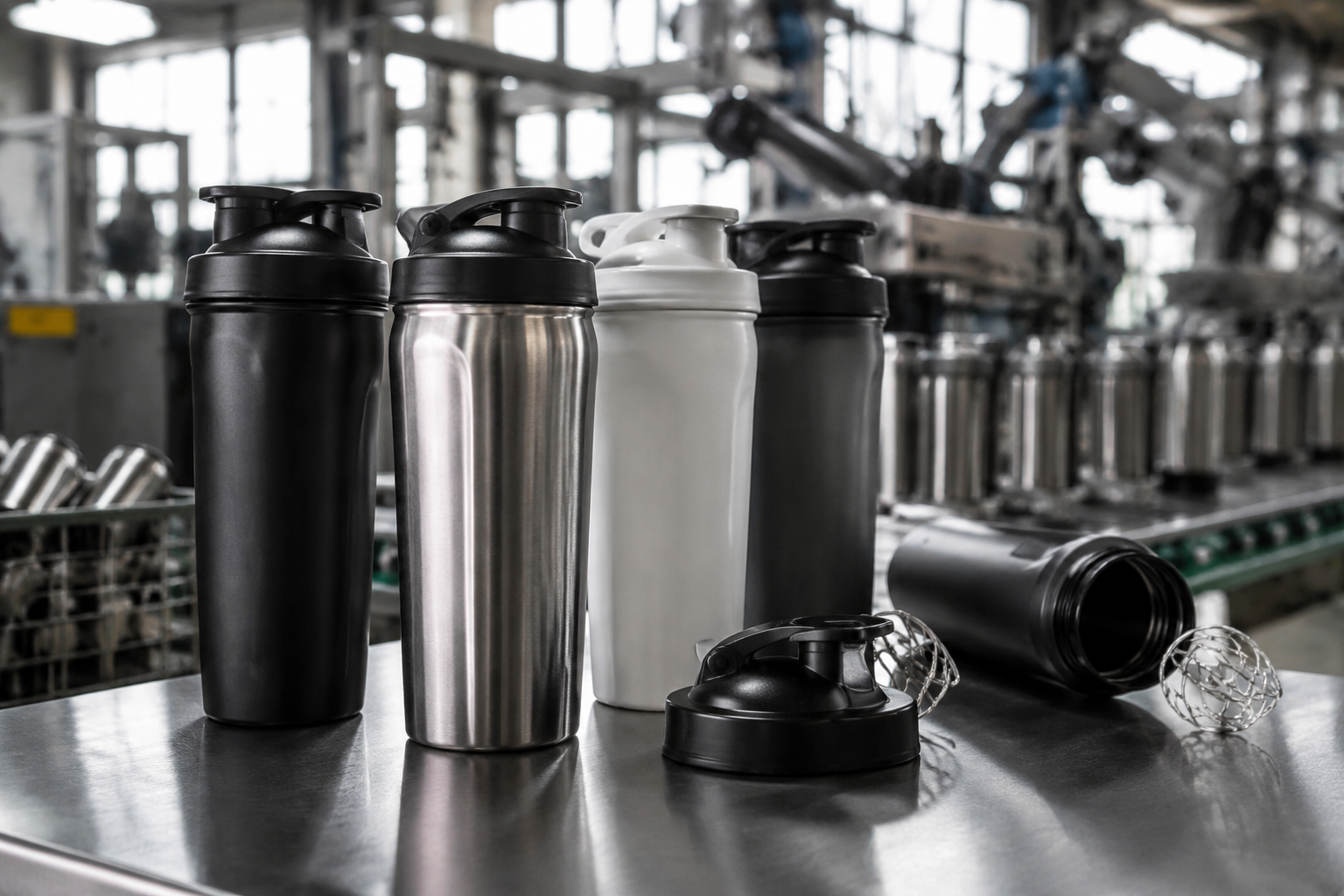
- A basic 600 ml PP shaker usually lands at USD 0.95-1.80 FOB China at 5,000-20,000 pcs
- Custom PMS body color normally starts at 3,000-5,000 pcs per color, depending on resin and mold
- A realistic bulk gym water bottle production timeline is 30-45 days after sample and artwork approval
- AQL inspection at Level II with 2.5/4.0 limits is common for fitness retail and gym chain orders
If you are buying a vendor shaker bottle for a gym chain or fitness brand, the hard part is not finding a supplier with a pad-print machine. The hard part is checking whether a USD 1.20 quote survives a 500 ml leak test, whether 1,000 pieces covers custom color resin, and why one factory books 25 days while another writes 55 on the PI.
BottleForge Industrial manufactures sports bottles and shakers in Hangzhou, Zhejiang, and we run into this question on 6 or 7 buyer calls every week. China sourcing still works for bulk shaker bottle programs, but the math gets ugly when cost, MOQ, and lead time are treated like sales copy instead of line inputs; last month QC pulled a sample with a 0.4 mm lid gap, and the buyer flagged it before we shipped.
Start with the bottle type
Before you ask for a vendor shaker bottle quote, pin down the exact bottle type. “Shaker” is too loose on a PO. We run separate BOMs for a protein shaker with a 304 wire ball, a mixer-grid lid, a two-compartment powder cup, a stainless insulated shaker, and a sports bottle with a flip straw. Same name, different molds, gaskets, cycle time, and carton size.
For a gym chain giveaway, a 500-700 ml PP or Tritan shaker is usually enough; the line can pack 24 pcs per master carton without wasting space. For a retail fitness brand, ask for heavier Tritan, a threaded lid with a silicone ring, a stronger carry loop, and a logo method that survives 50 dishwasher cycles. For a premium custom fitness water bottle, stainless 18/8 vacuum construction changes the quote completely. The math doesn’t work if you compare it against injection-molded plastic.
Typical FOB China reference ranges help only when the specification matches line by line. Last month QC pulled a 700 ml sample because the buyer’s artwork said 650 ml on the measurement scale, while the PO said 700 ml. That one typo delayed approval by 4 days.
- Basic PP shaker, 600 ml: USD 0.95-1.80 at 5,000-20,000 pcs, usually with a 304 wire ball and single-color silk print.
- Tritan shaker, 700 ml: USD 1.65-3.20 at 3,000-10,000 pcs, often with a clearer body, molded scale, and threaded PP lid.
- Two-compartment shaker: USD 2.10-4.20 at 5,000-15,000 pcs, because the extra powder cup adds tooling fit checks and packing labor.
- Stainless insulated shaker: USD 5.80-9.50 at 1,000-5,000 pcs, based on 18/8 vacuum body, leak test, and foam sleeve packing.
If you are comparing a bulk fitness water bottle to a bulk sports water bottle, check whether the quote includes the mixing ball, inner grid, measurement scale, individual polybag, carton marks, and drop-test packaging. We’ve seen this go sideways: the buyer flagged a “cheap” offer after inspection because it missed carton marks and 1.2 m drop-test packaging. Small omissions can shift the real landed cost by 8-15%.
Where the unit cost moves
The factory price is not one number. It is a stack: resin, injection cycle seconds, lid parts, logo process, packing, reject allowance, and export handling. Last month a buyer pushed for the cheapest custom shaker bottle, and QC pulled 32 leaking samples from a 500-piece pre-shipment check because the cap thread was cut too shallow by 0.3 mm. So I ask a direct question: which problem can your program tolerate, color drift, loose lid threading, logo rub-off, or a 3% leakage claim rate? Cheap can work. No boundaries is where the math breaks.
Material moves the quote first. PP is the low-cost choice and runs fast on the injection line, around 28-35 seconds per body in our Hangzhou workshop, but cheap resin can feel thin and hold protein-powder odor after 2-3 washes. Tritan costs more and gives better clarity, so retail buyers accept it faster on shelf. Stainless 304 is a different cost bracket; vacuum insulation means welding, polishing, leak testing at 0.6 MPa, and more line time before packing.
Wall thickness changes both feel and scrap. A 600 ml PP shaker with a 1.2 mm wall will not feel like a 1.8 mm wall product, and the buyer will notice as soon as they squeeze the body. For gym chains, 1.5-1.8 mm is the practical middle range; we run calipers on the shoulder and base because those spots thin out first after molding. If you want a custom gym water bottle that members use for 6 months, cutting the wall to save USD 0.04 is the wrong question to ask.
Logo cost depends on method and surface. One-color silk screen can be USD 0.05-0.12 per piece. Heat transfer can be USD 0.18-0.45. Laser engraving on stainless may be USD 0.10-0.30. A custom logo shaker bottle with full-wrap artwork needs trapping, curved-surface proofing, and a bigger reject allowance; we once saw a PO typo change Pantone 186C to 189C, and the buyer flagged it at approval. That is why the same bottle can move from USD 1.45 to USD 2.05 with no mold or material change.
MOQ tiers you should expect
MOQ is where fitness brands often misread China production. We can run 500 pcs for a stock-color custom logo shaker bottle if the bottle, cap, flip lid, and carton are already on the shelf. That 500 pcs does not cover custom body color, custom lid color, private color box, and mixed carton labels. Each part has its own MOQ. Last month a buyer sent a PO for 500 pcs with “black bottle, red lid, 4 gym logos, retail box”; the math did not work once the line checked resin changeover and pad-printing setup.
For stock molds in existing colors, 500-1,000 pcs works for simple logo printing. For custom PMS plastic color, plan on 3,000-5,000 pcs per color because the resin has to be mixed, dried, purged, and stabilized through injection molding. We check the first shots with a Datacolor unit, and QC pulled the sample if the body color drifts more than the approved PMS chip. For a custom made shaker bottle with a new lid shape or proprietary grip, tooling may start around USD 2,000-8,000 for simple plastic parts and goes up fast when the design needs multiple sliders or tight seal geometry.
At BottleForge in Zhejiang, our practical monthly sports bottle capacity is about 480,000 units across plastic and stainless lines, but small orders still fight for color-change time, printing setup, and packing labor. A 1,000-piece customized shaker bottle will not get the same unit cost as a 10,000-piece order even if the bottle looks identical. We run the same injection machine, but the smaller order still needs mold cleaning, ink mixing, a screen setup, carton marking, and a pre-shipment check under AQL 2.5.
For distributor shaker bottle programs, the cleaner setup is one master design with 3-5 logo versions. If each gym location asks for a different body color, the MOQ turns ugly. We’ve seen this go sideways: 12 locations wanted 12 colors, then the buyer flagged freight because each color needed its own production slot and carton label. Keep the bottle color fixed and change only the logo; distributors gym water bottle orders are easier to combine, inspect, and ship together.
Good sourcing is not asking the factory to ignore MOQ. It is designing the program so MOQ works in your favor.
Lead time by real milestones
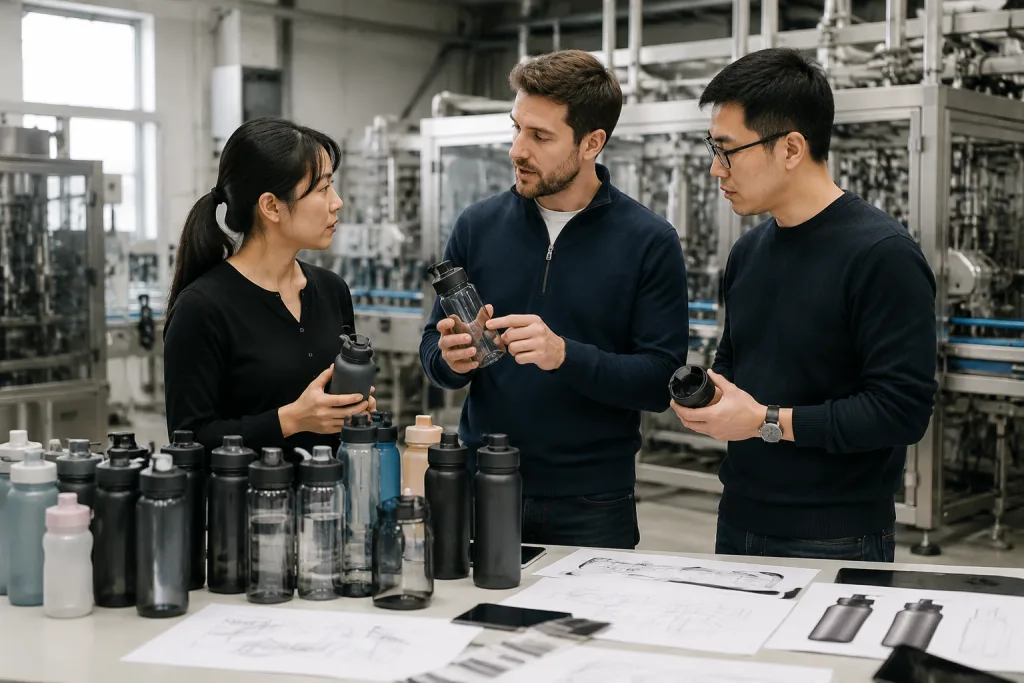
A serious lead-time quote should show milestones, not just “35 days.” For a customizable shaker bottle, we start the clock after 5 items are locked: deposit, final artwork, color standard, barcode data, and packaging files. We had one PO last month with the EAN code typed 1 digit wrong, and QC pulled the carton label sample before printing plates were released. Five days lost there means five days lost. The line will not catch up by magic.
A normal timeline for a stock-mold custom sports water bottle looks like this:
- Quotation and spec confirmation: 1-3 working days if your brief includes bottle capacity, lid type, logo size in mm, and target MOQ.
- Digital artwork proof: 1-2 working days after logo files arrive in AI, PDF, or EPS; JPG logos from a sales deck usually need redrawing.
- Pre-production sample: 5-10 days for stock color, 10-15 days for PMS plastic color; we check the first shot against the PMS book under a D65 light box.
- Mass production: 20-35 days depending on order size, color count, and logo process; a 2-color silk print ties up the pad-printing table longer than a single-side logo.
- Inspection and export packing: 2-4 days, including AQL 2.5 checks, drop test on the master carton, and barcode scan.
- Ocean freight to Europe or North America: commonly 25-40 days port to port, before customs clearance and local truck booking.
Air freight can work for 500-1,000 pcs urgent launch orders, but it often adds USD 1.50-4.00 per plastic bottle depending on volume. The math doesn’t work for most bulk gym water bottle campaigns. We’ve seen buyers approve air freight on 800 pcs, then push back when the landed cost beats their retail plan by USD 2 per unit.
For a custom mold, add 25-45 days for tooling and T1 samples before production. On the factory floor, the mold room needs confirmed 2D drawings, wall thickness in mm, and resin shrinkage before cutting steel. If your launch date is fixed, do not approve tooling and packaging at the same time unless your team can review samples within 24 hours. The slowest part of China sourcing is often not the factory line; it is buyer-side approval.
Customization that affects risk
Customization is not just branding. It changes production risk on the line. We run a one-color logo on a stock black lid with a 120 mm screen fixture and the scrap rate stays low. A customizable gym water bottle with translucent gradient body, silicone sleeve, retail box, QR code insert, and four FNSKU labels is a different job; QC pulled the sample twice last month because the sleeve sat 1.5 mm off-center.
Logo placement needs to follow the bottle curve. A flat vertical panel prints cleaner than a full round body. If you need a custom logo shaker bottle for retail, ask for 6 photos and a 10-second pre-production sample video under normal workshop light, not just a studio render. Curved transparent plastic makes white ink look weaker than the PDF proof, and yes, the buyer will flag it after the first carton is opened.
Packaging moves both cost and lead time. A plain export carton is cheapest. An individual white box may add USD 0.12-0.35. A four-color retail box can add USD 0.25-0.80 and normally requires 1,000-3,000 pcs MOQ from the packaging supplier. For Amazon or marketplace programs, specify FNSKU labeling and carton size control before quotation; we have seen this go sideways when the PO says “label later” and the cartons are already sealed with 48 mm BOPP tape.
Compliance is where buyers should be blunt. For Europe, ask about LFGB, REACH, and food-contact declarations. For the United States, ask about FDA food-contact suitability and, for children’s products, CPSIA and ASTM requirements. Most adult bulk sports water bottle programs do not need every test under the sun, but the resin and colorant should match the sales market before sample approval; the math does not work if SGS pulls a failed color migration report after 5,000 pcs are molded.
Quality checks before shipment
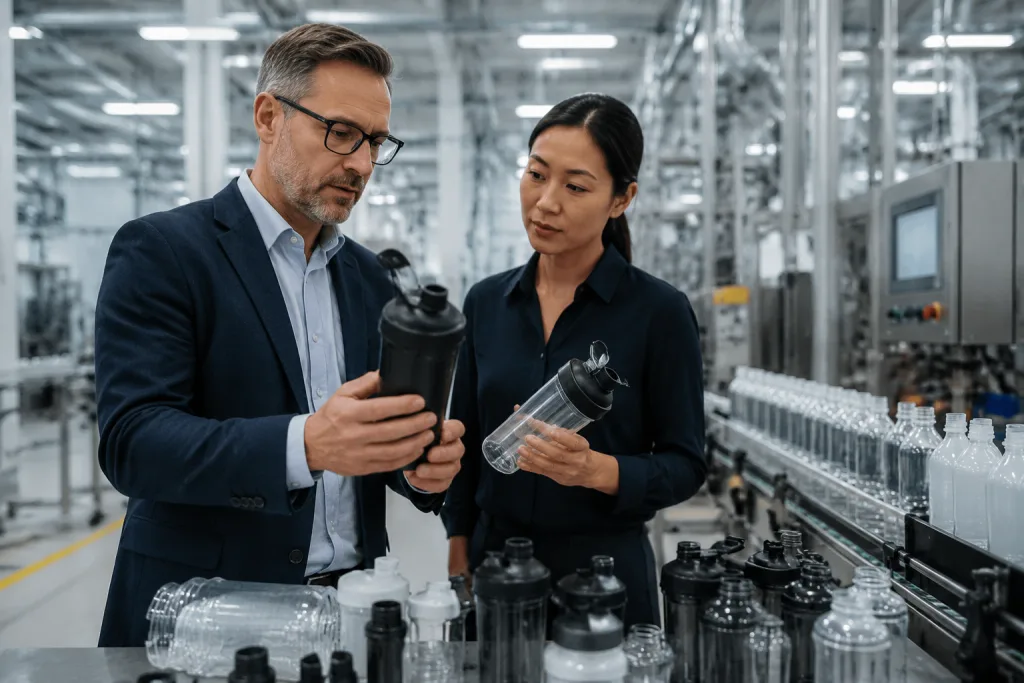
A shaker bottle usually fails in boring places: a lid weeps 3 ml after a 60-second upside-down test, a hinge pin walks out by 1 mm, the mixing grid rattles, PP keeps a hot-water smell, the body gets scuffed in the polybag, the logo lifts under tape, the 500 ml mark sits 8 mm off, or the cap cracks after a 1.2 m carton drop. Not exciting. Still returns.
For a distributor fitness water bottle or gym chain order, lock the inspection sheet before the line starts. AQL Level II with critical 0, major 2.5, minor 4.0 is a common baseline. Critical defects mean contamination, sharp edges, unsafe materials, or leakage that fails our inverted leak jig. Major defects cover logo misprint, functional leak, broken lid, wrong color, or an unreadable barcode. Minor defects are small cosmetic marks inside the signed limit sample, such as a 2 mm scratch on the back side. We have seen buyers ask for “factory standard” on the PO; that is the wrong wording, because nobody agrees what it means when QC pulled the sample at 10 p.m.
Practical tests should cover 100% visual checks on the line, random leak testing from sealed cartons, logo adhesion with 3M tape, lid cycling to 500 opens, and carton drop testing from 1.2 m on corner, edge, and face. For stainless shakers, test vacuum performance by temperature retention or pressure methods, not by shaking one sample and guessing. For plastic shakers, run odor testing after hot water exposure, especially for PP; we use 80°C water for 30 minutes, then QC smells the cup after cooling. Simple test. It catches trouble.
Our Hangzhou, Zhejiang quality team holds shipment until inspection photos, carton dimensions, gross weight, and packing list match the purchase order. It is not glamorous, but it prevents the classic issue where a customized gym water bottle order passes product inspection and then fails receiving because the carton label says 24 pcs while the PO says 36 pcs. For distributors shaker bottle shipments, carton discipline matters. One mixed pallet can slow receiving for 18 store locations, and the math does not work when the buyer flags it after the container has already left Ningbo.
How to brief the factory
A clean RFQ saves 3–5 working days. A loose RFQ gets you a cheap number that moves after sampling. For a vendor shaker bottle, put capacity, material, lid style, logo size, order quantity, target market, packaging, delivery term, and ship date in the first email. We had one buyer send “sports bottle, urgent” with no lid drawing; the line quoted our standard flip cap, then QC pulled the sample and the buyer flagged the hinge gap at 0.8 mm.
Use numbers. “High quality” is not a spec. “700 ml Tritan body, 1.6 mm average wall, screw lid, mixing ball, one-color logo 60 x 45 mm, individual polybag, 24 pcs/carton, FOB Ningbo, 5,000 pcs, EU market” gives the merchandiser something real to price. Our quote sheet has separate cells for resin, logo process, carton size, and GW; if one cell is blank, purchasing starts guessing.
If you are sourcing a distributor sports water bottle range, split fixed requirements from paid upgrades. Leak-proof screw lid and BPA-free material belong in the fixed column if your buyer will reject anything else. Dishwasher-safe logo needs a test method, not just a promise; we run 20 wash cycles on the sample before signing off. Silicone sleeve, retail box, or metallic finish can sit in the upgrade column, so your team can compare a custom sports water bottle at USD 1.85 against a premium version at USD 2.45 without mixing two products on one PO.
For fitness brands, ask for two tiers: launch MOQ and reorder MOQ. Your first order might be 2,000 pcs to check sell-through, then 10,000 pcs with better pricing and 3 colorways on reorder. This is the right question to ask. The math does not work when a new brand is pushed into 12,000 pcs on day one, especially if the ship date is 18 days out and the mold insert still needs a 2 mm logo adjustment.
Send your shaker spec and target launch date
We will quote MOQ tiers, logo options, sample timing, and FOB China pricing for your gym or fitness bottle program.
Frequently asked questions
What is a realistic MOQ for a vendor shaker bottle?
For a stock mold and stock body color, 500-1,000 pcs is often possible with one-color logo printing. For custom PMS body color, plan on 3,000-5,000 pcs per color because resin mixing and machine purging create setup loss. For a custom made shaker bottle with a new lid, grip, or compartment system, MOQ usually starts at 5,000-10,000 pcs after tooling. Gym chains can reduce MOQ pressure by using one bottle color and changing only the logo for each location.
How much should a custom shaker bottle cost FOB China?
A basic 600 ml PP custom shaker bottle usually costs around USD 0.95-1.80 FOB China at 5,000-20,000 pcs. A Tritan version may run USD 1.65-3.20, while a two-compartment shaker is often USD 2.10-4.20. Stainless insulated shakers are usually USD 5.80-9.50 depending on capacity and finish. These ranges exclude ocean freight, import duty, VAT, and domestic delivery. Logo method, wall thickness, packaging, and inspection requirements can move the final quote by 10-25%.
Can we order a bulk fitness water bottle with multiple gym logos?
Yes, but structure it carefully. The lowest-cost method is one bottle color, one lid color, and multiple logo print runs. For example, a 10,000-piece bulk fitness water bottle order can be split into five logos of 2,000 pcs each if the print setup is planned together. Expect a small setup charge per logo, often USD 30-80 depending on screen or pad-print tooling. If every logo also needs a different bottle color, MOQ and lead time increase because molding must be scheduled separately.
What lead time should a fitness brand plan before launch?
For a stock-mold customized shaker bottle, plan 5-10 days for sample proofing, 20-35 days for mass production, and 2-4 days for inspection and export documents. Ocean freight to Europe or North America commonly adds 25-40 days port to port. A safe launch calendar is 60-85 days from confirmed artwork to warehouse arrival. If you need custom mold tooling, add another 25-45 days before mass production. Air freight is faster, but it can add USD 1.50-4.00 per plastic bottle.
What quality standard should distributors shaker bottle buyers use?
For distributors shaker bottle orders, AQL Level II is a practical default, with critical defects at 0, major defects at 2.5, and minor defects at 4.0. Define leakage, logo adhesion, color tolerance, odor, barcode readability, carton strength, and packing accuracy before production. A leak test should include inverted bottles with water for a fixed time, not just a quick shake at the line. If you sell into the EU, confirm LFGB or relevant food-contact testing; for the US, confirm FDA food-contact suitability.