Key Takeaways
- For a new custom kids water bottle, plan 1,000-3,000 pcs MOQ per color or design
- Tritan, PP, 304 stainless steel, and silicone parts need different test reports
- Laser engraving lasts longer than silkscreen, but full-color school mascots need transfer or UV print
- A realistic China production timeline is 25-35 days after artwork and sample approval
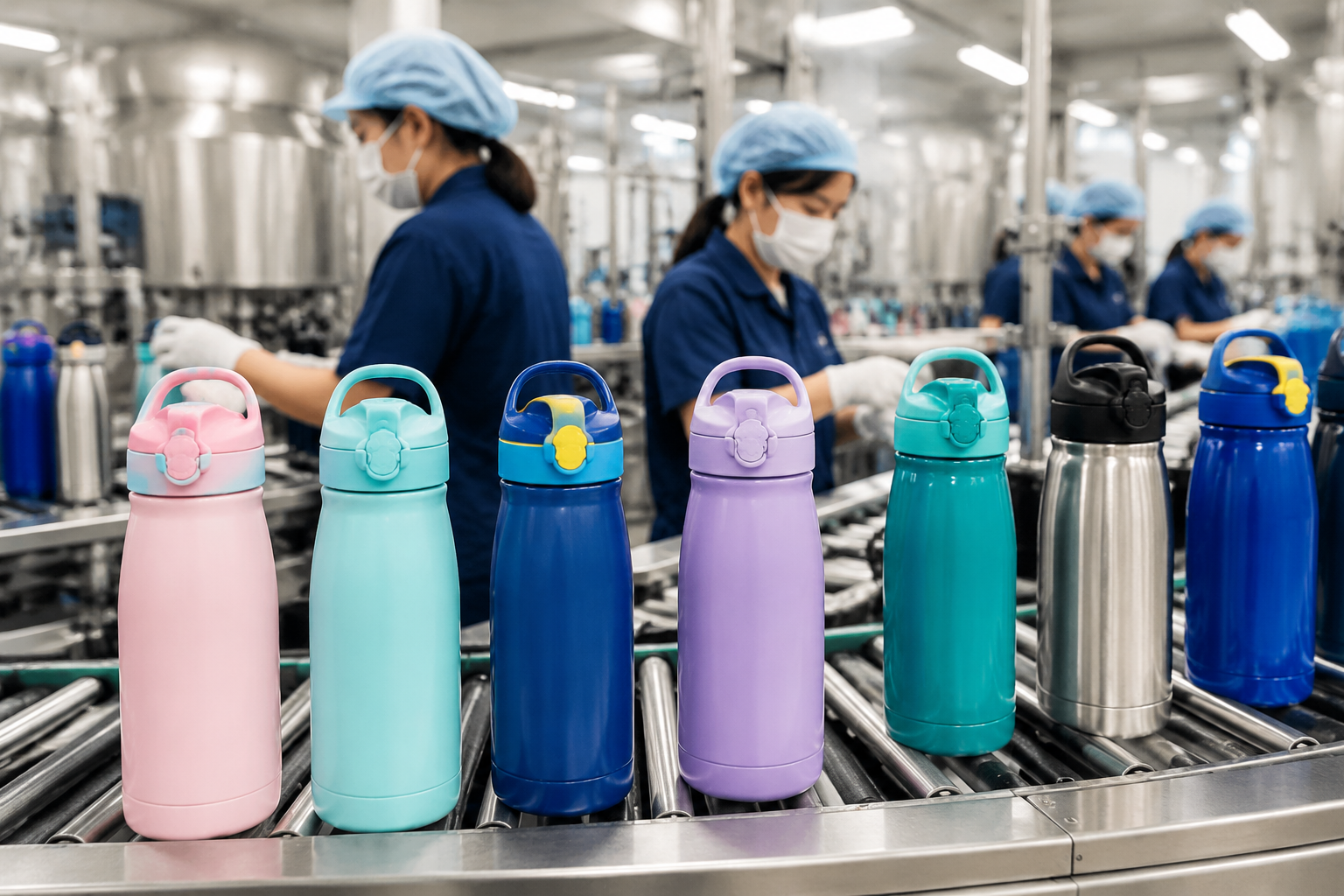
Buying a vendor school water bottle is a different job from sourcing a small retail sports bottle. The user is a child, but the risk sits with the school, importer, and brand owner. We’ve seen this go sideways: QC pulled 32 samples from a pre-shipment lot, and 5 lids leaked after a 1.2 m drop test. A cute shape will not save a loose silicone gasket, a failed CPSIA report, or cartons arriving 12 days late.
For school district buyers and kids-product importers, start with 4 practical checks: safe material that survives daily knocks, a lid a 6-year-old can open without help, printing that holds up after 30 dishwasher cycles, and a supplier that can send compliance files before you pay the balance. BottleForge Industrial in Hangzhou, Zhejiang works on bulk kids bottle projects from 1,000 units to container programs. We run these orders on the line, so we know the early trouble signs: unclear Pantone codes, a missing straw length on the PO, or a buyer asking for a 0.3 mm cheaper wall thickness when the math doesn’t work.
Start with the school use case
The first mistake is asking a children water bottle supplier for “your best kids bottle.” This is the wrong question to ask. Best for what? We quote a kindergarten giveaway differently from a middle-school fundraiser, and a district-wide reusable bottle program has its own headache list. Last month one buyer flagged a 62 mm bottle body because it would not fit the cup pocket on their classroom storage rack. Before you compare prices, lock the use case.
For younger children, 350-450 ml is usually enough. It keeps the filled weight under about 550 g for plastic and under 750 g for stainless steel vacuum bottles; our QC scale catches this before packing. For older students, 500-650 ml works better, especially where refill stations are limited. A custom school water bottle that is too large gets left in lockers; one that is too small creates teacher complaints because children keep asking to refill between classes.
Lid behavior matters more than most buyers expect. Flip straws are easy for children, but they add silicone valves, shafts, and hidden cleaning areas; QC pulled the sample once because milk residue stayed under a 4 mm straw gasket after washing. Screw caps are stronger and cheaper, but younger kids lose them. Push-button lids feel premium, but a weak lock can open inside a backpack. If you are buying a bulk school water bottle for daily classroom use, ask the factory to run an inverted leak test for 30 minutes and a drop test from 1.0 m onto tile or concrete simulation.
For procurement, define these points in the RFQ instead of letting every children water bottle vendor quote a different item. We’ve seen this go sideways when a PO said “blue kids bottle” and the artwork file called out Pantone 299C, while the sample tag showed 300C. Small typo. Big argument.
- Target age group: 3-5, 6-9, or 10-14 years, with grip diameter checked against the child’s hand size
- Capacity: 350 ml for kindergarten, 500 ml for general school use, or 650 ml where refill access is limited
- Material: Tritan, PP, 304 stainless steel, or glass only for older children, with wall thickness confirmed before mold approval
- Lid type: straw, chug, screw cap, or one-touch, matched to the cleaning routine and loss risk
- Required tests: CPSIA, FDA/LFGB, REACH, EN 14350 where applicable, ASTM F963 for some promotional programs
This short RFQ list cuts vague quotations. It lets you compare one children water bottle manufacturer against another on the same technical basis, not just the lowest FOB Ningbo or FOB Shanghai price. On our line, two bottles can look the same in a photo, but a 0.3 mm thinner lid hinge changes the return math fast.
Choose material before decoration
Decoration gets the buyer’s eye first. Material decides the safety file, unit cost, bottle weight, tooling risk, and lab test result. For children water bottle bulk orders, we usually quote 4 materials: Tritan copolyester, PP, 304 stainless steel, and borosilicate glass with a silicone sleeve. Each one has a job. None solves every brief.
Tritan works well for custom children water bottle projects because it is clear, BPA-free, and handles the daily beating inside a school bag. A 500 ml Tritan bottle with straw lid often lands around USD 2.10-3.20 FOB China, depending on lid structure, print size, and packaging. PP is cheaper, often USD 1.20-2.00, but the surface marks faster; QC pulled one PP sample last month with rub scratches after 300 cycles on the RCA tape tester. If your program is a children water bottle promotional giveaway and the buyer is fighting for every USD 0.10, PP can work. If parents pay through a school shop, Tritan usually sells better.
304 stainless steel is the right call when insulation matters. A 12 oz or 14 oz vacuum insulated custom kids bottle can keep water cold for 12-18 hours if the vacuum line is controlled and the copper coating is even. Typical wall thickness is 0.4-0.5 mm inner and outer stainless steel. Go thinner and the math looks nice on the quotation sheet, then cartons come back with dents after drop testing from 80 cm. For school distribution, we run powder coating or solid color spray with a simple logo. Full-wrap art on small stainless kids bottles looks nice in a rendering, but we’ve seen this go sideways when curing time is cut from 22 minutes to 16 minutes.
Glass is honest and clean, but we rarely recommend it for primary school. Even borosilicate glass with a silicone sleeve brings breakage and liability questions; one district buyer flagged it before sampling after their legal team saw “glass” on the PO description. If you are a children water bottle distributor selling to older student retail channels, glass can work. For school districts, it is usually the wrong fight.
Decide material first, then match the decoration method to that material. Reversing the order is how buyers approve beautiful samples that fail in mass production.
Decide the logo durability level
A custom logo kids bottle should still look fresh after 14 school-day dishwasher cycles, not chalky at the edges. The right decoration depends on the bottle material, the artwork detail, MOQ, and how rough the pupils are with it. School buyers ask us for mascot artwork, district text, sponsor marks, name panels, or grade colors; each one points to a different process. Last month QC pulled 12 samples from a 3,000 pcs run and the buyer flagged one panda mascot because the white ink looked 0.8 mm off against the cap color. Small thing. Parents notice.
Silkscreen printing is the safe budget choice for one- or two-color logos. On a bulk children water bottle order, screen setup is usually USD 30-60 per color, and the unit cost impact can be under USD 0.10 for simple prints. We run it on smooth Tritan and coated stainless steel with a 120T mesh screen when the logo has clean edges. It gets messy with fine gradients or big wrap prints. If the bottle has ribs, texture, or a curved shoulder, screen registration moves, and the line operator will fight the jig all afternoon.
Laser engraving is the toughest option on stainless steel. It cuts or marks the coating instead of sitting on top like ink, so the logo survives lunch bags, bottle cages, and a year of desk drops better than print. For a school name, crest, or donor text, laser is clean and reliable. The trade-off is color: you get substrate contrast, not a full-color mascot. UV printing and heat transfer give stronger color and photo-style artwork, but ask for tape adhesion tests and rub tests before you sign the PP sample. For children water bottle customized programs, we normally test 3M tape pull, 500-cycle rub, and 45°C warm water soak before bulk approval, and we reject if the edge lifts under the fingernail gauge.
Personalization is a separate decision, and this is where we have seen projects go sideways. If every bottle needs a student name, unit cost jumps and the error risk jumps with it; one typo on a PO can turn 200 “Sofia” bottles into dead stock. A safer approach is a writable name area or a class-color silicone band. A children water bottle customizable design should make ID easy without turning one 2,000 pcs order into 2,000 mini orders on the packing table.
For importers, keep artwork files clean: vector AI, PDF, or CDR; Pantone references; exact print size in mm; and placement from a fixed datum line. “Logo centered on bottle” is the wrong spec. “Logo 55 mm wide, 78 mm from base, opposite hinge” gives our printing master a real target, and the caliper check at inline QC takes 10 seconds instead of 3 emails.
Check compliance like an importer
Kids bottles sit in a tighter risk category than adult promo drinkware. A children water bottle factory should be able to map each test to each part on the BOM. “We have FDA” is the wrong answer. FDA food-contact testing may cover the plastic body, but it does not automatically cover the printed ink, silicone straw, PP lid, coating, packaging inks, or small parts. We had QC pull a 480 ml straw bottle last spring because the silicone mouthpiece was from a different supplier than the tested sample, and the buyer flagged it before mass production.
For North America, ask for FDA food-contact compliance, CPSIA lead and phthalates, plus ASTM F963 if the bottle is sold with toy-like parts such as charms, stickers, or animal-shaped caps. For Europe, LFGB or EU 10/2011 food-contact, REACH SVHC screening, and EN 14350 for drinking equipment may apply based on age grade and design. The exact requirement sits with your importer of record, target market, and label claims. Do not let a children water bottle vendor set the legal scope for you. Use the factory to supply test reports, sealed samples, material declarations, and 2 extra sets for your lab. We run this through a component checklist, not a sales brochure.
Factory audits matter too. About 6 out of 10 school-district and retail buyers we see ask for BSCI, Sedex, ISO 9001, or at least a basic social compliance profile before they release artwork. BottleForge Industrial is based in Hangzhou, Zhejiang, with partner production lines in Zhejiang and nearby China manufacturing clusters. For standard kids bottle programs, our monthly capacity is about 300,000 units across plastic and stainless styles, with common MOQ from 1,000 pcs per color and 25-35 days production after approved pre-production sample. On the line, a 1,000 pcs color run still needs separate resin color matching, pad-print setup, and a first-article check with a digital caliper on lid fit.
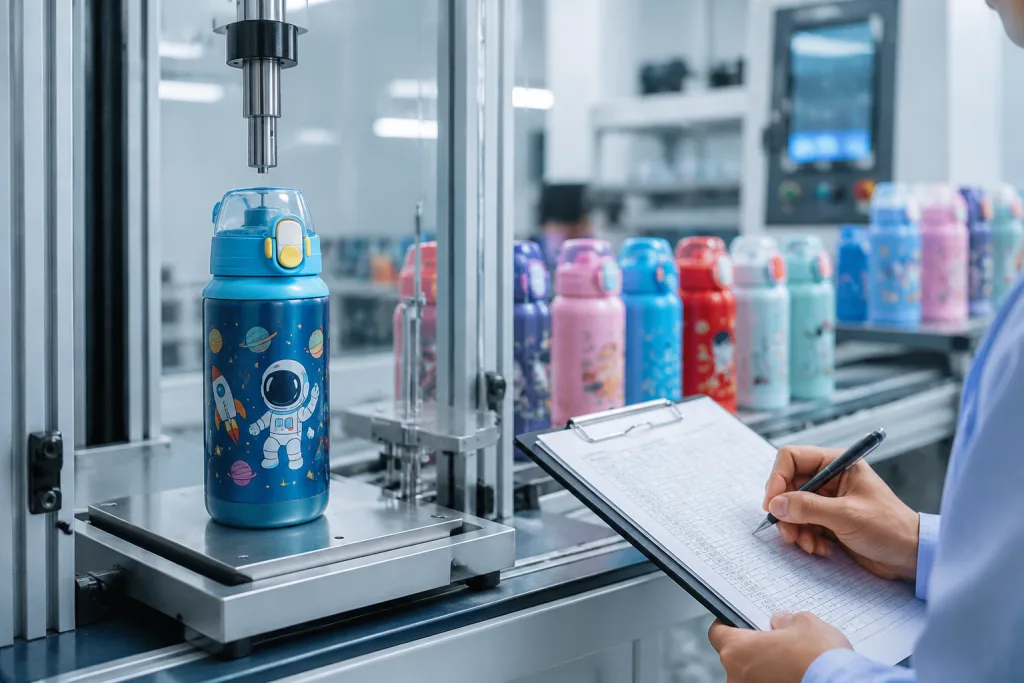
Inspection should be written into the PO. For school orders, use AQL instead of “factory QC.” A normal Level II inspection with AQL 2.5 for major defects and 4.0 for minor defects is common. Critical defects should be zero: sharp edges, broken latch, choking-risk loose parts, contamination, strong odor, or wrong material. Define carton drop testing, barcode scan checks, and random leak testing too. We usually ask inspectors to fill 32 bottles, invert them for 30 minutes, then check the cap seam and straw vent. The cost of a third-party inspection in China is small compared with replacing 8,000 leaking bottles after delivery. We have seen that go sideways.
Price the whole delivered program
The lowest FOB number is not the cheapest school program. We run kids bottles through one line, and the invoice keeps growing once you add tooling, logo setup, sample shots, lab reports, inner packs, master cartons, ocean freight, duty, storage, and classroom kitting. If you look only at unit price, the math does not work.
A 500 ml Tritan custom kids bottle can land at USD 2.45 FOB Ningbo for 3,000 pcs with one-color screen print and an OPP bag. Put a color box on it and you may add USD 0.18-0.35 a unit. Switch to full-color heat transfer and the decoration can rise by USD 0.25-0.60. We had one buyer flag LFGB and CPSIA testing as "extra"; the lab bill on that style still came to USD 450-900 depending on the parts count, so this is the wrong question to ask if the board wants a clean landed number.
Freight changes the picture fast. Plastic bottles are light but take up space. Stainless steel is heavier but can cube out better in some cartons. A 500 ml kids bottle carton often holds 24-48 pcs, and on the packing table we check the outer size before sealing because 58 x 38 x 42 cm can make a sea quote jump. For North America, sea shipment usually needs 30-40 days port-to-port, then customs and inland trucking. Air freight can save a late event, but at USD 1.50-4.00 more per bottle it wipes out most promo budgets.
If you sell as a children water bottle wholesale importer or through a children water bottle distributors network, ask for carton size, gross weight, HS code suggestion, and packing photos before you sign off. For Amazon or marketplace runs, we ship with FNSKU labels, carton marks, and drop-test packing, and QC pulled the sample once because the PO had a typo on the carton count. For school district delivery, class packs of 25 or 30 units work better than retail boxes. Less waste. Faster handout.
Select the supplier by risk
China has at least 300 factories and trading offices selling children water bottles, but grading them with one checklist is the wrong question to ask. A trading company fits mixed orders, like 4 bottle styles plus lunch boxes under one 1,000 pcs MOQ. A children water bottle manufacturer fits programs where the line must hold the same lid fit, gasket compression, Pantone color, and carton mark for repeat orders. For a vendor school water bottle program, the hard part is not finding a bottle. It is holding 12 small details until the last carton is taped with the 48 mm BOPP gun.
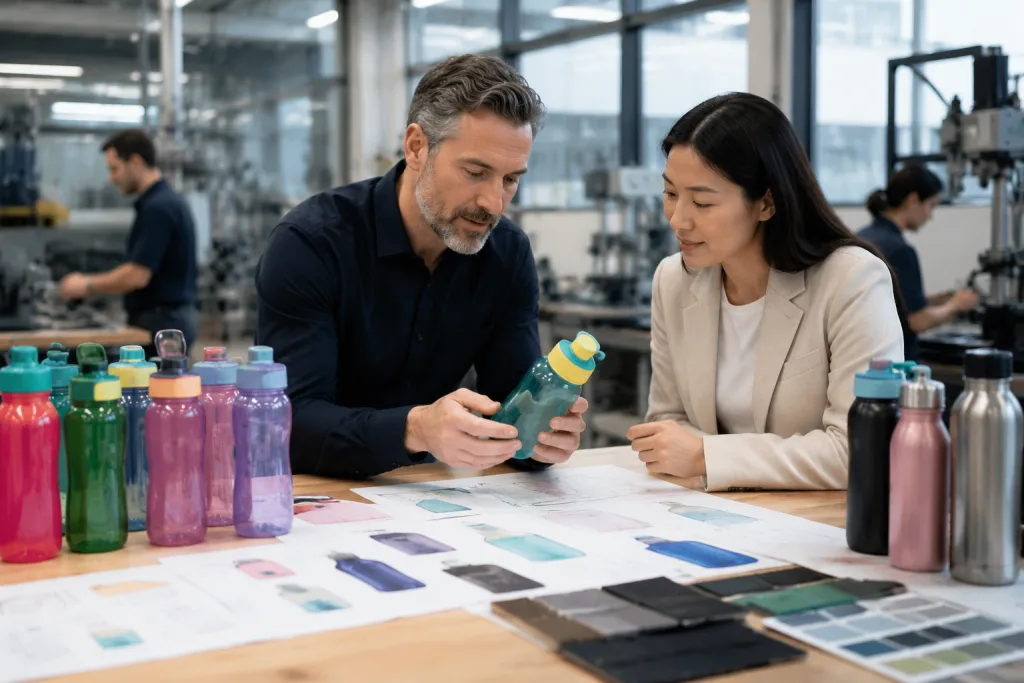
Ask direct questions before you place the PO. Who owns the mold? Can the straw, gasket, and lid be reordered six months later? What is the silicone hardness, 50 Shore A or 60 Shore A? Is the stainless body 201 or 304? Is the Tritan original material or mixed regrind? Can the factory keep Pantone color within Delta E 2.0-3.0? What is the spare parts rate for lids and straws? A serious children water bottle manufacturer answers with numbers, mold photos, past FDA or LFGB reports, and a test record from the torque gauge. “No problem” is not an answer; we have seen that go sideways when QC pulled the sample and the gasket was 0.4 mm thinner than approved.
For a first order, we suggest ordering 2-3% spare lids or straws if the design has moving parts. Schools lose components. Importers need after-sales stock too. If you are a children water bottle vendor serving districts, one 12 kg spare-parts carton can stop a small complaint from becoming a 600 pcs replacement claim. The math works. One buyer flagged this after a spring shipment because 37 students lost flip straws in the first month.
Sampling shows the supplier’s discipline. A good pre-production sample must match the confirmed material, color, logo, lid, gasket, straw length, packaging, barcode, and instruction sheet. If the sample uses a “similar lid” or “temporary color,” production is not approved. Simple. In Zhejiang, China production schedules fill fast before March-April back-to-school planning and September export peaks; we run bottle assembly on tight windows, and one wrong PO typo in the barcode can cost 3 days vs a normal 1-day artwork check. Lock the sample, artwork, and deposit early, or expect lead time to move from 25 days to 35 days.
Use a practical buying sequence
A clean buying process cuts surprises. Start with a written decision sheet, not a catalog screenshot copied into WhatsApp. For a custom children water bottle project, we want to see age group, capacity, material, lid type, decoration, compliance market, target MOQ, delivery date, packaging, and shipping mode on one page. Send it to 2 or 3 qualified children water bottle vendors, not 10 random suppliers. Ten quotes usually create noise; we have seen buyers chase the lowest line, then find the supplier missed the silicone straw or quoted a 0.32 mm thinner carton.
After you shortlist, request a quotation with separated lines: product, decoration, packaging, test cost estimate, sample cost, mold cost if any, FOB port, and lead time. For custom tooling, a simple lid modification may cost USD 800-2,500, while a new bottle body mold can run USD 3,000-8,000 or more depending on complexity. For most school buyers, existing molds with custom color and logo are the better first order. The math usually does not work on a new mold for 1,000 pcs, especially after the buyer adds color box, barcode sticker, and drop-test packing.
Then approve a physical sample. Photos help, but they do not show lid force, odor, hand feel, or child usability. We run a quick lid open-close check on the line with a torque gauge and a few wet hands, because glossy PP lids can feel different after washing. If possible, give the sample to five children in the target age range and watch them open, drink, close, and carry it. Adults often overestimate the lid. Children find weak points fast.
Once approved, freeze the specification and issue the PO. Changes after deposit create delays and quality ambiguity. During production, ask for material receiving photos, first-article print photos, in-line QC notes, and packing photos. Before shipment, perform AQL inspection and verify carton marks; QC once pulled a sample where the PO said “Grade 3 Blue,” but the carton mark read “Garde 3 Blue.” Small typo. Big warehouse headache. This sequence is not paperwork for paperwork’s sake; it keeps a bulk kids bottle order from turning into a claims discussion.
If you need a long-term program, record the exact model number, mold version, lid supplier, gasket material, Pantone color, print process, and test report date. The second order should be easier than the first: same mold rack, same gasket hardness, same pad-print fixture, fewer back-and-forth emails. A real children water bottle supplier will help you build that repeatable file because repeat orders are better for both sides. We ship smoother when the file is clean.
Build your school bottle program with fewer surprises
Send your age group, capacity, logo file, delivery date, and compliance market. We will suggest workable models, MOQ, pricing, and timeline.
Frequently asked questions
What MOQ should I expect for a vendor school water bottle order?
For existing molds, a realistic MOQ is usually 1,000 pcs per color or design for plastic kids bottles and 1,000-3,000 pcs for stainless steel, depending on coating and lid color. If you need a custom Pantone body, MOQ may rise because resin coloring, spray coating, or powder coating has batch minimums. For a full custom made kids bottle with new mold, expect 3,000-5,000 pcs minimum and tooling costs from about USD 3,000-8,000. Small trial orders under 500 pcs are possible only with stock colors and limited logo methods, but unit price is higher and packaging options are narrower.
Which material is safest for bulk school water bottle programs?
There is no single safest material without context. Tritan is a strong choice for clear, lightweight bottles because it is BPA-free and impact resistant. PP is budget-friendly and food-contact safe when properly tested, but it feels less premium. 304 stainless steel is best for insulated bottles and long service life, but it is heavier and costs more. For school districts, we usually avoid glass for younger children because breakage risk outweighs the clean-material story. Whatever you choose, require component-level testing: body, lid, straw, gasket, coating, ink, and printed logo should match your destination market’s requirements.
How long does production take for children water bottle custom orders?
For an existing model with custom logo and standard packaging, plan 25-35 days after pre-production sample approval and deposit. Sampling normally takes 7-12 days if artwork is ready and no new mold is needed. Custom color matching can add 3-7 days because the factory needs resin chips, spray panels, or silicone color samples approved. New mold projects are longer: 35-60 days for tooling and trial samples before mass production. Add ocean freight time separately. From China to North America, door delivery can easily take 45-60 days after production if you use sea freight.
Can you pack bottles by classroom or school instead of retail cartons?
Yes, and it is often smarter for district programs. Instead of individual color boxes, you can use bulk inner packs of 25 or 30 units with one instruction sheet per pack, then label master cartons by school, grade, or classroom. This reduces packaging cost by about USD 0.15-0.35 per unit compared with many retail box formats and makes distribution easier for staff. For importers or distributors, we can also apply SKU labels, carton barcodes, FNSKU labels, or mixed-color carton plans. The key is to confirm the packing matrix before production, not after bottles are finished.
How do I compare children water bottle manufacturers fairly?
Give each supplier the same RFQ: capacity, material, lid type, logo method, packaging, compliance market, MOQ, and delivery date. Then compare more than FOB price. Ask for wall thickness, material grade, lid component list, test reports, audit status, carton size, production lead time, and spare parts availability. A USD 0.12 cheaper quote can become expensive if the lid leaks, the print fails tape testing, or the supplier cannot provide REACH or CPSIA documents. For a first order, request a pre-production sample and set AQL inspection terms in the PO. Serious children water bottle suppliers will accept that.