Key Takeaways
- A workable RFQ should state capacity, material grade, decoration method, target FOB price, MOQ, and test requirements within 1 page
- Typical custom stainless bottle MOQ is 1,000-3,000 units per color, depending on coating and lid tooling
- Pre-production samples usually take 7-12 days after artwork approval; bulk production is commonly 30-45 days
- Use AQL 2.5/4.0, sealed sample photos, and PO line items to prevent disputes before shipment
A vendor reusable water bottle looks simple until your PO has six colors, two lid styles, three logo methods, carton marks, REACH paperwork, and a delivery window tied to a retail launch. This is where B2B buyers burn 7–10 days: the RFQ says “blue” with no Pantone code, the sample approval happens on WhatsApp, and the bulk PO uses a lid part number the factory never quoted. We have seen QC pull a 750 ml sample from the line and find the logo 3 mm off center because the buyer approved only a photo.
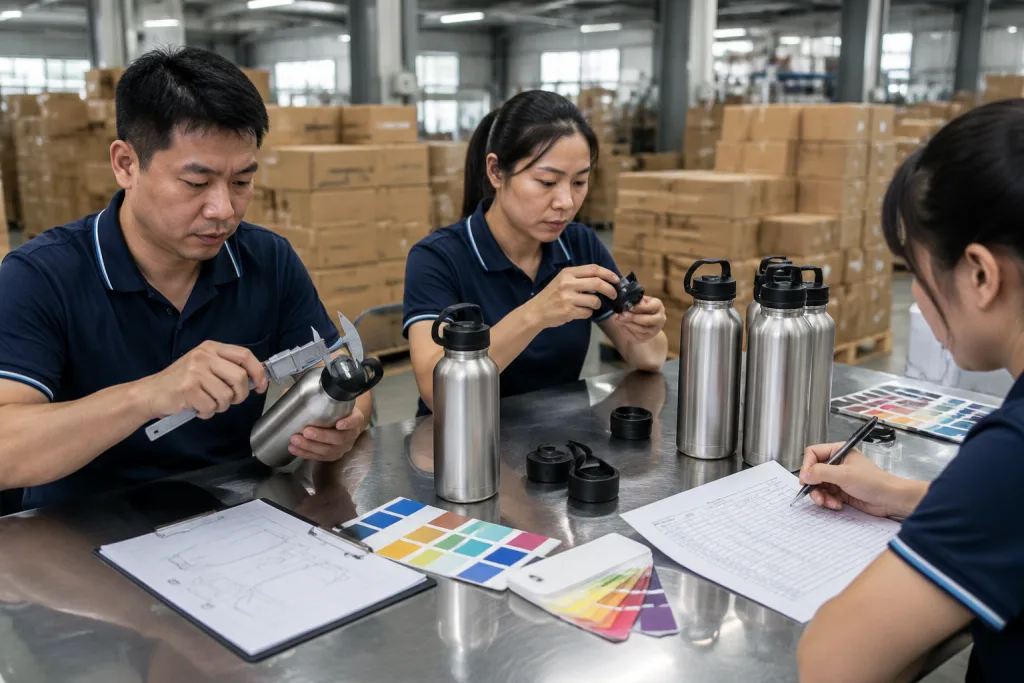
We manufacture custom drinkware in Hangzhou, Zhejiang, and we see the same sourcing mistakes from Europe and North America at least 12 times a month. China can deliver solid value, but the math does not work if the first spec sheet is loose and the final AQL inspection is expected to catch everything. Treat the bottle like an engineered SKU, not a giveaway item. On our floor, we run calipers, torque checks, and carton drop tests before packing; the buyer usually flags problems only after a retail launch date is already printed on the PO.
Start with the buying brief
Before you ask any canteen supplier for pricing, write the buying brief like it will be copied into the PO. “Quote a 750 ml bottle with logo” is the wrong question to ask. On our line, that sentence can turn into five samples: different mouth diameter, lid thread, coating gloss, carton count, and logo position. A useful brief names the sales channel, the user, the yearly buy plan, and the country where compliance files must pass. QC pulled one sample last week because the PO said “Canada retail,” but the artwork file still carried German label text.
For a vendor reusable water bottle RFQ, include capacity in ml and oz, body material, lid material, insulation requirement, finish, logo size, packing, and delivery term. If you need a canteen custom program, state whether the product is single-wall, double-wall vacuum, aluminum, Tritan, or glass. “Canteen customizable” is too loose. In our factory it can mean a 45 mm laser logo on a stock body, or a new cap mold with 2D and 3D drawings, CNC sample work, and a tooling bill of USD 2,500-8,000.
A clean RFQ should include these PO-style fields:
- Item: 750 ml double-wall stainless steel bottle, 18/8 inner, 18/8 or 18/0 outer, with mouth diameter confirmed in mm
- Finish: powder coating, matte black, Pantone close match, with gloss checked under the light box
- Logo: 1-color silkscreen, 45 mm wide, one side, artwork supplied as AI or PDF
- Packaging: white box, 24 pcs/master carton, barcode sticker, carton mark shown before mass packing
- Compliance: LFGB or FDA food contact, REACH for coating if selling in the EU, test report name matched to the importer
- Target: 3,000 units, FOB Ningbo or Shanghai, delivery in 40 days after deposit, deposit date counted from bank slip
That detail lets a canteen manufacturer quote the bottle you plan to buy, not a cheaper cousin from the shelf. We ship faster when the brief is clean. It also filters out canteen vendors who send a low price first and argue later about box thickness, AQL 2.5 inspection, or whether the barcode sticker was included.
Translate specs into real costs
Price is not one number. It is a stack of decisions. A 500 ml stainless bottle may quote at USD 3.20 FOB China with a basic PP lid and single-color print. Use the same body, then add copper coating, a leak-proof straw lid, custom gift box, and laser logo, and the quote often moves to USD 4.60-5.80. We see buyers compare those two as if they are the same bottle. They are not. Last month the buyer flagged a USD 0.18 lid gap only after QC pulled the sample and weighed the lid set on a 0.01 kg bench scale.
For stainless steel custom drinkware, cost starts with steel grade and wall thickness, then moves through vacuum performance, lid parts, coating, logo process, packaging, and lab testing. Wall thickness commonly ranges from 0.38 mm to 0.50 mm for 12 vacuum bottle styles we run. Thinner steel saves cost but raises dent claims after a rough LCL shipment. For a promotional campaign, 0.38 mm may be acceptable. For a premium customized drinkware line, 0.45 mm is the safer baseline. We check this with a digital micrometer on the line; if the shoulder area comes in 0.03 mm light, QC pulls the sample before packing.
Your RFQ should ask the canteen factory to quote at two or three volume breaks, not just one. This is the wrong place to chase a single neat unit price. Ask for the same spec sheet at each break, including lid type, carton pack, logo method, and color count. We once had a PO typo list 3,000 pcs as 30,000 pcs, and the tooling room had already opened the color chip file before the buyer caught it. For example:
- 1,000 pcs: pilot order or market test, usually stock body plus logo
- 3,000 pcs: normal production MOQ for many colors, with coating line scheduling
- 10,000 pcs: distributor canteen or retail replenishment level, where carton cube starts to change the landed cost
At BottleForge Industrial in Zhejiang, our monthly capacity across stainless bottles, tumblers, and growlers is about 450,000 units/month, with typical MOQ from 1,000 units for stock-body logo projects and 3,000 units per color for coated custom items. A canteen distributor should ask for carton dimensions and gross weight at quote stage, not after artwork approval. Freight can add USD 0.35-1.20 per unit by sea depending on carton cube, so the math does not work if a “cheaper” bottle ships in a loose gift box with 6 pcs per master carton. We ship enough 40HQ containers to see this go sideways.
Put artwork into the sample PO
The sample stage is where buyers either lock the job down or leave a gap that bites during bulk. “Looks good” in an email is not approval; this is the wrong place to be casual. Issue a sample PO or sample confirmation sheet with the same detail we run for bulk: body model and capacity, 304 stainless or other material callout, finish with Pantone target, logo method with size in mm, lid type with gasket color, packaging mockup version, and sample purpose such as appearance sample, functional sample, or pre-production sample. Last month QC pulled a sample because the PO said “blue lid” while the artwork file named “navy cap,” and that 1-word mismatch cost 2 days.
A clean sample PO for a vendor reusable water bottle might read: 3 pcs matte blue, 3 pcs matte white, 1-color silkscreen logo, 55 mm wide, front center, leak test required, plus 6-hour heat retention photo beside the digital thermometer. Simple enough. If you need canteen promotional items for a trade show on a fixed date, we may run a faster digital mockup and 1 physical color sample from stock. If you are building a long-term customized canteen SKU, insist on a pre-production sample made on the same coating line and decoration jig as bulk, because the math does not work when a buyer approves UV print but the bulk order switches to silkscreen.
Typical timing from China is workable, not magic. Digital artwork proof takes 1-2 working days. A blank stock sample can ship in 2-4 days after the courier label is booked. A decorated sample usually takes 7-12 days after AI or PDF artwork is confirmed, and we count from the approved file, not from the first blurry logo sent by WhatsApp. If a new lid, silicone part, or customized growler handle is involved, tooling can add 15-25 days. We have seen this go sideways when the buyer expected 12 days total, while the actual schedule was 18 days with logo revision and EVA insert cutting.
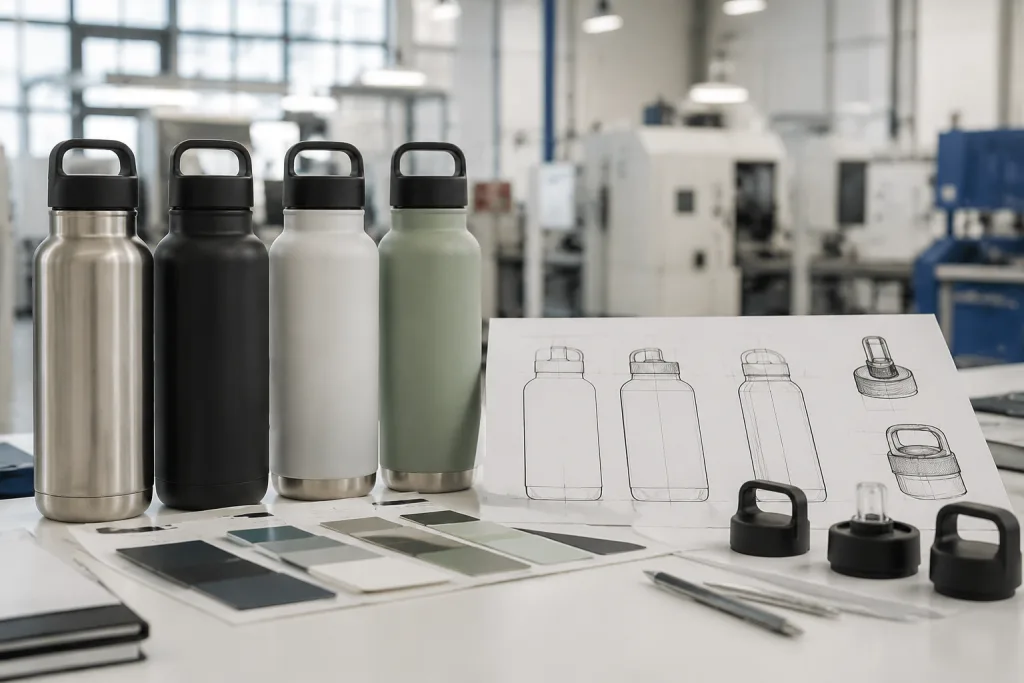
Use Pantone references with care. Powder coating is not offset printing; a Delta E tolerance of 1.5-2.5 is realistic depending on surface texture and batch, and our color meter will show different readings on a curved 750 ml bottle than on a flat chip. For laser engraving, state whether you expect silver steel exposure, dark marking, or logo depth, preferably with a 0.2 mm depth note if the logo needs a carved feel. For silkscreen, confirm whether the ink must pass 3M tape test and what dishwasher claim you want on the carton. Most reusable bottles are not truly dishwasher-safe after decorative coating, even when the stainless body can survive it.
Lock the bulk purchase order
The bulk PO is not just a payment paper. It is the order control sheet. For a China canteen vendor, we treat it like the last checkpoint before the line opens: approved sample code, artwork file, packaging dieline, carton mark, AQL 2.5 major / 4.0 minor, delivery term, all written into the PO or attached by file name. QC pulled a sample last month where the PO said “water bottle as sample,” but the approved logo file was V3 and production used V2. That fight took 9 emails. Put the details in writing.
Use line items, not paragraphs. Cleaner for the factory ERP, cleaner for inspection. For example:
- Line 1: 2,000 pcs, 750 ml vacuum bottle, matte black, white logo, item BF-V750
- Line 2: 1,000 pcs, 750 ml vacuum bottle, matte cream, black logo, same lid
- Line 3: Retail box with FNSKU sticker, 3,000 pcs, applied on box lower right
- Line 4: Spare lids, 1% free of charge, packed separately
- Line 5: Third-party inspection, AQL 2.5 major / 4.0 minor before balance payment
For payment, 8 out of 10 canteen manufacturers we deal with ask for 30% deposit and 70% before shipment on first orders. Larger distributor growler or distributor drinkware accounts may get credit after 3 to 5 clean shipments, not on order one. The math does not work for most factories before trust is built. If you need Amazon or marketplace fulfillment, state barcode, polybag warning, carton drop-test level, and FNSKU placement. We have seen a PO typo put the FNSKU on the master carton instead of the retail box. The buyer flagged it during inbound prep, not at our packing table. A custom growler with a powder-coated handle needs foam or molded pulp inserts, or the handle rubs through the coating after 12 hours in a vibration test.
Define the trade term too. FOB Ningbo is common for Zhejiang factories; from Hangzhou, the truck run is about 150 km and usually books smoother than Shanghai in peak season. FOB Shanghai works if your forwarder consolidates there. EXW looks cheaper on the quote sheet, but it pushes local trucking, export handling, and customs coordination onto you. For a new buyer, FOB is the cleaner call.
Inspect before the balance payment
Book the final inspection only after goods are 100% finished and at least 80% packed. Earlier than that, you are checking the line, not the shipment. For a vendor reusable water bottle order, we run AQL sampling against a written checklist: capacity by graduated cylinder, unit weight on a digital scale, coating finish under a light box, logo placement in mm, leak performance, lid fit, carton marks, barcode scanning, odor, and packaging count. One buyer once pushed to inspect at 50% packing to save 2 days; the math does not work when the last 12 cartons still have mixed color lids.
Common AQL settings are 2.5 for major defects and 4.0 for minor defects. Critical defects should be zero. A leaking bottle, sharp burr, wrong food-contact material, or unreadable compliance label is critical or major depending on your market. A tiny dust point under powder coating can pass as minor if QC cannot see it at arm’s length, about 60 cm, under normal light. Be practical. Be firm. Last month QC pulled 5 samples with small burrs inside the straw slot, and we stopped packing before the inspector arrived.
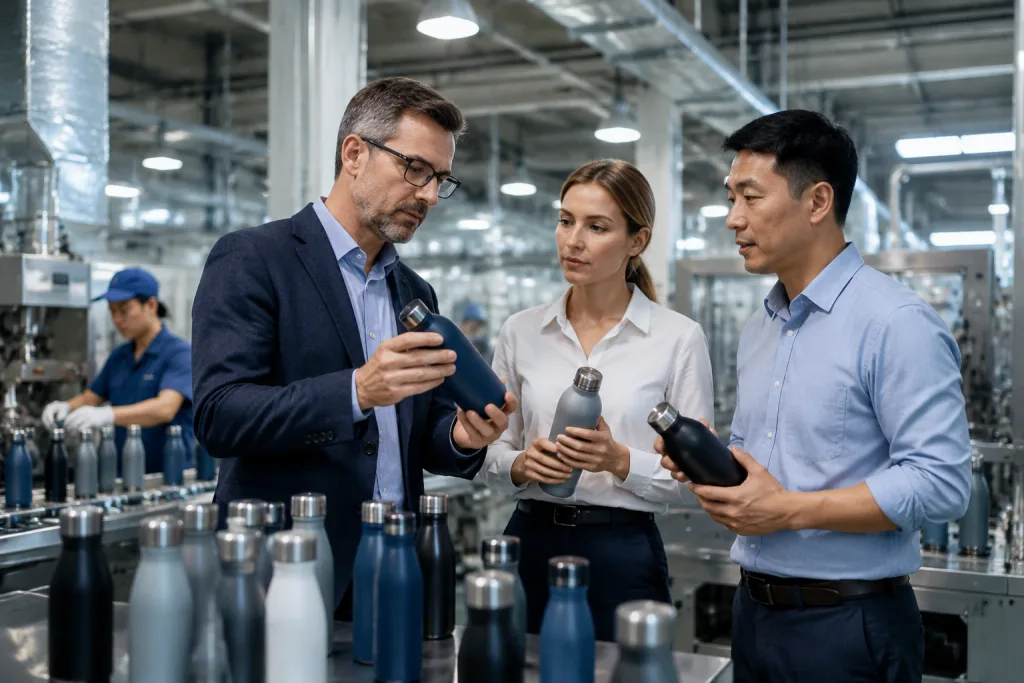
Ask your canteen factory for internal QC records before you book the third-party inspector. A serious canteen manufacturer should already have incoming steel checks, vacuum test logs, coating adhesion records, and final packing checks. At our Hangzhou, Zhejiang facility, vacuum bottles are tested by hot water holding and random air-pressure checks during assembly, with the test pressure marked on the line sheet. We also run lid torque and leak checks because one bad silicone ring can turn into 300 refund emails. We have seen this go sideways when the PO says “black lid” but the approved sample has a dark gray PP lid.
For compliance, match the test file to the market before balance payment. FDA food-contact documentation may cover some US programs. EU buyers often ask for LFGB, REACH, and audit information such as BSCI or Sedex from the canteen factory. If children use the bottle, review CPSIA or ASTM expectations for coatings and accessible parts. Do not wait until the container is on the water to ask for these documents; by then, changing a label layout from 22 mm to 28 mm can hold shipment for 7 days.
Plan replenishment like a program
A one-time promo order can survive a little waste. A reusable bottle program cannot. If you are a canteen distributor, distributor canteen buyer, or brand owner planning repeat POs, open a replenishment file right after the first shipment. Put the signed sample, final AI artwork, Pantone chip, carton size in mm, HS code, FDA or LFGB reports, and AQL 2.5 inspection photos in one folder. We do this on our side too. Six months later, when the buyer asks for “same as last time” but the PO has the old logo typo, that file saves 3 or 4 days of email checking.
Reorder lead time is shorter than the first order only when the bottle body, lid, coating, and packing stay the same. Stock bodies with repeat logos usually ship in 25-35 days after deposit. Custom colors, seasonal peaks, or a new lid mold can push the line to 45-60 days. Chinese New Year is the big trap. If you need March delivery, a PO placed on January 24 will not move like a normal April reorder; our coating room may already be closing batches and QC may only have 2 working days left for pre-shipment checks.
If the range might grow, tell the factory before the first mold and carton layout are locked. A canteen customized program can share one body shape family across 500 ml, 750 ml, and 1,000 ml sizes, with only the height and carton grid changing. A customizable growler line can run the same powder color and box design as matching travel tumblers, so the shelf does not look patched together. This cuts repeat artwork charges and helps the canteen manufacturer reserve 304 stainless coil, PP lids, and silicone rings before the next 3,000-piece reorder lands.
For distributors, the wrong question is “Can you promise no delay?” The math does not work that way. Define substitutions before the stock-out happens. If matte navy powder is short, can the canteen supplier use a Pantone 2965C close match within 1 Delta E? If the standard lid is delayed, is a similar PP lid acceptable if it passes the 24-hour leak test at 45 degrees? Put those rules in the PO notes. Reliable canteen vendors are not the ones who hide bad news; they are the ones who flag the risk early and give you 2 controlled choices before the ship date gets squeezed.
Send your bottle RFQ for a practical factory quote
Share capacity, quantity, logo, packaging, and target market. We will return workable FOB pricing, MOQ, sample timing, and QC notes.
Frequently asked questions
What MOQ should I expect for a vendor reusable water bottle order?
For stock-body custom drinkware, a realistic MOQ is often 1,000 units with one logo and one standard color. For powder-coated custom colors, many canteen manufacturers require 3,000 units per color because coating line setup, color change, and scrap control need volume. If you need a new lid mold, silicone part, or special shape, the practical MOQ may move to 5,000-10,000 units, plus tooling of roughly USD 2,500-8,000 depending on complexity. Smaller trial runs are possible, but unit cost rises and color accuracy may be weaker. Ask the canteen supplier to quote 1,000, 3,000, and 10,000 units so you can see the real cost curve before committing.
How long does sampling and bulk production take from China?
For a normal vendor reusable water bottle using an existing body, blank samples can usually ship in 2-4 working days. Decorated samples take about 7-12 days after artwork approval. If you need a canteen customizable color match, add 3-7 days for coating swatches. Bulk production is commonly 30-45 days after deposit and pre-production sample approval. During peak months before summer or before Chinese New Year, plan 45-60 days. Freight is separate: sea freight to Europe or North America often takes 25-40 days port-to-port, while air freight is faster but can add several dollars per unit. Build your timeline from launch date backward, not from quote date forward.
Which decoration method is best for customized canteen programs?
It depends on the finish, budget, and expected use. Silkscreen is cost-effective for simple 1-2 color logos and often adds about USD 0.08-0.25 per unit. Laser engraving is durable and clean on stainless steel or coated bottles, usually around USD 0.15-0.40 per unit depending on logo size and time. Heat transfer works for larger full-color graphics but needs careful abrasion testing. UV printing can look sharp, but curved bottle surfaces limit artwork size and production speed. For canteen promotional orders, silkscreen is usually enough. For premium customized drinkware or a corporate gifting program, laser engraving gives fewer complaints because there is no ink layer to scratch off.
What should I put in the PO besides price and quantity?
Your PO should include item model, capacity, material grade, wall thickness if agreed, lid type, finish, Pantone target, logo method, logo size, logo position, packaging, carton quantity, barcode requirements, inspection standard, delivery term, and payment term. Also reference the approved sample date and attach final artwork files. For example, state “AQL 2.5 major / 4.0 minor, inspection before balance payment” rather than “quality must be good.” If you are a distributor drinkware buyer, add carton marks and customer item numbers. If the order is for Amazon or marketplace delivery, include FNSKU placement and carton weight limits. A detailed PO prevents arguments when the factory, inspector, and freight forwarder each read the order.
How do I choose between canteen suppliers and trading companies?
A good trading company can manage mixed orders, but for repeat vendor reusable water bottle programs, you should know who controls production. Ask for factory audit documents, production photos, QC flow, monthly capacity, and whether the company owns coating, welding, polishing, or assembly lines. A real canteen factory should answer technical questions about stainless grade, vacuum failure rate, lid gasket material, and coating adhesion. If the seller cannot explain AQL defects or gives only generic catalog answers, be careful. For China sourcing, transparency matters more than a USD 0.10 lower quote. You do not always need to buy directly from canteen manufacturers, but you do need clear accountability for samples, bulk quality, and corrective action.