Key Takeaways
- Lock bottle capacity tolerance at +/-3% and verify it by water fill, not catalog volume
- For stainless vendor refillable water bottle orders, specify 304 or 316 and request incoming XRF checks
- Use AQL 2.5 for major defects and AQL 4.0 for minor defects on pre-shipment inspections
- Plan 7-10 days for samples and 30-45 days for bulk production after artwork approval
A vendor refillable water bottle looks simple until the first container lands with leaking lids, dull printing, mixed cartons, or a retail customer asking why the stainless steel tastes metallic. We have seen QC pull 32 samples from a 1,200-piece lot and find 9 lids failing the 45-degree inverted leak test. That is not bad luck. It usually starts with loose specs, rushed sampling, and an inspection checklist that misses the parts buyers actually complain about.
At BottleForge Industrial in Hangzhou, Zhejiang, we see the same problems from buyers switching between canteen vendors, canteen suppliers, and general custom drinkware factories in China. Our stainless line runs about 850,000 units/month, with practical MOQs from 1,000 units per color for standard bottles. The goal is not to over-engineer your order. The right question is simpler: which 6 or 7 details must be locked before the PO goes to the line? We run this check before tooling, printing plates, and carton marks, because once the buyer flags “matte black” but the PO says “black powder coating,” the math gets ugly fast.
Capacity promises that miss reality
The first failure mode is boring, but it still starts arguments: the bottle does not hold the capacity printed on the sell sheet. We see this on 32 oz vendor refillable water bottle orders when 32 oz means “filled to the lip,” not the usable line under the thread. Nobody fills like that. If your customer wants 946 ml below the thread line, write it on the PO, because QC will test against the number we run on the bench scale.
For stainless bottles, wall thickness and forming method change internal volume. A 0.45 mm wall gives a lighter bottle, but hard stretching on the hydraulic forming line can create 8-12 ml spread between cavities. A 0.50-0.60 mm wall is steadier for canteen custom projects, especially after powder coating and 18 kg master cartons get handled by distributors. For a custom growler or customized growler, the math gets tighter because buyers compare fill volume against beer, kombucha, or cold brew serving sizes; we have seen this go sideways over a 20 ml short fill.
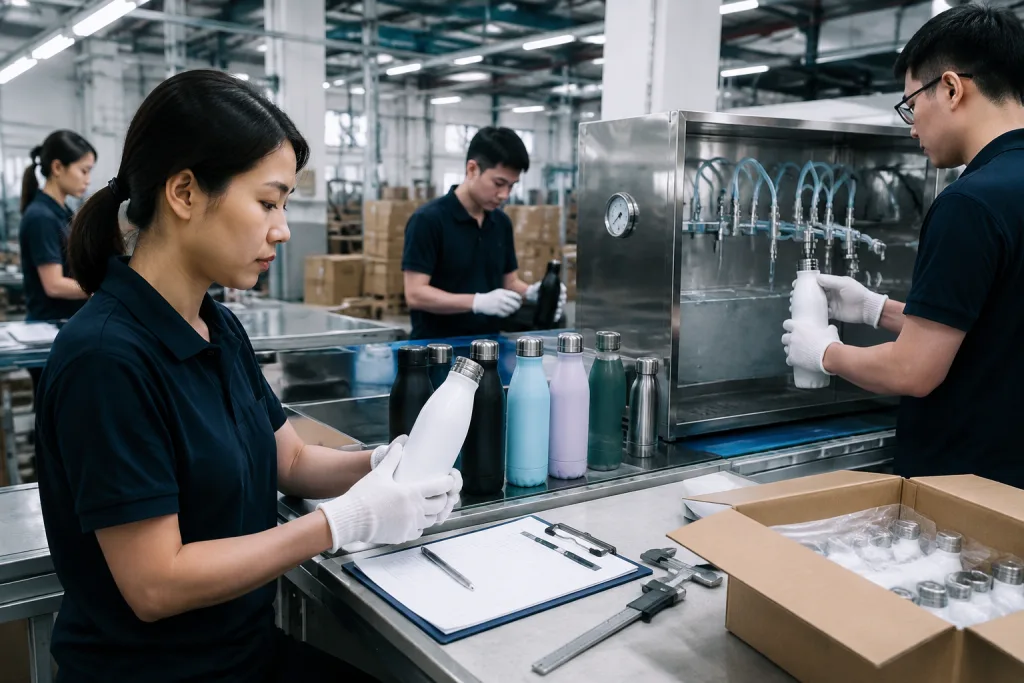
Do not approve a sample by looking at the outside. Ask the canteen factory to run a water-fill test on 10 pieces from the pilot batch. The method is simple: tare the empty bottle on a 0.1 g digital scale, fill to the agreed usable line, weigh again, and convert grams to milliliters. Put the tolerance in writing, normally +/-3% for standard drinkware and +/-2% when your retail claim is strict.
If you are a distributor canteen buyer selling into chain stores, confirm carton labels match the usable capacity. Mixed claims create returns even when the product is technically safe; one buyer flagged a PO that said 32 oz while the carton artwork said 950 ml. A canteen manufacturer in Zhejiang can produce good bottles, but it cannot read your customer’s mind. The usable fill line belongs in the spec sheet.
Steel grade and taste failures
Metallic taste usually starts at coil cutting and welding, not after the bottle lands in your warehouse. For a refillable water bottle, the inner surface needs food-contact safe steel, clean passivation, and no black polishing paste left near the mouth thread. We run 304 stainless steel for most B2B inner walls; QC pulled a 750 ml sample last month where residue showed up on a white cotton swab after 20 wipes. 316 makes sense for higher chloride exposure, coastal markets, and premium custom canteen programs with sports or marine positioning. It adds cost. Don’t spec it just because it sounds better.
The dangerous shortcut is accepting vague wording like “food grade stainless.” This is the wrong question to ask. A serious canteen supplier should state material grade, inner wall thickness, outer wall thickness, and test standard on the quote, not only on the proforma invoice after deposit. For Europe, ask for LFGB or EU food contact testing where relevant, plus REACH for coatings and inks; for North America, FDA food-contact expectations and California Proposition 65 screening may apply depending on your channel. For children’s bottles, ASTM and CPSIA questions come into play, and we have seen buyers flag one PO because “CPSIA” was typed as “CPSP” in the artwork approval sheet.
Our practical recommendation: specify 304 inner wall, 201 or 304 outer wall depending on price tier, and require XRF material verification on incoming coils or random cut pieces. The XRF gun takes about 8 seconds per reading, and we usually test 3 cut pieces from a new coil before the line starts. If the project is a premium customizable growler, use 304/304 or 316/304 and write it clearly in the spec table. The price gap may be USD 0.25-0.80 per unit depending on size and market steel pricing; on a 10,000 pcs order, the math gets noticed fast.
Watch welding quality too. Poor laser welding leaves pinholes, heat tint, or weak vacuum performance, and we’ve seen this go sideways when a buyer only checked the logo print and ignored the seam. For double-wall bottles, request a vacuum retention test after welding and before coating; on our line, samples sit in the 100°C water tank before the coating crew touches them. A canteen vendor that refuses to describe these checkpoints is not saving you time. It is asking you to carry its risk.
Lids leak before cartons ship
Leaks are the defect buyers remember because they create photos, debit notes, and angry sales teams by Monday morning. The bottle body can pass polish, logo, and packing checks, then one bad silicone ring or loose thread turns 10,000 pieces into a claim. We see this most often on canteen promo orders: the buyer approves the logo strike-off fast, then QC pulled the sample and found water sitting under the flip cap after 20 minutes.
Start with the lid material. Food-contact PP, Tritan, stainless, and bamboo-look parts do not shrink or flex the same way after molding. Silicone gaskets need odor control and a groove match; they should not be stretched into place by hand on the line. A gasket 0.2 mm too thin can pass a quick bench check and still leak after cartons sit in a 38°C truck for 6 hours. For straw lids, we run checks on the vent hole, straw OD fit, and flip-cap hinge after 300 open-close cycles. For screw lids, check thread bite and closing torque with a digital torque meter, not someone’s thumb feel.
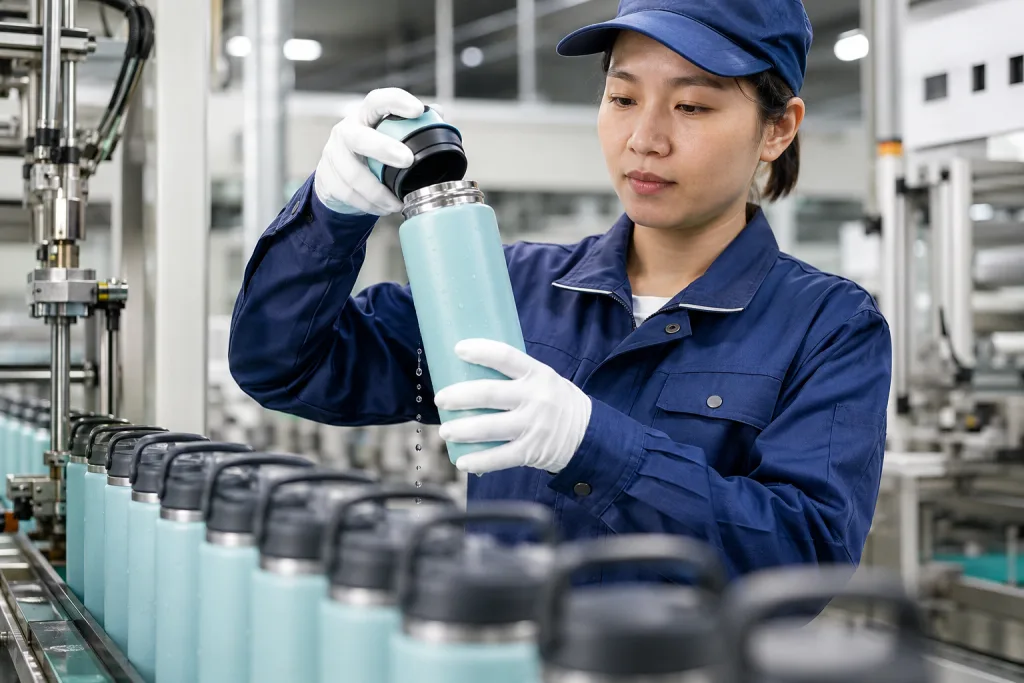
Use a real leak protocol during production QC. Fill the bottle with room-temperature water, close it to the agreed torque, invert for 30 minutes, then shake 10 times and inspect the lid seam with a dry tissue. Simple test. It works. For sports bottles, add side-position testing because users throw them into gym bags, and we have seen this go sideways when only upside-down testing was written on the PO. For a custom drinkware program sold through canteen distributors, test at least 32 pieces during in-line inspection and again during final inspection under AQL 2.5.
Talk about replacement lids before production starts. If you buy 10,000 bottles, order 1-2% spare lids and gaskets, packed in a separate inner carton with the SKU marked clearly. The added cost is small, often USD 0.03-0.18 per set, and the math works better than air-freighting full bottles from China. Last season one buyer flagged a PO typo that listed “100 spare lids” instead of “1,000”; catching that before mass packing saved 12 days versus 18 days for a later replenishment shipment.
Decoration that fails after handling
Decoration failures are not always bad printing. Half the time, the print method was matched to the wrong surface or to the way the bottle gets handled in real use. A vendor refillable water bottle with powder coating needs different artwork rules than a polished stainless canteen customized with laser engraving. On our line, QC pulled 12 black powder-coated samples last month where the ink passed the first check, then lifted at the shoulder after a fingernail scrape because the curve was too tight for that logo size. Treating every surface the same is the wrong question to ask; the logo becomes the weak part before the bottle does.
Silkscreen is economical for simple 1-2 color logos and can start around USD 0.08-0.20 per position at volume. Heat transfer handles gradients better, but we still run adhesion testing on the actual coating panel before mass production. Laser engraving is durable and clean, but it exposes the base metal and can look flat on champagne, brushed silver, or light gunmetal finishes. Full-wrap artwork can look sharp. Registration drift of 1-2 mm is normal unless the body shape and fixture are built for it; our fixture tech usually checks this with a 0.5 mm feeler gauge before the first 30 pcs go through.
For canteen customizable projects, ask for a printed pre-production sample using actual coating, not a digital mockup. Then run basic abuse tests: cross-hatch adhesion with a 1 mm cutter, 3M tape pull, alcohol rub for 50 cycles, and dishwasher simulation if you claim dishwasher safe. Be careful with that claim. We have seen this go sideways: 8 out of 20 powder-coated bottles looked fine after hand washing but showed logo wear after 6 high-heat dishwasher cycles, especially near the lower grip area where buyers keep rubbing the bottle.
Artwork files should be vector AI, EPS, or PDF, with Pantone references for spot colors and a clear note for logo size in mm. If your brand color is strict, request a coated Pantone match and accept a realistic tolerance; the math does not work if the PO says “same as screen color” with no Pantone code. Different substrates reflect light differently. A canteen manufacturer in China can control the process with a spectrophotometer and a signed color chip, but powder coating, silicone, and stainless will not display color identically under every retail light.
Cartons create hidden damage
About 7 out of 10 first-time buyers check the bottle finish and leave the carton spec until crushed cartons show up in the claim photos. Packaging is not decoration. It is part of the protection system. A canteen distributor shipping through UPS or DPD parcel lanes needs a tougher pack than a brand owner sending full master cartons to one warehouse. For Amazon-style fulfillment, we set FNSKU label size and scan position on the packing instruction, then check it with a handheld scanner before the line seals the first carton.
For individual boxes, 300-350 gsm white card is common, but a 900 ml steel bottle or custom growler often needs an E-flute corrugated inner box. Master cartons should usually stay below 15 kg for manual handling in Europe and North America. If the bottle has a handle lid, straw lid, or painted loop, we add a polybag or tissue wrap because QC pulled 32 samples last month with loop-rub marks after a 40-minute vibration table run. For premium customized drinkware, molded pulp or paper dividers cut scuffing without making the pack look cheap.
Drop testing should match the shipment path. For normal export cartons, we run a 1-corner, 3-edge, 6-face drop sequence from 60-80 cm depending on carton weight. Courier and DTC fulfillment need a higher standard before mass production approval; this is the wrong place to save USD 0.08 per box. We have seen this go sideways. One matte-black canteen promotional bottle passed bottle QC, then came back with 18 dent claims because the carton wall was 5 mm too soft.
Carton markings need the same attention as the logo artwork. Put item number, color, quantity, gross weight, net weight, dimensions, country of origin, and PO number on the shipping mark, then match them against the final PI before sealing cartons. If mixed colors are allowed, define the ratio per carton, such as 12 black and 12 white in a 24 pcs master carton. Zhejiang factories can pack exactly what you approve, but vague packing instructions create warehouse friction months later; one buyer flagged a PO typo where “blue” became “bleu,” and the receiving team held 186 cartons for recheck.
Inspections that check too late
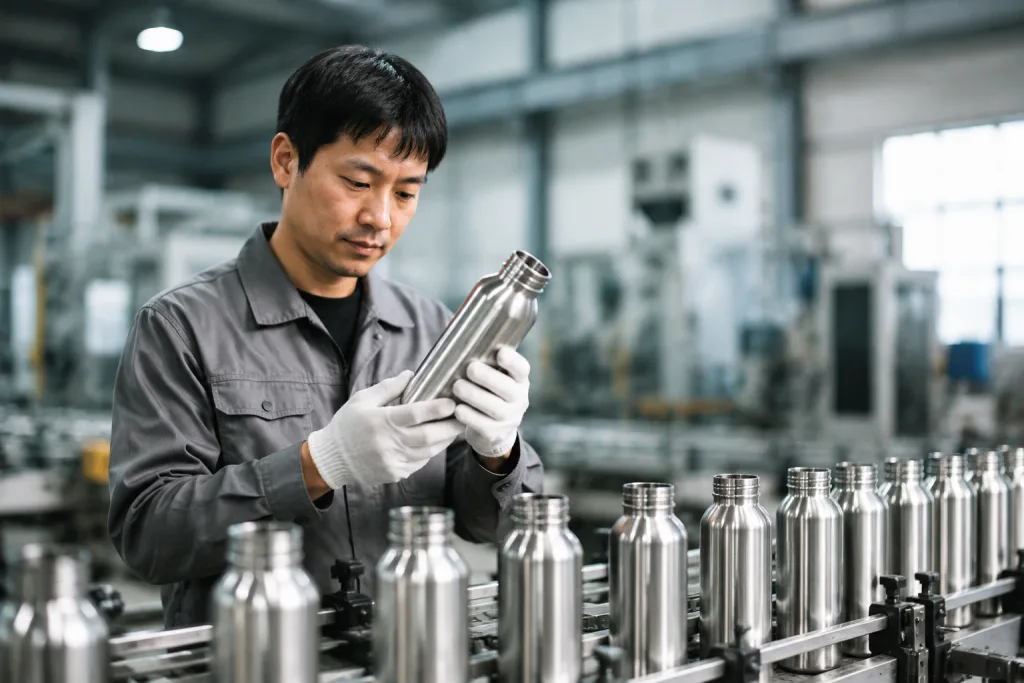
The weakest inspection plan is one final check after 100% of goods are packed. Too late. At that point, our packing team has to cut straps with a carton knife, reopen 5-layer export cartons, pull bottles from polybags, and argue about who pays for the missed sailing. A better plan checks the failure where it starts: 304 stainless sheet thickness at incoming, weld seam after forming, powder coat adhesion before printing, logo position on the pad-printing jig, lid fit during assembly, and carton marks before the pallet is wrapped.
For a standard vendor refillable water bottle order, we run three control points. First, confirm incoming material and components before production, including silicone ring weight, straw length in mm, and outer carton print against the PO. Second, run an in-line inspection when 20-30% of goods are completed; QC pulled the sample last month because the buyer flagged a 2 mm logo shift on the first 600 pcs. Third, perform final random inspection when 80-100% is packed. Use ISO 2859-1 sampling with AQL 0 for critical defects, AQL 2.5 for major defects, and AQL 4.0 for minor defects unless your customer requires stricter limits.
Critical defects include unsafe sharp edges, contaminated interiors, wrong food-contact material, or serious leakage. Major defects include dents deeper than 0.5 mm, poor vacuum performance after a 6-hour heat test, wrong logo color, lid mismatch, and carton shortage. Minor defects include small cosmetic specks within an agreed viewing distance, usually 30-50 cm under normal light. Define these before the inspector arrives; we have seen this go sideways when the PO says “blue” but the artwork file says Pantone 2925 C.
Lead time should be realistic. At BottleForge in Hangzhou, China, typical sampling takes 7-10 days for standard items and 12-18 days for new molds or complex decoration. Bulk production is usually 30-45 days after deposit and artwork approval, with FOB Ningbo or Shanghai commonly used. If a canteen vendor promises 15 days for a new customized canteen, custom lid, and printed gift box, the math does not work unless they skip mold trial, salt-spray checks, or a full packing test with a 12 kg drop carton.
Send your bottle spec before you place the PO
We will review capacity, material, lid, logo, packaging, MOQ, and lead time so your next custom drinkware order is easier to control.
Frequently asked questions
What MOQ should I expect for a vendor refillable water bottle order?
For standard stainless steel bottles, a realistic MOQ is 1,000 units per color and 3,000 units per model when you need custom color, logo, and retail packaging. If you need a new lid mold, shaped body, or private tooling, expect 5,000-10,000 units because tooling, testing, and setup losses become material. Some canteen suppliers quote 500 units, but the unit price can rise by USD 0.60-1.50 because coating, printing, and carton setup costs are spread over fewer pieces. For a first distributor drinkware test, use an existing mold and customize color, logo, and packaging before paying for tooling.
How much does a custom canteen usually cost from China?
A basic single-wall stainless custom canteen may land around USD 2.20-4.00 FOB China depending on capacity and decoration. Double-wall vacuum bottles commonly run USD 4.50-8.50 FOB for 500-1,000 ml sizes. A customized growler with vacuum insulation, powder coating, and a strong handle lid can range from USD 8.00-15.00 FOB. These are planning ranges, not fixed quotes, because steel price, lid design, coating, logo method, and packaging change the number quickly. If a canteen manufacturer quotes far below market, check wall thickness, steel grade, carton strength, and whether testing is included.
Which logo method is best for canteen promotional programs?
For canteen promotional projects, choose the decoration based on expected use. Silkscreen is cost-effective for simple logos and large corporate giveaways, usually around USD 0.08-0.20 per position at volume. Laser engraving costs more but is more durable, especially on powder-coated stainless bottles. Heat transfer is better for full-color graphics, but it needs adhesion testing on the actual coating. For premium custom drinkware, we often suggest laser engraving or tested heat transfer rather than cheap pad printing. Always approve a physical pre-production sample and run tape pull, rub, and scratch checks before bulk production.
How do I compare canteen manufacturers without only chasing price?
Ask every canteen supplier for the same information: steel grade, wall thickness, capacity tolerance, lid material, gasket material, testing standards, MOQ, sample time, bulk lead time, and AQL plan. Then compare quotes on an equal spec. A cheaper canteen factory may be using thinner 0.38 mm steel, weaker cartons, or untested coating. Also ask about production capacity and export experience. A factory producing 500,000-900,000 drinkware units/month with documented inspections is usually safer than a trading-only canteen vendor that cannot explain welding, vacuum testing, or packing controls.
Can one supplier handle canteen, growler, and other customized drinkware?
Yes, if the supplier has the right production network and QC system, but do not assume every canteen manufacturer is strong in every category. A customizable canteen, customizable growler, glass bottle, and travel tumbler use different tooling, materials, and testing. For distributor growler or distributor canteen programs, ask for category-specific samples and test reports, not just a catalog. It is reasonable to consolidate orders for freight and account management, but each product should still have its own spec sheet, golden sample, inspection checklist, and packaging test.