Key Takeaways
- A practical vendor protein shaker MOQ starts at 1,000 pieces for stock molds and 5,000 pieces for custom color runs
- PP and Tritan are not interchangeable; Tritan can add USD 0.35-0.90 per unit depending on capacity and mold
- AQL 2.5/4.0 inspection should check leak rate, cap torque, logo adhesion, and carton drop performance
- Normal production lead time is 25-35 days after artwork approval for one-color custom drinkware orders
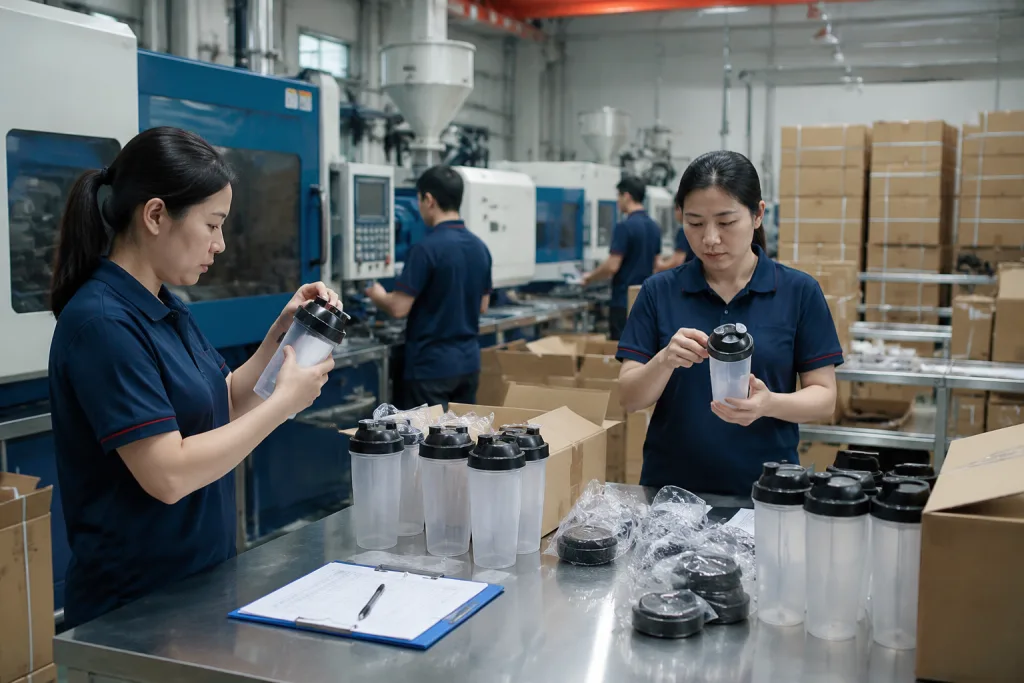
A vendor protein shaker looks simple until you book 5,000 units and QC pulls 32 lids with slow seepage after a 3-minute upside-down test. Then the buyer flags measurement marks that scratch off under 3M tape, or cartons that split during Amazon FBA drop checks. It is almost never one careless worker on the line. It starts with a loose spec sheet.
If you buy custom drinkware for a gym chain, supplement brand, canteen distributor, or promo order, read the shaker spec line by line. At our Hangzhou, Zhejiang facility, we quote from material grade, mold type, wall thickness in mm, print method, packing, and inspection level—not soft words like “premium.” We have seen POs arrive with “PP food grade” typed as “PC food grade,” and that one typo changes the whole risk profile. China can ship a cheap shaker or a serious shaker. The wrong question is “what is your lowest price?” Ask what spec the factory is actually pricing before you pay the deposit.
Capacity Is A Cost Decision
The first spec line is usually capacity: 500 ml, 600 ml, 700 ml, or 800 ml. Retail buyers sometimes pick the size that looks strongest on shelf, but this is a cost line, not just a design line. Capacity changes resin weight, carton size, freight, and how the end user mixes powder. A 600 ml vendor protein shaker is the safer middle: enough room for 35 g whey plus water, still short enough for gym bags and the 73 mm car-cup-holder gauge we keep at the sample table. An 800 ml body looks more “performance,” but it can increase plastic weight by 12-20% and carton cube by roughly 15%. The math doesn't work if the buyer only sells it as a giveaway.
For B2B programs, define whether capacity is brimful or usable. Brimful means liquid to the lip. Usable capacity stops below the thread, where shaking is realistic. If your label says 700 ml but practical mixing volume is 600 ml, customers will notice after the first clump of powder hits the lid. We run both checks during sampling with a graduated cylinder: QC marks brimful, usable fill, and leak-test height on the sample card, then we print only the buyer-facing volume on the cup.
Capacity also changes MOQ. At our Zhejiang canteen factory, stock mold protein shakers can start from 1,000 pieces per SKU. If you need a custom canteen shape, custom growler-style grip, or a new shaker mold, tooling and MOQ move up fast: expect 5,000-10,000 pieces and 30-45 days for mold sampling. That is normal in China manufacturing, not a sales trick. We have seen this go sideways when a PO says “700 ml” but the approved drawing is for the 800 ml mold; the line stops while sales, tooling, and the buyer fix one typo.
For a canteen supplier or distributor drinkware buyer, keep the first order boring: one capacity, two colors, one logo process. Clean order. Faster shipment. We ship fewer surprises that way, and QC pulled fewer mixed-carton samples last season when the opening order stayed at 1,000 pieces per color instead of splitting across four cup sizes. You can add a customizable canteen or customized growler later when reorder data proves demand.
Material Grade Drives Complaints
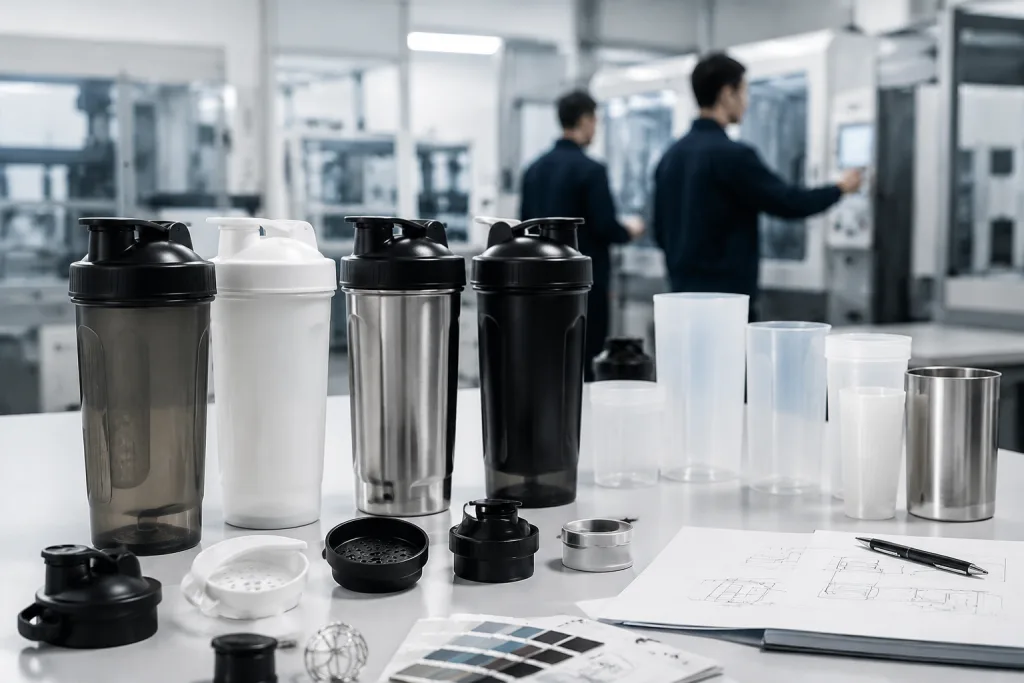
The material line gets skipped too fast on buyer POs. This is the wrong place to save 2 cents. We run protein shakers in PP, PE, Tritan, or stainless steel, and each one creates a different complaint pattern after shipment. PP is the budget workhorse: light, bendable, good for 5,000-20,000 pcs canteen promo orders where the buyer is fighting for a low landed cost. Tritan looks clearer on the shelf and survives drop tests better, but the dryer has to hold the resin at the right setting before injection or QC will pull cups with haze and bubbles near the gate. Stainless steel feels premium and handles rough use, but buyers lose body visibility, so printed ml/oz markings need a separate check with a film ruler on the line.
For PP, ask for food-contact grade resin and paperwork that matches the selling market. For the EU, REACH and LFGB-style food contact migration testing may be required depending on the claim and retail channel. For the US, buyers commonly ask for FDA food-contact compliance and California Prop 65 review. If the shaker is for children or school canteen customized programs, ASTM and CPSIA questions may still come up even if the item is not sold as a toy. We have seen this go sideways when a PO says “school bottle” in one line and the buyer flags child-use compliance 12 days before loading.
Do not accept “BPA free” as the full material spec. It is one claim, not a spec sheet. You need the resin name, colorant safety, odor control target, and a clear answer on recycled content. Recycled PP can work for some outer parts, such as a non-contact carry loop, but not for food-contact shaker cups unless your compliance file allows it. QC once rejected 300 lids after a hot-water odor check because the color masterbatch smelled sharp at 60°C, even though the supplier kept saying “BPA free.”
Typical wall thickness for a PP shaker body is 1.2-1.8 mm. Below 1.0 mm, squeeze deformation and thread distortion show up fast, especially around the cap seat where the caliper reading drops near the parting line. For Tritan, 1.5-2.2 mm is more realistic. A canteen manufacturer quoting 30% below the market is often cutting resin, not finding magic efficiency. The math doesn't work. That small saving turns into leak complaints, AQL 2.5 inspection pressure, and refund deductions when the buyer’s warehouse finds wet cartons after a 1.2 m drop test.
Thread, Lid, And Seal Details
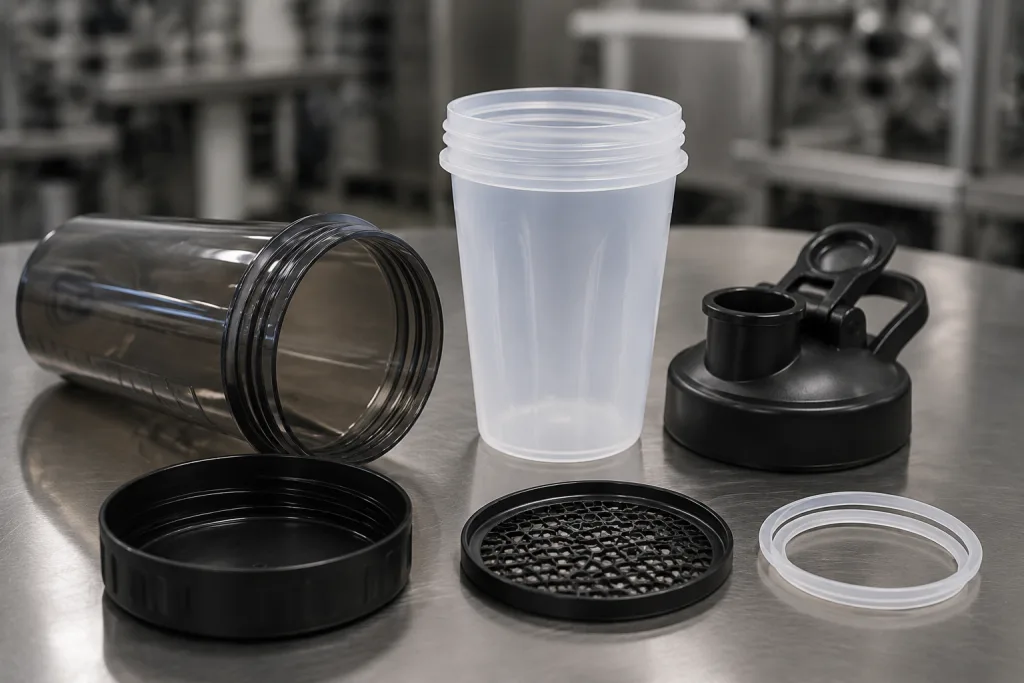
Leakage is where a vendor protein shaker order usually wins or fails. On the PO, we want the lid structure written out, not guessed from a photo: screw lid with thread pitch in mm, flip cap or snap cap with hinge material, silicone gasket or PE seal ring, carry loop load rating, plus mixing ball or grid. “Leakproof” is too soft. Ask for the test method. Last April, QC pulled a 700 ml sample where the buyer’s artwork file said “leak proof,” but the PO missed the gasket line item; 3 cartons later, the buyer flagged seepage at the cap corner.
Our standard leakage test for shaker samples is 100% visual check after filling to 80% capacity, closing to normal hand torque, and shaking upside down for 30 seconds. We run it over a white inspection tray, so even a 1 mm wet line around the thread shows up. For mass production, we use sample-based inspection unless the buyer pays for 100% water testing. For retail launches above 10,000 pieces, 100% cap fit check is worth discussing because one bad cap cavity can affect thousands of units. The math works better than handling 260 return emails from gym customers.
Thread design matters more than lid thickness. A shallow single-start thread closes quickly, but it is less forgiving when whey powder sits in the groove after two uses. A deeper thread takes about half a turn more, yet it holds better when the bottle is squeezed in a backpack. Silicone gaskets reduce leakage, but they add assembly labor and end users lose them in the sink. We have seen this go sideways. If your channel has high return sensitivity, specify gasket hardness around 50-60 Shore A and require spare gasket retention testing; our line checks this with a Shore A durometer and a simple pull test before packing.
For a canteen vendor, canteen distributors, or distributor growler buyer selling into gyms and outdoor channels, check one-hand opening before you approve the mold. A cap that passes a lab test but hurts the thumb will create bad reviews. We normally target a flip-cap opening force of 18-35 N, measured with a push-pull force gauge on the sample table. Lower than that risks accidental opening in a sports bag; higher than that feels cheap and stiff. This is the wrong question to ask: “Does it pass?” Ask whether a sweaty hand can open it after leg day.
Mixing System And User Cleaning
The mixing part is usually one of four options: 304 stainless steel ball, plastic whisk, fixed grid, or an internal agitator molded into the lid. They do not sell the same. The 304 stainless steel ball mixes whey fast and gym users know it, but we have had buyers flag the rattling sound during carton drop checks, and it adds roughly USD 0.08-0.18 per unit. A plastic grid is quieter and cheaper. The catch is open area. On the line, we check the grid slot width with a 0.5 mm feeler gauge because powder cakes under the lid if the ribs are too tight.
If you sell customized drinkware through retail, cleaning becomes part of the product review. Narrow shoulders look sleek, then trap protein residue near the top curve. Deep ribbing gives grip, then holds odor when users rinse once and leave it in a gym bag. A dishwasher-safe claim needs testing, not guessing. For PP, repeated dishwasher cycles at 70°C can deform thin walls or fade printed measurement marks; QC pulled one PP sample last month where the 600 ml mark ghosted after 18 cycles. Tritan performs better, but logo ink still fails when the printing process is wrong.
Measurement markings need a straight decision: molded-in embossing, printed scale, or both with a clear reason for the extra tooling step. Molded marks do not rub off, but they are harder to read on opaque cups. Printed scales read better at the shelf, but abrasion and dishwasher tests decide whether they survive. We run a 3M tape adhesion test after curing and a 50-cycle wet rub test for printed graphics; if the ink lifts at the 200 ml line, the math doesn't work for retail returns. For supplement brands, 100 ml and 4 oz increments usually cover daily use.
A canteen customizable program should not turn into a parts museum. If the buyer wants a shaker, custom canteen, and customizable growler in one campaign, keep the cleaning logic the same: a wide mouth around 55 mm or above, removable parts that pass a pull test by hand, and no hidden pocket behind the hinge where protein paste sits. We ship fewer complaint emails when the user can see every dirty surface. Fancy names do not fix bad cleaning.
Logo Method Changes Durability
Branding is not decoration in B2B. It is the reason you are not buying blank stock. For a vendor protein shaker, we run silk screen for simple PP or Tritan logos, heat transfer for photo-style artwork, in-mold labels when the buyer accepts tighter process control, pad print for small curved positions such as flip caps, and laser engraving on stainless parts. Each route changes MOQ, plate charge, rejection risk, and what QC looks for under the 3M tape test.
Silk screen is still the safe workhorse for one- or two-color logos on PP and Tritan. It works best when the AI file uses solid blocks, not hairline gradients. Setup is usually USD 40-80 per color, and our line can print 8,000-12,000 cups per shift once the jig is locked. Heat transfer handles gradients and complex graphics, but the film edge can show at 0.3-0.5 mm, and weak transfer pressure will peel after dishwashing. In-mold labeling looks premium. The math doesn't work for a 1,000-piece test order because tooling trials and scrap control eat the margin.
For stainless shaker cups or hybrid lids, laser engraving is permanent but only works on the metal surface. No bright brand colors there. Powder coating plus laser is common for distributor drinkware, especially on matte black and navy bodies, but QC should pull samples for cross-hatch adhesion testing and salt spray review if the product is sold for gym bags, camping kits, or outdoor retail. We have seen this go sideways when the buyer approved color first, then flagged coating chips around the logo after a 24-hour salt spray check.
Artwork files should be AI, PDF, or EPS with Pantone references. Do not approve a production sample from a WhatsApp photo. Ask for a physical pre-production sample when color matters, and ask the supplier to measure it with a colorimeter, not just a phone camera under office LEDs. On plastic, a Pantone difference of Delta E 2-4 can happen because resin color, 1.8-2.2 mm wall thickness, and matte texture all change how the eye reads the shade. A serious canteen manufacturer will say this before mass production, not after QC pulled the sample from carton 7.
Packing Specs Protect Margin
Packing looks boring until freight damage eats your margin. We have seen a shaker pass leak test, torque check, and 1,000-cycle lid flip, then lose money because the outer carton softened in Ningbo warehouse humidity. Bad packing hurts fast. Your packing spec should call out individual polybag or no polybag, instruction sheet size, barcode type, FNSKU, master carton quantity, carton dimensions, gross weight, and drop-test rule. QC pulled one sample last month where the PO said “no bag,” but the artwork file said “opp bag.” That typo stopped the line for 4 hours.
For standard 600 ml PP shakers, we usually run 48 pieces per master carton, about 53 x 42 x 45 cm, with gross weight around 9-12 kg depending on wall thickness, mixing ball, and carry loop. If you switch to color boxes, carton cube goes up by about 18-25%, so sea freight cost per unit climbs. The math doesn't work for every order. For e-commerce, a color box can save returns and buyer complaints. For canteen promotional or event giveaway programs, bulk packing is usually the cleaner choice because nobody pays extra freight for a box that gets thrown away in 30 seconds.
Ask whether the factory follows ISTA-style drop logic or only checks if the carton “looks okay” after packing. That is the wrong question to leave vague. We recommend a 76 cm carton drop test on one corner, three edges, and six faces for e-commerce cartons, using a packed carton from the line, not a hand-built sample from the office. QC should check cracked lids, scuffed printing, loose straws, and crushed dividers after the drop. For palletized wholesale orders, compression matters more than repeated courier drops, so we also check stack height and bottom-carton deformation after 24 hours.
Labeling also matters for canteen suppliers and canteen vendors shipping to North America. FNSKU placement, suffocation warnings on polybags, country of origin, and carton marks should be locked before mass production. Changing carton labels after goods are packed can cost 1-3 days, and nobody enjoys reopening 380 cartons with a box cutter because the buyer flagged a missing “Made in China” line. At BottleForge Industrial in Hangzhou, Zhejiang, our normal lead time is 25-35 days after sample and artwork approval, with monthly capacity around 450,000 plastic drinkware units across shaker, sports bottle, and canteen customized lines.
Inspection Terms Belong In PO
A purchase order should do more than list item name, price, and delivery date. It should freeze the inspection standard before we cut steel or print film. For a vendor protein shaker, we run AQL sampling with separate limits for critical, major, and minor defects. A workable default is Critical 0, Major 2.5, Minor 4.0. Critical defects mean unsafe material, sharp edges, oil contamination in the cup, or leakage after a 30-second inverted water test. Major defects cover wrong logo size, loose lid fit over 0.5 mm, cracked body, missing mixing ball, or barcode scan failure. Minor defects are small scratches, slight color drift against the approved Pantone chip, or print specks inside the signed limit sample.
Define who pays if inspection fails. If defects exceed AQL because the line produced bad goods, rework is factory cost. Simple. If the buyer changes artwork, packing, or labeling after the signed approval sample, the buyer pays for the extra work. Put this in the PO, not in a WeChat message at midnight. We had one buyer flag 1,200 cartons after changing the barcode file from EAN-13 to UPC-A after approval; without written terms, the math does not work.
FOB pricing also needs hard edges. A quote of USD 1.10 FOB Ningbo for a PP shaker may include one-color logo and bulk packing, while another quote at USD 0.98 may leave out logo setup, testing, insert cards, and barcode labeling. For Tritan, realistic FOB ranges are USD 1.55-2.80 depending on capacity, lid structure, and logo process. Stainless hybrid shakers sit above that. On our quote sheet, we separate mold charge, 1C pad print, carton mark, and SGS test fee because one PO typo, “logo included” instead of “logo mold included,” can burn 3 days before production even starts.
If you are comparing canteen manufacturers in China, do not chase the lowest spreadsheet number. This is the wrong question to ask. Ask for a line-by-line quote covering resin grade, body weight in grams, lid material, seal type, logo method, accessory set, packing, test report, inspection terms, and lead time. QC pulled a 600 ml shaker sample last month that looked fine in photos, but the body weight was 82 g instead of the quoted 95 g and the lid thread skipped under hand torque. The best canteen supplier is not always the cheapest. It is the one whose spec sheet matches what your customer receives in the carton.
Send Your Shaker Spec Sheet For Review
We will check material, MOQ, logo method, packing, and FOB cost before you lock the order with a China factory.
Frequently asked questions
What MOQ should I expect for a vendor protein shaker order?
For stock molds, a realistic MOQ is 1,000 pieces per design if you accept standard body shape and available colors. Custom Pantone body colors usually start at 3,000-5,000 pieces because resin mixing and machine setup create waste. A fully custom mold can require 5,000-10,000 pieces for the first run, plus tooling charges that may range from USD 2,000 to more than USD 12,000 depending on cavities and lid complexity. If you are a new canteen distributor testing demand, start with a stock mold, one logo, and two colors. It keeps cash exposure lower and gives you real reorder data before investing in a customized canteen or proprietary shaker shape.
What is the normal FOB price for custom protein shaker bottles?
For a 600 ml PP vendor protein shaker with one-color silk screen logo and bulk packing, FOB China pricing often sits around USD 0.85-1.45 depending on body weight, lid design, and order quantity. Tritan versions are commonly USD 1.55-2.80 because the resin is more expensive and processing control is stricter. Add USD 0.08-0.18 for a 304 stainless mixing ball, USD 0.05-0.12 for an insert card, and more if you need retail color boxes. Be careful with quotes that are 25-30% below the market. They may use thinner walls, weak caps, recycled material, or exclude logo and testing costs.
Can I use the same supplier for shakers, canteens, and growlers?
Yes, if the supplier has the right production mix. A plastic shaker line is not the same as a stainless vacuum growler line, but one coordinated canteen factory can manage both through in-house and audited partner workshops. For a broader custom drinkware program, ask whether the supplier controls injection molding, printing, powder coating, stainless forming, and final QC. A distributor canteen or distributor growler order needs consistent color, carton marks, and documentation across SKUs. At BottleForge in Zhejiang, we often combine vendor protein shaker, custom canteen, sports bottle, and customized growler projects under one export schedule to reduce communication errors.
Which logo method is best for gym or supplement brands?
For most gym and supplement brands, one- or two-color silk screen printing is the most practical choice. It is clean, affordable, and durable enough when cured correctly. Use Pantone colors and ask for tape adhesion and wet rub testing. Heat transfer is better for full-color graphics, but it can peel if the film or pressure is wrong. In-mold labels look more integrated but need higher MOQ and tighter process control. For stainless lids or stainless shaker bodies, laser engraving is permanent but not colorful. If your product will go through dishwashers, approve a physical sample after at least 20-50 wash or rub cycles.
How long does production and shipping take from China?
For a stock mold vendor protein shaker, normal production is 25-35 days after deposit, artwork approval, and pre-production sample approval. Custom color resin can add 3-7 days. New mold development can add 30-45 days before mass production begins. Sea freight from Ningbo or Shanghai to Europe or North America often takes 25-45 days port to port, depending on route and season. Air freight is faster but can cost more than the shaker itself on low-value items. Build your purchase plan backward: sampling, approval, production, inspection, export clearance, ocean transit, customs, and local delivery all need calendar space.