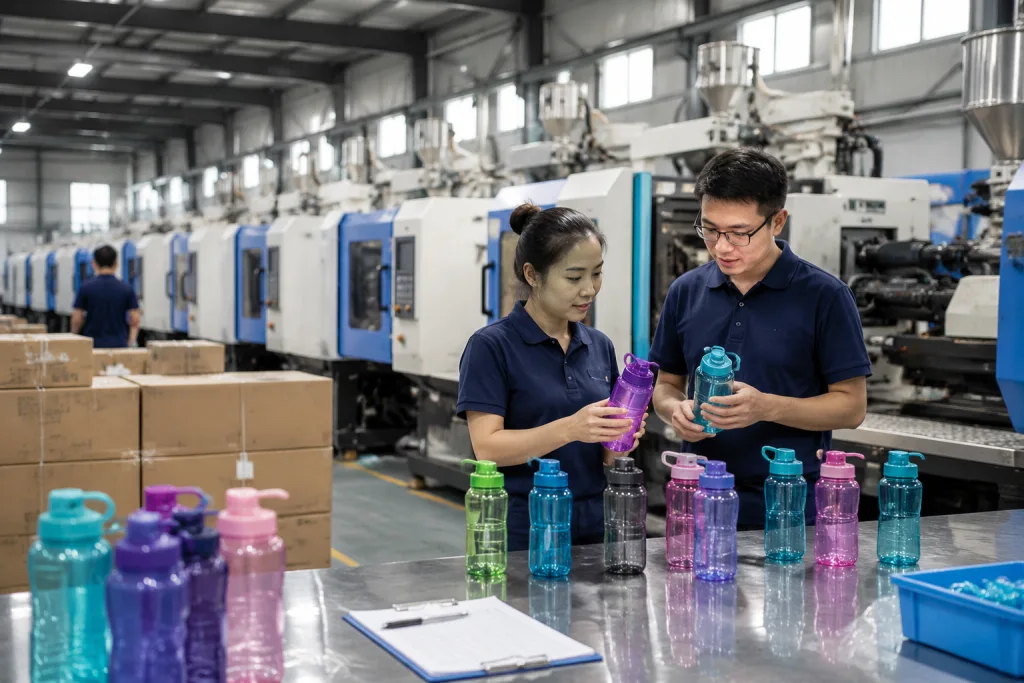
Key Takeaways
- A realistic MOQ for custom PP bottles starts at 3,000 units for stock molds and 10,000 units for private molds
- Typical FOB China pricing runs USD 0.85-2.40 per unit before retail packaging and lab testing
- Stock-color lead time is usually 25-35 days; custom molded PP projects need 45-70 days
- Use AQL 2.5/4.0 inspection and confirm food-contact compliance before paying the 70% balance
A vendor polypropylene bottle looks simple until you need 20,000 units landed on time, retail-packed, and steady enough to pass the buyer’s first receiving check. PP is cheaper than stainless steel or glass, but the math doesn’t work if the mold leaves a 0.4 mm parting-line burr, the flip cap fails a 24-hour leak test, or the Pantone batch drifts between run 1 and run 2.
If you source custom drinkware from China, price the bottle like an engineered promo item, not a cheap catalog giveaway. We run Hangzhou, Zhejiang PP canteen and bottle quotes with MOQ, mold condition, printing process, carton spec, and AQL level broken out; last month QC pulled 32 samples from the line after a buyer flagged “blue lid” on the PO but sent artwork calling for navy.
Start with the bottle economics
Polypropylene, usually quoted as PP, sells well because it is light, impact-resistant, and cheap to inject. For a vendor polypropylene bottle, resin is only one line on the costing sheet. The real unit price comes from PP grade, gram weight, lid parts, who owns the mold, print method, carton spec, and whether your PO can slot into the line without stopping a running color. Last month QC pulled a 72 g body from a trial mold and the caliper showed 1.35 mm at the shoulder, not the 1.5 mm the buyer wrote on the spec.
For a 500-750 ml PP sports bottle or custom canteen, a practical FOB China price range is USD 0.85-1.35 using an existing mold, single color body, simple flip lid, and bulk carton packing. Add a strap, measuring scale, translucent finish, silicone gasket, or retail box and the same project moves toward USD 1.50-2.40. A larger 1 L hiking canteen customized with a wide-mouth cap, handle, and two-color body can go higher, especially if the wall thickness is above 1.8 mm. We run these on existing tooling fastest when the buyer accepts our standard 24 pcs/ctn packing; changing to a 1 pc color box added 12 days vs 18 days on one promo order because the artwork proof came back with the cap color typed as “Pantone 299C” on the PO and “293C” on the box file.
Do not compare quotes by capacity alone. This is the wrong question to ask. A 650 ml bottle at 70 g of PP resin will not feel like one at 95 g, even if both pass a basic leak test. Buyers ask for the lowest price, then flag body flex after we ship the counter sample. We have seen this go sideways on school and canteen promotional orders: the sample looked fine on the desk, then failed a 1.2 m drop test when filled to 90%. If the bottle is for outdoor, school, or canteen promotional use, specify target weight, wall thickness, lid material, gasket material, and drop-test requirement before asking canteen suppliers for a final price.
At BottleForge Industrial in Zhejiang, our PP drinkware line can run about 450,000 plastic bottle units/month when molds and packaging materials are pre-approved. Capacity helps. It does not fix a loose spec sheet. Before we release mass production, our QC team checks first-shot samples against the signed sample, weighs 20 pcs on a digital scale, and records lid torque on the inspection sheet. If the buyer has not locked color, logo size, carton marks, and MOQ by SKU, the math does not work cleanly.
MOQ tiers that change pricing
MOQ is not a penalty fee. It is the point where the line stops wasting time on barrel heat-up, resin drying, color matching, logo fixture setup, and carton packing changeover. For a vendor polypropylene bottle, we usually run three MOQ bands, and the quote sheet changes once the injection machine has enough shots to stay warm for a full shift.
- 3,000-5,000 units: workable for stock shapes and stock PP colors, usually with our existing 350T injection mold and standard carton. This is the entry point we see for a canteen distributor testing a summer promo or a distributor drinkware buyer adding one low-cost SKU. QC pulled a 3,000-piece sample lot last month because the buyer wanted Pantone 186C on a stock red resin. The math did not work, so we moved them to stock red and kept the order alive.
- 5,000-10,000 units: better for custom Pantone colors, one- or two-position logo printing, and basic retail packaging with barcode stickers. Unit price can drop 5-12% versus a 3,000-unit run because mold setup, screen alignment, and packing labor spread across more bottles. On the floor, one color change can burn 18-25 kg of purge resin before the melt looks clean.
- 10,000-30,000 units: the normal range for private color, custom lid combinations, canteen customized packaging, and stable production planning across 2-4 production days. If you need a private mold, 10,000 units is usually the minimum that makes the tooling conversation serious. Below that, the mold fee looks cheap on paper, but the landed cost per bottle goes sideways fast.
Private mold costs vary widely. A simple single-cavity PP bottle mold may start around USD 3,500-6,000. A more complex bottle-and-cap set with handle, gasket seat, threaded mouth, and textured grip can reach USD 8,000-18,000. Mold lead time is normally 20-30 days before first samples, then another 3-5 days if the T1 sample shows flash over 0.2 mm at the parting line. If a canteen manufacturer promises a new mold in 7 days, ask which step they skipped: CNC finishing, mold trial, or leak testing.
For mixed SKUs, do not assume that 10,000 total units means 2,000 units each across five colors. Resin color change requires purging, scrap allowance, and line cleaning, and we still have to label each master carton so the warehouse does not mix lids. Most canteen manufacturers will quote 3,000 units per color for custom PP, while accepting smaller splits only for standard black, white, blue, or clear-translucent resin. We have seen a PO typed as “10,000 assorted” with no color split; the buyer flagged it only after cartons were printed, which is the wrong time to ask for five colors.
What actually drives unit cost
The cheapest build is bare bones: one PP body, one PP cap, no logo, 100 pieces per export carton. We run that spec on the line, but almost no B2B retail buyer keeps it there once they ask for custom bottle printing or promo pack-out. The math changes fast.
Decoration moves the needle first. Silk screen printing usually lands around USD 0.05-0.12 per position for one color, depending on artwork size and UV curing time. Heat transfer often sits at USD 0.18-0.45 and gives better coverage for full-color canteen graphics. In-mold labeling looks clean, but it pushes MOQ up and the artwork tolerance gets tight; QC pulled the sample once because the logo shifted 1.5 mm. Laser engraving is usually the wrong call for PP, and buyers who ask for it on polypropylene are mixing it up with stainless steel custom growler or metal tumbler work.
Packaging is the next line item. Bulk packing is cheapest, full stop. Distributors still come back asking for UPC labels, color boxes, kraft boxes, hang tags, or master carton marks, and each one adds handling on the packing table. A white box can add USD 0.08-0.18. A printed retail box can add USD 0.18-0.45, depending on paper weight and order volume. If the order ships through fulfillment channels, we add FNSKU labeling and carton drop-test checks before release.
Compliance is the third driver. For Europe, ask for EU food-contact testing, LFGB where it applies, and REACH screening for restricted substances. For North America, buyers usually ask for FDA food-contact material confirmation and sometimes ASTM-related physical tests. Testing may cost USD 250-900 per project depending on scope. Saving that money on a bottle for children, schools, or outdoor groups is the wrong question to ask; one failed test can kill the order after the PO is already signed.
A good canteen supplier splits these costs in the quotation. If the supplier gives one all-in number, the buyer flags it for a reason. We’ve seen that go sideways when a PO typo left out carton marks and the factory had to reprint 3,000 labels at the last minute.

Lead time by decision point
Lead time starts when the spec sheet is signed off, not when the first email lands in our inbox. For stock-mold vendor polypropylene bottle orders from China, we normally quote 25-35 days after deposit and artwork approval. That assumes an existing mold, approved Pantone color, standard lid, normal carton packing, and no third-party lab delay. On the line, we do not open PP resin bags or set the injection machine until the buyer confirms the last PDF; one PO last month still had “blue lid” in the text and a green lid in the artwork.
A typical customized drinkware schedule runs like this: 2-4 days for quotation and spec confirmation after we check bottle weight, carton size, and MOQ; 5-7 days for a pre-production sample if the mold is already on the rack; 3-5 days for sample review and buyer approval after QC pulls the sample and checks cap fit with a torque tester; 18-25 days for mass production; 2-3 days for internal QC under AQL 2.5; and 1-2 days for loading prep. Ocean freight sits outside the factory lead time. Ningbo or Shanghai to the US West Coast is often 16-24 sailing days port-to-port in normal conditions; to Northern Europe, 28-38 days is the number we use when the buyer asks for a safer plan.
If you need a private mold or a canteen customizable shape, add 20-30 days for tooling and T1 samples. Add 5-10 days if the first sample needs thread adjustment, cap sealing improvement, or body thickness correction. We have seen this go sideways when a buyer treats T1 as a sales sample. It is not. The tool room still has to measure the thread with a caliper, test the lid after hot-water filling, and polish small gate marks before the mold is ready for bulk production.
Peak season changes the math. Before Chinese New Year, factories in Zhejiang and other parts of China may stop accepting new custom color orders 30-45 days before the holiday. After the holiday, resin suppliers, printing workers, and carton vendors do not all restart on the same morning. Last year our carton vendor came back 6 days later than the injection team, so finished bottles waited on pallets with no export cartons. If your retail delivery date is fixed, place the deposit at least 90 days before you need goods at your warehouse.
Quality checks before shipment
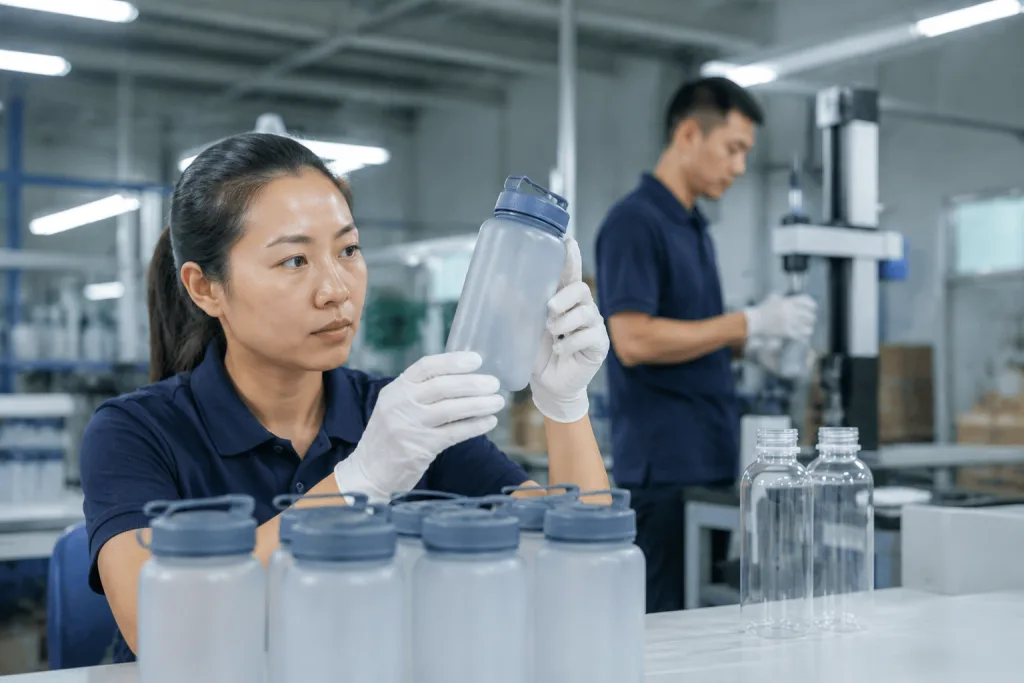
PP bottles usually fail on the small stuff: caps seep after 10 minutes, hinge pins whiten at the bend, mouth rims show 0.3 mm flash, logos rub off, and 5-ply cartons collapse on the bottom layer. We see it on the line. A canteen vendor should lock these risks before the first kilo of PP resin goes into the hopper.
For most B2B orders, we run AQL inspection with critical defects at 0, major defects at 2.5, and minor defects at 4.0. Critical defects include sharp plastic flash, contamination, wrong material, or clear safety problems. Major defects include leakage, cap misfit, incorrect logo, severe color mismatch, or damaged retail packaging. Minor defects include small scuffs, slight print offset within an approved tolerance, or carton mark issues. QC pulled one sample last May where the PO said “blue lid” but the artwork file showed black; catch that before packing, or the math doesn't work.
Ask for the leak test method in writing. Use plain steps: fill the bottle with room-temperature water, close the cap, invert for 30 minutes, then shake for 15 seconds. For outdoor customized canteen projects, a 1.0 m drop test on a filled bottle is fair, but name the surface, such as concrete tile or 18 mm plywood, and write the pass/fail rule. One controlled drop may leave scratches. That is not the same as cracking or leaking, and we have seen buyers reject good bottles over this wording.
Color control needs an approved physical sample, not just a Pantone code on a screen. PP resin shifts when the wall is translucent, matte, or glossy; a 2.5 mm wall can read warmer than the same color on a thin lid. For large orders above 30,000 units, keep one golden sample at the factory, one at your office, and one with the third-party inspector. Simple habit. It stops arguments when the final canteen distributor shipment is already sealed with 48 cartons per pallet.
Choosing the right factory model
A trading company, a canteen supplier that outsources assembly, and a direct canteen factory do not sell the same level of control. None is a dirty word. The wrong question is “factory or trader?” Ask whether the setup can handle your BOM, artwork, and inspection points without losing details between the PO and the line.
If you are buying 3,000 stock PP bottles with one-color printing, a solid canteen vendors network can work. We run orders like that with a 7-day sample target, 12 kg master cartons, and barcode labels checked against the buyer’s PDF before packing. You need fast sampling, clean carton marks, and shipment dates that do not move every Friday. If you are building a private customizable canteen line with custom cap tooling, calibrated colors, retail packaging, and repeat orders, stay closer to the molding machines and assembly benches.
Ask direct questions. How many injection molding machines are assigned to drinkware? What is the monthly output for PP bottles? Are gaskets produced in-house or purchased from a silicone shop 40 minutes away? Can the factory provide BSCI audit documents, ISO 9001 certificate, and food-contact test reports for the actual resin grade? Who signs off the pre-production sample? Last month QC pulled a sample because the PP cap thread was 0.4 mm loose after drop testing. A serious canteen manufacturer will talk through that kind of finding without acting offended.
For distributors, consistency beats a one-time low quote. Distributor canteen and distributor growler programs live or die on reorder control: cap fit within the same feel, carton size that still fits the pallet plan, barcode location that scans at receiving, and logo color that matches the approved PMS chip. We have seen this go sideways when a supplier changed a gasket vendor to save USD 0.03 per unit. The math does not work if the buyer rejects 18 cartons at warehouse intake.
Our Hangzhou, Zhejiang office works with export buyers who need PP bottles, stainless thermos items, travel tumblers, and occasional custom growler programs under one QC workflow. We ship mixed drinkware projects, but we still keep separate spec sheets for resin grade, lid torque, carton drop test, and logo position. China is still strong for this category. Factory discipline has to match the buying plan.
How to brief your supplier
A tight RFQ saves more time than another round of price squeezing. Ask canteen suppliers for a vendor polypropylene bottle quote with bottle capacity, use case, market, order quantity by color, delivery date, logo method, packing, compliance requirement, and Incoterm. Be blunt. If you want FOB Ningbo, write FOB Ningbo. If you need DDP to a US warehouse, write it as a separate line because our shipping desk prices ocean freight, duty, and UPS final delivery from 3 different sheets. Last month a PO came in with “FOB LA” typed on one page and “DDP Ohio” on the artwork sheet; the line waited 2 days while the buyer fixed it.
For example, a clean brief might say: 750 ml PP sports bottle, existing mold preferred, matte navy body, black flip cap, silicone gasket, one-color logo 60 x 35 mm, 10,000 units, 100 pieces per carton, EU food-contact test required, AQL 2.5/4.0 inspection, FOB Ningbo, ship before 20 May. That gives a canteen manufacturer enough to quote with fewer guesses. We run the wall-thickness check with a digital caliper at the first-shot stage, so even one missing detail, like whether the logo sits on a curved grip area, can change the pad-printing fixture cost.
If you are comparing custom canteen, custom drinkware, customized growler, and polypropylene bottle options in the same program, split them by material and production route. PP injection molding, stainless steel vacuum forming, and glass bottle production use different tooling, scrap rates, and QC points. A canteen customized from PP may be ready in 35 days, while a stainless custom growler with powder coating and laser logo may need 45-60 days. The buyer sometimes asks, “Can you just quote one blended price?” That is the wrong question to ask; the math does not work when one item needs an injection mold and the other goes through a vacuum test tank.
Keep negotiation practical. Push on excess packaging, color count, and carton cube before asking the factory to go below a sustainable molding price. A supplier who accepts an impossible price often takes it back through 0.2 mm thinner walls, cheaper gaskets, skipped inline checks, or lower shipping priority. We have seen this go sideways: QC pulled the sample, the cap passed the first leak test, then 6 cartons showed gasket deformation after 24 hours under stack pressure.
Send your PP bottle RFQ for a clean quote
Share quantity, colors, logo, packaging, and delivery market. We will return MOQ, FOB pricing, sample timing, and production lead time.
Frequently asked questions
What is a fair MOQ for a vendor polypropylene bottle order?
For an existing mold, 3,000 units is a fair starting MOQ if you accept standard colors and simple logo printing. For custom Pantone resin, many China factories prefer 5,000 units per color because color change creates purge waste and setup time. For a private mold, expect 10,000 units minimum for the first production run, plus tooling cost. If a canteen supplier offers 500 custom-color PP bottles at a very low price, check whether they are printing over stock bottles rather than molding your requested color.
How much should I budget per bottle FOB China?
A basic 500-750 ml PP bottle from a stock mold usually lands around USD 0.85-1.35 FOB China in B2B quantities. Add USD 0.05-0.12 for one-color silk screen, USD 0.18-0.45 for heat transfer artwork, and USD 0.08-0.45 for individual packaging. Larger canteen customized designs, heavier walls, straps, wide-mouth caps, or complex gaskets can push the price to USD 1.80-2.40. Lab testing, inspection, inland freight, ocean freight, duty, and warehouse delivery are separate unless your quote clearly states DDP.
Is polypropylene safe for food-contact drinkware?
Polypropylene is widely used for food-contact drinkware, but you still need proof for the actual material grade and colorant used in production. For Europe, ask for EU food-contact testing and REACH-related screening where relevant. For North America, request FDA food-contact material confirmation and any buyer-specific test protocol. Do not rely on a generic report from three years ago if the resin supplier, pigment, or gasket material has changed. For children’s bottle programs, add stricter physical checks such as sharp-edge review, bite resistance where applicable, and carton traceability.
Can I order one bottle shape with several brand designs?
Yes, but the economics depend on how you split the order. If you order 12,000 units in one body color with four printed logos at 3,000 units each, most canteen manufacturers can handle it. If you want four body colors, four cap colors, and four different retail boxes, the factory may price each combination as a separate SKU. That affects setup time, scrap allowance, barcode control, and inspection sampling. For distributor drinkware programs, keep the body and cap common when possible, then vary the logo or sleeve artwork.
How do I reduce lead time without increasing defect risk?
Use an existing mold, choose stock resin colors, approve artwork within 24 hours, and avoid custom retail packaging on the first run. That can keep a PP bottle project around 25-35 production days after deposit. Do not skip pre-production samples or final inspection to save time; that is usually false speed. If timing is tight, pay for faster sample courier service, pre-book inspection, and confirm carton marks early. For urgent orders above 20,000 units, ask the factory whether machine capacity is reserved before you send the deposit.