Key Takeaways
- Start RFQs with resin, capacity, cap type, packaging, logo method, and target FOB price within USD 0.70-2.40
- Approve one signed golden sample before opening molds or bulk production
- Use AQL 2.5 for major defects and AQL 4.0 for minor defects on bulk inspections
- Add carton marks, barcode files, spare parts, and testing clauses directly into the PO
A vendor plastic water bottle looks simple until you release a 20,000-piece PO and QC pulls a carton with the wrong cap resin, a 3 mm logo drift, or a retail barcode that won’t scan at the warehouse gate. We’ve seen this go sideways. Most buying mistakes start before sampling. The RFQ says “BPA-free bottle with logo,” the PO line item has no cap material or carton mark spec, and the supplier picks the cheapest option that still passes a quick visual check.
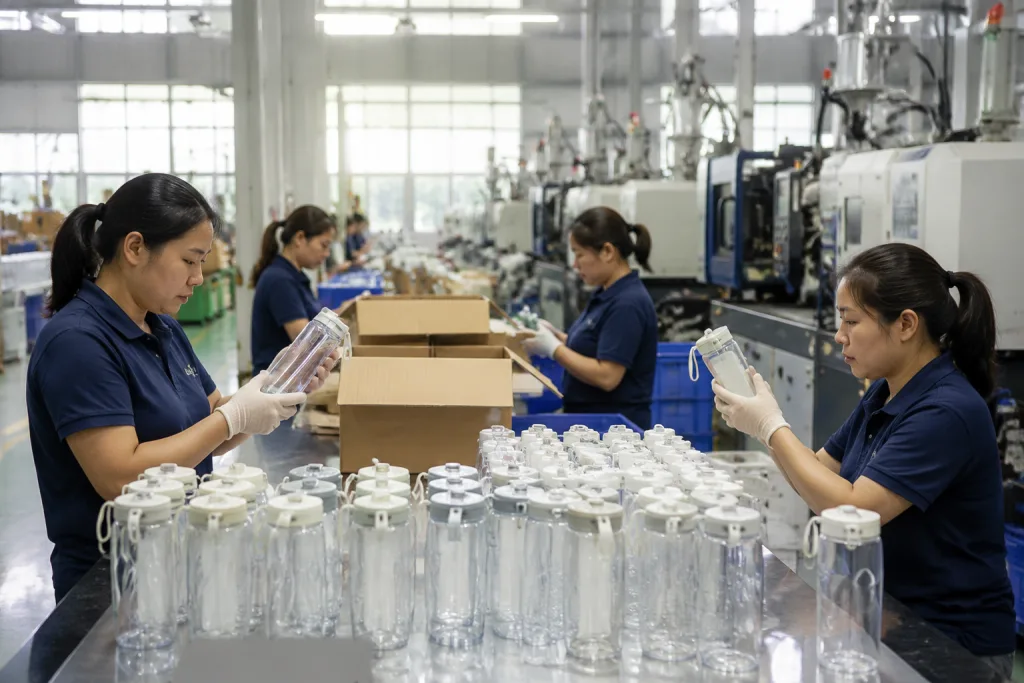
If you buy custom drinkware for retail, events, clubs, schools, or distributor programs, guessing is the wrong place to save time. Our Hangzhou, Zhejiang team runs plastic, stainless, and hybrid drinkware for Europe and North America, with plastic bottle MOQ from 3,000 pieces per color and normal production lead time of 25-35 days after approved sample. On the line, we confirm Pantone chips under a D65 light box and check logo position with a simple mm ruler before mass printing starts.
Start With The Buying Use
Before you ask a canteen supplier for a quote, decide where the bottle will be used and who owns the claim if something fails. This matters. A vendor plastic water bottle for a marathon giveaway is a different job from a retail bottle going into outdoor stores. For a giveaway, we run the line around low FOB cost, 1-color silkscreen, and 24-piece bulk packing. For retail, QC will pull the sample for cap torque, color ΔE, barcode scan, 1.2 m drop test, and a 5-layer carton that does not crush when the warehouse stacks 18 kg on top.
Your first sourcing note should read like a PO draft, not a mood board. Capacity: 500 ml, 650 ml, 750 ml, or 1 L, with fill line tolerance in mm if you need it. Material: PP for budget orders, PE for squeeze bottles, Tritan or PETG for clearer retail shelves, or recycled-content plastic only if your market and test lab accept the claim. Lid choice should be locked early: screw cap or flip cap for simple production, straw lid or push-pull cap when you accept more leak-risk checks, carabiner cap when the buyer cares about outdoor use. Logo and packing need the same discipline: silkscreen or pad print for low MOQ, heat transfer or sleeve for full-color artwork, bulk polybag or color box for normal export, display tray or Amazon-ready carton when carton marking and barcode position must pass inspection.
At BottleForge Industrial in Zhejiang, China, we see buyers lose 7-10 days because they send one JPG and ask for “best price.” The factory can quote it, but the math doesn’t work. The number will have too much padding because we do not know the resin grade, lid mold, carton size, or test market. A better RFQ states target quantity, delivery port, compliance market, and whether you need a canteen customized from an existing mold or a custom canteen with new tooling. Last month one buyer’s PO even said 750 ml in the item name and 700 ml in the spec table; QC flagged it before sampling, but it still burned 2 days.
Useful RFQ line items:
- Item: vendor plastic water bottle, 750 ml, PP body, flip cap, existing mold if possible
- Decoration: 1-color silkscreen, front center, 55 mm wide, Pantone code confirmed before film output
- Quantity: 5,000 / 10,000 / 20,000 pieces price tiers, with carton weight kept under 16 kg if your warehouse requires it
- Trade term: FOB Ningbo or FOB Shanghai, named port written exactly the same on the PO and carton marks
- Compliance: EU food contact, REACH, LFGB if required, or FDA for the US, with test sample pulled from mass production
Build A Quote That Compares
A quote from one canteen manufacturer can look cheaper because inner bags, stronger master cartons, Pantone matching, or lab testing sit outside the unit price. Another canteen vendor puts those lines in from day one and gets called expensive. Wrong comparison. We had a buyer flag USD 0.04 on the bottle price last March, then miss USD 680 in carton upgrades on the PO. Force every quote into the same rows before you argue over USD 0.03.
Ask every canteen supplier to quote the same PO structure: bottle cost, logo cost, mold or screen charge, sample fee, packaging cost, testing cost, spare cap cost, then estimated carton dimensions. For a standard 650 ml PP bottle, a practical FOB China range is often USD 0.75-1.35 at 10,000 pieces, depending on resin, lid complexity, print area, and packaging. Tritan-style materials or more complex lids can move into USD 1.60-2.80. If a quote is 25% below the rest, check material grade and wall thickness first; QC pulled one 650 ml sample at 0.92 mm when the buyer’s spec sheet said 1.3 mm.
For distributor drinkware orders, request price breaks that match how you sell. A canteen distributor serving schools may need 3,000 pieces per mascot color, with one logo screen and 12 spare caps per carton set. A distributor canteen program for national retail may need 50,000 pieces split across 4 colors. BottleForge runs plastic bottle programs at up to 450,000 units/month across partner molding and assembly lines in Zhejiang and nearby China supply clusters, but color splits need to land early so the line can buy resin in full lots instead of chasing 300 kg top-ups.
Quote comparison lines to request:
- Body resin and declared grade, not just “food grade plastic”; ask for the resin bag photo before sample approval
- Wall thickness target, such as 1.2-1.6 mm for 8 of our last 10 sports bottle projects
- Cap gasket material and replacement rate allowance, since silicone and TPE do not price the same
- Carton quantity, gross weight, and drop-test carton grade; our packing table checks this with a 1.2 m corner drop
- Lead time for sample, pilot run, and bulk production, with dates written as 12 days vs 18 days, not “fast”
This is also where you decide if the order is canteen promotional, retail shelf, or corporate uniform supply. The same bottle can be built to three cost levels, but pretending one BOM fits all channels is how programs go sideways. We run the quote beside the BOM and packing spec before PI, because one typo like “opp bag” instead of “PE bag” can change both price and retail compliance.
Turn Samples Into Evidence
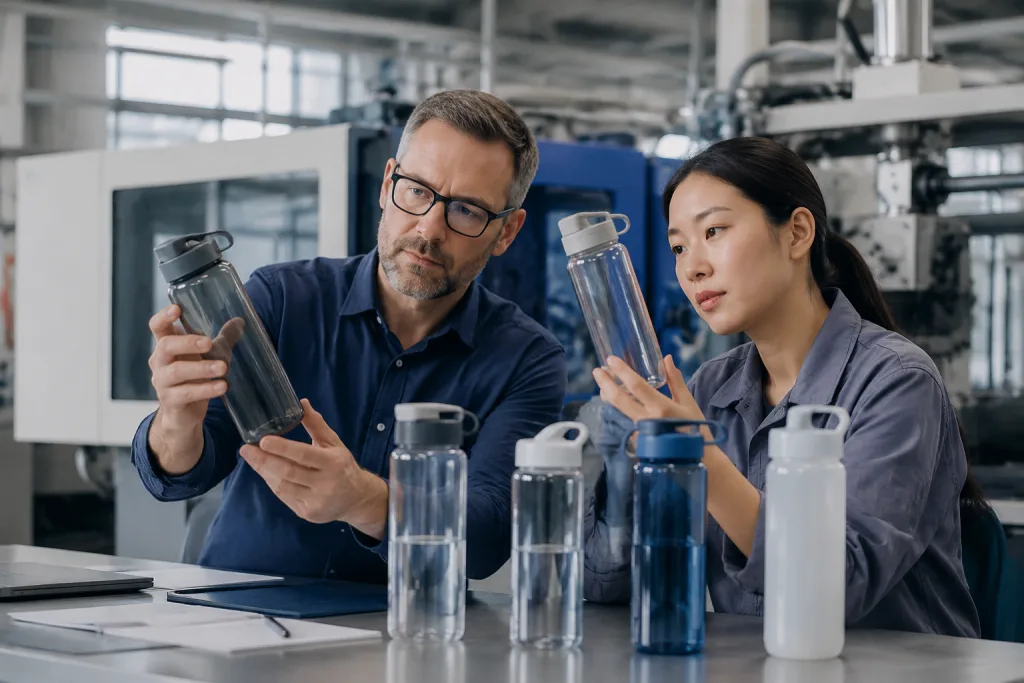
Sampling is not a beauty contest. It is where your RFQ turns into a controlled product. For a vendor plastic water bottle, approve construction, color, and decoration as separate checkpoints: wall thickness at the grip, Pantone match under the light box, and logo position measured with a caliper. If you approve only a photo, bulk production is still open to argument. We have seen this go sideways when QC pulled the sample and the printed logo sat 4 mm lower than the buyer’s PDF.
For stock-mold samples, a canteen manufacturer can usually ship an undecorated sample in 3-5 days and a printed sample in 7-10 days after artwork confirmation. If you need a canteen customizable shape with a new cap or new body mold, prototype timing can run 12-20 days for CNC or 25-35 days for trial mold work. Tooling for a simple plastic bottle body may start around USD 1,200-3,500, while a more complex cap set can cost more than the bottle body mold. The line needs the confirmed cap thread drawing before mold cutting; one missing 0.3 mm vent gap has cost buyers 9 days.
Your sample PO should not say only “sample bottle.” Say what the sample must prove. Is this a visual sample, function sample, color sample, pre-production sample, or golden sample? A golden sample must be signed or digitally locked with photos, dimensions, Pantone number, artwork file version, weight, and packaging method. Small detail, big difference. Last month a buyer wrote “blue” on the PO, while the artwork showed Pantone 286C; the buyer flagged it after DHL delivery, not before.
Sample PO line items:
- Sample type: pre-production vendor plastic water bottle
- Quantity: 5 pieces per color, 2 pieces with logo, 3 pieces blank
- Color: Pantone 286C body, white cap, tolerance Delta E under 2.0 if measured
- Logo: AI file v3, silkscreen, 55 mm width, position 35 mm below shoulder
- Tests: leak check for 24 hours, cap cycle check 300 openings, odor check after warm rinse
A serious canteen factory should push back if your artwork is too close to a curve, seam, or grip texture. That pushback saves money. We run a quick tape test and position check before printing; if the logo crosses the mold parting line by even 2 mm, the math doesn’t work for clean bulk output.
Write The Bulk PO Clearly
The bulk purchase order is where 6 out of 10 new buyers go too thin. A two-line PO protects nobody. If you buy from canteen suppliers in China, the PO needs to copy the approved sample details and attach controlled artwork, BOM, and packing files. Do not rely on WhatsApp screenshots. Sales changes shift, merchandisers take over, and the production manager on the line reads the PO before he reads your chat. We have seen this go sideways over a 0.5 mm straw length difference.
For a 10,000-piece customized drinkware order, your PO should state the item number and mold number, then lock the material grade, capacity tolerance, net weight target, color code, logo method, packing method, inspection standard, delivery term, payment term, and shipment deadline. If you are a canteen distributor, add the customer SKU and territory rules. If you sell online, add FNSKU or retail barcode rules before mass packing starts. QC pulled a sample last month with the right bottle and the wrong carton sticker because the PO missed one digit in the barcode. Re-labeling 10,000 cartons in Zhejiang can be done, but the math does not work.
Bulk PO line items that matter:
- Product: 750 ml vendor plastic water bottle, mold BF-PB750-04, matched to the signed golden sample
- Material: PP body, PE straw, silicone gasket, BPA-free declaration, with resin lot recorded before injection
- Quantity: 10,000 pieces, 5,000 blue and 5,000 black, +/- 3% shipment tolerance, packed by color
- Unit price: USD 1.18 FOB Ningbo, including 1-color logo and bulk polybag, no extra screen charge
- Inspection: AQL 2.5 major, AQL 4.0 minor, critical defects not accepted, checked at final carton stage
- Payment: 30% deposit, 70% before shipment after passed inspection, based on stamped PI and PO match
- Lead time: 30 days after deposit and golden sample approval, with print screen ready before day 7
For canteen manufacturers, this PO is not paperwork theater. It drives resin purchase, print screen setup, assembly headcount, carton booking, and the inspection slot. Clear PO language cuts the “I thought you meant” problem. The buyer flagged it once after mass production started; by then we had 42 cartons sealed with 48 mm tape and no clean fix left.
Control Decoration And Packaging
Most complaints on promotional plastic bottles do not come from the bottle body. They come from the logo sitting 8 mm too low, ink scratching after 30 rubs, a 12 kg carton corner crushing on the pallet, or a barcode failing the first scan at receiving. We treat decoration and packaging as a separate approval gate; skipping it is how we’ve seen a clean bottle order go sideways.
Silkscreen works for simple logos on smooth cylindrical areas, and we run it often on 500 ml and 750 ml sports bottles because the screen jig holds the print position within about 2 mm. Pad printing is better for smaller curved zones, such as caps or shoulder panels. Heat transfer gives cleaner multicolor artwork, but the bottle surface must be controlled or the edge lifts during tape pull. Sleeve labels look good on retail shelves, but they add tunnel setup, film waste, and shrink consistency risk. For a canteen promotional order under tight budget, one-color silkscreen is still the best cost-to-impact choice in most cases. For customizable drinkware sold in stores, buyers usually accept the extra charge for cleaner multicolor decoration and stronger cartons.
Ask your canteen vendor for a print adhesion test before bulk printing. QC pulled the sample, not the sales PDF. Common checks include 3M tape pull, 50-rub alcohol wipe depending on ink system, and dishwasher claims only if the item has actually been tested for that use. Do not print “dishwasher safe” because marketing likes the phrase; that label belongs on the bottle only after the correct test protocol is passed.
Packaging is specific work. Bulk export cartons for plastic bottles often use 5-ply corrugated board, with 24-60 pieces per carton depending on capacity and shape. We check carton size with a tape measure on the line because a 6 mm height mistake can break the pallet plan. If cartons will enter a distributor growler or distributor drinkware warehouse system, carton marks need PO number, SKU, color, quantity, gross weight, net weight, and country of origin. For North America retail, confirm UPC location and any FNSKU rules before packing; one buyer once flagged a PO typo where the SKU color said “blue” but the artwork file said “navy.”
Packaging PO lines:
- Each bottle in clear polybag, with destination warning text printed at the approved font size
- Master carton: 48 pieces, 5-ply export carton, drop-test target 76 cm, carton weight checked before sealing
- Carton marks: two long sides, black print, buyer SKU and PO number matched against the PO
- Spare parts: 1% extra caps packed separately if agreed, labeled so the warehouse does not count them as shortage
Inspect Before The Balance Payment
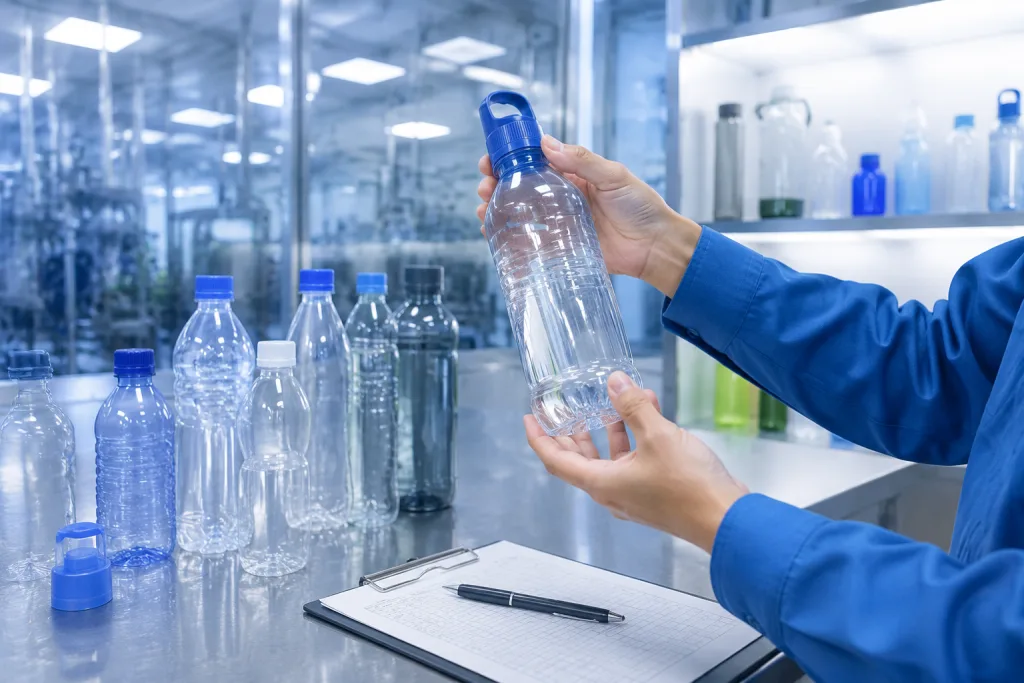
Inspect before you release the balance, not after the cartons land at your warehouse. For vendor plastic water bottle orders, we like inspection at 100% finished goods and at least 80% packed; on a 5,000 pcs run, that usually means 4,000 pcs already in export cartons with carton marks printed. Then the inspector can open sealed cartons with a cutter, pull random units from the line’s packing stack, and check the bottle, logo, polybag, barcode, carton mark, and packed quantity in one visit.
Use AQL, not “please check carefully.” That phrase causes trouble. A standard general inspection level II with AQL 2.5 for major defects and 4.0 for minor defects fits most B2B drinkware orders we ship. Critical defects, such as sharp plastic flash, severe leakage, wrong food-contact material, missing warning label, or contaminated product, should be zero tolerance. QC once pulled a sample with a 1.8 mm plastic burr near the spout; the buyer was right to block balance payment. If the order is for children, ask about ASTM, CPSIA, EN71, or destination-specific requirements; kids’ bottles are not just smaller adult bottles, and the math does not work if compliance is checked after packing.
A practical inspection checklist should cover capacity check, weight check, cap torque, leakage, odor, print position, print adhesion, color comparison against Pantone or sample, carton drop condition, barcode scan, and quantity count. Make each point measurable where you can: 750 ml fill line, 152 g bottle weight, 24-hour inverted leakage test, or 3M tape test on the logo. For custom growler, customized growler, or customizable growler programs using plastic components, add lid seal testing and handle load checks, such as 5 kg for 60 seconds. The same logic applies to a customized canteen or customizable canteen with straps, clips, or silicone sleeves; we have seen a strap pass visual inspection and fail when QC pulled it by hand twice.
At our China-side QC desk, we prefer buyers to define defect examples before production starts. Write “minor scratch under 5 mm on back side acceptable” instead of fighting over photos at 11 p.m. Hangzhou time. One buyer flagged a PO typo that said “matte black lid” while the approved sample had a glossy black lid; fixing that before mass production saved 3 days and one ugly argument. If you are working with several canteen vendors, use one inspection template across them. It makes factory performance visible and stops emotional debates about what “acceptable” means.
Plan Reorders Like A Program
The first order tells you if the bottle sells. The reorder tells you if the supply chain is under control. If you expect repeat business, we run your vendor plastic water bottle like a program, not a one-time PO that gets rebuilt from old emails.
Keep one spec sheet with mold number, resin grade, Pantone color, logo file, packaging artwork, carton size, test reports, golden sample photos, and approved defect limits. Our merchandiser normally locks this in a 12-column order file before the line opens, because one wrong Pantone code on a PO can turn into 30,000 caps in the wrong shade. This lets any canteen manufacturer repeat the order without asking basic questions again. It also gives your finance team a clean reason why a USD 1.22 bottle from last year moves to USD 1.30 when PP resin, exchange rate, or 5-layer carton board costs change.
Reorder planning needs spare parts too. Caps are the weak point in plastic drinkware programs. We have seen this go sideways when the buyer only reorders bottles, then asks for lids 9 months later after the color masterbatch has changed. If your distributor canteen customers sell replacement lids, put those lids on the same supply plan. A 2,000-piece cap reorder is simple while the mold is active and the same colorant is still in the warehouse. Waiting 18 months can push the MOQ up or leave you with visible color drift under a D65 light box.
For brand owners expanding into custom canteen, canteen custom, canteen customizable, or canteen customized lines, keep the family logic tight. The bottle and custom growler do not need matching bodies, but the cap colors, logo position, carton language, and compliance files should line up. QC pulled a sample last season where the 750 ml bottle had the logo 18 mm lower than the 1 L growler, and the buyer flagged it before shipment. Fair point. Distributors want fast replenishment, and canteen distributors want fewer calls from their key accounts. A good canteen supplier should protect both.
China stays strong for plastic drinkware because mold making, printing, carton supply, and export logistics are close to each other. Zhejiang adds speed because Ningbo and Shanghai ports are within normal trucking range from Hangzhou, usually same-day loading if the booking is clean. Use that advantage. Do not skip the boring controls: golden sample sign-off, AQL check, carton drop test, and a reorder file that the next merchandiser can read without guessing.
Send Your Bottle RFQ For A Practical Quote
Share capacity, material, quantity, logo file, and destination market. We will return pricing, MOQ, sample timing, and PO notes without guesswork.
Frequently asked questions
What MOQ should I expect for a vendor plastic water bottle?
For existing molds, a realistic MOQ is usually 3,000 pieces per color for a basic vendor plastic water bottle. Some canteen suppliers accept 1,000-2,000 pieces if the color is standard and the logo is simple, but the unit price will be higher. For custom-mold projects, expect 10,000-30,000 pieces to make tooling and setup cost sensible. At BottleForge Industrial in Zhejiang, we normally quote price tiers at 3,000, 5,000, 10,000, and 20,000 pieces so you can see where the cost breaks actually happen.
Which plastic is best for promotional water bottles?
It depends on the use and price target. PP is common for budget canteen promotional orders because it is light, affordable, and durable enough for giveaways. PE is flexible and often used for sports squeeze bottles. Tritan-type materials give better clarity and a more retail feel, but cost more. PETG can work for clear bottles, but heat resistance and market rules must be checked. For Europe, ask for food-contact documentation and REACH-related declarations. For the US, ask for FDA food-contact suitability and any state-level packaging or labeling requirements.
How long does sampling and bulk production take?
For a stock-mold plastic bottle, blank samples usually take 3-5 days, and printed samples take about 7-10 days after artwork approval. Bulk production normally takes 25-35 days after deposit and golden sample approval for 5,000-20,000 pieces. Custom tooling adds time: simple prototype work can take 12-20 days, while a production mold may need 25-45 days depending on complexity. Shipping is separate. Sea freight to Europe or North America can add roughly 25-45 days port-to-port.
What should be included in my plastic bottle PO?
Your PO should include mold number, capacity, resin, cap material, gasket material, color, Pantone reference, logo process, artwork version, unit price, quantity by color, packaging, carton marks, inspection standard, payment term, delivery term, and shipment deadline. Add barcode, FNSKU, warning labels, and country-of-origin marks if needed. For a 10,000-piece order, do not rely on email notes or chat screenshots. Put AQL 2.5 major and AQL 4.0 minor into the PO so the canteen factory knows how the shipment will be judged.
Can one supplier handle bottles, canteens, and growlers?
Yes, but check capability by material and process. A canteen manufacturer that is strong in molded plastic bottles may not automatically be strong in stainless custom growler production, and the reverse is also true. If you need customizable drinkware across plastic bottles, custom canteen items, and distributor growler lines, ask for factory audit documents, production photos, material test reports, and recent export examples. A practical supplier can coordinate plastic molding, stainless forming, printing, packaging, and QC under one project file, even when different workshops are involved.