Key Takeaways
- A realistic MOQ for a custom canteen starts at 1,000-3,000 pcs per color, depending on body shape and logo process
- 304 stainless steel at 0.45-0.55 mm wall thickness is the practical baseline for outdoor canteen durability
- Plan 35-55 days production after artwork approval for most canteen promotional and distributor drinkware orders
- Use AQL 2.5/4.0 inspections, REACH/FDA material checks, and carton drop tests before balance payment
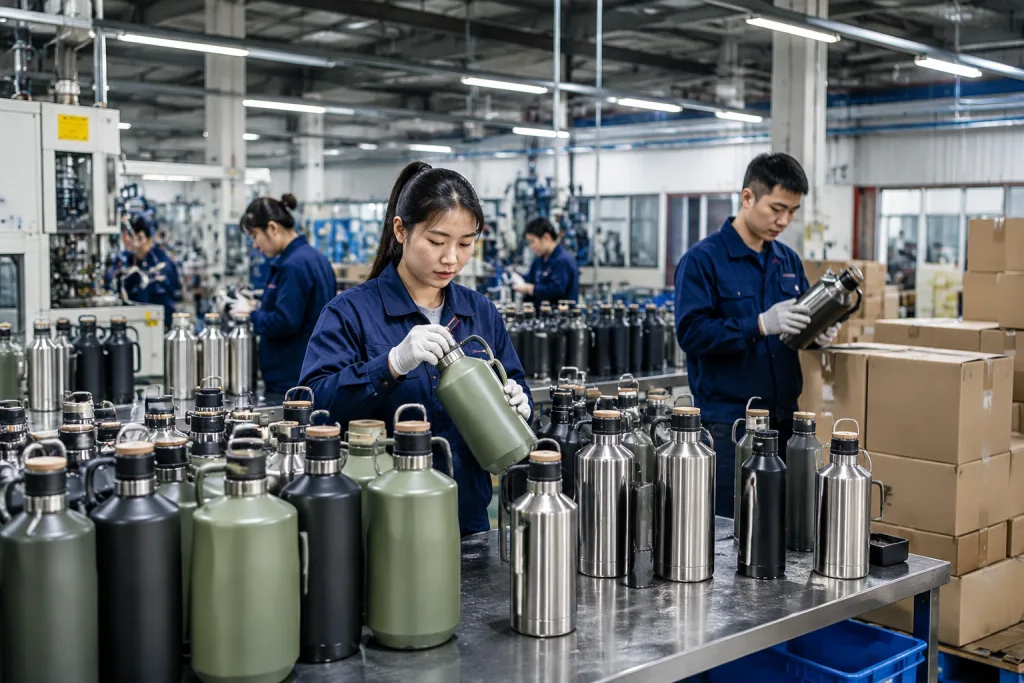
A vendor outdoor canteen looks simple until you have to buy 5,000 pieces for retail shelves, a promo kit, or distributor stock. Then the small choices start costing money: 0.45 mm vs 0.55 mm wall thickness, cap seal compression, coating cross-hatch result, logo method, 12 kg carton drop test, and whether the supplier can match the same Pantone color when you reorder 6 months later. We see this on the line.
We manufacture custom drinkware in Hangzhou, Zhejiang, and buyers in Europe and North America bring us the same issue about 8 times a month: the sample looks fine, but the PO says “blue bottle with logo” and skips the canteen customized spec. QC pulled one sample last season where the lid passed by hand, then leaked after 3 minutes on the vacuum leak tester. China sourcing works when you write the canteen like an industrial product, not a souvenir. The wrong question is “Can you make it?” The better question is “Can you repeat it after 5,000 pieces?”
Start With The Real Use Case
The first question is not “what is your cheapest canteen?” It is “where will the canteen be used, sold, and refilled?” A vendor outdoor canteen for a 3-day festival booth gets handled, dropped, and refilled at public taps. A distributor canteen for camping stores needs cleaner shelf fit, usually a 40 mm hang hole and no carton corner crush after transit testing. Different job. Different risk.
If you are selling through retail, you need a clean shelf presentation, barcode label, hang tag, and repeatable color, down to the powder coat chip on the approval board. If you are buying for a promotion, logo visibility and deadline control matter more than a premium cap; we have had buyers flag a 2 mm logo shift on a pre-production sample because the event photo wall was already booked. If you are a canteen distributor carrying stock, you need stable cartons and spare lids from the same thread gauge, plus a canteen manufacturer that can keep the same mold open for repeat orders.
For most outdoor programs, we ask buyers to define the buying case in four lines before price. This is the wrong question to ask first if your PO still says “outdoor bottle, black, logo” with no Pantone code. QC pulled one sample last month where matte black from line 2 and line 5 looked close indoors, then failed beside a window at 10:30 a.m.
- Channel: retail with barcode placement, promotional giveaway with event date, subscription box with tight carton size, Amazon FBA prep, wholesale replenishment, or field staff issue.
- Capacity: common sizes are 600 ml, 750 ml, 1 L, and 1.9 L for growler-style use.
- Material: 304 stainless steel for most markets, 316 stainless steel only when you have a real corrosion requirement, such as saltwater or acidic drink exposure.
- Branding: laser engraving for durable marks, silkscreen for simple colors, UV print for full artwork, powder coating for grip and color, embossing with mold cost, or retail packaging.
A canteen vendor should push you on these details. If a quote arrives with only “stainless steel canteen, logo, carton” you do not yet have a controlled quotation. You have a guess. In Zhejiang, China, our export team usually turns a loose inquiry into a spec sheet before pricing, including carton size, lid drawing, sample lead time, and MOQ. It feels slower on day one, but the math does not work when you are fixing a 10,000 pc mistake after production.
What Should The Spec Include
A custom canteen program needs a written spec both sides can check with tools. A sample photo is not enough. Photos do not show 304 stainless or 201 stainless, TIG weld condition, powder coating thickness from the coating gauge, gasket material, or whether the cap thread still feels clean after we run 500 open-close cycles on the bench.
For a standard stainless vendor outdoor canteen, ask the canteen factory to confirm body construction, steel grade, wall thickness, finish, lid material, gasket material, and packaging. We check wall thickness with a digital caliper before polishing, not after the line has already packed 3,000 pcs. A practical body wall thickness is 0.45-0.55 mm for single-wall stainless canteens and 0.40-0.50 mm inner wall plus 0.50-0.60 mm outer wall for vacuum insulated designs. Below that, dent rates rise in drop handling and outdoor use. Above that, the math does not work for most promotional orders because weight and FOB price climb fast.
For lids, PP is common and cost-effective. Tritan works for clear parts. Silicone gaskets should be food-grade and removable for cleaning; QC pulled samples last month where the gasket looked fine but stretched 2 mm after hot-water soaking. For North American and European orders, request FDA/LFGB or food-contact declarations where appropriate, plus REACH compliance for coating, printing ink, and plastic parts. If the item is for children, ASTM and CPSIA requirements may apply, even when the buyer calls it general outdoor drinkware on the PO.
Here is the checklist we like buyers to approve before sampling:
- Capacity tolerance, usually ±3% measured with water on a calibrated scale.
- Empty weight tolerance, usually ±5% for mass production, checked before final carton sealing.
- Leak test: inverted 30 minutes after filling with room-temperature water.
- Logo position tolerance, normally ±1.5 mm for screen print and ±1 mm for laser, measured from the front seam or handle centerline.
- Coating adhesion: cross-cut test with 3M tape, no major peeling.
- Carton strength: 5-ply export carton for 12-24 pcs, depending on unit weight and carton drop-test result.
Good canteen manufacturers will not push back on this. Weak canteen vendors often answer “no problem” but leave the numbers out of the PI or sample approval sheet. We have seen this go sideways: the buyer flagged a rough cap thread at final inspection, and the shipment sat 12 days while the line reworked lids by hand.
MOQ, Price, And Lead Time
Buyers ask MOQ first. Good habit. Cash is tight, forecasts move, and the wrong carton count ties up a season. MOQ is not one fixed number anyway. It shifts with the mold, coating color, logo method, packaging, and whether you want a canteen with a private cap or just a printed logo. On the line, a 1.0 mm cap change can stop a run for half a day, so the math is not the same for every spec.
For our Hangzhou, Zhejiang production network, a common MOQ is 1,000 pcs for laser logo on an existing stainless canteen, 2,000-3,000 pcs for custom powder coating, and 5,000 pcs or more for a new mold or private lid design. A custom growler or customizable growler with vacuum insulation may start at 1,500-3,000 pcs because the body setup is heavier and the reject rate is higher. We’ve seen buyers push for 500 pcs on a new lid and then flag the sample cost later. That question usually goes sideways.
FOB China pricing varies, but these are the numbers we use for early budgeting:
- Single-wall 750 ml stainless canteen: about USD 2.20-3.80 FOB, depending on finish and cap.
- Vacuum insulated 750 ml canteen: about USD 5.20-8.50 FOB.
- 1.9 L customized growler: about USD 8.80-14.50 FOB with powder coating and logo.
- Retail color box: add roughly USD 0.25-0.70 per unit.
- Laser engraving: often USD 0.08-0.25 per unit, depending on size.
Production lead time is normally 35-55 days after deposit, confirmed artwork, and approved pre-production sample. Peak season before summer outdoor campaigns can add 10-15 days. Our Zhejiang canteen factory partners can run around 300,000-500,000 stainless drinkware units per month across bottles, tumblers, canteens, and growlers, but capacity still needs booking. QC pulled a sample last week because the print sat 2 mm off center, and that is the kind of miss that eats a ship date. If you need an event date, work backward from delivery, not the PO date.

Logo And Finish Decisions
Canteen promotional orders usually go wrong because the logo call comes after the body color is already approved. We’ve seen this go sideways on a 3,000 pcs PO where the buyer typed “gloss army green” in one line and “scratch-resistant outdoor finish” in the next. The math doesn’t work. Branding changes MOQ, sample lead time, durability testing, and carton packing because high-gloss shells need PE bags or paper sleeves to stop rub marks during a 12 kg export carton drop.
Laser engraving is the safest choice for 304 stainless steel canteens. It does not peel, it runs clean on brushed steel and powder coating, and QC can check it with a 10x loupe in 20 seconds. The trade-off is color: laser gives a metal tone or dark marked effect, not a Pantone logo. Silkscreen costs less for one-color or two-color artwork, but the line needs a proper curved-body jig or the edge of the logo will creep 1-2 mm. UV print handles fine detail and multi-color artwork; still, ask for the scratch test result, not just a “dishwasher safe” line in the quote. We run a 3M tape pull and key rub sample before telling a buyer it is safe for outdoor use.
Powder coating is the standard finish when a canteen customizable in brand colors needs to match a campaign. Send a Pantone target, then expect an approximate match, often within Delta E 2-4 when the powder supplier controls the batch. A rough outdoor texture hides fingerprints and small scratches better than smooth gloss; QC pulled one glossy navy sample last month with rub marks before packing, and it never left Hangzhou. For retail shelves, matte black, olive green, sand, navy, and off-white keep moving better than seasonal colors that look good in a mood board but sit in stock after 90 days.
For a customized canteen, approve artwork at actual size. Not just a PDF. A 70 mm wide logo on a 750 ml canteen usually sits balanced between the shoulder and lower radius. A 110 mm logo can wrap too far around the curve, so the first letter looks fat and the last letter disappears from the front view. If you are building a distributor drinkware line, keep the logo zone consistent across canteen, bottle, tumbler, and custom growler SKUs; we usually mark the printable area with a caliper and a paper ruler before releasing the pre-production sample.
Practical rule: if the canteen must survive field use, choose laser or one-color screen print over complex full-wrap graphics.
Quality Checks Before Shipment
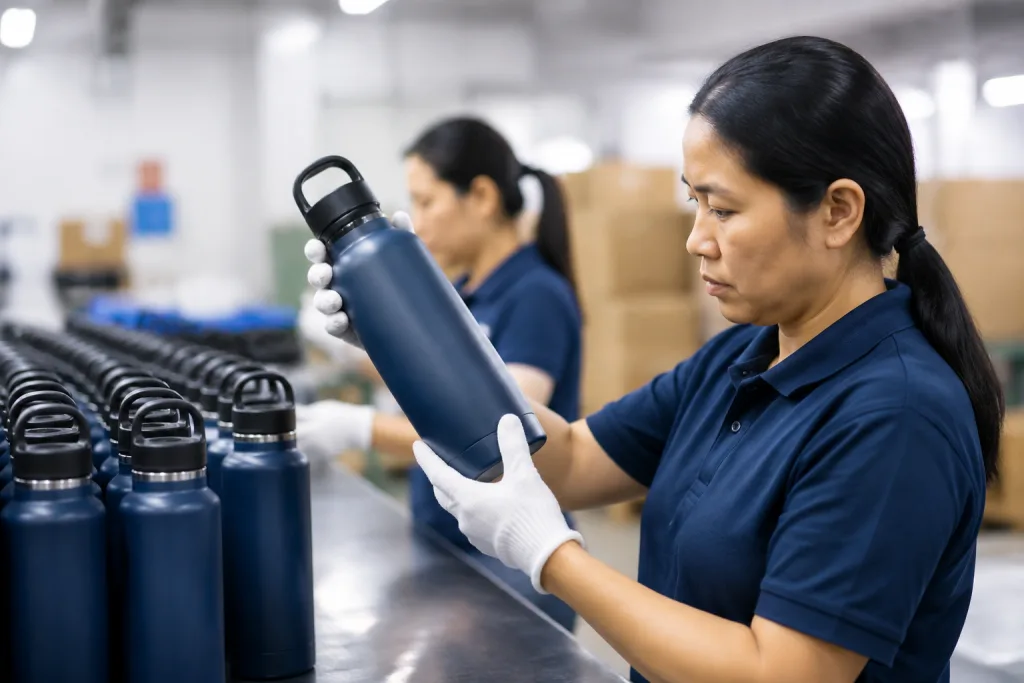
You do not need to inspect every unit. You do need a written inspection plan tied to the PO. For bulk orders, we run AQL standards on the QC table before the cartons are sealed. A common setup is AQL 2.5 for major defects and AQL 4.0 for minor defects. Critical defects get zero tolerance: leaking, sharp metal burrs, wrong material, mold contamination, or unsafe packaging staples. QC pulled one canteen last quarter with a 0.6 mm burr inside the mouth; the buyer was right to reject it.
For vendor outdoor canteen orders, inspect at three points when the quantity is significant: incoming material, in-line production, and final random inspection. Incoming checks catch wrong steel thickness and coating color before 3,000 pcs move down the line. In-line checks cover logo position, weld polishing, lid fit, and leakage; we usually use a 1.5 bar air-pressure jig for leak screening before packing. Final inspection checks packing, labels, cartons, and random functional testing. Skipping in-line inspection is the wrong question to ask if the logo is laser-marked 4 mm off center.
A useful final inspection checklist includes:
- Capacity test on 5-13 units depending on lot size, checked with a graduated cylinder, not a guess from the sales sample.
- Leak test on at least 20-32 units from random cartons, including upside-down storage for 30 minutes.
- Logo rub test using a dry cloth and alcohol wipe where relevant; the buyer flagged weak pad print after 15 rubs on one matte-black order.
- Cap thread test: open and close 20 cycles on random samples, then check for cross-threading by hand.
- Drop test: packed master carton dropped on 1 corner, 3 edges, and 6 faces from 76 cm for typical export cartons.
- Barcode, FNSKU, country-of-origin, and retail label verification, including typos like “Made in Chian” on a carton mark.
For Europe, keep REACH and food-contact documentation available. For the United States, confirm FDA food-contact suitability and any state-level labeling concerns if you sell into stricter retail channels. BSCI or ISO 9001 factory documentation also matters when your customer audits suppliers. A canteen supplier that already exports from China to Europe and North America should know these documents without you teaching them from scratch; if they ask what LFGB means during RFQ, the math doesn't work.
How To Compare Canteen Vendors
Compare price only after the spec matches. This is the wrong question to ask first. If one canteen supplier quotes 0.40 mm steel and another quotes 0.55 mm, the two prices are for different bodies; our micrometer will show that gap before the blank even reaches the press. If one quote includes a 5-ply carton, spare gasket, color box, and AQL inspection support while another is bulk polybag only, the “cheap” offer usually comes back as carton crush, cap complaints, or rework at the warehouse.
Ask each canteen supplier to fill the same quotation sheet. We run this with 18 lines on the sheet: body material, wall thickness, capacity, finish, lid structure, logo process, unit weight, carton size, gross weight, MOQ, sample time, mass production lead time, payment terms, FOB port, and tooling charges, plus packing photo and barcode position if retail is involved. Ningbo and Shanghai are common FOB ports for Zhejiang factories; some China suppliers quote Shenzhen or Xiamen because their plant sits closer to those ports, not because the freight is magically cheaper. The buyer flagged this once after a PO typo changed “FOB Ningbo” to “FOB Shanghai.” It cost 2 days.
Ask what happens after the first PO. Can the canteen manufacturer keep your artwork file under the same SKU name? Can they reserve the same powder color with a Delta E target, not just “army green”? Can they supply spare caps at 1-3% of order quantity? Can they repeat the SKU within 45 days? For canteen distributors, these answers matter more than cutting USD 0.06 from the first order. We have seen this go sideways when a second batch used a new cap mold and QC pulled the sample for a 0.8 mm thread mismatch.
Be careful with a canteen vendor who will not confirm material grade in writing or sends only showroom photos. Ask for a 30-second video of the production line, sample cartons, and previous export packing style, including the carton drop-test corner if they have it. For larger programs above 10,000 pcs, a live factory audit or third-party inspection is normal. A good canteen factory will not take that as an insult; we treat it as standard B2B purchasing, the same as checking AQL 2.5 findings before the balance payment.
PO Checklist For First Orders
Your purchase order should kill assumptions before they hit the line. A clean PO for customized drinkware needs more than item name, quantity, and price. We want the approved sample reference, revision date, drawing or spec sheet, artwork file name, Pantone color, packaging layout, carton mark, inspection standard, shipping term, and required documents. Last month QC pulled a 750 ml canteen sample because the PO said “black lid,” while the signed sample had a matte PP lid with a 1.8 mm silicone gasket. That one word cost 2 days.
For a first vendor outdoor canteen order, we run a controlled pre-production sample before mass production. Use the actual steel, finish, logo method, cap, gasket, and retail packaging where possible. If the pre-production sample is handmade or uses substitute parts, write that on the PO and require one mass-production line sample before full packing. This matters. We have seen a buyer approve a hand-polished sample, then flag the first 300 pcs from the line because the brushed finish looked 10% duller under the light box.
Payment terms vary, but 30% deposit and 70% balance before shipment is still common for custom drinkware from China. For established distributor drinkware customers, terms can improve after 3 repeat orders and a credit check. If the order involves tooling, the mold charge is normally paid before tool cutting. If you are working with a canteen manufacturer on an exclusive body, define who owns the tooling and how many years the factory must maintain it. Do not leave this to email memory; we have seen a mold ownership dispute start from one missing line on a PO.
Before you release balance payment, check these items:
- Final inspection report passed under agreed AQL level, with defect photos attached.
- Product photos match approved sample and artwork, including logo size in mm.
- Carton marks, FNSKU, UPC, and country-of-origin labels are correct.
- Packing list carton count matches booking data, down to the last carton.
- Food-contact and compliance documents are complete.
- Spare caps, gaskets, or replacement parts are packed if ordered.
This is basic work, not bureaucracy. It is how you turn canteen custom buying from a gamble into a repeatable supply chain. The wrong question is “can we skip this on the first order?” The math does not work when one carton mark error holds 86 cartons at the forwarder warehouse.
Send Your Canteen Spec For Factory Review
Share capacity, quantity, logo, finish, and target market. We will check feasibility, MOQ, FOB pricing, and lead time before sampling.
Frequently asked questions
What is the best MOQ for testing a custom canteen program?
For a first test, 1,000-2,000 pcs is usually practical if you use an existing mold and a simple laser or one-color logo. If you need powder coating in a custom Pantone color, expect 2,000-3,000 pcs because coating lines need setup volume. A fully canteen customized body, private cap, or new mold often starts at 5,000 pcs or more. If your sales forecast is uncertain, start with one capacity and two colors rather than four colors and three sizes.
Should I buy from a trading company or a canteen factory?
Both can work, but you should know what role each party plays. A direct canteen factory gives better technical control, faster engineering feedback, and clearer accountability on steel thickness, welding, and coating. A trading company may be useful if you need mixed SKUs from several canteen manufacturers. For orders above 3,000 pcs per SKU, ask for factory name, audit documents, production photos, and sample origin. If the canteen vendor cannot explain where production happens, treat the quote carefully.
Which material is safest for Europe and North America?
For most stainless custom drinkware, 304 stainless steel is the normal choice for the body and food-contact surfaces. It balances corrosion resistance, price, and availability. 316 stainless is better for harsh saltwater environments but often adds 8-15% cost and is not necessary for most outdoor canteen programs. Plastic lids should use food-grade PP or Tritan, and gaskets should be food-grade silicone. Ask for FDA, LFGB, or relevant food-contact declarations, plus REACH support for coatings and printed parts.
How long does canteen promotional production really take?
A realistic timeline is 7-12 days for pre-production sample preparation after artwork confirmation, then 35-55 days for mass production after sample approval and deposit. Add 3-7 days for final inspection, booking, and export paperwork. Ocean freight to North America or Europe may add 25-45 days depending on port and season. Air freight is faster but can destroy the margin on heavy stainless canteen or distributor growler orders. For event deadlines, start sourcing at least 90 days before delivery.
Can I use one supplier for canteens, bottles, tumblers, and growlers?
Yes, if the supplier has the right production network and quality system. Many buyers prefer one customizable drinkware supplier because artwork control, color standards, carton labels, and compliance files stay consistent. The risk is assuming every factory is good at every item. A strong canteen supplier may not automatically be the best glass bottle or kids bottle supplier. Ask for actual production history by category, monthly capacity, defect rate, and sample references. For distributor drinkware lines, consistency across SKUs is often worth more than the lowest unit price.