Key Takeaways
- Typical vendor military canteen MOQ is 1,000-3,000 units, with 25-35 day bulk lead time after sample approval
- 304 stainless steel costs more than aluminum but gives better dent resistance, taste neutrality, and REACH positioning
- Logo method changes unit cost by about USD 0.08-0.45 depending on silkscreen, laser engraving, or embossed cover patch
- Use AQL 2.5/4.0 inspection plus 100% leak testing before shipment, especially for distributor canteen orders
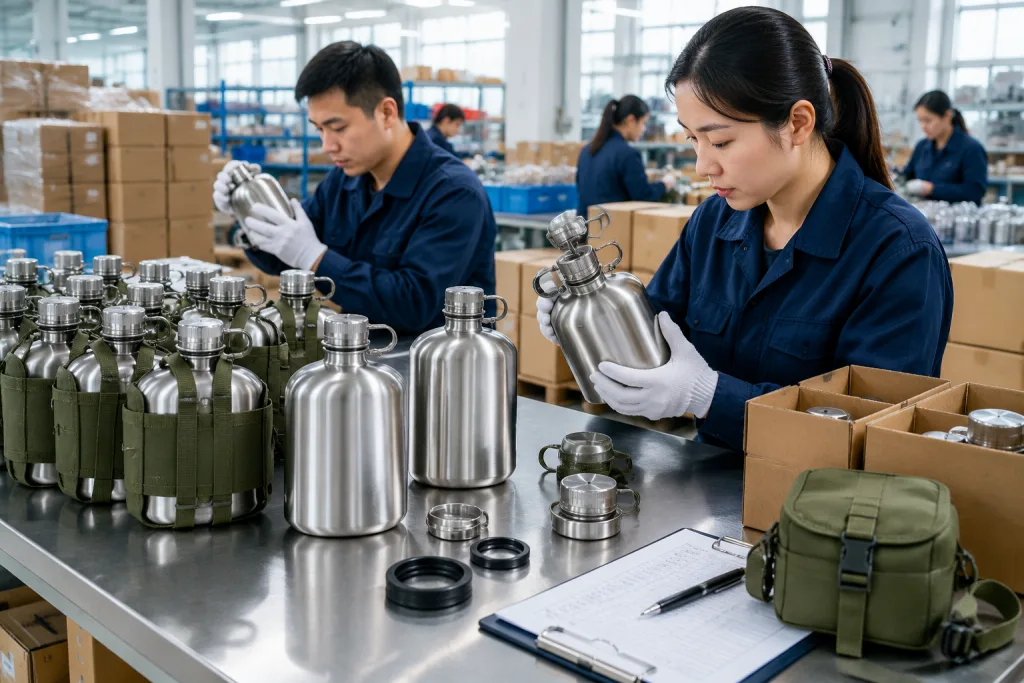
A vendor military canteen looks simple until a buyer asks us to quote 5,000 units for a distributor, outdoor brand, cadet program, or promo tender. Then the real questions hit the RFQ sheet: aluminum or 304 stainless, single-wall or double-wall, 600D nylon cover or bare bottle, laser logo or printed badge, LFGB or FDA, FOB Ningbo or delivered duty paid? QC pulled one pre-production sample last month because the cap chain gap measured 4.8 mm instead of the 3 mm spec. Small part. Big argument.
You do not need a perfect engineering drawing to start. You need a working checklist, because the wrong choice on coating, pouch fabric, cap mold, or carton packing can move cost by USD 0.20 to USD 1.50 per unit. BottleForge Industrial manufactures custom drinkware in Hangzhou, Zhejiang, China, and we run 300,000 drinkware units per month, with typical canteen MOQ from 1,000 to 3,000 pieces depending on tooling and decoration. We’ve seen this go sideways when a PO says “army green” but gives no Pantone code.
What are you really buying?
A request for a vendor military canteen is not specific enough for a factory quote. We see it split into 3 products on the line. One is the old kidney-shaped field canteen, usually 750 ml to 1.2 L, with a screw cap and sometimes a polyester or canvas cover. One is a military-style stainless bottle for retail outdoor shelves. One is a canteen promotional piece, where the buyer cares more about the silhouette than a 1.2 m drop test. Last month QC pulled a sample that looked correct in the photo, but the wall read 0.48 mm on the digital caliper, not the 0.6 mm written on the PO.
Before asking any canteen supplier for price, lock the use case. If the order is for cadet training, hiking clubs, or tactical merchandise, specify body thickness in mm, cap tether material, cover fabric weight, and the leak test standard, such as 30 minutes upside down after filling. If the order is a low-cost campaign giveaway, reduce thickness and use a plain white box. Those two orders should not share the same RFQ. We have seen this go sideways: the buyer asked for “army canteen,” then rejected the sample because the canvas cover felt too thin, even though no GSM was listed.
For export buyers in Europe and North America, we run canteen projects in 3 buying grades. This is the practical split our costing team uses before tooling, sampling, and carton size are checked:
- Promotional grade: 0.5-0.6 mm aluminum or 201 stainless steel, basic cap, simple box, target FOB China price around USD 1.80-3.20 depending on volume. MOQ usually starts near 3,000 pcs because the line loses time changing logo pads for smaller runs.
- Retail grade: 0.6-0.8 mm 304 stainless steel, better cap gasket, retail carton, barcode, target FOB around USD 3.50-6.80. The buyer normally asks for cleaner welding, tighter cap fit, and carton drop marks under 3 mm after transit testing.
- Program grade: customized cover, woven label, spare gasket option, drop and leak checks, target FOB often USD 5.50-9.50. We ship these with more inspection points, including cap torque checks and cover stitching review under AQL 2.5 if the buyer writes it into the QC file.
A serious canteen manufacturer will ask these questions early. If a canteen vendor quotes immediately without confirming capacity, material, decoration, and compliance market, treat the price as a placeholder, not a buying number. The math does not work when a quote ignores 304 stainless, LFGB testing, or a logo color that the artwork file calls “army green” but the PO spells as “amry green.”
Material choices buyers should challenge
The cheapest quote we see is usually aluminum, and aluminum is fine for a custom canteen if the buyer accepts the trade-off. We run most aluminum canteen samples from 0.5-0.7 mm sheet, checked with a digital thickness gauge at the trimming station. It forms fast and keeps the carton weight down; a 1,000 pcs promo order can save 18-26 kg in freight versus stainless. The weak points are dents, metallic taste complaints, and the inner coating. If the canteen will hold lemon water, sports drink, or vinegar-based drinks, this is the wrong place to chase the last USD 0.20. For North America, ask how the factory controls FDA food-contact requirements. For Europe, ask for LFGB or EU food-contact migration test options tied to the same coating batch used on the line.
304 stainless steel is the safer default for customized drinkware sold at retail or used more than a few times. A 0.6-0.8 mm 304 body feels solid in hand, resists odor, and gives the sales team a cleaner durability claim. QC pulled one 0.55 mm stainless sample last year because the buyer wanted “lighter,” then flagged side-wall flex after drop testing from 1.2 m. The math didn’t work. If your buyer asks for a premium customizable canteen, 304 stainless is usually worth the extra USD 0.60-1.40 per unit. 316 stainless can be made, but for most canteen projects it is wasted cost unless the brand needs a marine-use or heavy corrosion claim.
Plastic caps are not equal. PP is the common budget cap material, and we ship plenty of it. Tritan works for transparent parts, but it is rare on military-style canteens because buyers usually want a matte, solid-color look. Silicone gaskets should be food-grade, removable, and checked with a simple pull test; a loose gasket is how leak complaints start. For cap tethers, PE and nylon cord pack cleanly. Stainless chain has that old-school army look, but we’ve seen it go sideways when the chain rubbed powder coating inside a 50 pcs inner carton.
Here is the buyer question that matters: “What material grade will appear on the test report and invoice?” A vague reply like “food-grade metal” is not a spec. We had one PO arrive with “SS” typed in the material column, and the buyer only noticed after the proforma invoice was already stamped. A capable canteen factory in Zhejiang or elsewhere in China should write out 304, 201, aluminum grade, PP, silicone, coating type, and whether the test report covers the exact material used in mass production.
Customization that does not backfire
Canteen custom work sounds easy: print the logo and ship the cartons. That is the wrong question to ask. The first check is whether the process fits the coating, order size, and retail position. For powder-coated 304 stainless bodies, we run laser engraving on the fiber laser after checking the coating thickness with a film gauge; 70-90 μm powder usually engraves clean. It cuts down to bare metal, so the logo will not hit a Pantone chip. For a one-color unit logo, laser engraving usually adds USD 0.10-0.25 per piece and has low reject rates. QC pulled 32 samples from a 1,000 pcs trial last month, and only 1 had a weak edge on the star.
Silkscreen printing works when the buyer needs an exact logo color or a wide graphic wrap. Curves make trouble. On canteen bodies, our screen jig has to hold the body tight, or the artwork stretches near the shoulder. Thin lines below 0.25 mm may break, and registration across multiple colors can drift by 0.5-1.0 mm. If your canteen customized design has a badge, coordinates, slogan, and small legal text, a flat PDF is not enough. Ask for a curved-surface mockup and a pre-production sample. We have seen this go sideways: the buyer approved artwork on Monday, then flagged the 3 mm legal text after the line had already printed 600 pcs.
For covers, customization often carries the brand better than bottle printing. A polyester or nylon cover can take a woven label, rubber patch, embroidery, or silkscreen print, but each one has its own limit on stitch density and edge peeling. This suits customizable drinkware programs where the buyer wants a military look without changing the metal tooling. A woven label may add USD 0.08-0.18 per piece. A molded rubber patch can require USD 120-250 tooling and add USD 0.20-0.45 per piece. On the sewing line, we check label placement with a 1 mm ruler; if the patch sits 4 mm too low, the strap rubs it during packing.
If you also source a custom growler, customizable growler, or customized growler from the same supplier, do not assume decoration behaves the same. The math does not work. Growlers often have larger flat branding zones; canteens have tighter curves and more cap-cover interference. For a customized canteen, approve decoration after checking cap rotation, cover fit, and rub resistance. We ship assembled samples, not just bare bottles, because a logo that looks fine at the printing table may sit half-covered after the pouch is added. One PO even called the pouch “black,” while the artwork file said “OD green”; the buyer flagged it during sample review, not after mass production.
Factory questions before you pay
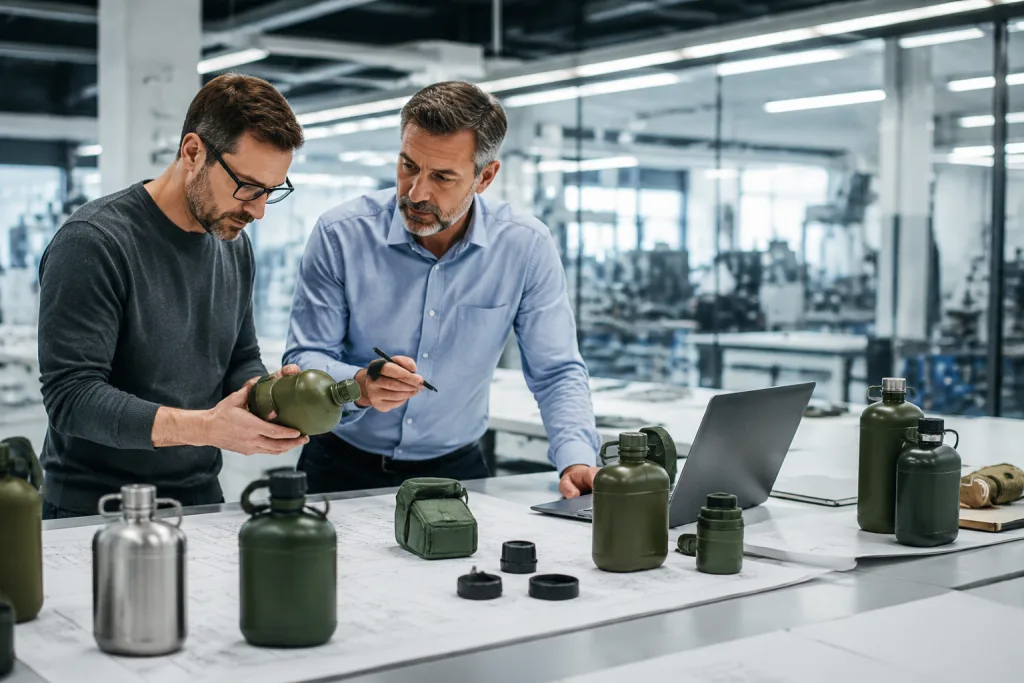
A procurement manager should question a canteen manufacturer the same way we question a custom drinkware line before opening a new PO. You are buying the bottle, yes, but you are also buying weld consistency, carton labels, export paperwork, and a supplier who answers at 8:40 p.m. when the buyer flags “120 cartons short” on the packing list. We’ve seen this go sideways.
Use this checklist before placing a deposit:
- Can the factory show canteen production photos from the last 12 months, with date stamps from the line, instead of catalog renders?
- What is the real MOQ for your exact version: bare bottle, printed bottle, covered bottle, or private mold? For example, 3,000 pcs may work for a printed bottle, while a new body mold can push the math past 10,000 pcs.
- What are sample charges and timing? A realistic custom sample is usually 7-12 days after artwork confirmation, and QC should pull the sample under a light box before it leaves.
- What is the bulk lead time after approval? At our Hangzhou, Zhejiang facility, standard lead time is 25-35 days for 3,000-20,000 units, assuming the PO color code is correct and the deposit lands on time.
- Which port is quoted? For Zhejiang factories, FOB Ningbo or FOB Shanghai are common, but Ningbo usually saves 1 day of inland trucking from our plant.
- Can they support BSCI, ISO 9001 process documents, REACH, LFGB, FDA, or California Prop 65 testing if required? Ask who pays the lab fee and whether the test uses the final coating, not a clean stock sample.
- Who owns tooling if a custom cap, cover patch, or body mold is developed? Get the mold number and storage terms written on the PI, not buried in a WeChat message.
You should also ask whether the quoted factory is the actual producer or a trading company. Trading companies are not automatically bad; some coordinate well. But if you are a distributor drinkware buyer managing repeat programs, direct factory communication cuts mistakes. A real canteen supplier should talk about gasket Shore A hardness, coating adhesion cross-cut results, weld marks, polishing grade, carton drop tests at 76 cm, and barcode placement. If they only repeat unit price, the math doesn't work for repeat orders.
For canteen vendors in China, the best signal is not a glossy catalog. It is whether they push back when your spec is risky. If your artwork line is 0.18 mm and you want silkscreen on a curved body, or your requested 15-day lead time would cut curing from 18 hours to 6 hours, you want the factory to say no early. QC pulled the sample for a reason.
Pricing and MOQ reality check
Most disputes around a vendor military canteen start with a price written too loose on the first RFQ. We see this every month. Buyers put 6 quotes in one Excel sheet, but the rows do not match material, wall thickness, cover spec, cap type, packaging, testing, or Incoterms. A USD 2.40 quote and a USD 4.20 quote can both be clean numbers if one is 0.5 mm aluminum in a bulk polybag and the other is 304 stainless steel with a stitched cover, color box, and final AQL 2.5 inspection. Last March, QC pulled the sample and found the “same” canteen had a 0.38 mm body, not the 0.5 mm shown on the buyer’s PO. The math changed fast.
For planning, we run these broad FOB China ranges before a firm quote goes to purchasing:
- 750 ml aluminum canteen, basic cap, one-color print: USD 1.80-3.00 at 5,000 pieces. Check whether the quote includes a PE bag or plain white box.
- 1 L 304 stainless canteen, powder coat, laser logo: USD 3.80-6.20 at 3,000 pieces. Color matching usually needs a sprayed panel before the line starts.
- 1 L stainless canteen with polyester cover and woven label: USD 4.80-7.80 at 3,000 pieces. The cover sewing allowance is usually checked at 2-3 mm.
- Private mold or unusual shape: tooling from USD 1,500-8,000 depending on mold complexity. We quote this only after a 2D drawing or sample lands on the engineer’s desk.
MOQ follows the bottleneck, not the buyer’s target price. This is the wrong question to ask if the spec is still moving. For a stock body with laser engraving, 1,000 pieces can work because the laser station can switch logos in minutes. For custom powder coating, 2,000-3,000 pieces is more realistic because the coating line loses powder during color changeover, and the first 80-120 pieces often get held back for color drift checks. For a custom cover fabric color, MOQ may come from the fabric mill, often 1,000-2,000 meters. For private molds, the commercial MOQ may be 5,000-10,000 pieces to spread tooling cost.
If you are a canteen distributor or work with multiple canteen distributors, build a price ladder at 1,000, 3,000, 5,000, and 10,000 units. Then you can quote your customer without pretending the 1,000-piece pilot has the same cost as a full container run. The same logic applies to distributor canteen and distributor growler programs. Freight matters too. A covered canteen may pack 24 pieces per carton, while a bare bottle may pack 48; on one EU order, the buyer flagged this only after the carton mark proof showed 62 cartons instead of 31. That packing difference can add more landed cost than the logo method.
Quality checks that catch failures
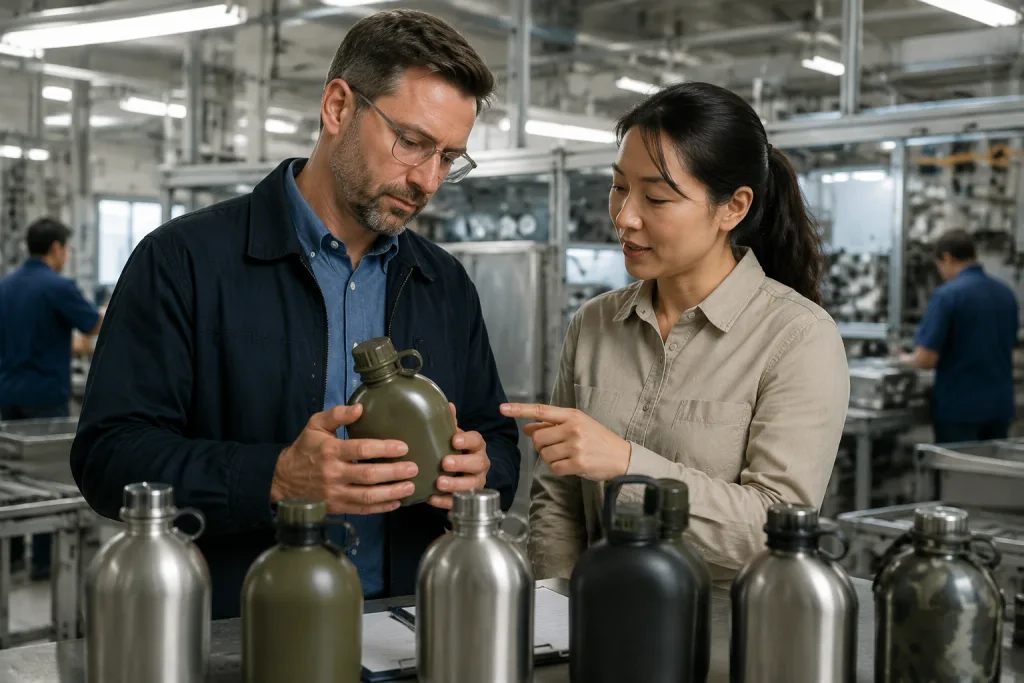
For canteens, QC is not a big theory job. It has to be run the same way at 9:00 a.m. and again at 8:30 p.m. after the line is tired. The 3 failures that cost buyers money are leakage at the cap, scratches through the coating, and decoration drifting off the approved position. We had one buyer flag a 4 mm logo shift on a 5,000 pcs olive-drab order because the retail card showed the canteen dead-center; that kind of miss gets expensive at Amazon FBA, retail stores, military-themed events, and distributor warehouses.
We use a written inspection plan with AQL 2.5 for major defects and AQL 4.0 for minor defects. Critical defects, such as sharp edges, contamination, or serious leakage, should be zero tolerance. No debate there. A practical factory process includes 100% leak testing after cap assembly; on our line, the operator flips each filled sample for 30 seconds and checks the gasket seat under a white LED bench light. For stainless steel canteens with powder coating, random salt spray or coating adhesion checks should be added. A cross-hatch adhesion test with a 1 mm cutter and 3M tape is simple, cheap, and it catches bad pretreatment before the buyer does.
Ask for these checks before shipment:
- Capacity check with tolerance, usually plus or minus 3% unless otherwise agreed; QC should record the actual ml reading, not just tick “pass.”
- Cap torque and gasket seating check after 20 open-close cycles, especially when the cap uses a tether or wide silicone ring.
- Carton drop test from 60-80 cm, especially for color box orders; corners crush first, so inspect the bottom layer after the drop.
- Logo position tolerance, such as plus or minus 2 mm from approved sample, measured with a clear ruler or caliper from a fixed seam point.
- Barcode, FNSKU, carton mark, and country-of-origin verification; one PO typo on “Made in China” can hold 120 cartons at the forwarder.
For canteen manufacturers, making the metal body is usually not the hardest part. Holding decoration and packaging consistency across 3,000 or 10,000 units is where we have seen this go sideways. If you require REACH, LFGB, FDA, ASTM-related packaging claims, or Prop 65 review, confirm testing before mass production. Pulling a random sample after production is the wrong question to ask; by then the cartons are sealed, the vessel is booked, and the math doesn't work.
A good canteen supplier in China should accept third-party inspection without drama. If a supplier pushes back on SGS, Intertek, Bureau Veritas, or your own QC agent, ask what they are worried QC will find. We ship goods that need to survive import, warehouse stacking, and customer use, not just look clean in 6 WeChat photos taken beside the packing table.
How to brief your supplier
The best RFQs are short, but they have all the parts the line needs. Don’t send 8 lifestyle photos and ask for “best price.” That quote will drift. Send a buying brief our production engineer can cost against a BOM. For a canteen customizable project, spell out capacity, material, wall thickness target, finish, logo method, cap requirement, cover spec, packaging, compliance market, order quantity, delivery term, and target ship date. We still see POs where “1L” appears in the email, “1000ml” appears on the artwork, and the carton mark says “32oz.” QC catches it, but it burns half a day.
A solid brief reads like this: “1 L 304 stainless military-style canteen, 0.7 mm body, matte olive powder coat, laser logo 50 x 35 mm, black PP cap with silicone gasket, polyester cover with woven label, individual kraft box, 3,000 and 5,000 piece pricing, FOB Ningbo, for EU market, need LFGB and REACH documentation.” Good enough. A serious canteen factory can quote that within 24-48 hours because purchasing can price the 304 sheet, the powder room can check the olive coating, and sample room can confirm whether the 50 x 35 mm logo fits the curved body without stretching.
If you are comparing canteen suppliers, make them use the same quote sheet. Ask each canteen vendor to list body material, cap material, gasket material, packaging, lead time, sample fee, mold fee, payment terms, inspection standard, and validity date. This is where cheap quotes hide. We’ve seen this go sideways when one supplier quoted a bare canteen, another included the cover, and the buyer only noticed after QC pulled the pre-shipment sample under AQL 2.5.
At BottleForge Industrial in Zhejiang, China, we like buyers who send the hard limits early: retail price target, launch date, compliance market, and whether the order repeats after the first 3,000 pieces. If your budget does not support 304 stainless plus a custom stitched cover, we will say it straight and price a simpler route, maybe stock cap tooling and a one-color cover label. The math has to work. Pretending every customized drinkware idea can hit every price point only creates late artwork changes, rushed samples, and awkward calls before shipment.
Send your canteen brief for a factory quote
Share capacity, material, logo, cover, packaging, market, and quantity. We will return practical options with MOQ, lead time, and FOB China pricing.
Frequently asked questions
What MOQ should I expect for a vendor military canteen?
For a stock-shape vendor military canteen with laser engraving, MOQ is often 1,000 pieces. If you need custom powder coating, silkscreen artwork, or a cover with woven label, plan for 2,000-3,000 pieces. Private mold projects usually start at 5,000-10,000 pieces because tooling can cost USD 1,500-8,000. The real MOQ depends on the bottleneck: metal body, coating color, fabric, cap, or packaging. If a supplier offers 100 pieces with full customization at a very low price, check whether they are using existing stock and manual decoration rather than factory production.
Is aluminum or stainless steel better for a custom canteen?
Aluminum is better when weight and price are the main priorities. A 750 ml aluminum custom canteen can sit around USD 1.80-3.00 FOB China at 5,000 pieces, depending on finish and logo. Stainless steel is better for retail, repeated use, and premium brand positioning. A 1 L 304 stainless version usually costs USD 3.80-6.20 before cover upgrades. For Europe and North America, stainless also gives cleaner food-contact messaging. Aluminum can work, but you should confirm coating, migration testing, and whether acidic beverages are excluded in the user instructions.
How long does sampling and bulk production take?
A plain reference sample can ship in 3-5 days if stock exists. A customized canteen sample with powder coating, laser engraving, or printed cover usually takes 7-12 days after artwork confirmation. Bulk production is commonly 25-35 days after sample approval and deposit for 3,000-20,000 pieces. Add 5-10 days if a special fabric, rubber patch, or private cap color is involved. For sea freight to North America or Europe, also add roughly 25-40 days on the water, depending on port and season.
Can one supplier handle canteens, tumblers, and growlers?
Yes, if the supplier is a real custom drinkware manufacturer rather than a narrow product trader. Many buyers combine a canteen, travel tumbler, sports bottle, and customized growler program to reduce supplier management. The advantage is shared artwork control, packaging standards, inspection routines, and export paperwork. The risk is assuming every product has the same MOQ and decoration behavior. A distributor growler may need different welding, insulation, and leak testing from a military-style canteen. Ask for separate spec sheets and AQL standards for each item.
What should a distributor check before approving shipment?
A canteen distributor should check function, appearance, packaging, and labeling before final payment. Require 100% leak testing at the factory and a random final inspection using AQL 2.5 for major defects and AQL 4.0 for minor defects. Check logo position within plus or minus 2 mm, carton marks, barcode or FNSKU labels, country-of-origin marking, and color consistency against the approved sample. For retail orders, open at least 20 color boxes during inspection to catch rubbing, missing inserts, or wrong labels. Do not rely only on production photos.