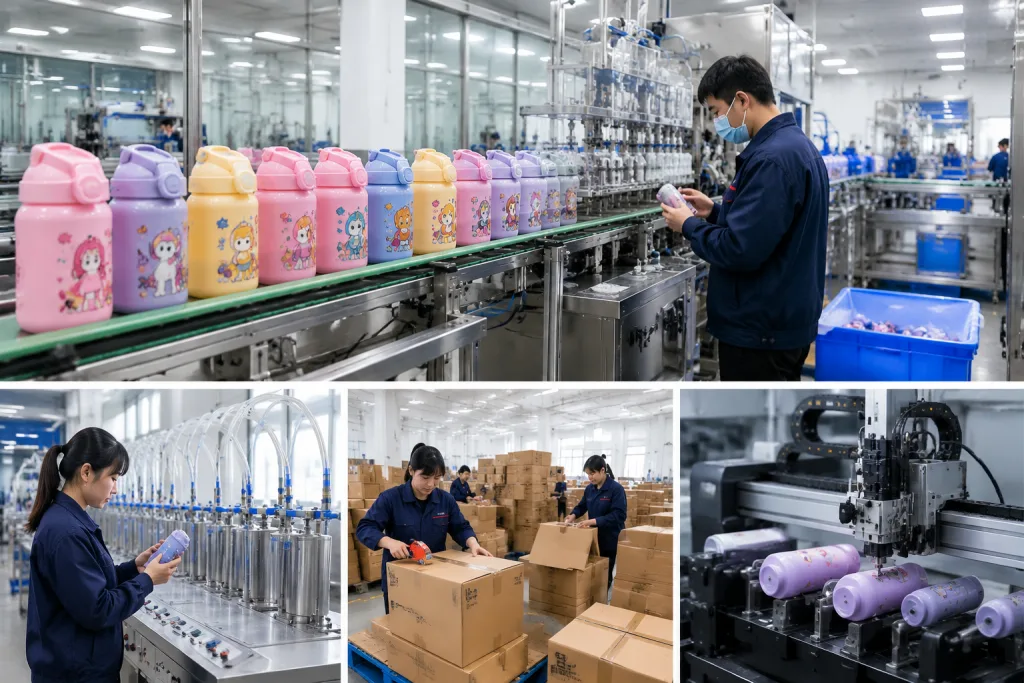
Key Takeaways
- A real vendor kids bottle decision starts with age group, lid type, and compliance, not color.
- For bulk children water bottle programs, Tritan and 304 stainless usually beat cheap PP on durability.
- A practical MOQ is often 3,000 pcs, with 30-45 day lead time from a children water bottle factory in China.
- A clean PO spec with AQL 2.5, REACH, and carton test requirements cuts dispute risk fast.
If you are buying a vendor kids bottle for a school district, retail chain, or import program, the bad orders usually fail in 3 places: backpack leaks, missed compliance, or decoration that looks tired after 1 dishwasher cycle. A shiny sample can hide all 3. QC pulled a straw-lid sample last month and found a 0.4 mm gap at the silicone plug after the drop test; the buyer only noticed after 2 cartons leaked in their office.
Decide like a buyer, not a sample collector. Start with age group and daily use, then test the lid, material, and print method against your target cost and return risk. In Zhejiang, we run this every season: buyers who freeze the spec before artwork approval usually save 7–12 days on tooling and avoid the “why did the color change?” call before shipment. We’ve seen this go sideways when the PO says 500 ml but the dieline reads 520 ml.
Choose the bottle around the child
Before you ask for a quote, pin down who will actually use the bottle. A bulk school water bottle for ages 5-8 is not the same build as a bulk kids water bottle for middle school or a retail children water bottle promotional item. Small hands need a 52-58 mm body grip, one-hand opening, and a lid that can take a drop on classroom tile. We run drop checks from 1.2 m on sample lids, and QC pulled 3 cracked flip caps last month on a cute design that looked fine in the render. Older kids usually care about 600 ml capacity, lower carry weight, and whether the bottle clears a backpack side pocket.
The key calls are capacity, drinking style, and cleaning access. For primary school, 400-500 ml is the safe range. For older children, 600-750 ml makes more sense. Straw lids control spills, but they add silicone tubes, bite valves, and one more place for parents to complain about mold. Flip lids are faster on the line and easier at school, but the hinge pin and seal groove need proper tooling. We check the seal with a 30-minute inverted leak test after assembly. If the bottle will sit in backpacks, lunch bags, and buses, leak resistance is not a slogan. It is the spec.
Buyers often ask for a children water bottle custom design before they settle the use case. This is the wrong question to ask first. Decide whether you need a bulk children water bottle for classroom use or a retail-ready children water bottle wholesale SKU, then lock the shape, lid, and artwork in that order. We have seen this go sideways: one PO said “kid bottle 500ml” but the artwork file was built for a 650 ml body, so the logo wrapped into the parting line by 7 mm. If you skip the order, the math doesn't work. You pay once for extra samples and again when returns start.
Pick the material with purpose
Material choice is where vendors oversell and buyers leave gaps on the spec sheet. For a custom kids bottle, we usually run 3 routes: Tritan, 304 stainless steel, or PP-based plastic. Tritan works when the buyer wants a clear body, lower weight, and a cleaner logo window; our line checks haze under the light box before packing. 304 stainless is the safer call for dent resistance and heat stability, especially when kids drop bottles from desks. PP fits a low-cost children water bottle bulk program, but if the product sits in-store and parents handle it, PP often feels cheaper in the hand.
Do not buy only on appearance. Ask for wall thickness, resin grade, and test documents before artwork approval. A decent Tritan body often sits around 2.0-3.0 mm depending on design; QC pulled one 2.6 mm sample last month because the shoulder dropped to 1.7 mm after blow molding. Stainless bottles should specify 18/8 or 304 material, and the gauge needs to stay steady enough to avoid dents under carton pressure. If you need a custom made kids bottle for school programs, put chemical and migration compliance first: REACH for Europe, FDA food-contact declarations for the US, plus ISO 9001 and traceable incoming inspection if you want a cleaner factory file.
Be realistic about price bands. A simple PP children water bottle supplier quote may start near USD 1.20-1.80 FOB at larger volumes, often with MOQ 3,000 pcs per color. Tritan often moves into the USD 2.20-3.80 range depending on lid complexity and print; the buyer flagged it last week when a 4-color wrap added USD 0.18. Stainless with insulated construction can climb above USD 4.50 quickly. Chasing stainless at a PP shelf price is the wrong question to ask. The math does not work, and the bottle gets squeezed on lid fit, carton strength, or inspection time.
Lids decide whether buyers complain
Want fewer complaints? Start with the lid, not the bottle body. A solid lid turns a custom school water bottle into something kids use for the whole semester; a weak one gets parked in a desk tray after 10 school days. In our Hangzhou line, QC pulled 32 lid samples last month and found 3 slow leaks caused by a gasket sitting 0.4 mm off-center. Leakage almost never comes from one “bad cap.” It comes from gasket shape, tolerance stack-up, hand assembly pressure, or a cap nobody opened and closed 500 times before quoting.
For school and daycare orders, we run two lid types most often: straw lids with a real lock, and flip-top lids with a silicone seal that sits cleanly in the groove. Screw tops look cheaper on the PI, but 5-year-olds do not tighten them like adults; we have seen this go sideways on repeat orders. Sippy-style lids fit younger children, but they add 2-3 small parts and slow down cleaning. If your program needs a bulk school water bottle with fewer returns, ask the vendor for a 50-cycle opening test, then an upside-down leak test at room temperature and again after a hot-water fill. QC should record it, not just say “no problem.”
Ask for the parts count. This is where the math doesn't work on over-designed lids. A lid with 4-5 components is easier to control than one with 8-10, especially when the order moves from a 1,000 pc children water bottle distributor trial to a 60,000 pc school rollout. On one PO, the buyer flagged “soft straw” in the artwork note, but the factory read it as “soft spout” and quoted the wrong mold insert. Small wording, big delay. If the factory cannot explain the seal material, spring mechanism, or latch life in plain language, it is not just a design issue. It is a warning sign.
Print and branding that survive use
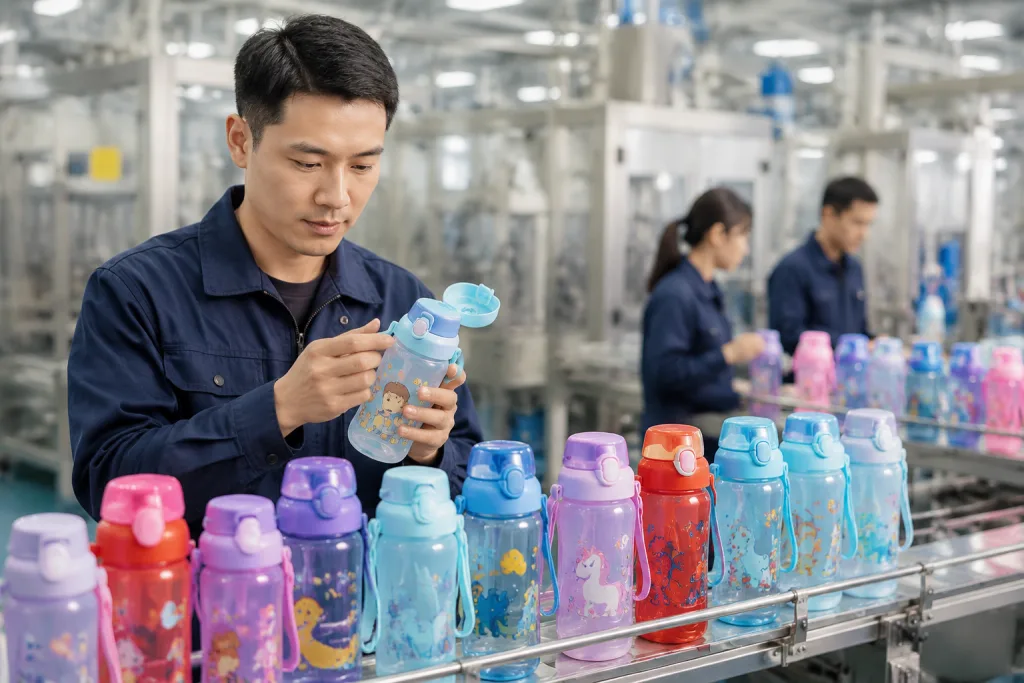
Branding on a kids bottle is not decoration for the sake of it. It affects the PO. Schools, distributors, and retail buyers want the logo readable after 30 dishwasher cycles and a week of backpack rub against zippers. If you need a custom logo kids bottle, pick the print method from the surface finish first, then from the wear test; QC pulled 12 samples last month where the artwork passed on glossy PP but failed on a powder-coated 304 stainless body.
Silkscreen keeps the cost down for 1-color or 2-color logos, especially on a matte straight-wall body with a 45 mm by 70 mm print window. Heat transfer handles cartoon artwork and gradient school mascots, but we run a 3M tape pull and 60°C wash check before mass production. Laser engraving works well on stainless steel and gives a permanent mark. It is the wrong choice for bright classroom artwork. For a children water bottle customizable line, buyers usually also ask for Pantone spot color matching, private label packaging, and barcode placement, but the math gets tight under 1,000 pcs per SKU.
For e-commerce and retail, look past the logo. A children water bottle customized for Amazon-style programs needs an FNSKU label zone, polybag warning text, and carton marks that do not rub off during fulfillment. We ship cartons with 2-side marks because warehouse teams still stack them wrong. If you are building a children water bottle custom assortment for a chain or school district, ask for a printable area map in millimeters before artwork starts; one buyer flagged a mascot face stretched 4 mm wider after it wrapped around a curved 350 ml body. Mockups lie sometimes.
Price, MOQ, and lead time reality
Good buyers do not start with “give me your best price.” Wrong question. They ask what is sitting inside the price. A serious children water bottle manufacturer will quote one way for an open stock mold with 1-color silk screen, and another way for a new PP lid, 4-color heat-transfer print, color box, and LFGB test. For a standard program, an MOQ of 3,000 pcs is common for a custom run from a children water bottle factory in China, though a simple stock mold sometimes starts at 1,000 pcs if the color is already on the line. In Zhejiang, we also run school orders at 10,000-50,000 pcs with split delivery; last month QC pulled a lid sample because the silicone straw was 1.5 mm short against the approved drawing.
Lead time can hurt more than price. For a custom order, expect 30-45 days after sample approval if the mold is ready and packaging is simple. Add 7-15 days if you need new tooling, special cartons, or third-party lab work. A factory with 120,000 units per month of capacity can still miss your ship date if print files and packaging stay open; we have seen a PO typo on Pantone 2975C vs 297C cost 6 days before mass printing. Lock the artwork early. Experienced buyers ask for weekly production photos, pre-shipment AQL inspection reports, and carton drop-test results before booking freight.
On trade terms, FOB Ningbo or FOB Shanghai is standard for most buyers in Europe and North America. If the vendor pushes vague landed pricing without itemized costs, keep digging. The math does not work unless you can see each line. A transparent children water bottle supplier should separate bottle cost, packaging, test fees, and freight assumptions; our export desk usually breaks this into 4 rows because buyers often flag carton CBM and inland trucking first. That is the only way to compare a children water bottle vendor against other children water bottle vendors without getting trapped by half-built quotes.
Write the spec before the sample
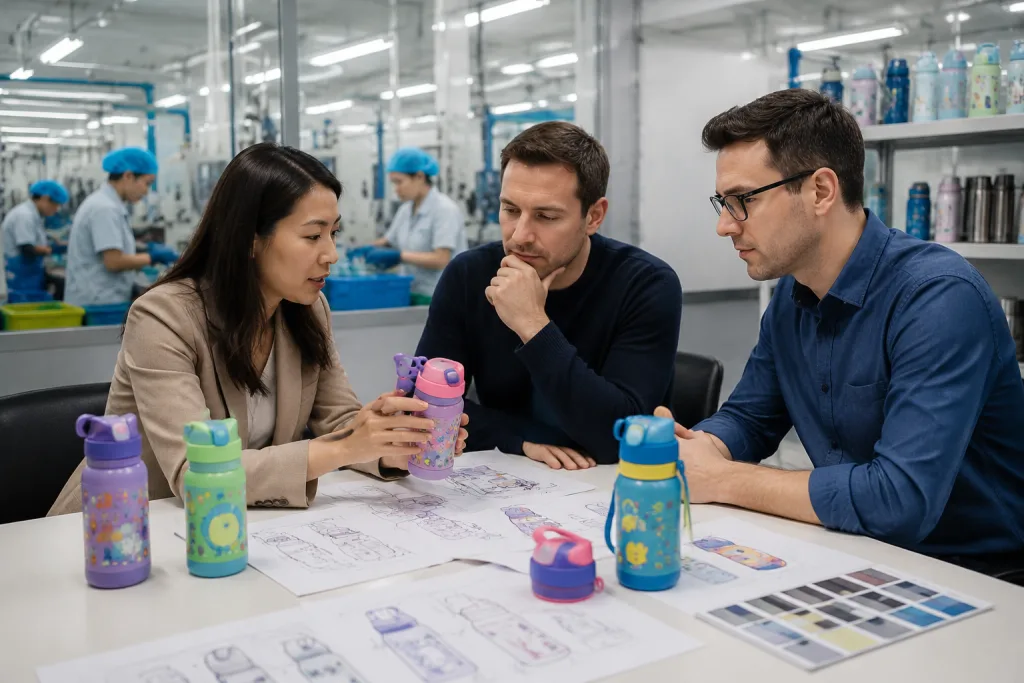
The cleanest way to start a sourcing job is to write the spec sheet before anyone cuts a sample. No shortcuts. A good spec turns “cute school bottle” into dimensions the line can build and QC can check with a caliper. For a custom children water bottle program, state capacity in ml, body material, lid type, gasket material, print method, Pantone color code, carton pack, and compliance target. Last month we got a PO that said “blue lid” with no Pantone; the sample came back 2925C, while the buyer expected 299C. That mistake cost 6 sample days.
Use simple, strict wording: material must be food-contact grade, printing must pass 50 rubbing cycles, cartons must pass drop test, and finished goods should be inspected at AQL 2.5 for major defects unless your program demands tighter controls. If the bottle is for school distribution, specify odor-free interior, no sharp edges, and no paint flaking after washing. QC pulled the sample after washing at 60°C for 30 minutes because the straw cap edge measured 0.4 mm burr height. Too sharp for kids. If you are buying from a children water bottle manufacturers shortlist in China, ask for the factory audit status, whether they hold BSCI or equivalent social compliance documentation, and how they manage traceability by batch.
A disciplined brief also helps you compare a children water bottle distributor offer with a direct factory quote. Distributors work when you need 3 mixed SKUs fast, but this is the wrong question to ask if your order is 5,000 pcs with custom print and retail packaging. A direct children water bottle manufacturer in Zhejiang usually gives tighter control on decoration, packaging, and lead time when the volume justifies the line setup. We ship better when the buyer sends artwork, carton marks, barcode size, and inspection level in one file. The vendor that answers your spec in plain numbers is usually the one worth keeping.
Send your kids bottle spec for a fast quote
We can quote your bulk children water bottle project with material, print, and packaging options in plain numbers, no guesswork.
Frequently asked questions
What MOQ should I expect for a vendor kids bottle order?
For a custom order, 3,000 pcs is a realistic MOQ for many factories, especially in China and Zhejiang. Simple stock-mold bottles may go lower, but once you add a new logo, custom color, or special lid, 3,000 pcs is a normal planning number. If you want mixed SKUs, the MOQ may rise because each color or print setup adds labor and setup cost. For a school district or importer, it is better to negotiate one clean spec than split into too many variants.
Which material is best for bulk kids bottle programs?
For a bulk kids bottle program, Tritan and 304 stainless are usually the most practical choices. Tritan works well when you want a clear body and lighter weight. 304 stainless is better when you want a tougher premium feel. PP can be acceptable for lower-cost bulk children water bottle projects, but it is not as strong in perceived value. If you are selling into Europe or North America, ask for REACH and food-contact documents before approving the material.
How do I reduce leak complaints from schools?
Start with lid design, not packaging. Ask the vendor to run upside-down leak tests, 50-cycle open-close tests, and seal checks after hot water filling. A good school bottle usually needs a silicone gasket, consistent thread tolerance, and a lid that a child can close without over-torquing. For a bulk school water bottle, a straw lid with a lock or a well-built flip-top usually performs better than a simple screw cap in daily use.
Can I get custom logo kids bottle printing on short lead time?
Yes, if the mold is ready and the artwork is simple. A standard custom logo kids bottle order can often ship in 30-45 days after sample approval. Silkscreen is fastest for one- or two-color logos. If you need laser engraving, special packaging, or multiple print positions, add time. For tight retail or school deadlines, lock the design before production and approve a digital proof in millimeters, not just a rendered mockup.
What documents should a children water bottle manufacturer provide?
At minimum, ask for food-contact declarations, material specs, a packing list, commercial invoice, and an inspection plan. For Europe, REACH and related conformity documents matter. For quality control, ask for AQL inspection reports, carton drop-test results, and batch traceability. If you work with a children water bottle manufacturer in China, also confirm business license details, factory audit records such as BSCI if applicable, and whether the production line has stable monthly output.