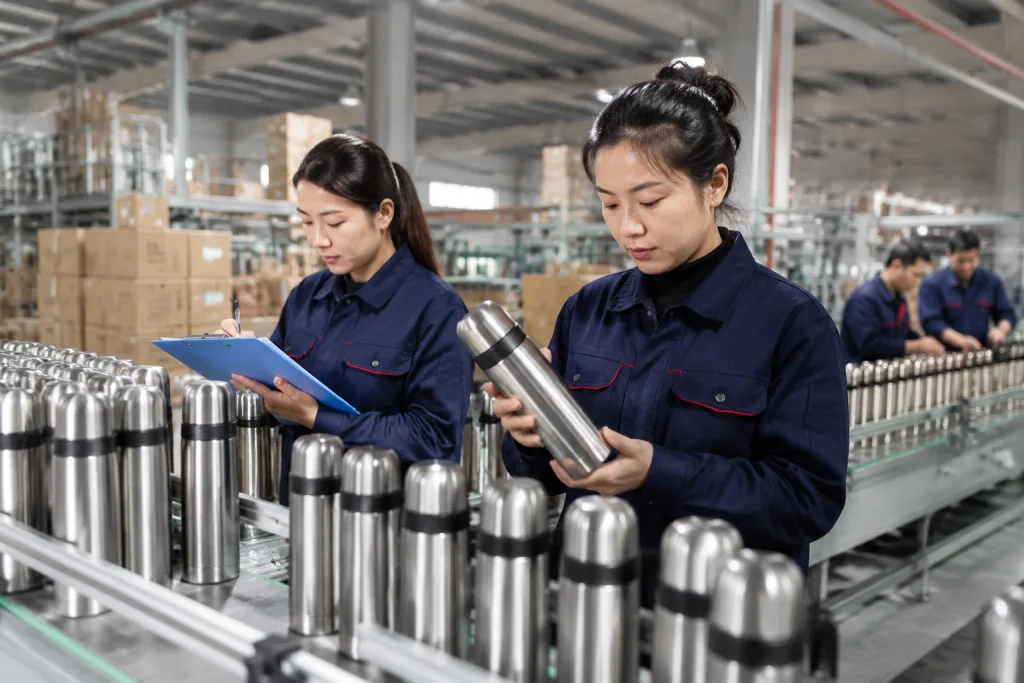
Key Takeaways
- A practical MOQ for custom stainless thermos orders is usually 500-3,000 pieces per SKU
- FOB China pricing for common 500-750 ml vacuum bottles often sits around USD 3.80-8.50
- Logo-ready samples usually take 7-12 days; mass production typically takes 25-40 days after approval
- AQL inspection, REACH/LFGB checks, and carton drop tests should be budgeted before shipment
If you are buying a vendor insulated water bottle for an outdoor retail line or a promo drop, finding a stainless thermos is the easy part. The harder call is whether a USD 4.20 quote leaves room for 304 stainless, a clean powder coat, and a cap that passes a 30-minute leak test. A 1,000-piece MOQ can work. It can also bite you if the buyer changes the logo size from 38 mm to 42 mm after the laser jig is made, which we’ve seen go sideways on the line.
At our Hangzhou, Zhejiang factory, we quote 15 to 25 custom thermos projects most weeks for Europe and North America. A bulk order is not one price and one ship date. We run it through steel grade, vacuum hold, lid tooling, coating thickness, logo method, inner box artwork, compliance files, and China shipping terms; QC pulled a sample last month where the PO said “matte black” but the carton mark still showed “black glossy.” Small typo. Big delay.
Start with the real landed cost
A vendor insulated water bottle quote usually lands on your desk as FOB Ningbo or FOB Shanghai, not the cost into your warehouse door. Big difference. If you compare only the unit price, the wrong supplier thermos wins on paper while hiding a thin K=A carton, a 14-day sample delay, or a cap upgrade we already know adds USD 0.35. We had one buyer flag a USD 0.18 carton gap after QC pulled the drop-test sample from a 1.2 m bench.
For a standard 500 ml to 750 ml double-wall stainless steel bottle, we see FOB China pricing fall into these working ranges on the line:
- Basic promotional thermos: USD 3.80-5.20, 201 outer shell, 304 inner wall, simple screw lid, one-color logo. Usually packed 50 pcs per master carton, with a 0.32 mm shell that our thickness gauge checks before polishing.
- Retail outdoor bottle: USD 5.20-7.50, 304 stainless steel inside and outside, powder coating, stronger cap seal, retail box. The buyer usually asks for a 6-hour heat test sheet and a lid torque check around 8-10 kgf.cm.
- Premium custom thermos: USD 7.50-11.80, special lid tooling, copper lining, handle cap, silicone boot, color box, tighter finish control. Here we run extra visual sorting under the LED inspection lamp because tiny coating pinholes get expensive once Amazon photos go live.
Those figures assume a normal order between 1,000 and 5,000 units per design. Ask a thermos manufacturer in Zhejiang for 300 pieces with six colors, and the math does not work. Coating line setup, logo screen setup, carton printing, and QC time barely move whether we make 300 or 3,000 pieces. On our powder line, changing from matte black to cream white can burn 45 minutes before the first good bottle comes off.
Add non-product costs before you approve the PO: USD 80-180 for logo sample setup if screens or fixtures are needed, USD 120-350 for carton artwork or printed box plates, and USD 250-600 for third-party inspection depending on location. If you need REACH, LFGB, FDA food-contact documentation, or ASTM-related packaging checks, confirm whether existing reports match your exact material and coating. This is the wrong place to trust a generic PDF. We have seen shipments get stuck because the PO said “304 stainless,” while the test report only covered an uncoated silver bottle from 18 months earlier.
MOQ tiers change the math
MOQ is where 7 out of 10 first-time buyers read a thermos quote the wrong way. A low MOQ can be done, but the line usually locks you into one stock powder color, a laser logo, and a plain box we already have on the packing table. For a serious vendor insulated water bottle program, the wrong question is “what is your lowest MOQ?” Ask what you lose at each tier.
At BottleForge Industrial in Hangzhou, Zhejiang, our monthly drinkware capacity is about 480,000 units across stainless bottles, tumblers, and food jars. For stainless thermos projects, the workable MOQ often looks like this, based on how we run coating racks, pad-print fixtures, and final AQL checks:
- 500 pieces: acceptable for one existing bottle shape, one stock coating color, laser logo or simple silkscreen, plain white box. QC pulled the sample last month because a buyer asked for 3 colors at 500 pieces, and the coating loss alone made the math fail.
- 1,000-2,000 pieces: better unit cost because logo setup and carton packing are spread across more bottles. 2-3 coating colors are possible, and retail box printing starts to make sense if the artwork file is clean and the PO does not have a barcode typo.
- 3,000-5,000 pieces: stronger pricing and steadier production scheduling. This tier works for customized thermos packaging, silicone parts, and Pantone coating options because we can fill coating racks properly instead of stopping the line for short color changes.
- 10,000 pieces and above: best for distributor thermos programs, seasonal outdoor ranges, and larger promotional thermos campaigns. At this level, we ship with cleaner carton plans, better spare-part control, and fewer last-minute arguments over mixed pallets.
A thermos vendor may say “MOQ 100 pieces” to win your inquiry. Ask what changes at that quantity. Most times it means no custom color, no custom cap, no individual barcode, and no carton mark changes. Fine for a trade show giveaway. It is not enough for outdoor retailers who need shelf-ready packaging, GS1 barcode placement, and replenishment that looks the same 90 days later.
For distributors thermos programs, we suggest separating MOQ by SKU and by shipment. You may order 6,000 units total, but if that is split into twelve colors and two sizes, the factory sees twenty-four small production lots. That adds coating loss, logo setup, and inspection time. We have seen this go sideways when a buyer approved 0.5 mm logo placement tolerance on one SKU, then rejected the same position on another color. A cleaner first run is usually 2-4 colors, then expand after sales data proves demand.
Decoration costs are not equal
Logo work can add USD 0.10 or USD 1.20 per bottle, depending on the process and reject rate. Choosing decoration by looks alone is the wrong question to ask. On the line, QC pulled 32 samples last month after a black powder-coated bottle failed a 3M tape pull at the logo edge. You need to price abrasion, dishwasher claims, production yield, and whether the same artwork repeats cleanly on 5,000 bottles, not just on one golden sample.
For a customizable thermos, we usually price these decoration choices first:
- Laser engraving: USD 0.12-0.35 per unit. Clean and durable on powder coating or bare stainless steel. We run it with a fiber laser, usually within a 0.2 mm position tolerance if the bottle body is straight. Good choice for outdoor brands that need a permanent mark.
- Silkscreen printing: USD 0.08-0.25 per color per position. Works for simple logos and solid text. Large wrap prints need fixture control, because a 1.5 mm drift at the seam looks cheap when the buyer checks the pre-shipment sample.
- Heat transfer: USD 0.35-0.90 per unit. Better for gradients and multi-color graphics. The risk is abrasion, so we ask for a rub test on the curved area before the PO is locked.
- Powder coating Pantone color: often adds USD 0.25-0.70 per unit at lower quantities, plus setup time. For 1,000 pcs, the math often hurts because the spray booth, powder change, and oven trial still take half a shift.
- Embossed or molded cap logo: tooling often starts around USD 800-2,500 depending on part complexity. If the cap has silicone, hinge pins, or a drinking spout, the mold shop will ask for 2D drawings and a 3D file before quoting.
If your buyer asks for a thermos custom project with a full wrap mountain graphic, matte coating, and individual name personalization, the production plan changes. A factory thermos line can keep speed with one laser mark. It slows fast when every unit carries a different name. For personalized B2B orders, ask whether variable data is handled by spreadsheet, barcode scan, or manual sorting. Manual sorting is where we have seen this go sideways; one PO had “Micheal” instead of “Michael,” and 86 bottles had to be reworked after packing.
For promotional brands, we usually recommend laser engraving or one-color silkscreen for deadlines under 45 days. For outdoor retail, powder coating plus laser engraving gives a cleaner balance of durability and margin. If you want a thermos customized with retail-grade graphics, allow time for 3M tape test, cross-hatch adhesion test, and 3-5 wash or rub cycles before mass production approval. Rushing that step saves 2 days on paper, then costs 12 days vs 18 days when rework hits the packing schedule.
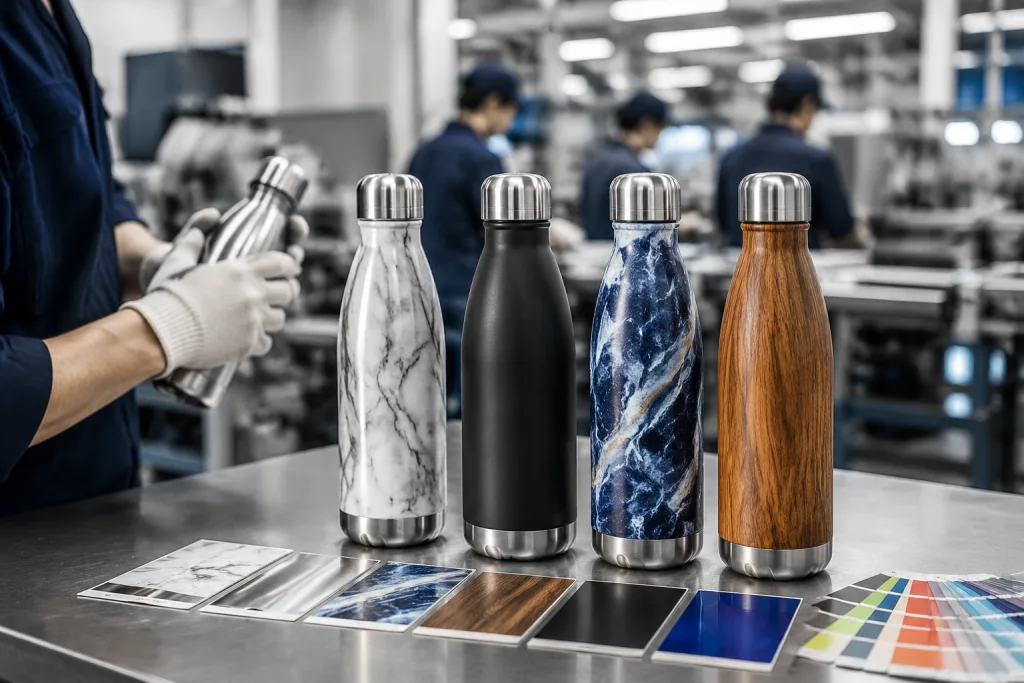
Bottle construction drives price
A manufacturer thermos is not just a stainless tube with a lid. Small engineering choices change cost, scrap rate, and how many cartons come back after launch. Ask for construction details in writing, not just photos; last month our QC pulled the sample and found the drawing said “304 inner,” but the PO typo showed “340 inner.” That one digit matters.
The inner wall should usually be SUS304 stainless steel for Europe and North America. Some low-cost bottles use 201 stainless steel outside, which is acceptable for a 3,000 pcs price-sensitive promo order if the powder coating passes cross-cut tape testing, but we do not put 201 on exposed rims or food-contact areas. For a retail outdoor bottle, 304 inside and 304 outside is the safer spec. Wall thickness commonly runs 0.4-0.5 mm for the inner shell and 0.5-0.6 mm for the outer shell, depending on size and shape; we check it with a digital micrometer before polishing because polishing can hide thin spots.
Vacuum performance drives cost fast. A normal 500 ml bottle should hold hot water above roughly 55-60°C after 6 hours when tested from 95°C starting water at room temperature. Better copper-coated vacuum bottles add USD 0.25-0.60 per unit and improve heat retention, but the math does not work if the welding line is unstable. Copper lining will not rescue a bad seam; we have seen this go sideways when the buyer approved copper plating, then QC found 7 bottles out of 80 leaking vacuum after the 24-hour temperature rack test.
Caps often cause more complaints than the bottle body. A leak-proof flip lid with spring parts costs more than a simple screw cap and needs cycle testing on the lid jig, not just a hand shake over the sink. Silicone gaskets should be food-grade and removable enough for cleaning, because buyers flag black tea residue trapped under fixed seals. For kids or hiking use, a carry handle adds convenience but creates a stress point; we normally test handle pull at 8-12 kg depending on design.
When a thermos manufacturer quotes far below the market, check whether the bottle is lighter than specified. This is the wrong place to chase USD 0.08. A 750 ml bottle that is 25-40 g lighter may save cost, but it dents more easily in carton drop tests; on our line, QC usually sees the first trouble at the bottom shoulder after a 76 cm corner drop.
Timeline from sample to shipment
Lead time is where a nice sourcing plan either holds up or starts hurting. For a vendor insulated water bottle order, our normal path from artwork to FOB shipment is 40-65 days. We can run faster, but only if the buyer accepts an existing mold from the rack, a stock powder color, and a logo method the line already knows. Ask for a new cap shape plus matte gradient coating, and the math doesn't work.
A typical timeline on our production whiteboard looks like this:
- Day 1-3: lock the spec sheet, target price, artwork files, carton layout, and compliance needs. QC checks details like 304 stainless thickness, lid material, and whether the PO says “500ml” while the artwork says “17oz.”
- Day 4-10: prepare the blank sample or logo sample. Laser marking and silkscreen usually move faster; custom coating needs spray-panel matching under a D65 light box.
- Day 11-14: buyer review and written approval. We have seen 3-day silence on a 1 mm logo-position change cost a full coating slot.
- Day 15-35: run material prep, forming, welding, vacuuming, polishing, coating, logo work, and assembly. The vacuum station records each bottle pull; weak insulation gets pulled before packing.
- Day 36-42: handle internal QC, packing, carton marking, and final AQL inspection. QC pulled the sample last month for a 2 mm carton mark shift, so artwork proofing matters.
- Day 43-50: finish booking, customs paperwork, loading, and FOB handover in China. The warehouse team checks container loading photos against the packing list before release.
For a bulk thermos reorder using the same color and logo, production can often be 25-35 days. For a new cap mold, add 20-35 days for tooling and T1 samples. If you need FNSKU labeling for marketplace fulfillment, add at least 2-4 days for label printing, scanner testing, and carton-level verification. We ship a lot of these orders, and the buyer usually flags label placement only after seeing the first packed carton.
The biggest hidden delay is unclear artwork. “Use our logo” is the wrong instruction to send. Send AI, EPS, or PDF vector files, Pantone colors, logo size in millimeters, print position, barcode data, carton marks, and packaging dielines if you have them. On one suppliers thermos project, the barcode file had a missing digit; QC caught it with a handheld scanner before 3,000 cartons were sealed. Complete files move faster because the factory is not guessing.
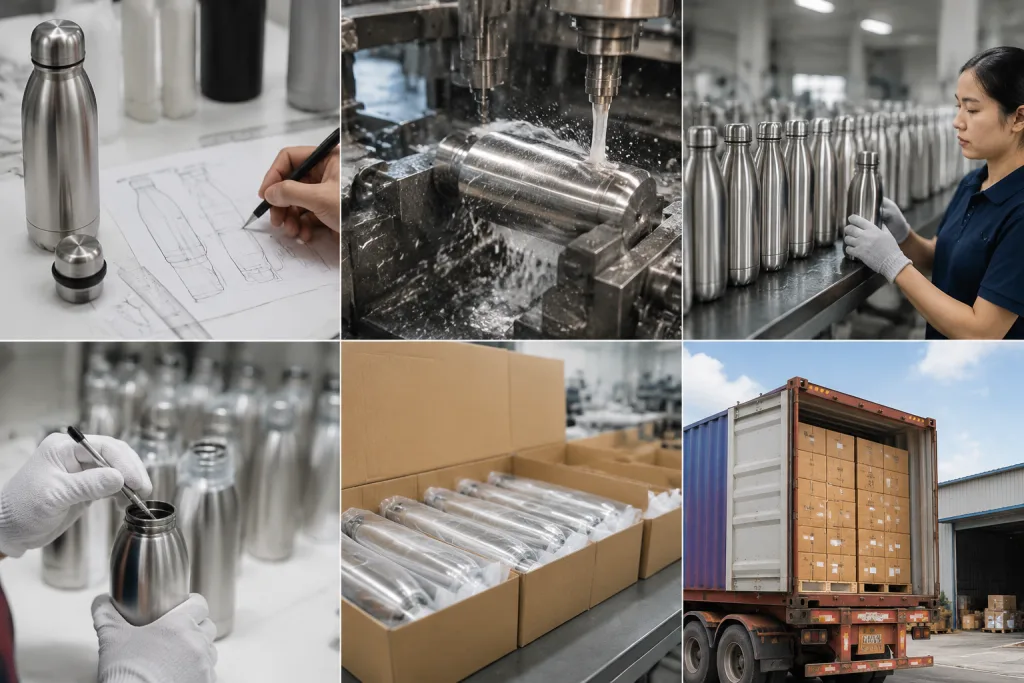
Quality control worth paying for
Quality control is not a last-minute inspection photo on WeChat. For thermos bulk orders, we start checks before the line opens, because coating color drift, weak vacuum, lid leakage, and soft cartons are cheaper to catch at 30 pcs than after 3,000 units are packed. QC pulled one sample last month with a 0.4 mm mouth-roundness issue; the buyer only noticed it after the cap felt “scratchy.” That is exactly how small defects turn into return claims.
For stainless thermos production, we run these checkpoints:
- Incoming material check: verify steel grade, sheet thickness with a digital caliper, plastic resin batch, and silicone gasket hardness before cutting starts.
- In-process check: check welding appearance, vacuum seal rate, polishing marks under the line lamp, and coating adhesion with a 3M tape pull test.
- Function check: run leak testing, cap assembly fit, thread feel, gasket compression, and heat-retention sampling after the first stable batch comes off the line.
- Final inspection: use AQL Level II, commonly 2.5 for major defects and 4.0 for minor defects unless your retailer writes stricter rules into the PO.
- Packaging check: do carton drop testing, barcode scans, master carton weight checks, and shipping mark confirmation before the warehouse tapes the cartons shut.
Outdoor retailers need tighter QC than one-off promotional buyers. A dented bottle in a giveaway bag is a complaint; a leaking bottle returned through retail channels eats margin, freight, and shelf trust. We have seen this go sideways when a distributor flagged 47 loose lids from one shipment and asked for spare gaskets by air. If you sell through distributors, your thermos distributors may ask for batch traceability, spare gaskets, and clear replacement policy terms.
For compliance, ask early whether you need LFGB for Germany, REACH declarations for EU markets, FDA food-contact support for the United States, or California Proposition 65 review. Around 8 out of 10 thermos manufacturers can provide existing material reports, but coatings, inks, and silicone parts still need separate confirmation against the exact SKU. The wrong question is “Do you have certificates?” Ask which part number, ink code, and gasket material the report covers. Do not wait until the vessel is booked to request documents; by then the math does not work.
My practical rule: if the order value is above USD 8,000, pay for a documented pre-shipment inspection. It is cheaper than arguing about defects after the container leaves China.
How to brief the factory
A clear brief gets you a sharper price and fewer schedule surprises. If you send only “quote 1,000 pcs custom bottle,” the thermos supplier has to fill in 20 blanks. Some quote low and assume a thin carton, stock lid, and no drop test. Others add margin because they smell trouble. Neither helps you buy well.
For a serious vendor insulated water bottle inquiry, include bottle capacity, retail or promo use, quantity per size, color count, logo method, packaging type, shipping term, destination port, compliance market, and deadline. If you have a target price, say it. “FOB under USD 6.20 for 2,000 pcs” is useful; “best price please” is not. We had one PO last month with “Matte balck” typed in the color line, and the buyer flagged the sample only after QC pulled it under the D65 light box. That costs days.
Here is a practical starting specification: 750 ml double-wall vacuum bottle, SUS304 inner and outer shell, 0.5 mm outer wall, powder coating in two Pantone colors, laser logo 45 x 28 mm, leak-proof screw cap with carry loop, individual kraft box, 24 pcs per master carton, AQL 2.5/4.0 final inspection, FOB Ningbo, 2,000 pcs per color. Good brief. With that, a thermos factory in Zhejiang can check the drawing, weigh the shell on the line, and price without hiding risk in the quote.
Be careful with terminology. Buyers use custom thermos, thermos custom, thermos customizable, and thermos customized to mean different things. To a factory, custom color is not custom mold. A custom logo is not a redesigned cap. A distributor thermos program is not a one-time promotional thermos run. Spell out what must be unique and what can use existing tooling; we have seen this go sideways when a buyer expected a new flip lid but the RFQ only said “custom cap.”
If you are building a long-term outdoor line, ask the factory about reorder lead time, spare parts, color consistency between batches, and whether the same mold will remain available for 12-24 months. The first shipment is the easy part. The wrong question is “can you make it?” Ask whether the line can repeat it in batch 3 with the same Pantone tolerance, same silicone ring hardness, and the same carton size after peak season. A good suppliers thermos relationship is repeatability.
Send your thermos spec and target launch date
We will return a practical FOB quote, MOQ plan, sample timeline, and risk notes for your custom stainless thermos project.
Frequently asked questions
What is a realistic MOQ for a custom stainless thermos?
For an existing mold with a simple logo, 500 pieces per SKU is often workable. For better pricing, custom color, and retail packaging, 1,000-3,000 pieces per SKU is more realistic. If you need a new lid, special silicone boot, or molded logo part, expect 3,000-5,000 pieces because tooling, color setup, and QC time must be spread across more units. For distributor thermos programs, we suggest planning total orders around 6,000-10,000 units but limiting the first run to 2-4 colorways. That keeps coating setup, carton printing, and inspection manageable.
How much should a vendor insulated water bottle cost FOB China?
A common 500-750 ml stainless vacuum bottle usually ranges from USD 3.80 to USD 8.50 FOB China, depending on steel grade, lid type, coating, logo method, and packaging. A basic promotional thermos may sit near USD 4.00-5.20. A retail-grade outdoor bottle with 304 stainless steel inside and outside, powder coating, laser logo, and printed box is more often USD 5.80-7.80. Premium caps, silicone boots, copper lining, or full-color artwork can push the unit price above USD 9.00. Always ask what is included: sample cost, carton marks, barcode labels, and inspection support are not automatically free.
Can I get samples before paying for bulk thermos production?
Yes, and you should. A blank stock sample can often ship in 3-5 days if the model is available. A logo sample usually takes 7-12 days for laser engraving or silkscreen printing. Custom powder coating can take 10-18 days because the coating line needs setup and curing. Sample charges commonly run USD 30-120 per model, plus courier cost, and special tooling or molded cap samples cost more. For outdoor retail, approve the actual coating, logo size, lid function, packaging structure, and carton mark before mass production. A photo approval is useful, but a physical sample prevents expensive misunderstandings.
Which logo method is best for outdoor retailers?
Laser engraving is usually the safest choice for outdoor retailers because it is durable, clean, and hard to peel or scratch off. It often costs USD 0.12-0.35 per unit depending on logo size and position. One-color silkscreen is cheaper for simple promotional designs, usually USD 0.08-0.25 per color, but it needs adhesion testing on powder coating. Heat transfer works for multi-color graphics but should pass tape, rub, and abrasion checks before you approve production. If your bottle will be clipped to backpacks, packed in crates, or sold in outdoor stores, prioritize durability over a slightly cheaper print method.
How do I compare thermos manufacturers without being misled?
Compare a written specification, not just the final unit price. Ask each thermos manufacturer for steel grade, wall thickness, bottle weight, lid material, gasket material, heat-retention test method, logo process, packaging details, MOQ by color, sample time, mass production lead time, and inspection standard. A USD 0.50 difference may come from a lighter body, weaker cap, thinner carton, or missing retail box. Request AQL terms, compliance documents for your market, and photos of production, not only showroom samples. If two quotes from China differ by more than 15 percent, there is almost always a specification difference hidden somewhere.