Key Takeaways
- Start RFQs with capacity, steel grade, wall thickness, lid type, packaging, target FOB price, and 3,000-5,000 pc volume.
- A realistic sample cycle for a vendor insulated tumbler is 7-12 days for stock shape and 18-25 days for new mold work.
- Bulk PO line items should include AQL level, carton drop test, logo tolerance, spare parts ratio, and shipment term.
- For Zhejiang production, standard MOQ is usually 3,000 pcs per color for powder coating and 1,000 pcs for laser logo on stock bodies.
Buying a vendor insulated tumbler looks easy until the quote sheet comes back with 5 steel grades, 3 lid options, 4 logo methods, and freight terms that miss your launch by 12 days. We see this on retail, promo, Amazon, and distributor programs. The buyer flags the price first, but the leak usually starts in a 0.2 mm wall-thickness change, a lid gasket swap, or one unclear Incoterm on the RFQ.
Our Hangzhou, Zhejiang team runs this work every week. Chasing the cheapest tumbler is the wrong question to ask; the math doesn’t work if QC pulls 80 scratched samples at final inspection. A clean custom drinkware order moves in order: RFQ, spec lock, sample, artwork approval, PO, inspection, and shipment. China ships fast when the buyer file is tight, down to the 304 stainless grade, logo position in mm, carton mark, MOQ, and the one PO typo that can hold the line for half a day.
Start the RFQ with usable specs
A weak RFQ says, “Please quote 20 oz tumbler with logo.” That is not enough for a canteen supplier to price. For a vendor insulated tumbler, state capacity in ml and oz, body diameter in mm, maximum height, lid style with material, insulation target such as 6 hours over 60°C, finish, logo process, packaging, test standard, order quantity, and delivery window. We run calipers on the lid fit first; if the buyer only writes “standard lid,” the line can price the wrong AS lid and nobody catches it until sample review. If you are comparing canteen manufacturers in China, this is how you compare the same build instead of 4 different cups wearing the same logo.
For PO planning, create a line-item table before you ask for pricing. A practical RFQ line reads: “20 oz / 590 ml double-wall vacuum tumbler, 304 inner, 201 outer or 304 outer option, 0.4 mm inner wall, 0.5 mm outer wall, push-on AS lid with silicone seal, powder coat, one-color silk screen logo, individual kraft box, 5,000 pcs, FOB Ningbo, target ready date 45 days after deposit.” Good line. That gives the canteen factory enough detail to quote tooling, labor, coating, packaging, and inspection risk; our coating team will also know whether to hang by rim hooks or base plugs before the powder coat oven is booked.
Do not hide your target market. Europe and North America ask for different paperwork: LFGB for food contact, FDA food-contact for the US, REACH for coating, and Prop 65 risk if the order touches California. If your order is canteen promotional, a 5-layer export carton and plain kraft box may pass. If it is retail customized drinkware, the math does not work unless you budget for cleaner coating, tighter color control, and shelf-ready packaging. QC pulled a sample last month where the PO said “matte black,” but the buyer flagged the finish as too glossy under a D65 light box. BottleForge Industrial in Zhejiang currently handles about 480,000 stainless drinkware units per month across tumblers, bottles, and growlers, but even with that capacity, unclear RFQs still lose 3-5 days in email cleanup.
Quote the product, not a photo
Photos help with styling. They do not define the tumbler. We have had two 20 oz cups on the same light table look identical, then price out USD 0.60-1.20 apart because one used 304 stainless at 0.50 mm wall, the other used thinner steel, a cheaper PP lid, lighter powder, and a single-wall export carton. If you ask canteen vendors to quote from a marketplace screenshot, the first price is usually the happy price, and QC pulls it apart after sampling.
Ask the supplier to quote the cost drivers, not the picture. At quote stage, we want the PO line to spell out body spec with steel grade and thickness, lid resin with gasket type, finish with coating requirement, logo method with size, packaging with carton drop-test target, testing standard, spare gasket quantity, and Incoterm. A normal 20 oz powder-coated tumbler from a Zhejiang canteen manufacturer might quote at USD 3.20-4.80 FOB Ningbo at 5,000 pcs depending on finish and lid. Laser engraving may add USD 0.12-0.25 per unit. Full-wrap heat transfer can add USD 0.45-0.90 and raises reject risk if artwork registration is tight. We once had a buyer flag “matte black” on the PO, while the artwork file said “soft touch black”; that 2-word mismatch stopped the line for 6 hours.
Ask whether the vendor insulated tumbler comes from an open mold or a private mold. Open mold is faster and cheaper: usually 35-45 days bulk lead time after sample approval, and we can often run a 5,000 pcs order without waiting for new tooling. Private mold gives differentiation but adds tooling, normally USD 2,500-8,000 for a stainless body and lid combination, with 45-70 days before the first mass production lot. If you are a canteen distributor selling seasonal programs, open mold makes more sense. If you are building a long-term retail SKU, custom mold can protect your shape and improve margin over 2-3 reorder cycles. The wrong question is “can you match this photo?” The better question is “which mold number, which lid, and what vacuum reject rate did you price?”
Sample before you negotiate hard
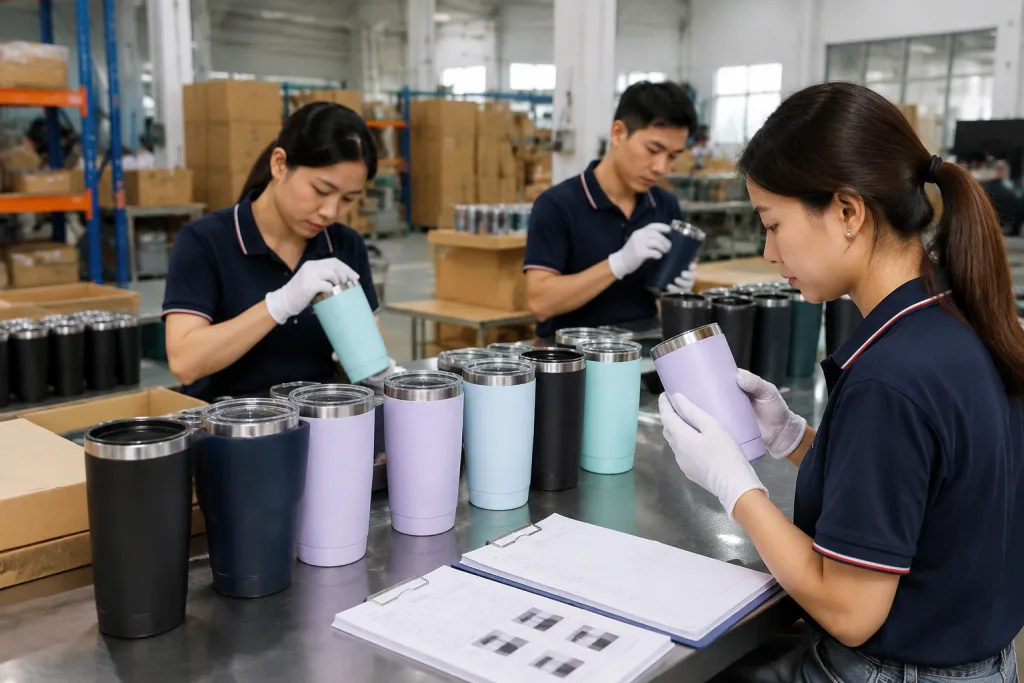
About 6 out of 10 buyers we meet try to beat down the FOB price before they hold a reliable sample. That is the wrong order. First prove the line can make the item at your target quality, then talk about quantity, payment, carton loading, and forecast. A vendor insulated tumbler sample is not just for appearance. We check vacuum performance on the temperature rack, lid fit with a go/no-go gauge, coating adhesion with 3M tape, logo position in mm, hand feel, and whether the gift box corners crush after a 1.2 m drop test.
For a stock-shape custom canteen or tumbler, expect 7-12 days for a plain or laser-marked sample and 10-15 days for powder coat with silk screen. New color matching against Pantone usually adds 5-7 days because coating chips and bottle curvature do not read like paper. We had one buyer flag a “warm white” that looked fine on a flat chip but turned yellow on a 500 ml curved body under the QC light box. For a customizable growler or customized growler with a new cap, handle, or thread structure, 18-25 days is more realistic.
Your sample PO should not be a loose payment note. It should list body model, capacity, finish, logo file name, logo size in mm, logo position from base or rim, lid type, packaging mockup, and required tests. Add two approval buckets: “golden sample for appearance” and “engineering sample for function.” The golden sample controls color, logo, and visual finish. The engineering sample controls vacuum, leakage, lid strength, and dimensional fit. Keep one approved sample with you and one sealed sample at the China factory. We usually sign across the carton tape and write the PO number on the hangtag, because we have seen this go sideways when a later bulk lot drifts and both sides start arguing from phone photos instead of a physical reference.
Lock artwork and packaging early
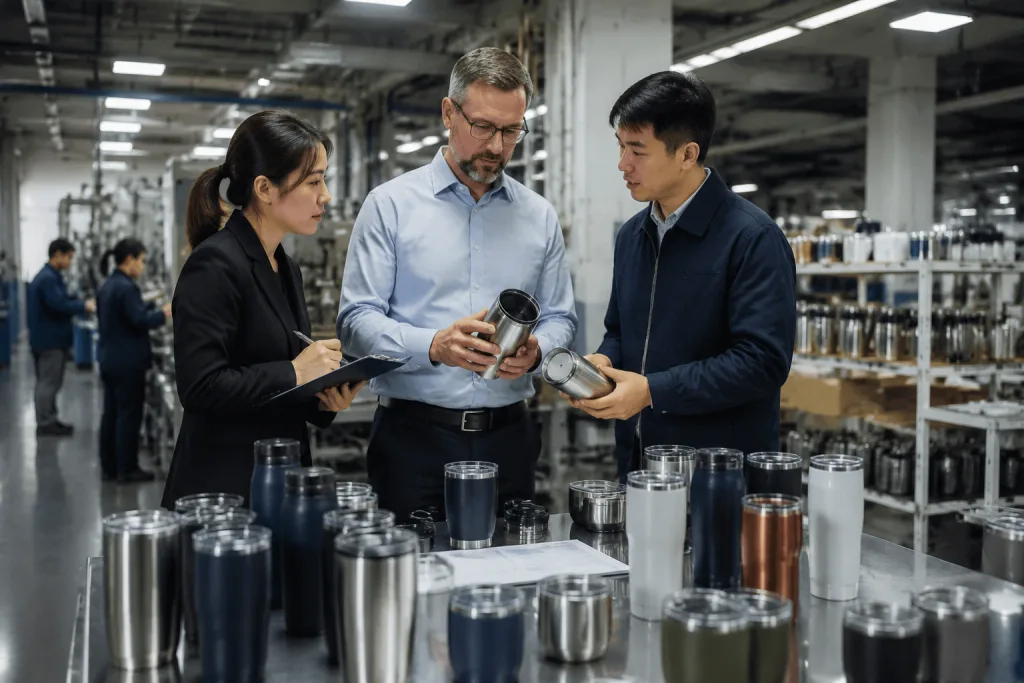
Artwork errors cost almost nothing while they sit in a PDF. They get expensive once we run 5,000 powder-coated cups through the line. Before bulk production, ask your canteen vendor for a digital proof and one pre-production decorated sample. QC should pull the sample under a 5500K light box, not check it from a phone photo. For laser engraving, lock logo width and height in mm, engraving depth or visual contrast, and whether the mark exposes 304 stainless or uses black laser on the coated surface. For silk screen, lock the Pantone C code, print area, tolerance, and the exact curve or taper the logo crosses.
For canteen customizable programs, packaging causes more late shipments than the cup body. We have seen a 12-day tumbler order turn into 18 days because the buyer sent the retail box file after the deposit, then changed the barcode size by 3 mm. A custom retail box needs dieline approval, barcode position, warning text, material description, country of origin, and sometimes FNSKU if you sell through marketplace fulfillment. A distributor canteen order may only need a white box with a master carton label. A retail customized canteen needs insert card, UPC, recycling marks, and importer details. Send the final packaging file before deposit if possible. If not, put a hard line in the PO: “final AI packaging artwork due within 5 calendar days after deposit.”
Use clear acceptance rules. Short PO language is where we see this go sideways. A practical PO line says: “Logo position tolerance ±1.5 mm, visible pinholes not accepted within front-facing 60 mm logo area, coating cross-hatch adhesion 4B minimum per ASTM D3359, carton drop test from 76 cm on 1 corner, 3 edges, 6 faces.” That level of detail may feel heavy, but the math works better than arguing after AQL 2.5 inspection. Last month QC pulled a sample with two pinholes inside the logo zone, and the buyer flagged it because the PO named that 60 mm area. Zhejiang factories can move fast. We cannot guess your retail shelf standard unless it is written down.
Write the bulk PO like a control sheet
The bulk PO is where serious buyers separate themselves from casual importers. A PO with only item name, quantity, and price is too thin. For vendor insulated tumbler orders, we treat the PO like a control sheet: 304 stainless spec, finish, logo file, packing, QC level, ship date, payment, and export documents all sit in one place. Last month QC pulled a 20 oz sample from the line where the PO said “black,” but the approved sample was matte black powder coat, PMS Black 6C; that 2-word gap cost 6 hours of rework.
Useful PO line items include SKU and capacity with exact ml/oz, color and finish with sample code, logo method with artwork revision, packaging revision with dieline number, unit price, order quantity, over/under shipment tolerance, spare parts, inspection standard, lead time, Incoterm, port, payment term, and document requirements. For example: “SKU VT20-BLK, 20 oz tumbler, matte black powder coat, laser logo file BF-R2.ai, 5,000 pcs, USD 3.85 FOB Ningbo, 30% deposit / 70% before shipment, lead time 40 days after deposit and artwork approval, AQL General II, critical 0, major 2.5, minor 4.0.” We run this against the signed sample card and the packing mockup before deposit invoice. Simple check. It catches PO typos like “BF-R1.ai” when the buyer approved “BF-R2.ai.”
Add practical protections. If the order includes lids with silicone gaskets, request 1% spare gaskets or 0.5% spare lids depending on sales channel. If you sell distributor growler or distributor drinkware sets, define master carton weight below 18 kg where possible to reduce warehouse complaints; we’ve had buyers flag 21.6 kg cartons after their 3PL refused manual unloading. If the order ships to Amazon FBA, carton labels, FNSKU labels, suffocation warnings, and pallet height must be locked before production packing starts. Retrofitting labels in a warehouse in China adds cost and loses 2 to 4 days close to vessel cutoff. The math doesn’t work.

Inspect before final balance payment
Do not use inspection to “teach the factory a lesson.” It is the normal gate before you release the 70% balance, and the math doesn't work if defects are found after the goods are on the water. For a 5,000 pc vendor insulated tumbler order, a final random inspection under ANSI/ASQ Z1.4, General Inspection Level II, usually pulls 200 samples. A common acceptance plan is critical defects 0, major defects 2.5 AQL, minor defects 4.0 AQL. Critical means food-contact contamination, sharp edges, severe leakage, wrong material, or unsafe packaging claims. Major means visible coating defects, bad logo, lid failure, incorrect capacity, or carton label errors. Last month QC pulled the sample rack and found 7 cartons with “matte balck” printed on the side mark; small typo, big headache when the buyer’s warehouse scans inbound labels.
Inspection should cover visual review, barcode scan, logo measurement with a digital caliper, capacity check on a scale, leak test, lid fit, coating rub test, carton drop test, and carton count. For insulated products, add a hot-water temperature retention check. Simple is better. We run 95°C water, 20-22°C ambient, then measure after 6 hours with a probe thermometer; the exact pass value depends on body shape, but it should match the approved engineering sample within a defined range. We have seen this go sideways when a buyer approves a slim sample, then asks production to widen the base by 6 mm without rechecking heat retention.
For orders from our Zhejiang facility, standard mass production lead time is 35-45 days after sample approval for stock tumblers, with MOQ from 3,000 pcs per color for powder coating. Bigger custom drinkware programs can be split into color batches, but each batch still needs inspection discipline. If your canteen customized order is urgent, do not skip QC. QC is cheaper than air freight. Reduce risk by approving a partial shipment only after the first lot passes, then keep the second lot under the same AQL plan. We ship from the line only after carton count, pallet height, and color separation are checked; one buyer once flagged 18 mixed-color cartons because the PO said “navy lid” but the packing list showed “blue cap.”
Ship with clean documents
Shipment problems start with small paperwork misses: a carton mark copied from last year’s PO, an HS code guessed by sales, a consignee name missing “LLC,” or a pallet note buried in WhatsApp. For stainless insulated tumblers and custom canteen products, confirm the HS code and product description with your broker before we print carton labels on the line. We have stopped a 6,000 pcs order at the label table because the PO said “vacuum flask,” the artwork file said “coffee cup,” and the buyer flagged it after QC pulled the pre-shipment sample. Wrong question to ask: “Will customs accept it?” Better question: “Will the documents match every carton face?”
Your shipping PO or release instruction should spell out the Incoterm and named port, the forwarder contact with email and phone, carton size in cm, gross and net weight in kg, pallet build or floor-loaded loading, required documents, and the deadline for draft invoice and packing list. FOB Ningbo or FOB Shanghai is common for Zhejiang production; we ship both every week. For North America, sea freight may take 18-32 days port-to-port depending on coast and routing. For Europe, Ningbo to main ports is often 28-38 days on the water, not including customs and inland trucking. One buyer once sent “FOB Ningo” on the PO; harmless typo, but our shipping clerk still had to correct it before the forwarder would release the booking.
Ask the canteen manufacturer for shipment photos before balance release: one open carton showing inner packing, one sealed master carton with readable marks, one pallet view if pallets are used, and container loading photos when you buy full container volume. Simple check. For canteen distributors, clean carton labels matter because mixed SKUs enter warehouses fast; a 2 mm barcode shift can make the warehouse team re-label 80 cartons by hand. For customized drinkware programs, keep the final commercial invoice, packing list, bill of lading, test reports, and inspection report in one shared folder by PO number. It is not glamorous, but this is how reorders move faster and claims get settled without drama.
Send your tumbler RFQ before tooling decisions
Share capacity, finish, logo, packaging, quantity, and target ship date. Our Zhejiang team will return a practical FOB quote and sample plan.
Frequently asked questions
What MOQ should I expect for a vendor insulated tumbler order?
For a stock vendor insulated tumbler, a realistic MOQ is 1,000 pcs for laser logo on existing stainless bodies and 3,000 pcs per color for powder coating. If you need a custom Pantone coating, full-wrap print, or retail box, 3,000-5,000 pcs is more practical because setup loss and coating line changeover are real costs. For private mold work, many canteen manufacturers will ask for 10,000 pcs annual forecast or a tooling charge of USD 2,500-8,000. Zhejiang factories can sometimes accept smaller trial orders, but the unit price may rise by USD 0.30-0.80.
How do I compare quotes from different canteen suppliers?
Do not compare only the final FOB price. Put each quote into the same table: steel grade, wall thickness, capacity, lid material, coating type, logo method, packaging, test reports, MOQ, lead time, Incoterm, and payment term. A USD 3.55 tumbler with 201 outer steel, thin coating, and weak box may not beat a USD 3.90 tumbler with 304 outer option, better lid, and AQL inspection included. Ask each canteen supplier to confirm whether FDA, LFGB, REACH, or Prop 65 documentation is available for the materials used in your actual order, not just a similar item.
What should be included in the sample approval file?
Your sample approval file should include photos, measurement sheet, capacity check, weight, logo size and position, color reference, lid fit notes, packaging proof, and any performance test results. For a vendor insulated tumbler, keep one golden sample for appearance and one engineering sample for function. The file should reference exact artwork names, such as logo_R3.ai and box_R2.pdf, because “latest logo” is how mistakes happen. For custom canteen, customizable canteen, or customized growler orders, also include mold number and lid version. A clear sample file can save 5-10 days during repeat orders.
Is FOB China better than DDP for distributor drinkware orders?
FOB China is usually better if you already have a freight forwarder, broker, and regular container volume. It gives you control over freight cost, sailing schedule, and customs handling. DDP can be useful for first-time canteen distributor orders under 2,000-3,000 pcs, but you must check what is included: duty, customs bond, pallet delivery, residential fees, and insurance are not always covered. For Zhejiang production, FOB Ningbo is common. If your distributor drinkware order goes to multiple warehouses, ask for carton-level packing lists before shipment so your forwarder can quote accurately.
How long does a full custom drinkware project take?
For stock-shape customized drinkware with logo and standard packaging, plan 7-12 days for sample, 3-5 days for approval, 35-45 days for bulk production, and 18-38 days sea freight depending on destination. That puts many real projects at 65-100 days door-to-door. A new mold custom growler or canteen customized project can add 25-45 days before bulk production begins. If you need retail packaging, add artwork approval time early, not after the deposit. The fastest projects are the ones where RFQ, sample PO, and bulk PO use the same technical line items.