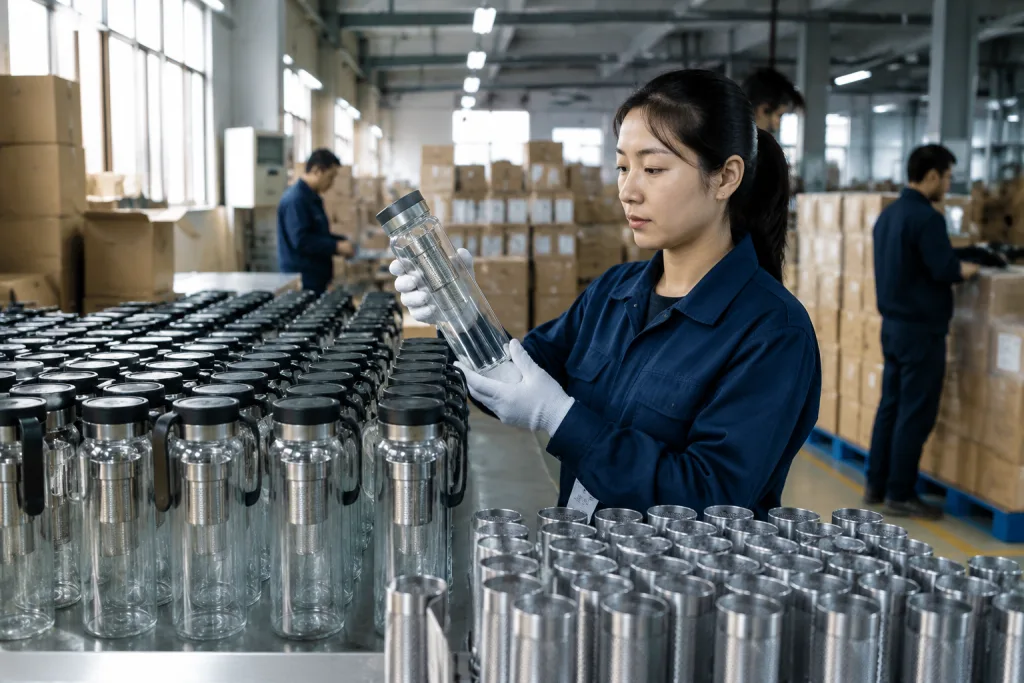
Key Takeaways
- Start with a 1,000-3,000 unit MOQ unless you need a private mold
- Tritan, PP, and 304 stainless steel solve different price and compliance problems
- Laser, silkscreen, UV print, and sleeve packaging each change unit cost by USD 0.08-0.45
- Plan 30-45 days for production after artwork and pre-production sample approval
A vendor infuser bottle looks simple until your PO says 3,000 pcs, the launch date is locked, and the buyer has already booked photos for Tuesday. Finding a factory infuser bottle listing in China is easy. Choosing what to customize is where orders get expensive: Pantone drift on the lid, a logo pad that bleeds 0.3 mm, a gift box insert that crushes in the drop test, or a cap seal that passes the first sample but leaks after the third fill. We have seen this go sideways.
If you are building a wellness brand or hydration startup, split the sourcing work into four hard calls: the bottle platform, the infuser structure, the logo process, and the supply model. BottleForge Industrial manufactures in Zhejiang, China, with typical MOQs from 1,000 units per model and monthly capacity around 300,000 plastic and stainless drinkware units. On our line, QC pulled one Tritan sample last month because the strainer sat 1.2 mm too high and rattled after the shake test; small detail, big buyer complaint.
Start with the bottle platform
Your first sourcing decision is not logo position. It is the bottle platform. This is the wrong question to ask first. A vendor infuser bottle usually starts from 3 platforms: Tritan plastic sport bottle, double-wall stainless bottle with tea basket, or glass bottle with stainless infuser. We run different drop tests and carton specs for each one, because freight cost, FDA/LFGB testing, and damage claims do not behave the same on the line.
For wellness startups, Tritan is usually the safest first run. It is light, transparent, BPA-free, and works well for a custom fruit infuser bottle where the customer wants to see lemon, mint, berries, or cucumber. A 700-900 ml Tritan bottle with PP lid and removable infuser tube often lands around USD 2.20-3.80 FOB Ningbo or Shanghai depending on cap complexity, logo, and packaging. We ship this platform for bulk fruit infuser bottle programs, gym giveaways, subscription boxes, and retail under USD 19.99. MOQ is often 1,000 pcs per color, and QC pulled the sample last month because the buyer’s PO said “matte black lid” while the approved sample had a glossy flip cap.
Stainless steel fits a custom tea infuser bottle better because heat retention matters. A 304 stainless inner wall with 201 or 304 outer wall, vacuum insulation, and a threaded tea basket usually costs more, often USD 5.50-9.50 FOB for 350-500 ml. If you sell premium tea, herbal blends, or office wellness kits, the higher cost can work. But do not call it the same product. The math doesn’t work. Wall thickness, vacuum performance, and lid gasket quality become the risk points, so we check the vacuum with a 95°C hot water test and measure the mouth thread with a 0.02 mm caliper before packing.
Glass gives the cleanest taste and a stronger shelf look, but breakage is real. For distributors infuser bottle programs, we usually suggest glass only when the carton design and inner protection are agreed early. A factory direct infuser bottle price can look attractive, then lose the savings if 3% breaks during domestic courier delivery. We’ve seen this go sideways: 12-bottle inner cartons looked fine in the showroom, then the buyer flagged cracked bases after a 1.2 m drop test because the EVA sleeve was 1 mm too thin.
Choose the infuser that fits use
The second decision is the infuser insert. Around 7 out of 10 buyers who ask us for a customizable infuser bottle forget to say what goes inside: fruit, loose tea, herbs, or cold brew coffee. That small line on the RFQ changes the mesh, mouth opening, insert material, and how the user cleans it at the sink. QC pulled one PP sample last month because the buyer wrote “tea infuser” on the PO, while the drawing showed a fruit tube with 2.2 mm slots.
Fruit needs space. A narrow tube with tiny slots looks neat in a product photo, but it will not hold enough orange, lemon, or strawberry to flavor 750 ml of water. For a custom made infuser bottle aimed at fruit water, we run a full-length basket with 35-45 mm diameter and slot openings around 1.5-2.5 mm. The insert should pull out without the user touching wet pulp; this is where cheap tooling goes sideways, because a 0.3 mm burr on the rim catches the seal or scrapes the finger. If your audience is hydration challenges or detox-style daily water intake, a customizable fruit infuser bottle needs to load in under 10 seconds and rinse clean under a tap.
Tea infusers need finer filtration and heat-safe materials. A bulk tea infuser bottle should use 304 stainless mesh or perforated stainless sheet, not low-grade metal that stains or gives odor after 20 test brews. For loose rooibos and green tea, hole size around 0.5-0.8 mm works better than large punched slots. You also need to choose whether the basket hangs from the lid, screws into the body, or sits loose at the neck; hanging baskets are easier to remove after steeping, but the lid tolerance must stay within about 0.2 mm or the buyer will flag leakage during carton drop testing.
For mixed-use customized infuser bottle projects, this is the wrong question to ask: “Can one insert do everything?” The math doesn't work. A fruit tube will not filter fine tea cleanly, and a fine tea basket will not hold enough fruit. If your SKU page promises both, customer reviews can punish you after the first 300 orders. We often recommend two SKUs: a distributor fruit infuser bottle and a distributor tea infuser bottle, sharing the same outer branding but using different inserts and one common lid mold to keep MOQ pressure under control.
Decide what is truly custom
Custom does not mean private mold. For a first-order custom logo infuser bottle, we usually push buyers toward an existing mold with logo work, Pantone cap, printed manual, and retail box. The math is cleaner. Tooling a new body can cost USD 3,000-12,000 for plastic and more for stainless components, before you have 1 sell-through report from the market. Existing mold customization can start from 1,000 units; private mold orders usually need 5,000-10,000 units before the unit cost makes sense. Last month QC pulled a 650ml Tritan sample from the line, checked the lid fit with a 0.20 mm feeler gauge, and the buyer still chose the stock body after seeing the tooling quote.
There are four practical customization levels. Level one is logo only: laser engraving on stainless, silkscreen on plastic, or pad print on lids, depending on the surface and artwork size. Level two adds color matching, usually with a Pantone tolerance checked under D65 light in the sample room, not under yellow office lamps. Level three adds packaging: color box, insert card, barcode, FNSKU label, or multilingual instructions, with placement confirmed on the dieline before mass print. Level four changes product structure, such as a new lid, handle, filter length, silicone sleeve, or body shape. We have seen this go sideways when a PO says “blue cap” but the approved sample was Pantone 2925C.
For a customized fruit infuser bottle in a lifestyle retail channel, packaging often does more work than a new mold. A matte color box, clean instruction card, and correct barcode placement can lift shelf value without adding 12 days to the schedule. New mold work can turn a 28-day repeat order into a 45-day headache. For a customized tea infuser bottle sold through specialty tea shops, the insert basket mesh size and cap seal matter more than outer graphics. On one 800ml bottle, the buyer flagged tea leaves leaking through a 1.2 mm punch hole, so we changed the basket spec before touching the box artwork.
Be careful with vague requests like “make it premium.” This is the wrong question to ask. A factory tea infuser bottle becomes premium through 304 stainless grade, smoother threads, thicker silicone gasket, and better polish, because each item can be measured on the bench. Ask your vendor for material grade, wall thickness in mm, print method, carton drop-test plan, and sample photos under neutral lighting. If they answer only with lifestyle photos, keep asking. We run a simple thread check with a torque tester, and QC has rejected lids that looked fine in photos but scratched after 20 open-close cycles.
Check compliance before pricing
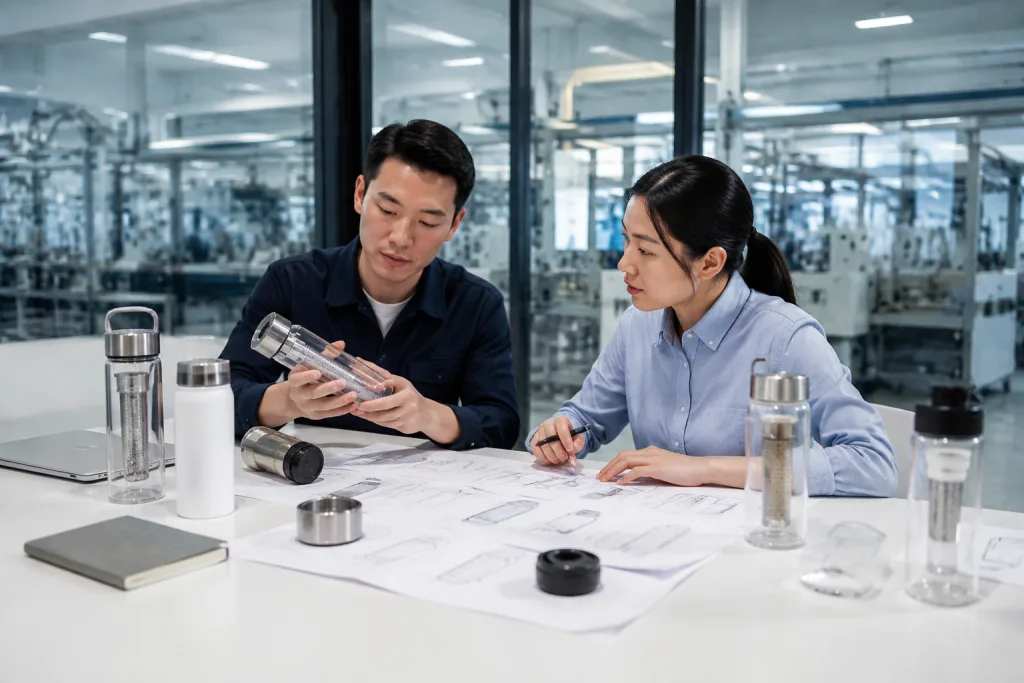
Infuser bottles touch water, lemon juice around pH 2–3, tea tannins, and sometimes 80–95°C hot liquid. Compliance is not a decoration for the file folder. For Europe, ask for LFGB food contact testing, EU 10/2011 for plastics where applicable, REACH restricted-substance review, and packaging checks. For North America, we usually see FDA food-contact expectations, California Proposition 65 risk review, and ASTM-related physical safety requests from 3 channel buyers. QC pulled one Tritan sample last year because the silicone gasket smelled after a 70°C soak in a 500 ml beaker. That report mattered.
A serious factory infuser bottle supplier in China should know which part needs which test: bottle body, lid, gasket, straw if included, infuser basket, coating, printing ink, and packaging. One old test report for another model does not cover your order. The math doesn't work. If you change from clear to smoke gray plastic, switch powder coating, or add UV ink on the lid, the risk changes and the report scope changes with it. We had a buyer flag a PO typo once: “PP lid” on the order, “ABS lid” on the sample tag. For baby or kids positioning, do not borrow adult bottle assumptions.
Quality control should be fixed before deposit. At BottleForge in Zhejiang, we commonly work with AQL 2.5 for major defects and AQL 4.0 for minor defects unless the buyer specifies a tighter plan. For a bulk infuser bottle order, inspection points should cover leak test, cap torque, thread fit, logo adhesion, odor check, color variance, carton count, barcode scan, and packaging damage. We run cap torque with a digital torque meter and record readings in N·cm, not “feels tight.” For vacuum stainless models, add temperature retention sampling and vacuum failure checks; on the line, a 6-hour hot-water test catches problems a quick shake test misses.
If your vendor says inspection is unnecessary because “we check everything,” push back. Get a written QC checklist and an approval sample with date, version, and signed label. For hydration startups shipping direct to consumers, a 2% leak issue is not small; on a 10,000 pcs launch, that means 200 angry buyers, refunds, bad reviews, and replacement freight. We've seen this go sideways. Compliance and QC cost money, but they cost less than a recalled product or a listing full of one-star photos showing wet backpacks.
Price the full landed order
FOB unit price is one line on the sourcing sheet, not the buying decision. A factory direct infuser bottle at USD 2.65 can cost more than a USD 2.90 quote if the carton jumps from 56 cm to 63 cm, the color box crushes in a 10 kg drop check, or the supplier cannot print Amazon FNSKU labels cleanly. Price the full landed order: product, logo setup, sample fees, testing, inspection, inner packaging, master cartons, pallets if required, freight, duty, customs clearance, and domestic delivery. We have seen this go sideways when a buyer approved the unit price, then flagged the carton CBM after the forwarder measured it with a tape on the loading dock.
For a plastic bulk fruit infuser bottle, one-color silkscreen usually adds USD 0.08-0.18 per unit. Multi-color UV printing can add USD 0.25-0.45 depending on print size, fixture time, and how many passes the line needs. A color box may add USD 0.18-0.40; a plain kraft box usually comes in lower if the paper grade stays at 250-300 gsm. Stainless laser engraving can be economical at scale, often USD 0.10-0.25 per unit, but large wraparound artwork needs another process. QC pulled a sample last month where the logo sat 3 mm off-center because the jig was made for a slimmer bottle body.
MOQ is not just a factory preference. Resin color, lid color, carton printing, and assembly speed set the real limit. For a bulk infuser bottle with standard transparent body and black lid, 1,000 units may work because we can run it with stock resin and shared lids. For three Pantone colors across 1,500 units, the math does not work: each color run has purging loss, setup loss, and more shade-check rejects under the D65 light box. The buyer may ask for 500 units per color, but the injection line still needs stable output before QC can judge the lid fit.
Lead time should be written by stage. A realistic schedule is 5-7 days for digital artwork and quote confirmation, 7-10 days for physical sample or pre-production sample, and 30-45 days for mass production after deposit and sample approval. Before the summer rush, add 7-14 days. Around Lunar New Year, late confirmation can turn a normal 35-day order into 55 days because workers leave, resin deliveries slow down, and the line schedule gets rebuilt daily. Put the approval date on the PO too; we once received one with the sample approval date typed as 2023 instead of 2024, and accounting held the deposit file for 2 days.
Match supplier type to risk
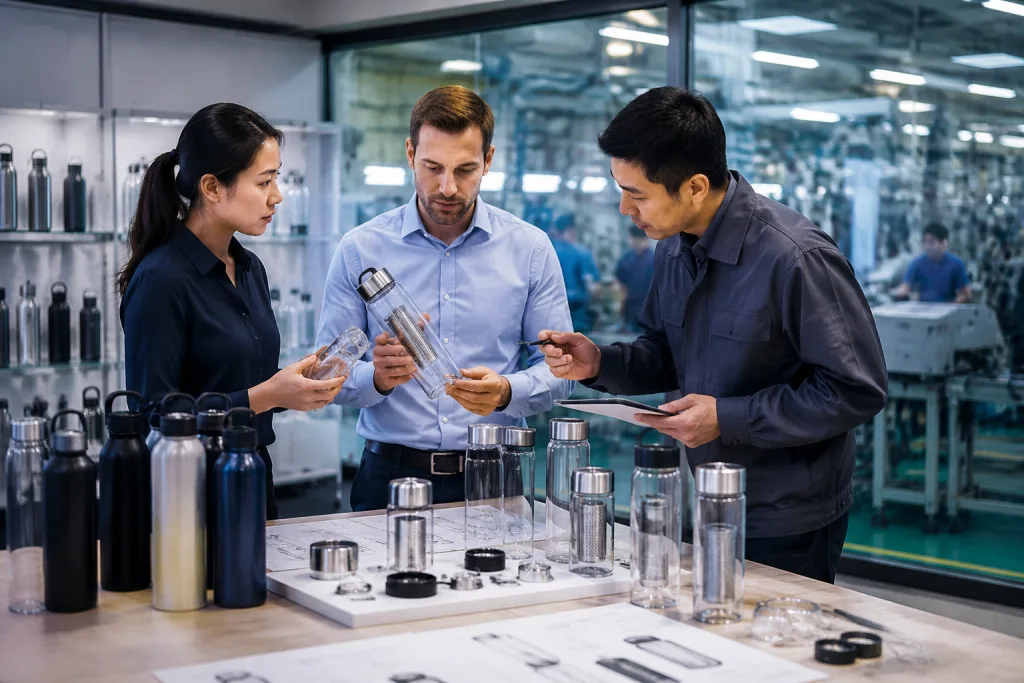
Not every supplier type fits every buyer. For a 3,000 pcs promotional customized infuser bottle, a trading company can work if they answer fast, consolidate lids and sleeves from 2 or 3 plants, and send clear pre-production photos. A factory fruit infuser bottle producer is the safer pick when you run repeat SKUs, need Delta E color control under 1.0 on the Pantone panel, or want feedback on thread fit and silicone seal compression. A distributor infuser bottle program from local stock ships faster, often 2 days vs 25 days from China, but the math gets tight once you ask for custom color, logo print, and retail carton.
Wellness brands should ask how the supplier handles repeat orders. Can they reserve the same mold cavity number? Can they keep the gasket at 50 Shore A instead of letting the next batch drift to 55? Can they match the same transparent tint six months later under a light box, not just by eye? Can they store your AI print file, carton dieline, and barcode position so the next PO does not restart from zero? We run this check before mass production because QC pulled the sample last year on a 0.6 mm gasket mismatch, and the buyer flagged leakage after the first container landed.
For distributors fruit infuser bottle and distributors tea infuser bottle programs, carton strength and labeling matter more than most new buyers expect. If you ship to 4 retailers or 3PL warehouses, each carton needs the correct SKU, quantity, gross weight, net weight, dimensions, country of origin, and barcode that scans on the first pass. Small mistakes hurt. We have seen a PO typo turn “24 pcs/ctn” into “12 pcs/ctn,” then the warehouse rejected 180 cartons during receiving. For Amazon FBA, check FNSKU labels, suffocation warning on polybags, carton weight limits, and prep rules before production, not after the line has sealed the cartons with 48 mm tape.
We are slightly opinionated here: choose a supplier who pushes back on your specification. If you ask for a glass bottle with a 300 gsm retail box and no inner EPE protection, a good vendor should warn you before the drop test fails at 80 cm. If you ask for boiling-water use on a plastic bottle not designed for it, they should say no and show the resin temperature limit. The cheapest agreeable supplier is rarely the safest long-term partner; we have seen this go sideways when the sample looked fine, then 6,000 pcs cracked at the infuser joint during packing.
Approve samples like a buyer
Sample approval should feel boring and strict. Do not approve a custom infuser bottle because the logo looks clean in one phone photo. Hold it, fill it to 650 ml, shake it 30 times, wash it, smell the lid, then pack it back into the color box. For fruit models, we run real lemon slices and mint through the basket, not paper props. For tea models, steep black tea for 20 minutes and check staining, basket removal, and heat transfer to the hand; QC pulled one sample last month where the PP lid still smelled after 2 wash cycles.
Your approval checklist should cover capacity marking, filled weight, lid alignment, gasket seating, thread smoothness, opening diameter, infuser removal, logo position tolerance, print scratch resistance, box fit, barcode scan, and carton layout. For plastic models, check flow marks, black spots, flashing, and odor under a 6000K inspection lamp. For stainless models, check weld lines, polish quality, vacuum performance, and rattling inside the wall; we usually tap the body on a rubber mat because loose solder beads are easy to miss on a quiet line.
Ask for a golden sample and keep one on your desk. The factory should keep one in Zhejiang, China, and both sides should treat it as the reference for mass production. If the mass order differs by 2 mm on logo position or the lid color drifts from the approved Pantone chip, the discussion stays factual. For orders above 5,000 units, run a pilot lot or first-article inspection before full production. We have seen this go sideways when a buyer approved photos only, then flagged the first 80 cartons because the infuser basket sat too tight.
The best vendor infuser bottle programs are not built on blind trust. They are built on clear trade-offs, written specifications, and repeatable checks. Less exciting than product design? Sure. But this is what protects your launch date, review score, and reorder margin when the PO says matte black and the carton mark has one wrong digit.
Send your infuser bottle specification for review
Share capacity, material, logo, packaging, market, and target price. We will respond with MOQ, FOB pricing, lead time, and practical risks.
Frequently asked questions
What MOQ should I expect for a custom logo infuser bottle?
For an existing mold, a practical MOQ is usually 1,000 units per model and color. Some simple logo-only orders can be discussed at 500 units, but the unit price and inland handling cost often become unattractive. If you need Pantone plastic parts, custom packaging, or a new infuser design, expect 2,000-3,000 units. A private mold custom made infuser bottle normally needs 5,000-10,000 units to spread tooling cost properly.
Is Tritan better than stainless steel for a bulk fruit infuser bottle?
For fruit water, Tritan is usually the better first choice because it is transparent, light, and cost efficient. Buyers can see the fruit, which helps retail photos and social content. A 700-900 ml Tritan bulk fruit infuser bottle often costs around USD 2.20-3.80 FOB depending on lid and packaging. Stainless steel is stronger and more premium, but the user cannot see the fruit and the price is typically much higher.
Can one bottle work for both fruit and tea infusion?
Technically yes, commercially not always. Fruit needs a larger basket with wider slots, often 1.5-2.5 mm openings. Loose tea needs finer holes around 0.5-0.8 mm or stainless mesh. If you use one insert for both, one use case will suffer. For a wellness brand, we usually recommend separate custom fruit infuser bottle and custom tea infuser bottle SKUs sharing the same logo, color language, and packaging style.
How long does production take after I approve the sample?
For a standard customizable infuser bottle using an existing mold, mass production usually takes 30-45 days after deposit and approved pre-production sample. Add 7-10 days for physical sample preparation and shipping. If you need custom color matching, retail box printing, third-party testing, or peak-season production before summer, allow another 7-14 days. Orders confirmed near China’s Lunar New Year need a much wider buffer.
What quality checks matter most for distributor infuser bottle orders?
For distributor infuser bottle orders, focus on leak testing, gasket fit, thread smoothness, logo adhesion, odor, carton strength, barcode accuracy, and quantity count. For stainless tea models, add vacuum retention and heat performance checks. A common inspection setup is AQL 2.5 for major defects and AQL 4.0 for minor defects. If you ship to retailers or 3PL warehouses, carton labeling errors can be as painful as product defects.