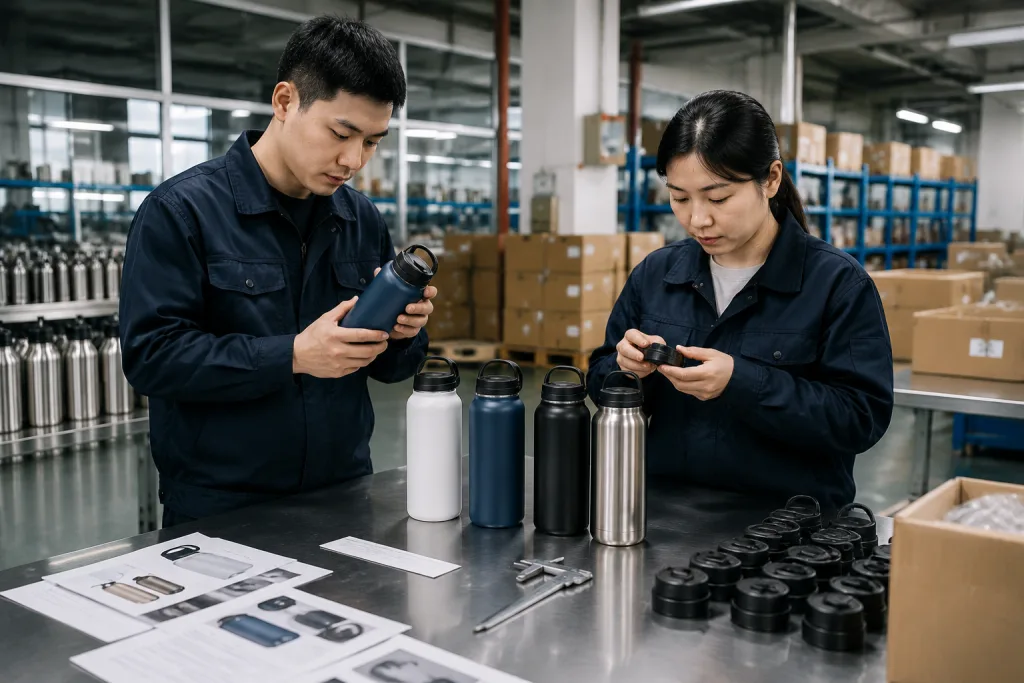
Key Takeaways
- For stainless vacuum flasks, 0.5 mm inner wall and 0.6 mm outer wall usually reduce dent claims versus lighter 0.4 mm builds
- A practical MOQ for private-label vendor hydration flask orders is 1,000 pieces per color, with 30-45 days production after artwork approval
- Use AQL 2.5 for major defects and AQL 4.0 for minor defects on distributor drinkware orders
- FOB Ningbo or Shanghai pricing should separate flask cost, logo cost, packaging, testing, and spare lids
A vendor hydration flask quote can look clean and still bury the items that eat your margin: steel grade, vacuum loss rate, lid tooling, carton drop strength, logo tolerance, and the bill for a failed inspection. We’ve had buyers send a 6-line PO where “304 stainless” was typed once, but the lid material, 0.2 mm logo position tolerance, and 12 kg carton drop test were missing. Bad start. If you buy custom drinkware for retail shelves, promotion orders, or distributor canteen programs, read the quote line by line like a spec sheet, not a sales flyer.
Our Hangzhou, Zhejiang team sees this 3 or 4 times a month: two China suppliers quote the same 750 ml flask, but one runs 0.4 mm inner steel and the other runs 0.5 mm, so the landed cost gap shows up only after returns. QC pulled the sample, weighed the body on a digital scale, and the buyer flagged the “same spec” claim within 10 minutes. This is where the math doesn’t work. Check the spec before you approve samples.
Capacity Is Not Just Volume
The first line on a vendor hydration flask spec is usually capacity: 500 ml, 750 ml, 1,000 ml, or 64 oz. Too many buyers treat it like a logo-space choice. Wrong question. Capacity changes tooling, freight, carton size, and how the bottle feels in hand. We run 750 ml often for office, gym, and outdoor retail, but it only fits most car cup holders when the base stays under about 75 mm; our caliper check on one sample last month came out 78.6 mm, and the buyer flagged it before approval. A 1,000 ml bottle gives stronger shelf presence, but it may miss cup holder expectations and push carton cube up by 20-35%.
For canteen promotional orders, 500 ml and 600 ml sizes are easier to hand out at events because each master carton stays lighter; one 24 pcs carton we shipped was 13.8 kg instead of 18.5 kg for the larger body. That matters when staff carry boxes from a van. For a distributor growler or custom growler program, 40 oz and 64 oz sizes need stronger handles, thicker lid threads, and a wider mouth around 55-60 mm for ice filling. If your product page says camping use, don’t pick a narrow-mouth body just because the render looks cleaner. We’ve seen this go sideways after QC pulled the sample and a standard ice cube jammed at the neck.
Ask your canteen supplier to state both nominal and brimful capacity. Nominal 750 ml may be brimful 780-800 ml, which is normal. If the supplier gives one number, you don’t know whether the line measured to the fill mark, the shoulder, or the top lip on a digital scale with water at room temperature. For North America, ounce markings should be checked against actual metric volume, not rounded casually; we once caught a PO typo that said 32 oz beside a 1,000 ml drawing. For Europe, keep the label simple and avoid inflated capacity claims. One wrong capacity line can create returns that cost more than the 304 stainless steel inside the bottle.
Steel Grade And Wall Thickness
Most B2B buyers write “304 stainless steel” on the RFQ and stop there. Wrong question. A canteen supplier should confirm SUS grade for the inner wall, SUS grade for the shell, wall thickness in mm, and the food-contact standard tied to that exact finish. For vacuum hydration flasks, we run SUS304 inside with either SUS304 or SUS201 outside. SUS201 on the shell usually cuts USD 0.20-0.45 per piece, but our incoming team can spot the tradeoff fast with an XRF gun and a 24-hour salt-spray check. For humid markets, coastal retail shelves, or premium customized drinkware, we push 304 inside and 304 outside because the warranty math is cleaner.
Wall thickness changes what the buyer sees after shipping. A 0.4 mm inner wall and 0.5 mm outer wall can pass for low-cost promotional orders, but dent claims climb when cartons move through courier hubs. We measured this last season with a digital micrometer on 32 mm cut samples from the line: 0.5 mm inner and 0.6 mm outer gave a steadier result for retail distributor canteen lines. On large customized growler bodies, 0.6 mm outer wall is worth the extra metal cost because flat panels show small hits that a narrow bottle hides.
Do not let weld quality sit in the fine print. The body seam, bottom joint, and mouth forming should feel smooth under a cotton swab, with no sharp burrs catching at the lip. QC pulled a sample last month where the bottom weld looked fine in photos, then failed after a 1.2 m carton drop test because the joint line had a thin spot. For food contact, ask for LFGB or FDA test reports based on destination, plus REACH if you sell into the EU and painted coatings are involved. In China, 8 out of 10 canteen manufacturers can show a test report, but check whether it covers the actual material and coating on your PO, not a different model from three years ago.
Practical rule: if your price gap between two canteen suppliers is more than USD 0.60 on the same flask size, check steel thickness before you celebrate the saving.
Vacuum Performance And Heat Claims
Vacuum performance is where a vendor hydration flask order starts to slip. Marketing wants “keeps hot 12 hours, cold 24 hours.” Fine, but only if the test is fixed first. We write down start water temperature, room temperature, fill level, lid-close time, and the reading point. On the line, QC pulls the first sample with a digital probe thermometer. Without those numbers, the claim is just packaging copy.
For a 500-750 ml double-wall flask, our internal QC test is boiling water at 95°C ± 2°C, room temperature at 20°C ± 5°C, then a check after 6 hours. Most retail-grade bottles should still stay above 55°C at that point. Cold retention gets messy fast because ice load changes the result by a lot. We have seen buyers argue over a 3°C gap that came from a different ice ratio. If the carton or listing makes a performance claim, put the test method into the purchase order.
Vacuum failure usually shows up as a warm shell, condensation, or weak heat hold. A canteen factory should check vacuum before packing, not wait until the last assembly step. At BottleForge Industrial in Zhejiang, monthly output for stainless vacuum bottles sits around 300,000 units, and inline vacuum screening beats a fight after delivery every time. We run random retention tests during pre-shipment inspection too, even if it adds 2 or 3 hours to the schedule. The math works; the shortcut does not.
If you are sourcing customizable drinkware for a budget campaign, be honest about the claim. A low-cost canteen customized with a big logo can still do the job, but overpromising heat retention turns into warranty trouble for you, not the end user. We have seen buyers push for a premium spec on a low-MOQ run, then blame the factory when the sample and mass order drift apart. That is the wrong question to ask.

Lid, Handle, And Leak Details
The lid is where buyers usually miss the engineering. The bottle body can survive 3 years of daily use, while a weak lid leaks before the first retail review goes live. On the PO, spell out the lid resin and gasket compound; for example, PP lid with silicone gasket, Tritan flip cap, or stainless steel insert touching the water path. Also call out thread type, spare gasket packing, the exact leak test, and dishwasher wording. QC pulled one 32 oz sample last month where the buyer wrote “BPA free” in the artwork file but forgot it on the PO, so our document team had to hold approval for 6 hours. For food-contact markets, ask for BPA-free declarations and FDA or LFGB support for plastic parts.
Leak testing needs numbers. We run a simple check on the line: fill with 22°C room-temperature water, tighten the lid to the normal hand torque, invert for 30 minutes, then shake or roll for 1 minute. For sports bottles and travel tumbler styles, we place 20 samples on their side in a polybag-lined carton because consumers throw bottles into backpacks, not display cases. If a canteen vendor says “leakproof” but cannot name the test, the math doesn't work. Treat it as a warning.
Handles matter once the bottle reaches 32 oz. A small plastic loop can look fine in the sample room, then crack after filling because the bottle weighs 1.3-2.0 kg. For custom canteen or custom growler orders, ask for handle pull testing with the same handle pin and screw used in mass production. We run larger carry handles at 15-20 kg static load, depending on wall thickness and hinge design; QC marks stress whitening around the hinge with a 10x loupe. Hinges and flip straws need cycle testing too. 3,000 open-close cycles is a useful baseline for mid-market goods.
Spare parts are not glamorous, but they protect distributor relationships. For canteen distributors and distributor drinkware programs, order 1-2% spare lids and 2-3% spare gaskets with the first shipment. We ship them in a separate inner carton with a “SPARE PARTS” label, because one buyer flagged 480 loose gaskets mixed into retail cartons during AQL 2.5 inspection. Airfreighting replacements from China after customer service tickets start costs more than planning the parts at PO stage.
Surface Finish And Logo Tolerance
Decoration turns a stock flask into canteen customizable inventory, and it also gives QC more places to reject goods. Start the spec with the base finish: powder coating, spray painting, electro-polished steel, mirror polish, matte polish, or rubberized coating, with the color chip taped to the work order on the coating line. Powder coating is our usual choice for premium customized canteen orders because it survives daily handling and hides fingerprints; we run 180°C curing for about 20 minutes on most 304 stainless bodies. Spray paint costs less and opens up 30–40 color options per season, but if the pretreatment bath is weak or the oven chart is off, the 3M tape test will tell on it fast.
Match the logo method to how the buyer will use the order. Laser engraving is clean and hard to wear off on stainless or coated bottles, though the mark color comes from the material under the beam, not from a Pantone book. Silk screen printing is still the safest call for one- or two-color logos on flat-ish areas; we normally hold logo tolerance around ±1.0 mm, and QC checks it with a steel ruler against the seam line. Heat transfer and UV printing handle gradients, but the artwork file needs tighter control, and abrasion testing should be written into the PO. For canteen promotional campaigns, one-color silk screen is often the better buy. The math works.
Ask your canteen manufacturer to confirm Pantone code, logo size in millimeters, print position from the base or seam, and acceptable color deviation before the sample room opens the film. A reasonable color tolerance is a close visual match under D65 light, but metallic powder and matte finish will not match paper Pantone chips perfectly; we have had buyers flag this on the third sample even when the spectrophotometer reading was within range. If you sell through Amazon or retail chains, lock barcode placement and FNSKU label size early, then add suffocation warning if polybags are used and carton label layout before mass production. One typo on a PO label can stop 120 cartons at final packing.
China factories can produce sharp customizable growler and customizable canteen finishes, but artwork approval should be boring and precise. Approve a pre-production sample, not only a digital mockup. Digital mockups do not show seam alignment, curved-surface distortion, or how 1.5 mm text fills in during printing. We’ve seen this go sideways: QC pulled the sample, the buyer loved the PDF, then the real logo wrapped 2 mm too close to the weld line.
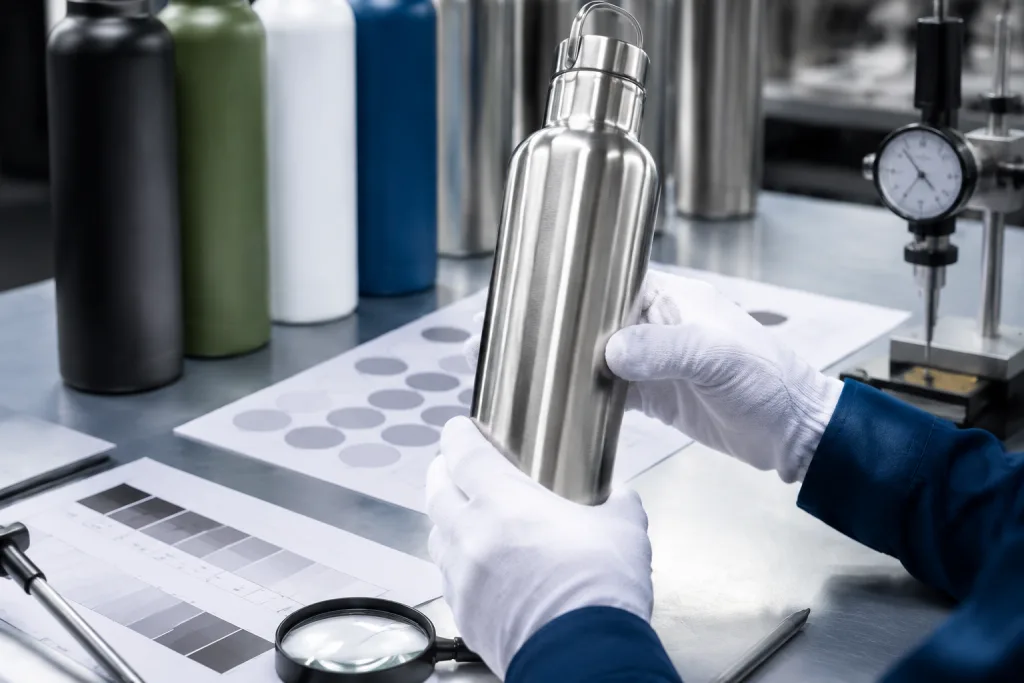
Packaging, Cartons, And Freight Math
Packaging is not an afterthought for decoration; it decides damage rate, CBM, and whether the goods can go straight to shelf. A standard vendor hydration flask ships in a white box, color box, kraft box, or gift tube, but the channel should drive the spec. For distributor canteen orders, we run plain white boxes with 30 x 50 mm SKU stickers because their warehouse usually re-labels inventory after arrival. Retail and gift programs need color boxes with barcode, legal text, capacity, material, and country of origin. The buyer once flagged a missing “Made in China” line on a PO proof; that small typo held artwork approval for 2 days.
Master carton strength needs a written spec, not a loose “export carton” note. For export from Zhejiang or other China production areas, common master cartons use 5-layer corrugated board. If your bottles are 750 ml or larger, ask for at least K=K or BC flute depending on carton weight and route. A 750 ml stainless flask often packs 24 pieces per carton, with gross weight around 11-14 kg depending on packaging. Once the carton goes past 15 kg, warehouse complaints start showing up, especially when one worker has to lift 180 cartons in a shift. QC pulled the sample carton on our compression tester last month; the weak corner failed before the tape seam did.
Add a drop test. ISTA-style testing is overkill for some repeat sea-freight orders, but a practical carton drop test from 76 cm on corners, edges, and faces catches weak inserts before the line packs 3,000 pieces. For ecommerce or FBA-style distribution, individual packaging must survive parcel handling, not only palletized sea freight. If you are buying distributor growler units, use thicker inserts or molded pulp to protect handles and caps. We’ve seen this go sideways: a handle looked fine after assembly, then cracked through the color box after a corner drop on the concrete floor near packing line 2.
FOB pricing should show packaging separately when possible. A color box can add USD 0.18-0.45 per piece, while premium gift packaging can add USD 0.80 or more. The math doesn’t work if that extra USD 0.35 only makes the buyer’s photo look nicer and gives no retail lift. Ask for the box unit cost, carton size in mm, and loading quantity per 20GP or 40HQ; we ship better when freight math is checked before artwork is locked.
MOQ, Inspection, And Supplier Reality
MOQ is where the spec sheet hits the line. At BottleForge Industrial in Hangzhou, we usually quote 1,000 pieces per color for stock molds and 3,000-5,000 pieces for new colors or special coatings. New mold work for a unique lid, body shape, or customized growler can require USD 1,500-8,000 in tooling and 25-40 days before production samples; our tooling room still checks lid threads with a 0.02 mm feeler gauge before we let sales promise a sample date. Normal production lead time is 30-45 days after deposit, artwork approval, and sample sign-off.
Payment terms vary, but 30% deposit and 70% before shipment is common for first orders from China. If you are a canteen distributor with repeat volume, negotiated credit comes later, not on the first PO; we had one buyer push for OA 60 days on a 1,200 piece trial order, and the math did not work. FOB Ningbo and FOB Shanghai are both practical from Zhejiang. Choose by sailing schedule and forwarder cost, not habit.
Inspection should be written into the purchase order. Use AQL 2.5 for major defects and AQL 4.0 for minor defects unless your channel requires tighter control. Define critical defects clearly: leakage after the 3-minute inverted test, vacuum failure after hot-water holding checks, rust on 304 stainless, sharp edges on the rim or handle, wrong material, unreadable barcode, and unsafe packaging. Major defects include visible dents, serious print misalignment over the approved artwork tolerance, coating scratches longer than the agreed limit, and wrong color against the Pantone chip. Minor defects include small cosmetic marks within agreed limits; QC pulled the sample under the light box, not beside a window.
A good canteen supplier will not object to inspection. Serious canteen vendors expect it. What matters is how they respond when defects appear. Ask for root cause, sorting plan, rework timing, and photo evidence from the line, including carton marks and close-ups of the failed units. We have seen this go sideways when a PO had one typo in the barcode file name and nobody caught it until final inspection. The cheapest canteen factory is rarely cheap after missed delivery windows, rejected cartons, and airfreight recovery.
Send Your Flask Spec For A Factory Quote
Share capacity, logo, packaging, market, and target price. We will return a practical MOQ, lead time, and FOB China quotation.
Frequently asked questions
What is a realistic FOB price for a vendor hydration flask?
For a 750 ml double-wall stainless vendor hydration flask from China, a realistic FOB range is usually USD 3.20-5.80 per piece for stock mold orders at 1,000-3,000 pieces. The low end normally means simple lid, standard powder coating, white box, and one-color logo. The high end may include 304 stainless inside and outside, heavier wall thickness, premium cap, color box, and laser or multi-color printing. A 1,000 ml flask may add USD 0.40-1.20 depending on steel weight and carton volume. Always ask the canteen supplier to split product, decoration, packaging, testing, and spare parts so you can compare quotes properly.
How do I compare canteen manufacturers without only choosing the lowest price?
Compare the spec line by line: steel grade, wall thickness, capacity tolerance, lid material, gasket material, coating type, logo method, carton strength, MOQ, lead time, and test reports. A canteen manufacturer quoting USD 0.50 less may be using thinner 0.4 mm steel, cheaper outer SUS201, or lighter packaging. Ask for a pre-production sample, current FDA or LFGB food-contact reports, and photos of vacuum testing equipment. For orders above 3,000 pieces, use third-party inspection with AQL 2.5/4.0. Good canteen suppliers answer technical questions directly; weak suppliers keep repeating “same quality” without numbers.
Can I order canteen customized packaging for multiple distributors?
Yes, but separate the product MOQ from packaging MOQ. The bottle itself may have a 1,000-piece MOQ per color, while color boxes may require 1,000-2,000 pieces per artwork because of printing setup. For canteen distributors, one efficient method is using the same bottle color and logo, then applying distributor-specific barcode labels or sleeves. If each distributor needs a different full-color box, cost and lead time rise. Build the packing list by SKU, not only total quantity. For North America, include FNSKU or UPC placement early; for Europe, check recycling marks and language requirements before box printing.
What tests should I require for custom canteen orders going to the EU?
For EU custom canteen orders, request LFGB or EU food-contact testing for stainless steel, plastic lid parts, silicone gaskets, and coatings that contact the mouth area. REACH screening is also sensible for painted or coated surfaces. If the flask is for children, discuss additional requirements and avoid small detachable parts. For physical QC, include leakage testing, vacuum retention testing, coating adhesion cross-hatch test, barcode scan check, and carton drop testing. Use AQL 2.5 for major defects and 4.0 for minor defects. The test report should match the actual model, material, and color system, not just a similar bottle.
Is a custom growler different from a standard hydration flask?
Yes. A custom growler is usually larger, often 32 oz, 40 oz, or 64 oz, and it needs stronger handle design, wider mouth tooling, and better dent resistance. For a 64 oz customized growler, we usually recommend at least 0.6 mm outer wall, a robust screw lid, and carton inserts that protect the handle. The unit price and freight cost are higher because steel weight and carton cube increase. MOQ for a stock-mold growler may start around 1,000 pieces, but new lid or handle tooling can push practical project volume to 3,000 pieces or more. Treat it as a heavier-duty product, not a stretched bottle.