Key Takeaways
- Start with 1,000 pcs MOQ for standard vendor hip flask bodies and 3,000 pcs for custom mold changes
- Use 304 stainless steel at 0.4-0.6 mm wall thickness for most promotional flask orders
- Approve a physical pre-production sample within 7-10 days before mass production starts
- Set AQL 2.5 for major defects and AQL 4.0 for minor cosmetic issues before shipment
You are not buying a vendor hip flask like a retail bottle off a shelf. You are buying a batch: 1,000, 5,000, or 20,000 units that need the same brushed finish, the same logo position within 1.5 mm, clean food-contact surfaces, and cartons that survive a drop test without corner dents. One loose line on the PO, like “silver logo” instead of Pantone 877C, can turn a small promo order into 38 cartons of buyer complaints.
At our Hangzhou, Zhejiang factory, most flask and canteen projects go wrong before the line even starts. The usual causes are plain: no capacity tolerance, no confirmed steel grade, caps that fail a 3 kg pull check, or artwork approved on a laptop screen instead of a pre-production sample. This is the wrong place to shop by catalog photos. We run better orders when the buyer locks the spec sheet first, then lets QC pull the sample and measure it with a caliper.
Start with the actual order
Start with a real order. You are buying for a distributor in Germany or the United States, and a beverage brand sends a PO for 5,000 matte black hip flasks for a winter retail promotion. They say a matching custom canteen or custom growler might come next if the shelf sell-through is clean. Fine. But the first order still has to ship. You need a canteen supplier or hip flask vendor who answers within 12 hours, marks the risk items on the spec sheet, and stays on WeChat or email after the deposit hits. We had one buyer flag “matt black” on the PO while the artwork file said “matte black”; QC pulled the sample under a D65 light box before we let the line run.
The wrong question is, “What is your best price?” That usually wastes 2 days. A useful RFQ for a vendor hip flask states capacity, material, finish, logo method, packaging, test requirements, and Incoterm. For example: 6 oz hip flask, 304 stainless steel inner and outer, satin or powder-coated finish, laser logo on front, individual white box, 5-ply export carton, FOB Ningbo, 5,000 pcs, AQL inspection before shipment. We also ask for carton drop requirements and barcode position, because a 3 mm logo shift or a missing FNSKU label can hold a pallet at the buyer’s warehouse.
For a standard flask body from our Zhejiang production line, MOQ is usually 1,000 pcs per color or finish. If you want a new body curve, special cap tooling, or a fully canteen customized shape, expect 3,000-5,000 pcs and 25-35 days tooling plus sampling. Existing molds move fast; new tooling does not. A canteen factory in China still has to cut metal dies, make polishing fixtures, run leak tests, and get sample approval before mass production. We run 100% water leak testing on flask bodies with a pressure jig, and one weak cap thread can stop 600 pcs on the line. One week is not a safe tooling timeline.
For pricing, a simple 6 oz stainless hip flask may land around USD 1.35-2.20 FOB Ningbo depending on steel grade, finish, cap quality, and packaging. A heavier boxed gift set can move above USD 3.50. If a quote comes in 25% below the other 4 suppliers, the math probably does not work. Check wall thickness with a micrometer, confirm whether 201 stainless is being swapped in for 304 stainless steel, and ask for carton specs before you compare landed cost. We have seen this go sideways: a cheap 5-ply carton looked fine in photos, then crushed at 14 kg during pre-shipment stacking.
Lock material before artwork
Artwork feels urgent because the brand team is waiting. Material is the one we lock first. It controls taste risk, compliance paperwork, scrap rate, and the landed cost on the PO. For a vendor hip flask, we run 304 stainless steel on all food-contact surfaces. Some low-cost canteen vendors quote 201 stainless steel to save about USD 0.08-0.15 per 6 oz flask, and that is the wrong place to save money. 201 can work on a non-food outer shell in certain jobs, but not for the liquid-contact interior. QC has pulled samples after a 24-hour acidic water check where the weld line already showed rust spots.
Ask the canteen manufacturer to write the steel grade in the proforma invoice, not just in a WeChat message or email thread. We have seen this go sideways when a buyer’s PO said “stainless steel flask” and the supplier read that as open grade. For most promotional flasks, a 0.4-0.5 mm body wall is common; our caliper usually reads 0.46 mm on a stable mid-market body. If you want a heavier hand feel, move toward 0.6 mm. The math doesn’t work if you ask for the cheapest quote and then expect a dent-free retail finish. Thicker steel adds cost and carton weight, but it cuts edge dents during crimping, polishing, and two container transfers.
Write down capacity tolerance too. A 6 oz flask does not always hold exactly 177 ml after forming, trimming, and seam welding. A workable tolerance is ±5% unless your retail label or market rule calls for tighter control; QC checks this with a graduated cylinder, not by eye. If the product is positioned as custom drinkware for alcohol gifting, ask whether your market needs LFGB, FDA food-contact documentation, REACH screening for coatings, or California Proposition 65 review. The right answer depends on where you sell. Not the factory address.
Plan related items at the same time. If the customer may add a canteen customizable line or customized growler later, ask whether the same powder coating code, logo Pantone, and 350 gsm packaging board can run across the set. A good canteen supplier will think in product families with shared specs: hip flask and custom canteen first, then customizable growler and stainless bottle when the buyer’s range expands. That keeps the shelf look consistent and avoids paying for 3 separate lab dips because someone typed “matte black” differently on the next PO.
Choose branding that survives handling
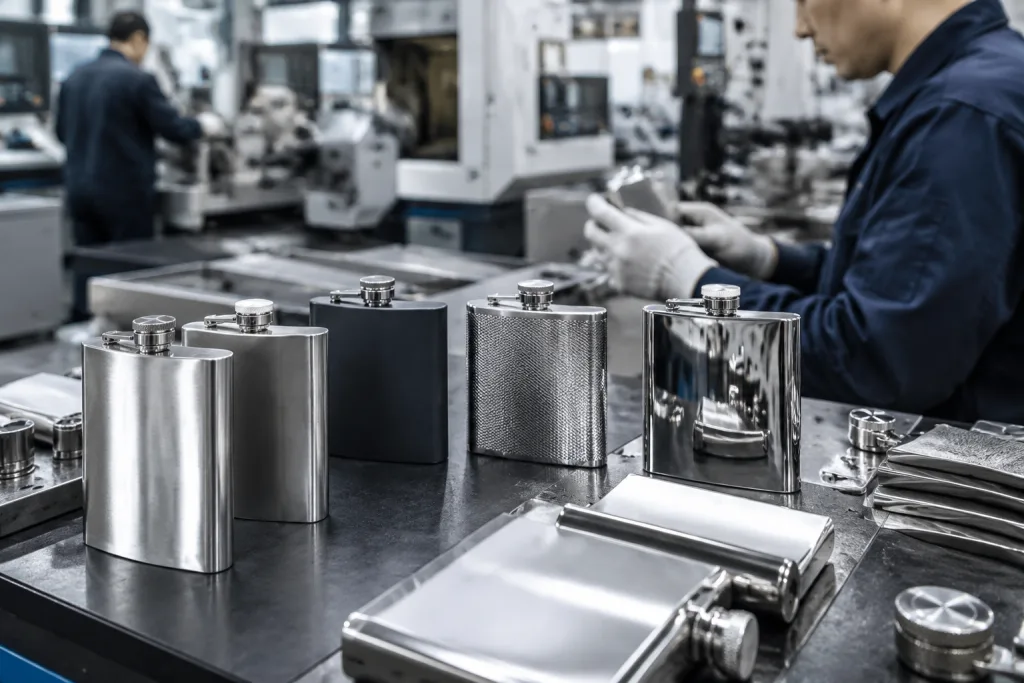
Logo method is not just a design choice. It changes scratch resistance, color match, line speed, and how many pieces QC rejects at final inspection. For a matte stainless vendor hip flask, we run laser engraving when the mark can stay as bare-metal contrast. It is permanent and tidy on the curved shell; our 20W fiber laser also keeps the edge cleaner than ink on a satin body. For a colored logo, silkscreen printing or pad printing is normal, but confirm ink adhesion on the coating first. Powder coating is where this goes sideways: QC should do a 3M tape pull after 24 hours, not just rub the sample with a thumb.
For a 5,000 pcs order, expect laser engraving setup around USD 30-80 per logo position. Silkscreen setup is usually similar, but each extra color adds registration risk and cost because the jig has to hold the flask in the same position every pass. If your artwork has fine lines below 0.2 mm, do not assume it will print clearly on a curved flask. This is the wrong place to trust a PDF. Ask for a real sample, or at minimum a printed film check measured with a caliper before the line opens.
A physical pre-production sample normally takes 7-10 days after artwork approval when using an existing body. This sample should show the actual finish and logo size, plus the cap and box from the same approved BOM. Do not approve mass production based only on a 3D mockup. Screens hide coating texture, laser depth, and print registration errors. We had QC pull a sample last quarter where the mockup looked centered, but the real logo sat 3 mm too close to the flask shoulder.
For a canteen promotional program, I usually advise buyers to limit the first run to one body color and one logo method. After the factory proves consistency, then add canteen customized colors or distributor canteen bundles with customized drinkware sets. We have seen 6 out of 20 canteen distributor projects lose margin because the buyer promised six colors to the end customer before checking MOQ per color. If MOQ is 1,000 pcs per color and the order is only 3,000 pcs, six colors will not work cleanly without a surcharge. The math doesn't work, and the PO usually gets messy fast.
Build the carton like insurance
Packaging is where buyers try to save USD 0.08 and later spend USD 800 handling complaints. We see it about 6 times a year. A hip flask has hard edges, a cap thread, and a brushed or mirror finish that picks up scratches fast; QC pulled one 6 oz sample last month with a 12 mm rub mark from a loose cap. If the flask is sold as a gift, the box is part of the product. For export, specify individual polybag or tissue wrap, fitted white box or kraft box, then a 5-ply master carton. For heavier gift sets, use inner dividers and 44 ECT or equivalent carton strength. Cheap cartons are false savings.
A typical 6 oz flask in an individual box may pack 100 pcs per master carton, but the final count depends on box size and gross weight. We run a scale check before carton sealing, and I prefer cartons below 15 kg where possible for easier warehouse handling in Europe and North America. The line moves better too. If your customer needs Amazon or retail distribution, carton labels, FNSKU labels, suffocation warnings, and barcode placement should be confirmed before production, not after cartons are sealed. We once had 1,200 cartons reopened because the buyer flagged the FNSKU height at 28 mm instead of 30 mm.
For a distributor growler or distributor drinkware program, packaging rules matter more because different SKUs may ship to different channels. A customizable canteen for retail may need a color box with a hang tag, while a vendor hip flask for an event may only need a plain white box. Do not let the factory choose packaging by habit; this is where we’ve seen clean orders go sideways. Send a packing instruction sheet with carton dimensions, carton mark layout, barcode file, and pallet preference, or at least mark “no pallet” on the PO. One buyer typed “kraft box” in email but “white box” on the PO, and the line stopped for 4 hours while sales confirmed it.
At BottleForge Industrial in Hangzhou, Zhejiang, our standard lead time for existing stainless flask and canteen manufacturer projects is 25-35 days after deposit and sample approval. Monthly drinkware output across flask, bottle, tumbler, and canteen lines is about 420,000 units. That capacity helps, but packaging approvals still sit on the critical path. A delayed barcode file can hold a finished order for three days. We ship fast when files are clean; when the carton mark arrives after packing, the math doesn't work.
Inspect before the balance payment
Do not treat QC as a factory favor. Put it in the PO before deposit. For a 5,000 pcs vendor hip flask order, we run ANSI/ASQ Z1.4 general inspection level II, AQL 2.5 for major defects and AQL 4.0 for minor defects. Critical defects get zero tolerance: contamination, sharp burrs, leakage, or wrong material. Last month QC pulled 200 samples from 42 cartons and found 3 mouths with a 0.3 mm burr, so the line had to re-polish the whole neck batch before we asked for balance payment.
Inspection is not just a beauty check. The basic list should cover capacity measurement with a 100 ml graduated cylinder, leak test, cap torque, thread fit, logo position, coating adhesion, carton drop condition, barcode scan, and carton quantity. For coating adhesion, use a cross-hatch tape test; it catches weak powder coating before the buyer flags flakes in retail photos. For leakage, fill the samples, cap them, invert them, then shake for 30 seconds. If the flask is for spirits, tell the customer plainly: short-term carrying, not long-term storage. We have seen this go sideways when a buyer expected whiskey to sit inside for 18 days.
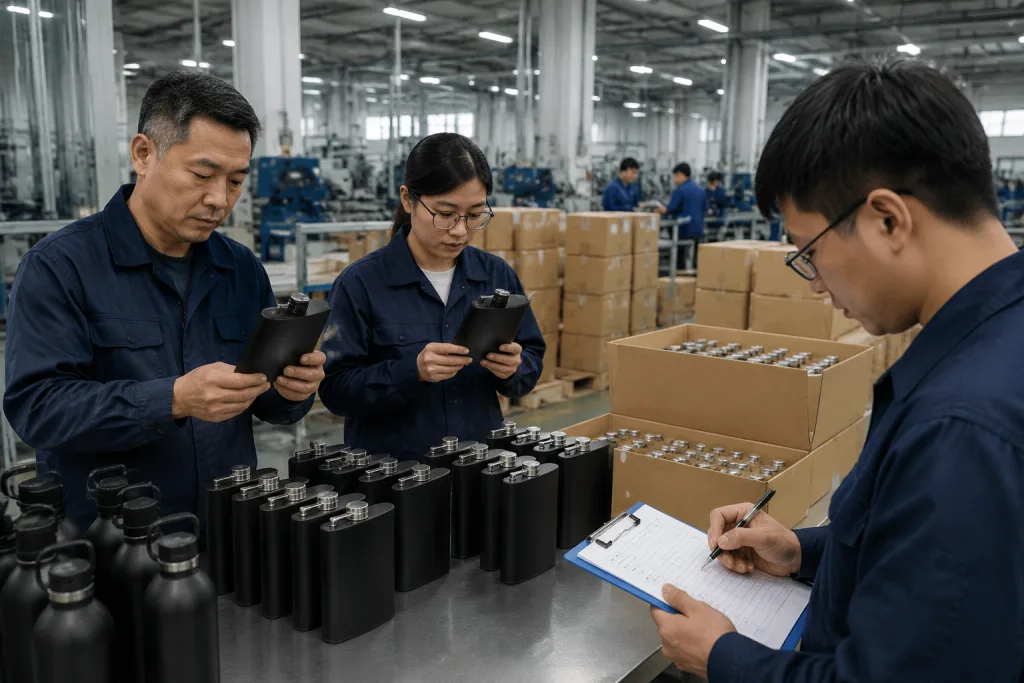
Common defects include pinholes near welded seams, uneven polishing around the neck, loose hinge arms on cap assemblies, print dust under silkscreen ink, and black specks in powder coating. Small defects. Big returns. On one matte black flask run, QC found 11 black specks per 125 inspected pieces under the LED inspection lamp, and the buyer rejected the carton photos before shipment. A canteen vendor that calls every defect “normal” is dodging the issue. Some tolerance is fair in metal forming, but the limit sample and defect photos must be signed before mass production.
If you use third-party inspection in China, book it when production reaches 80-100% finished and at least 80% packed. Inspect too early and you miss crushed gift boxes, wrong barcode stickers, and the classic PO typo where “24 pcs/ctn” becomes “48 pcs/ctn.” Inspect after paying the balance and the math doesn't work in your favor. Serious canteen manufacturers and canteen suppliers accept pre-shipment inspection because it keeps both sides out of emotional arguments later.

Quote freight with real assumptions
FOB Ningbo and FOB Shanghai are the normal quotes we run for Zhejiang flask orders; from Hangzhou, the truck to Ningbo port is usually 2.5-3.5 hours depending on the gate time. For a small trial order, buyers sometimes ask for DDP to a warehouse. Fine, but spell out import duty, import VAT, customs bond fee, residential or liftgate delivery, and appointment charges on the quote sheet. We have seen this go sideways. One US buyer flagged a “DDP included” line after the forwarder added USD 185 for warehouse appointment and inside delivery. A vendor hip flask in stainless steel is simple cargo, but the cartons are often 43 x 31 x 28 cm for 50 pcs, so CBM can hurt more than the unit price suggests.
Before you compare prices, ask each canteen supplier for the packed carton size, gross weight per carton, pieces per carton, and the HS code they used on the last export. Your customs broker makes the final call, but the factory should give a clean starting point from the packing table, not a guess from sales chat. If the shipment is 5,000 pcs, sea freight usually beats air unless your launch date is already in trouble. Air is the wrong question to ask for most flask programs; on one 8 oz model, QC pulled the sample at 142 g, and the air quote landed higher than the flask cost itself.
First-order payment terms usually sit at 30% deposit and 70% balance before shipment. Repeat buyers with steady monthly volume can ask for better terms after 2-3 clean orders, but the math does not work on a new logo job with open credit. If you are a canteen distributor building a seasonal program, place the order 60-75 days before your required warehouse date. We normally budget 7-10 days for sampling, 25-35 days on the line, 1 day for AQL inspection, then export booking, sailing, and customs clearance. On the factory floor, the production clerk still checks the PO against a caliper reading for mouth diameter, because one “8oz” typo on a PO once turned into a full carton mark reprint.
China sourcing works best when the commercial file is boring and complete. The purchase order should match the approved sample, artwork proof, packing sheet, and inspection checklist, with the same item number on each file. Short is good. Whether you buy a vendor hip flask, canteen promotional item, customized canteen, or a wider customizable drinkware family, the rule is the same: reduce interpretation. Factories repeat clear instructions fast. They get expensive when forced to guess, and QC will not save a file that left the logo size at “as sample” with no 38 mm measurement.
Send your hip flask specification for factory review
Share capacity, quantity, logo, market, and delivery date. We will reply with MOQ, FOB pricing, sampling time, and QC points.
Frequently asked questions
What MOQ should I expect for a vendor hip flask order?
For an existing stainless steel hip flask body, a realistic MOQ is 1,000 pcs per finish or color. If you need a new mold, special cap, unusual capacity, or a canteen customized body shape, expect 3,000-5,000 pcs. Logo method can also affect MOQ. Laser engraving is flexible at lower volume, while custom powder coating colors often require at least 1,000 pcs per color to keep coating loss reasonable. If a canteen vendor offers 100 pcs with full customization at factory price, check whether it is stock decoration rather than true production.
Is 304 stainless steel necessary for hip flasks?
For liquid-contact parts, 304 stainless steel is the safer standard for B2B custom drinkware. Some low-cost canteen suppliers quote 201 stainless steel to reduce price, but corrosion resistance is weaker, especially with acidic liquids or poor cleaning. For a vendor hip flask, specify 304 stainless steel in the purchase order and ask for material declaration. Typical wall thickness is 0.4-0.6 mm. If the product is for EU retail, also discuss LFGB, REACH coating requirements, and any local food-contact documentation with your importer or lab before mass production.
Which logo method is best for a promotional hip flask?
Laser engraving is the most durable option for a stainless or coated vendor hip flask, especially for one-color logos. It does not peel and handles warehouse friction better than ink. Silkscreen or pad printing is better when you need exact brand color, but you should run an adhesion test on the actual finish. For fine artwork, avoid lines below 0.2 mm. A physical pre-production sample usually takes 7-10 days after artwork approval and should be signed off before the factory starts 5,000 pcs of production.
How do I inspect a custom canteen or hip flask shipment?
Use a written AQL plan before production starts. For most distributor drinkware orders, ANSI/ASQ Z1.4 level II with AQL 2.5 major and AQL 4.0 minor is practical. Critical defects should be zero tolerance. Inspection should include leak testing, capacity check, cap fit, sharp edge review, coating adhesion, logo placement, carton quantity, barcode scan, and drop-related carton damage. Book inspection when production is 80-100% complete and at least 80% packed. That timing catches both product and packaging problems before balance payment.
Can one factory handle hip flasks, canteens, and growlers?
Yes, if the factory has stainless forming, polishing, coating, assembly, and packing capacity across several drinkware lines. A capable canteen factory can usually manage vendor hip flask, custom canteen, custom growler, and travel bottle projects under one color and QC system. The advantage is brand consistency across a customizable drinkware range. The risk is assuming every product shares the same MOQ or lead time. A customized growler may need different welding, pressure checks, and packaging than a 6 oz flask, so quote each SKU separately.