Key Takeaways
- A realistic MOQ for custom sports bottles starts around 1,000-3,000 pcs per color
- Tritan, PP, stainless steel, and PE each fit different gym price points
- Logo method should be chosen by bottle shape, order size, and washing expectations
- AQL 2.5/4.0 inspection is worth budgeting before FOB shipment
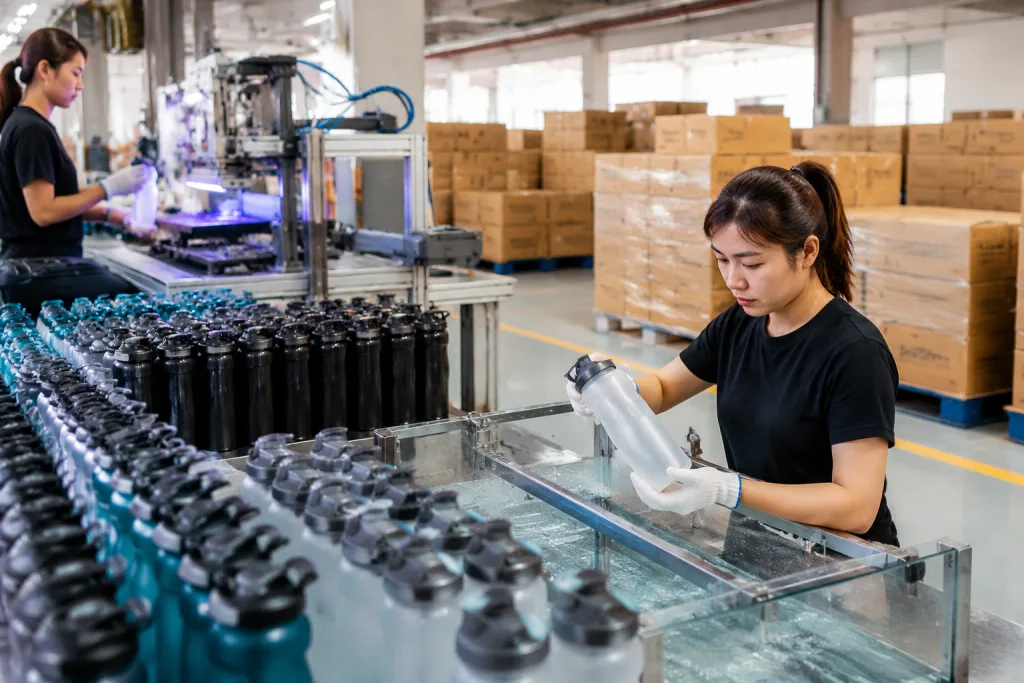
Your members do not care how hard sourcing is. They care if the bottle leaks in a gym bag, if the logo rubs off after 14 days, and if the shaker ball still smells after one protein mix. Fair enough. If you buy for a fitness brand or gym chain, a vendor gym water bottle is not a cheap handout. It is a daily-use item tied to renewals and counter sales. On our line in Hangzhou, QC pulled 32 samples last month where the flip cap looked fine, but the silicone ring was 0.4 mm too thin and failed the upside-down leak test.
Most sourcing trouble starts before the purchase order: loose specs, mixed plastics, weak caps, overpromised logo methods, and no inspection plan. We see the same questions from Europe and North America every week. The cheapest bottle in China is usually the wrong question to ask. The math does not work if 6% come back leaking at the front desk. We run better when the buyer locks material, capacity, lid style, logo size in mm, carton weight, and AQL 2.5 before the deposit; one PO last quarter even had “matte black” typed as “mate black,” and the buyer flagged it only after the pre-production sample.
Start With The Use Case
Before you ask for a quotation, decide what the bottle must survive. A member using a bottle during a 45-minute cycling class is not the same buyer as a supplement customer mixing whey powder twice per day. We’ve seen 30+ gym bottle projects go sideways at RFQ stage because the buyer wrote “nice bottle” on the sheet, then the factory quoted the easiest mold on the rack. Wrong question. Ask whether the cap must handle being dropped from a treadmill cup holder, whether the logo must survive 500 dishwasher cycles, and whether QC should pull samples for a 24-hour leak test.
For a gym chain, split your program into practical groups by selling point. Promotional bottles for sign-up campaigns are usually PP or PE, 500-750 ml, light wall, low cost, and bulk packed, often 100 pcs per export carton. Retail bottles for the front desk or online store need better caps, clearer material claims, stronger logo durability, and individual packaging with a clean barcode label. Shaker bottles for nutrition or personal training upsells need a proper mixing system, leak-resistant lid, and odor control from day one. On the line, QC pulled one shaker sample last month because the flip cap gap measured 0.6 mm too wide with a feeler gauge. That bottle would have leaked in a gym bag.
If you are sourcing a bulk fitness water bottle for 20-200 locations, do not let every branch choose a different model. Standardize the body, cap color, logo area, and carton pack. One 700 ml body with two or three cap colors is easier to control than five unrelated SKUs, and the warehouse team will thank you when reorders start. We run into this with franchise buyers: one branch wants black caps, another asks for translucent blue, then a PO arrives with “Pantone 2995C” typed as “299SC.” The math doesn’t work. Same mold, same artwork position, same 48 pcs carton pack keeps reorder cost down because the mold, printing jig, and packing setup stay stable.
For BottleForge Industrial in Zhejiang, a typical production line can handle about 300,000 plastic sports bottles per month, depending on cap complexity and printing. For a custom sports water bottle order, we usually advise 1,000-3,000 pcs per color as a workable MOQ. Below that, the unit price jumps fast because the screen-printing setup, masterbatch color change, and carton preparation still take the same factory time. A 600 pcs color run can take 12 hours of changeover and setup for a job that ships in 18 cartons. We ship those when needed, but for gym vendors chasing margin, it is usually the wrong place to save money.
Which Material Makes Sense
Material choice changes landed cost, gram weight, food-contact paperwork, odor claims, and the way a gym member reads your logo in hand. There is no universal best material for a vendor gym water bottle. This is the wrong question to ask. On our line in Hangzhou, a 650 ml plastic bottle can swing by 18-42 g depending on resin and wall thickness, and that small number shows up fast when the carton hits 12 kg.
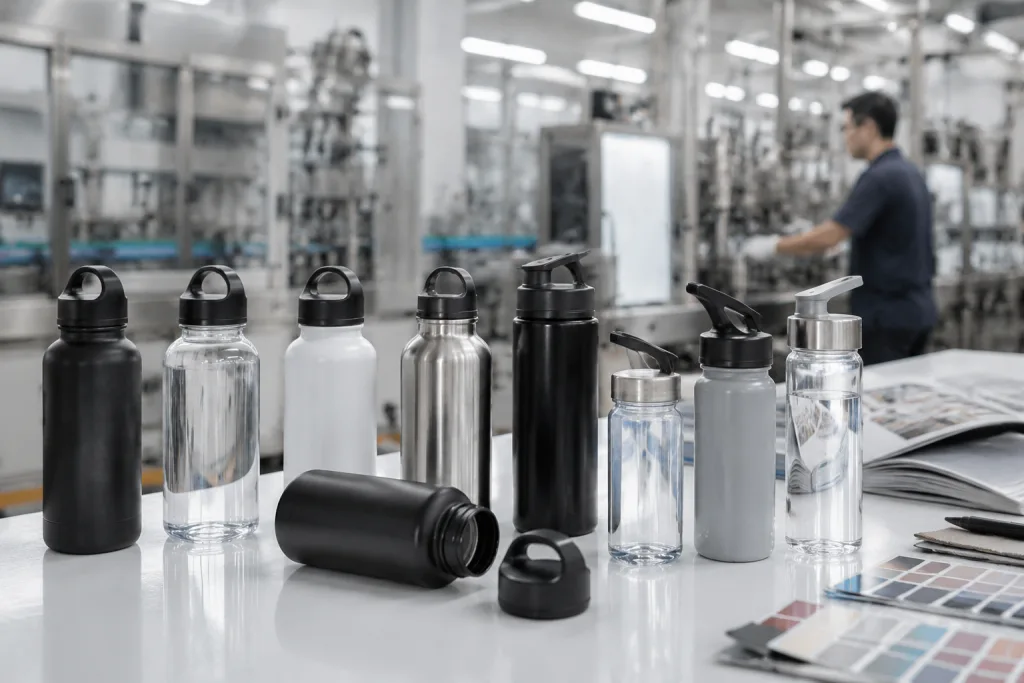
PP is common for a bulk gym water bottle and bulk shaker bottle. It is light, economical, and suitable for protein shakers. Food-grade PP can pass LFGB or FDA food-contact requirements when properly sourced. The trade-off is clarity: PP looks a little milky, and lower-grade resin can hold whey smell if users leave protein inside overnight. We had QC pull 20 shaker samples after a buyer flagged odor on day 3, and the problem traced back to recycled-content resin that was never approved on the PO.
Tritan fits a custom fitness water bottle sold at a higher price point. It gives glass-like clarity, stronger drop performance than basic AS or PS plastic, and a cleaner shelf look. Tritan costs more than PP, but for gyms selling bottles at USD 8-15 retail, the upgrade usually pays for itself. We run Tritan bottles with a 0.8-1.2 mm wall on most 600-750 ml molds, and the buyer pushback is almost always the same: “Can you make it look this clear but price it like PP?” The math doesn’t work.
Stainless steel works for premium customized sports water bottle programs. A 304 stainless double-wall bottle, usually 500-750 ml, can hold cold drinks for 12-24 hours depending on lid design and vacuum quality. It is heavier and more expensive, but it feels like merchandise, not giveaway stock. For one 750 ml gym order, our vacuum tester showed 4 bottles out of 200 losing cold time after 8 hours, so QC pulled the sample lot before laser marking started.
PE squeeze bottles still make sense for team training, cycling, and high-volume giveaways. They are not elegant. They are cheap, flexible, and familiar. For a distributor sports water bottle order, PE works when your buyer wants price first and logo second. We ship these in 1000-3000 pcs runs often, and the common inspection finding is logo stretch near the squeeze zone if the pad-print jig is set 2 mm too low.
Do not approve a material only from a photo. Ask for the resin type, food-contact declaration, and a physical sample before locking artwork; we have seen one PO typo turn “Tritan” into “PP” and the buyer only caught it after the pre-production sample arrived.
Logo Work Is Not Decoration
Your logo method is part of the build, not a decoration step. We have seen a 240 mm vertical logo look sharp on the proof, then stretch on a curved body once the pad printer hits the line. A small mark on a frosted shaker can lose the thin strokes. Metallic ink looks premium, but it can fail a rub test faster than a plain one-color print.
For a custom gym water bottle, the common logo options are silk screen printing, heat transfer, UV printing, laser engraving, and in-mold color components. Silk screen is the workhorse for 1 to 3 color logos. It stays cost-effective and repeatable, and it fits bulk sports water bottle orders above 1,000 pcs. Heat transfer gives more color and wraparound art, but the surface has to be clean and flat; QC pulled the sample twice on one job because the edge lift showed up after curing. UV printing works for short runs and complex graphics, though it is not the first pick for heavy dishwasher use.
Laser engraving works better on stainless steel than on plastic. If you want a custom logo shaker bottle with a permanent mark, engraving the stainless mixing ball or a metal lid accent is possible, but it adds handling cost and one more setup on the laser bed. For PP shaker bodies, printing is the practical call. The buyer often asks for engraving everywhere, but the math does not work.
Artwork files should come in vector format, usually AI, PDF, or EPS. Pantone codes matter. “Dark blue” is not a production instruction. If your gym brand has strict color rules, approve a printed pre-production sample under daylight and indoor lighting. Expect 5-7 days for logo proofing and 7-10 days for a pre-production sample if the base bottle is already available in China. We once caught a PO typo on the Pantone code, and the reprint cost was avoidable.
A practical checklist before artwork approval:
- Confirm the maximum print area in millimeters, not by eye.
- Check logo position against grip zones and volume marks.
- Use Pantone Solid Coated or Uncoated references where relevant.
- Run tape test and 300-cycle rub test for retail programs.
- Keep fine text above 1.2 mm line height for cleaner printing.
Shaker Bottle Questions Buyers Miss
A customizable shaker bottle is not just a cup with a lid. Most complaints we see start at the lid thread, flip cap, mixing insert, or smell after protein powder sits overnight. QC pulled 32 samples from one gym promo order last May; 5 leaked at the thread after a 1.2 m drop test with 500 ml inside. If the bottle is tied to a protein program, trainer package, or supplement subscription, these small parts matter more than the outside silhouette.
For a custom made shaker bottle, ask the factory to show how the lid seals. A screw lid with a silicone gasket is safer than a basic snap lid in a gym bag, but the gasket needs the right balance: removable for washing, tight enough that it does not fall into the sink. We check this with a small pull hook and a simple water inversion test on the line. The flip cap should pass repeated open-close testing; we normally recommend at least 2,000 open-close cycles for shaker lids intended for paid retail.
Capacity needs plain wording. A “700 ml” shaker may only feel comfortable at 600 ml once powder, ice, and shaking space are counted. If your label or website claims 24 oz, make sure the fill line and usable capacity do not mislead the buyer. We had one PO where “24OZ” was typed as “240Z,” and the buyer flagged it before artwork approval. North American buyers usually want ounce markings; European buyers ask for milliliters. Dual markings solve most distributor shaker bottle projects.
Mixing systems are not all the same. Stainless balls mix well and keep the unit cost down, but they rattle in cartons unless packed in a small PE bag or fixed inside the cup. Plastic grids reduce noise and can be molded into the lid or insert, but bad corners trap powder. We’ve seen this go sideways. For distributors gym water bottle orders, we usually recommend one standard mixing solution across the line, so customer service is not explaining 4 different inserts after delivery.
If odor is a concern, specify food-grade PP, smooth internal walls, and no unnecessary internal ribs. Protein powder finds every corner. During a 48-hour smell check, QC normally fills the sample with warm water and whey powder, then opens it after standing at room temperature. A low-cost customized shaker bottle with complicated inner geometry may look smart in a catalog and turn into a return problem after one month of use.
Price, MOQ, And Lead Time
Buyers ask us for the lowest FOB China price before they define the bottle. This is the wrong question to ask. For a vendor gym water bottle, the quote changes with material, gram weight, cap structure, logo colors, carton spec, AQL 2.5 inspection plan, and whether we can run an existing mold. Last month QC pulled a 720 ml sample that looked fine on the desk, but the cap had 4 parts instead of 2, and that alone added USD 0.18.
As a working FOB Ningbo or Shanghai range from Zhejiang, a simple 650-750 ml PP sports bottle may run USD 0.85-1.60 at 3,000 pcs. A PP bulk shaker bottle with ball or grid is often USD 1.20-2.20, with the spread coming from lid sealing, PE bag use, and carton strength. Tritan sports bottles usually sit around USD 2.20-4.50. Double-wall stainless steel bottles can range from USD 4.00-8.50 for standard 500-750 ml models. These are quoting lanes, not blind promises. Resin can move 3-6% in a month, the exchange rate can bite, and a 2-color silk print is not the same math as a one-position laser logo.
MOQ is usually 1,000 pcs for stock colors with simple logo, 3,000 pcs for custom body or lid colors, and 5,000-10,000 pcs if you need a new molded component. For a customized gym water bottle with a new cap, budget tooling from day one. A simple plastic cap mold may cost USD 2,000-6,000; a lid with flip lock, silicone seal, and carry loop can go higher. We had one buyer push back on MOQ after the Pantone chip arrived, but the line cannot purge custom blue resin for 600 pcs and keep the color stable.
Lead time depends on how much is custom. Stock bottle plus one-color logo can ship in 20-30 days after sample approval. Custom color plastic usually needs 30-40 days. New mold projects can take 45-70 days before mass production, especially if the first T1 trial needs adjustment on thread fit or leak rate. China has strong drinkware capacity, but factories still need clean AI artwork, deposit, and signed samples before production slots are locked. A typo on the PO, like “matte black” in one place and “gloss black” in another, can burn 2 days before anyone cuts film.
For gym chains planning seasonal campaigns, place the purchase order at least 90 days before launch if ocean freight is involved. Air freight can rescue timing, but the math doesn't work on bulky bottles. We ship 24-32 cartons per CBM on many sports bottle projects, so one late logo approval can turn a normal container plan into an ugly courier bill.
Compliance And Inspection Checklist
Handle compliance before we open the mold or book the line, not after 3,000 cartons are taped shut. For Europe, ask for LFGB, EU food-contact requirements, REACH for restricted substances, and packaging rules. For the United States, FDA food-contact suitability and California Proposition 65 depend on the material and the sales state. Kids’ bottles bring ASTM and CPSIA into the discussion; most adult fitness bottles still come down to food contact, chemical limits, and whether the silicone gasket passes the lab test. We usually ask for the test plan with the first PI, because a buyer once sent the LFGB request after mass production and the retest pushed shipment from 12 days to 18 days.
Factory audits belong in the same risk file. BSCI, Sedex, or ISO 9001 does not prove a bottle is leakproof, but it does show whether the factory keeps records, controls subcontractors, and closes corrective actions. If you sell into major retailers or a gym chain with 80 locations, ask early whether social compliance documents are required. Late audit questions go sideways. We had one PO where the buyer flagged a missing Sedex number only after carton labels were printed, and the packing line sat for 2 days while sales chased documents.
Inspection needs numbers. Use AQL sampling, commonly AQL 2.5 for major defects and 4.0 for minor defects. Critical defects should be zero tolerance. For a bulk sports water bottle order, QC should pull samples from finished cartons, not from the top of the packing table. Our inspector uses a torque meter, digital caliper, and a 500 ml measuring cylinder for this check. Inspection points should include:
- Leak test with bottle inverted and shaken for 30 seconds, then checked around the lid gasket and spout.
- Cap torque and thread fit on random samples, with cross-threading treated as a major defect.
- Logo position tolerance, often ±2 mm for standard printing, measured from the bottle centerline.
- Carton drop test for export packing, including one corner, three edges, and six faces.
- Odor check after opening sealed polybags, especially on PP lids and silicone seals.
- Capacity check against claimed ml or oz marking using a measuring cylinder, not visual guesswork.
For a distributor fitness water bottle program, packing mistakes cost almost as much as product defects. Confirm inner quantity, carton quantity, barcode placement, FNSKU if selling through marketplace fulfillment, and whether each bottle needs a hang tag, color box, or master carton only. This is the wrong question to ask after goods are sealed. We ship mixed-color orders every week, and one typo on a PO, such as “24 pcs/carton” instead of “48 pcs/carton,” can turn a clean 5,000 pcs order into a warehouse claim.
How To Brief A Factory
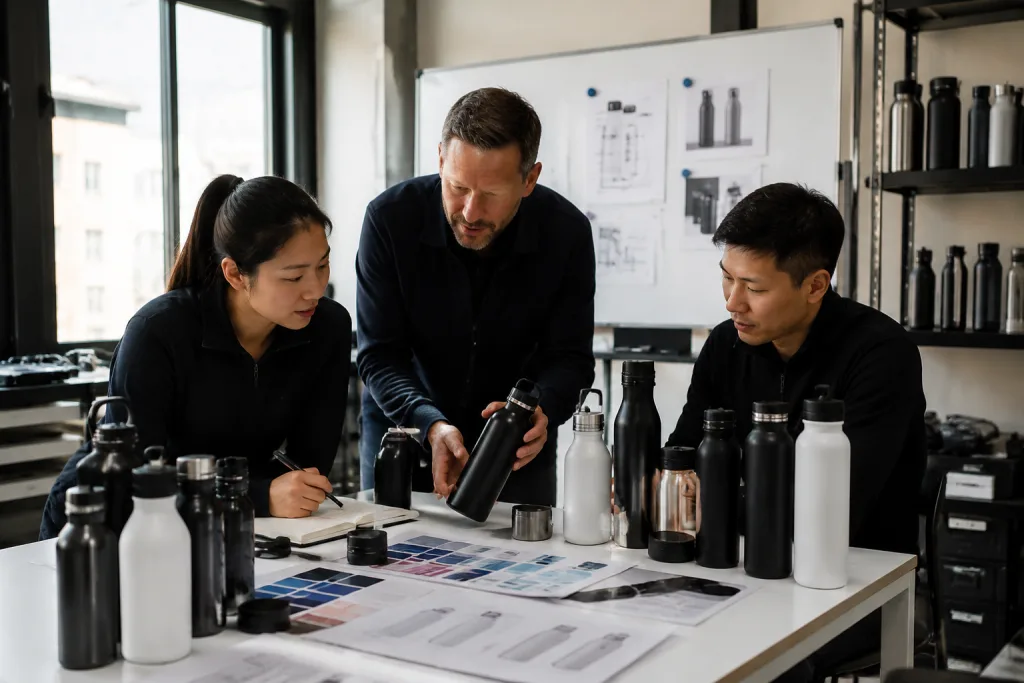
A tight RFQ can cut 3 email rounds down to 1. For a customizable sports water bottle, send a clean spec sheet, not screenshots from 5 catalog pages with different lids and capacities circled. We run quotes faster when the line can check the mold number, wall thickness, and logo position in one pass. “Best quality, lowest price” is the wrong question to ask. Last month a buyer sent that exact line, and our merchandiser still had to ask 9 follow-up questions before costing.
Your brief should include target capacity, material, lid type, color, logo size, logo colors, packaging, quantity by color, destination port, compliance market, and target price if you have one. If you are buying for distributors fitness water bottle channels, state whether the bottle will be sold wholesale, handed out as a gym membership gift, or packed with protein powder. The use case changes the bottle we quote. For a gym giveaway, we may suggest 600 ml PP with a flip lid; for retail, we usually check Tritan clarity under the light box and confirm the lid thread with a caliper to avoid wobble.
A practical RFQ line looks like this: “750 ml Tritan custom sports water bottle, matte black lid, one-color white silk screen logo 60 x 80 mm, individual kraft box, 5,000 pcs, FOB Ningbo, EU market, LFGB required, delivery needed before 15 June.” That is quotable. “Need customized fitness water bottle with logo, send price” is not. The math doesn’t work from that line because ink coverage, carton packing, and test market all affect the cost. QC pulled a 750 ml sample yesterday where the printed logo shifted 3 mm left, and that detail matters before mass production starts.
Ask for photos of existing molds, not just renderings. Ask whether the sample is from current production or an old showroom piece. Ask for net weight, carton size, and estimated CBM because freight matters. A 5,000 pcs order can look fine at unit price level, then lose money when the bottle shape wastes container space. We’ve seen this go sideways: one 820 ml bottle packed 24 pcs per carton at 58 x 42 x 36 cm, while a similar mold packed 36 pcs, cutting freight by about 18% on the same Ningbo shipment.
For gym chains and fitness brands, the safer first order is usually a proven mold with custom color and logo, not a fully new bottle. Start there. Inspect properly, check the sealing test, then consider a private mold after you know whether monthly sales are 3,000 pcs or 30,000 pcs. A new mold sounds better in a launch meeting, but it can add 25 to 35 days before sampling, and the buyer flagged that delay more than once when the club opening date was already printed on the PO.
Send Your Gym Bottle Brief For Quotation
Share capacity, material, logo, quantity, and market requirements. We will reply with MOQ, FOB price, sample timing, and practical options.
Frequently asked questions
What MOQ should I expect for a vendor gym water bottle order?
For existing molds, expect 1,000 pcs for a simple logo on stock bottle colors and 3,000 pcs per color for custom plastic colors. If you need a new cap, new body shape, or special molded grip, the MOQ often moves to 5,000-10,000 pcs because the factory must justify tooling, color setup, and production line changeover. For a bulk gym water bottle used across multiple gym locations, we recommend consolidating colors first. For example, 9,000 pcs split into 3 colors is much easier to manage than 9 colors at 1,000 pcs each. It also gives better control of color consistency and carton labeling.
Which bottle is best for a gym chain welcome gift?
For a welcome gift, choose durability and cost control over complex features. A 650-750 ml PP or PE bulk fitness water bottle is usually enough if the goal is member onboarding. If you want a more premium retail feel, move to Tritan with a stronger lid and one-color logo. Typical FOB China pricing might be USD 0.85-1.60 for PP and USD 2.20-4.50 for Tritan at around 3,000 pcs. Avoid fragile flip mechanisms for giveaway bottles unless they have been cycle-tested. A gym welcome gift is handled roughly, thrown into lockers, and washed inconsistently. Simple designs create fewer complaints.
Can I order one custom shaker bottle design for both Europe and North America?
Yes, but build the specification for both markets from the start. Use dual ml and oz markings, confirm food-contact compliance for EU and US requirements, and keep packaging claims conservative. For a custom logo shaker bottle, the same body can usually serve both regions if the material is food-grade PP, the lid seal passes leak testing, and the label avoids unsupported claims like “BPA free” unless documentation is available. If selling in Europe, ask about LFGB and REACH. If selling in the United States, ask about FDA food-contact suitability and Prop 65 review. This avoids relabeling and duplicated inventory.
How long does a customized sports water bottle project take?
For an existing bottle mold with a standard logo, plan 20-30 days for production after sample approval. Add 5-10 days for sample making and approval, depending on artwork complexity. Custom color plastic usually pushes total production time to 30-40 days. A new molded lid or body can require 45-70 days before mass production because tooling, first trial, adjustment, and approval all take time. Ocean freight to Europe or North America can add 25-45 days depending on port and season. If your campaign has a fixed launch date, start the project 90 days ahead.
What should distributors shaker bottle buyers check before placing a PO?
Check five things before issuing the purchase order: material declaration, leak test method, logo proof, packing plan, and inspection standard. For a distributor shaker bottle, also confirm whether each unit includes a stainless ball, plastic grid, extra compartment, or instruction insert. Small accessories are easy to miss during packing. Use AQL 2.5 for major defects and 4.0 for minor defects, with zero tolerance for critical defects such as sharp edges, broken lids, or serious contamination. Confirm carton size and gross weight too. Shaker bottles are bulky, and freight cost can change your landed margin more than a USD 0.05 unit price difference.