Key Takeaways
- A stainless vendor growler bottle should specify 304 steel, 0.45-0.60 mm wall thickness, and lid gasket material before sampling
- BottleForge typical MOQ starts at 1,000 pcs for stock-shape custom growler orders and 3,000-5,000 pcs for private molds
- Plan 25-35 days for mass production after artwork approval, plus 7-10 days for pre-production samples
- Use AQL 2.5/4.0 inspection with leak, coating adhesion, logo position, carton drop, and vacuum checks where applicable
A vendor growler bottle order looks simple until the 3 quotations land on your desk. One canteen supplier quotes 304 stainless steel, another writes “food grade,” and a third leaves out wall thickness, lid material, and carton drop test data. Bad sign. If you are buying custom drinkware for retail shelves, brewery merch, outdoor promos, or distributor programs, those blanks turn into 2% chargebacks, launch delays of 12 days vs 18 days, or logos that shift 3 mm off center on the line.
From our factory base in Hangzhou, Zhejiang, China, BottleForge Industrial sees the same buyer problem about 6 times a month: the sample looks fine, but the production file is thin. QC pulled the sample, the finish passed by eye, then the buyer flagged the PO because “matte black” was typed once as “mate black” and the carton spec was missing. A solid vendor growler bottle project needs locked specs, a MOQ the line can run cleanly, artwork tolerances, compliance documents, and an AQL 2.5 QC plan before deposit. China still gives strong value. Buy by numbers, not adjectives.
What Are You Actually Buying?
If you ask for a vendor growler bottle, do not accept a reply that says only “64 oz, USD 6.20.” That is the wrong question to ask. A growler is large-format drinkware, often 32 oz, 40 oz, 64 oz, or 2 L, but the buying job changes fast: brewery refill bottles need leak control, outdoor water bottles need dent resistance, and corporate gift bottles need clean logo placement. Last month our line rejected 37 swing caps because the wire bail sat 1.5 mm off center after assembly.
For stainless steel, we run 304 inner steel as the baseline, with 201 or 304 outer steel depending on the price target. For North American and EU buyers, 304 inner steel is the safer call because beer, kombucha, and cold brew punish weak material faster than plain water. Put wall thickness in the quotation. For many double-wall growlers, 0.45-0.60 mm is common; when a buyer pushed us down to 0.38 mm on a 64 oz sample, QC pulled the sample after a 76 cm drop test because the shoulder dented before packing.
If your program is closer to canteen promotional merchandise, a single-wall custom canteen may be enough. If you are selling through specialty retail, ask for a customized growler with vacuum insulation and a tested cap system, not just a nice powder-coated shell. A canteen custom order usually chases logo cost and fast repeat supply. A custom growler order needs better leak control and stronger packaging; we have seen this go sideways when a PO says “screw lid” but the approved sample used a silicone-sealed swing cap.
- Capacity: confirm US oz, metric ml, and fill-line tolerance, for example 64 oz / 1,900 ml with ±3% checked by measuring cylinder.
- Steel grade: list inner and outer material separately, such as 304 inner steel with 201 outer steel for a sharper price point.
- Lid: specify PP, stainless, silicone gasket, swing cap, or threaded cap, then ask for a 24-hour inverted leak test.
- Finish: choose powder coating, spray painting, polishing, or laser-safe coating, and state the logo size in mm on the artwork file.
- Use case: name the channel clearly, such as brewery refill, outdoor canteen, retail shelf, or distributor growler program.
One practical rule from our quoting desk: if two quotations differ by more than 12% and the spec sheet is not identical, you are not comparing the same product. The math does not work. We once found the gap in a missing egg-crate divider after the buyer flagged 18 scratched bottles in the pre-shipment photos.
Questions To Ask Before Quoting
A solid canteen manufacturer or growler factory will not get annoyed by detailed questions. Short, fuzzy replies are a warning sign. We see procurement trouble start with one line: “How much for 64 oz with logo?” The line then prices the thinnest acceptable spec, usually a lighter body, basic lid, and the cheapest carton. Bad RFQ. In our Hangzhou office, we once had a PO with “matte black” typed as “mate black,” and QC pulled the pre-production sample before 3,000 pcs went into the wrong powder coat.
Ask whether the item is a stock mold or private mold. Stock-shape customized drinkware moves faster because the tooling is already on the rack; for one 64 oz growler body, we can usually cut sampling time by about 10–14 days versus opening a new mold. Private molds make sense for a special cap, shoulder profile, handle, or retail silhouette, but tooling can run from USD 1,500 to USD 8,000 depending on structure. For a canteen customizable program, stock molds are usually the better first order. We’ve seen this go sideways when a buyer spends USD 6,200 on a private shoulder, then orders only 800 pcs. The math doesn’t work.
Ask for the packing method, not just carton quantity. A 64 oz customizable growler with powder coating should not rub against another bottle in ocean freight. For export cartons, we run individual polybag or tissue wrap, add egg-crate dividers when the coating is soft-touch, and use 5-ply master cartons. One buyer flagged scuff marks after a 26-day sea shipment because the sample carton passed, but bulk packing skipped the divider. If your products go to Amazon FBA or a retail DC, request carton dimensions in mm, gross weight in kg, barcode placement, and FNSKU or carton label handling before production.
Good RFQ questions include:
- What is the MOQ for this exact finish and logo method?
- Is the sample made from the same production line as bulk goods?
- What is the lead time after deposit and artwork confirmation?
- Can you provide REACH, LFGB, FDA, or BPA-free documentation?
- What AQL level is used for final inspection?
- What is the FOB port: Ningbo, Shanghai, or another China port?
At BottleForge in Zhejiang, our monthly drinkware capacity is about 450,000 units across stainless bottles, travel tumblers, canteens, and growlers. Capacity alone is the wrong question to ask. Scheduling discipline matters more. We ship repeat distributor POs by locking steel, coating, and carton slots on the production board; otherwise a 5,000 pcs growler order can get pushed behind a 40,000 pcs tumbler run. Ask the factory where your PO sits on the line, not just whether they have machines.
Cost Drivers Buyers Miss
Most vendor growler bottle price gaps come from five line items: 304 stainless vs lower-grade steel, 0.45 mm vs 0.55 mm wall, powder coat vs spray paint, simple screw lid vs gasketed or swing-top lid, and export carton spec. Logo cost matters, but it is not the biggest driver unless the buyer asks for full-wrap print or 2-3 artwork positions. We see this on the quoting desk every week; the buyer flags the logo first, then QC pulls the sample and the real cost is sitting in the body thickness.
As a rough FOB China range, a 64 oz stainless double-wall customized growler may sit around USD 6.20-9.80 per piece at 1,000-3,000 pcs, depending on cap, coating, and packaging. A simpler single-wall custom canteen can be far lower, sometimes USD 2.40-4.80 for common sizes, but it will not perform like an insulated growler. Use these as planning numbers, not a promise. Exchange rate, steel cost, and finish selection move the number fast; last month one PO had “matte black” typed as “mat black,” and the line stopped for 6 hours while sales confirmed whether the buyer meant powder coat or spray paint.
Powder coating costs more than basic spray painting, but it usually gives better abrasion resistance in a real carton drop, not just on a nice sample table. Laser engraving on powder coating looks clean for premium retail and brewery merchandise, especially when the logo height is kept above 18 mm so the mark does not fill in. Silk screen is cheaper for one-color canteen promotional orders with simple artwork. Heat transfer or water transfer gives richer graphics, but setup cost, defect risk, and curing time can push a job from 12 days to 18 days; we have seen this go sideways when the buyer approved a glossy sample and ordered a matte bulk finish.
Lids deserve more attention. This is the wrong question to ask: “Can you make the bottle cheaper?” Ask where the leak risk sits. A poor gasket can turn a good stainless body into a return problem. Silicone gaskets should be food-contact compliant and fitted consistently; our QC uses a 0.10 mm feeler gauge on random lids when the fit looks loose. Thread tolerance should be checked for leaking and cross-threading. If you need a swing-top custom growler, ask how the wire bail is tested. It is a small part, but buyers remember leaks more than they remember saving USD 0.18.
Cheap is fine when the specification is honest. Cheap plus vague is where B2B drinkware orders become expensive.
For distributor canteen or distributor growler programs, consider landed cost, not only FOB. A stronger carton may add USD 0.12-0.25 per unit, but it can prevent dent claims that cost several dollars each after repacking, credits, and account service time. We run 5-layer export cartons for heavier 64 oz items when the buyer allows it; the math does not work when a thin carton saves USD 0.16 and 37 pieces arrive with shoulder dents.
Customization Choices And Limits
Customizable drinkware is not a blank wall where we paste anything the sales deck shows. Every logo process has tolerance, minimum line width, curve distortion, and wash-test risk. We run artwork through a 1:1 film check first; last month QC pulled 6 growler samples because a 0.25 mm line filled in after coating. Better to catch it there.
Laser engraving is the safe premium choice on powder-coated 304 stainless. It stays on, has no ink adhesion problem, and works for names, brewery logos, and corporate marks down to about 3 mm text height if the font is clean. The limit is color. Laser shows the base metal or coating contrast, so if the buyer needs a red fox logo and blue wordmark on a canteen customized for a retail shelf, silk screen or UV print is the cleaner call.
Silk screen printing makes sense for 1-3 solid colors on flatter panels. On curved growlers, we write the logo position tolerance into the approval sheet, usually ±1.5-2.0 mm for placement with small rotation allowed. We have seen this go sideways: the buyer flagged 312 pcs as “crooked,” but the PO said only “front center,” with no seam reference or mm tolerance. For large wrap prints, the math gets worse because scrap rises and the line slows from about 900 pcs/day to 520 pcs/day.
For a customizable canteen or customized canteen aimed at outdoor retail, powder color consistency is where buyers push back hardest. Ask the canteen supplier for a Pantone target, but powder coating will not always match Pantone paper perfectly after baking at 180°C. We approve a physical color chip or pre-production sample under a D65 light box, not phone photos sent from a warehouse aisle.
Artwork checklist
- Vector file in AI, EPS, or PDF format, with fonts outlined so the plate room does not swap characters.
- Logo size in mm, for example 62 mm wide from the left edge, not just “front center.”
- Print color with Pantone reference or approved sample, plus powder chip number if the body color must match.
- Position from bottom or seam reference, measured with a caliper during first-piece inspection.
- Barcode, warning text, capacity mark, and country-of-origin text if required; one PO typo here can hold 5,000 gift boxes.
- Gift box dieline approved before mass printing, including flute direction and 3 mm bleed.
If you are a canteen distributor or brand owner running 8 or 12 SKUs, keep one master decoration file. Your canteen vendors should not reinterpret logo size every reorder. Repeatability lives in the file, not in someone’s memory, and we ship faster when the same AI file matches the last signed sample.
Compliance Is Not Optional
For Europe and North America, compliance is part of the product, not a PDF folder sent after the container leaves Ningbo. A canteen manufacturer should know which tests match the material, coating, gasket, and sales market. If the reply to every question is “FDA approved,” slow down. That answer is too thin. FDA food-contact expectations do not cover EU REACH, LFGB sensory testing, California Proposition 65 concerns, or child-specific rules; last month QC pulled a silicone-seal sample because the test report named TPR, not silicone, and the buyer flagged it before PO release.
For stainless growlers and canteens, buyers usually ask for FDA food-contact related documentation for the US, LFGB for Germany and broader EU confidence, REACH for restricted substances, BPA-free statements for plastic parts, and sometimes ASTM-related packaging or performance references depending on channel. If the item is marketed for children, CPSIA or ASTM considerations may apply. Do not sell an adult growler as a kids’ product without reviewing the full requirement set. We have seen this go sideways when a 64 oz growler with a 54 mm mouth was added to a “back-to-school” page and the importer then had to chase child-use paperwork after the artwork was already printed.
Factory social audits can also matter. Some retailers ask for BSCI, Sedex, ISO 9001, or factory audit reports before onboarding a canteen vendor. A 500 pcs promotional order may pass with basic product test files, but a 30,000 pcs national retail program usually will not. Ask early because audit scheduling is not instant; when we run a new audit slot, the auditor checks payroll files, needle-control records from the packing line, and even whether the emergency-exit light above workshop Gate 2 is working.
Compliance documents should match your actual product construction. A report for a different lid material, different coating, or old factory name may not satisfy a strict importer. If you need batch testing, budget time and money. Third-party lab tests often take 5-10 working days after sample receipt, and failing late can destroy a launch calendar. The math does not work when the vessel closes on Friday and the lab still has 3 samples on its bench, especially if the PO says powder coating but the test report says spray paint.
At our Zhejiang, China facility network, we build compliance review into the quotation stage when buyers tell us the destination market. This is not paperwork for show; it prevents the classic problem where the product is correct for one country and hard to clear or sell in another. We check the BOM line by line, down to 304 stainless, PP lid, silicone ring, coating code, and carton ink, before we quote mass production lead time.
QC Checklist Before Balance Payment
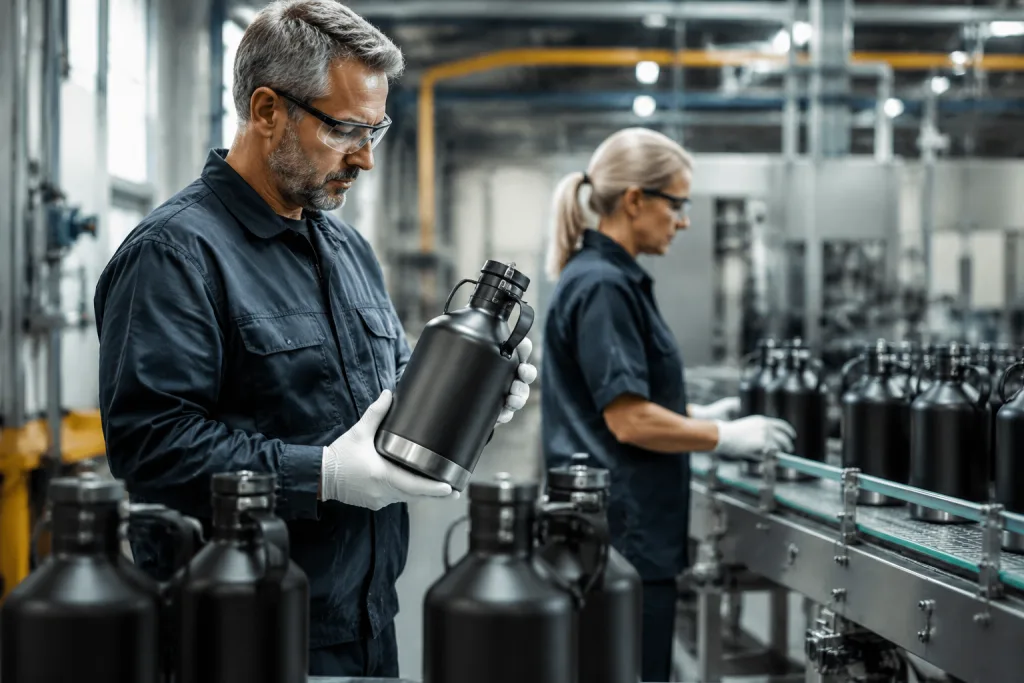
Run final inspection before balance payment and before the goods leave China. Once 1,200 cartons are on the water, your leverage drops fast. For vendor growler bottle orders, we use a written QC checklist tied to the approved sample, PO, and signed artwork; QC pulled the golden sample from the sample room and checked it with a digital caliper, scale, and 24-hour leak jig. Photos help, but they do not replace measured inspection.
We usually run AQL 2.5 for major defects and AQL 4.0 for minor defects, though some retail programs set tighter limits. Define critical defects in writing: leakage, sharp edges, wrong material, wrong capacity, unsafe odor, missing warning label, or barcode mismatch. Major defects include dents over the agreed limit, coating peel, weak logo adhesion, cap malfunction, wrong carton mark, or clear color mismatch against the Pantone chip. Minor defects cover small cosmetic marks inside tolerance, such as a 1 mm speck on the powder coat. We have seen this go sideways when the PO says “matte black” but the approved sample is charcoal black.
For vacuum insulated customized growler products, run thermal retention checks on sampled units. The test must match the claim. On our line, QC fills samples with 95°C water, locks the lid, records the starting temperature on the inspection sheet, then checks again after 6 or 12 hours with a probe thermometer. For leak testing, invert filled samples for 30 minutes, then shake 20 times over a white tissue. For coating, use cross-hatch adhesion or 3M tape tests where the finish allows it. For logo durability, rub testing matters on silk screen and UV print; buyers flag this after 2 weeks in store display if we skip it.
Pre-shipment checklist
- Capacity and weight match approved specification; check at least 13 units from different cartons on a calibrated scale.
- Logo size, color, and position match signed artwork, including the 2 mm placement tolerance if listed on the PO.
- Lid threads close smoothly with no gasket displacement after 10 open-close cycles.
- No metallic smell, plastic odor, oil residue, or loose debris; QC checks inside the bottle with a flashlight.
- Carton drop test completed for export packaging, with corner and edge drops recorded on the report.
- Inner box, barcode, FNSKU, and master carton marks verified against the buyer’s PDF, not a WeChat screenshot.
- Random units checked from multiple cartons, not only top cartons; we pull from front, middle, and back pallets.
If you work with 3 or more canteen suppliers, standardize this checklist. The math does not work if every factory defines “acceptable” in its own way. A shared checklist makes quotations easier to compare and cuts the usual argument after arrival, like whether 8 dented growlers in 500 pieces counts as normal handling damage or a claim.
How To Choose The Supplier
The best canteen vendor is not the cheapest quote or the thickest catalog. Wrong question. Ask whether the canteen manufacturer can turn your sales plan into shop-floor controls we can run on the line. For a brewery, that means swing caps checked with a 0.6 MPa air-leak tester and laser engraving that does not burn through the coating. For a canteen distributor, it means repeat colors matched against a Pantone chip, neutral cartons, and logo swaps without losing 4 days in artwork approval. For a promotional agency, it means the event date is real; if the PO says delivery on June 18 and the vessel books on June 6, the math either works or it does not.
Ask canteen manufacturers how they handle reorders. Do they keep color reference plates for 24 months? Do they store tooling in a numbered rack? Do they track the last logo file by PO number, not by “final-final.ai”? Can they split shipments by SKU and carton label without mixing silver 64 oz growlers into the matte black cartons? We have seen distributor drinkware programs go sideways because the buyer flagged a 2 mm logo shift on the second order and nobody had the approved sample photo.
Ask who owns the production file. A capable canteen factory should send a spec sheet showing material, capacity, dimensions, finish, logo method, packing, carton size, net/gross weight, MOQ, lead time, and inspection criteria. The file should read like something QC can use with a caliper and scale, not a sales screenshot. If you only receive a price and one product photo, you are buying hope; QC pulled samples last month where the carton mark had the right SKU but the PO typo changed “brushed” to “brushed black.”
For most first orders, I recommend starting with a stock mold at 1,000-2,000 pcs, one finish, and one logo method. Prove the supplier first. Test sell-through and collect customer feedback before you pay for private tooling. Move to a private mold or broader canteen customizable range only after repeat demand is real, because a new mold can add 18-25 days before mass production even starts. BottleForge can support custom growler, custom canteen, and broader customizable drinkware programs from Hangzhou, Zhejiang, with normal lead times of 25-35 days after sample approval for 40+ stainless SKUs we ship in export cartons with drop-test records.
A good supplier relationship should feel boring in the right way: drawings match the sample, emails answer the hard questions, cartons stack cleanly on a 1.1 m pallet, and delays are reported before the buyer has to chase them. Fewer surprises at inspection. That is the standard.
Send Your Growler Spec Before You Source
Share capacity, finish, logo file, market, and order quantity. We will return a practical FOB quote with MOQ, lead time, and QC notes.
Frequently asked questions
What MOQ should I expect for a vendor growler bottle order?
For a stock-shape stainless vendor growler bottle, a realistic MOQ is usually 1,000 pcs per color or finish. Some canteen suppliers may accept 500 pcs, but the unit price and setup cost often rise sharply. For private mold customized drinkware, expect 3,000-5,000 pcs, plus tooling cost. If you need several colors, ask whether MOQ applies per color or total order. At BottleForge in Zhejiang, China, we usually recommend first-time buyers start with 1,000-2,000 pcs in one color to validate quality and market demand before expanding the distributor growler range.
Is stainless steel always better than plastic for custom canteen products?
Not always. Stainless steel is stronger, more premium, and better for insulated custom growler or outdoor custom canteen programs. It also supports laser engraving and powder coating well. Plastic can be lighter and cheaper for high-volume canteen promotional campaigns, but it needs careful BPA-free and food-contact documentation. For EU or North American retail, stainless 304 inner material is often the safer positioning. If your target FOB budget is under USD 3.00, a plastic or single-wall option may fit better. If you want retail value above USD 18-25, stainless insulated construction is usually more credible.
Which logo method should I choose for a customized growler?
For premium customized growler orders, laser engraving on powder coating is the most durable and clean option, especially for brewery, outdoor, and corporate retail programs. For one-color canteen promotional orders, silk screen is usually cheaper and works well when the logo area is not too curved. UV print can handle more colors, but adhesion and scratch resistance must be tested. Ask for a pre-production sample and define logo tolerance, commonly ±1.5-2.0 mm. If the product will be washed frequently, avoid decoration methods that have not passed rub, tape, or dishwasher-related screening.
How long does production take after I approve the sample?
For stock-mold stainless growlers or canteens, plan 25-35 days for mass production after deposit, artwork approval, and sample sign-off. Pre-production samples usually add 7-10 days, depending on finish and logo method. Custom molds add more time: simple tooling may take 20-30 days, while complex lids or handles can take longer. Shipping is separate. Ocean freight from China to Europe or North America can add several weeks, while air freight is faster but often uneconomical for heavy stainless drinkware. Build your calendar around approval date, not quotation date.
How do I compare two canteen vendors fairly?
Put both quotations into the same specification table. Compare steel grade, wall thickness, capacity tolerance, lid material, gasket material, coating type, logo method, packing, carton strength, compliance documents, AQL level, MOQ, lead time, and FOB port. If one canteen vendor gives a lower price but omits packaging or uses thinner steel, it is not a true saving. Ask both canteen vendors to quote against the same drawing and artwork file. For distributor canteen programs, also compare repeat-order handling, carton labeling, and whether they can support split SKUs without creating warehouse confusion.