Key Takeaways
- A realistic MOQ for custom sports bottles is 1,000-3,000 pcs per model and color
- Tritan, PP, stainless steel, and PE each fit different gym, shaker, and retail programs
- Lead time is usually 25-35 days after artwork and pre-production sample approval
- Use AQL 2.5/4.0 inspection and written leak-test standards before paying balance
A vendor fitness water bottle looks simple until the first shipment lands with loose lids, cloudy logo printing, wrong carton labels, or a 42 mm mouth that won’t take standard ice cubes. We’ve seen this go sideways. One gym-chain buyer flagged 312 bottles in a 5,000 pc run because the flip lids rattled during their reception-desk check.
At our Hangzhou, Zhejiang factory, we run sports bottle sourcing from the spec sheet, not from catalog photos. China can make cheap bottles or solid bottles; the gap sits in millimeters, grams, resin grade, AQL limits, and carton rules. QC pulled the sample last month with a 0.6 mm lid gap, and that tiny number would have become a return claim if we had approved the custom sports water bottle order too fast.
Start with the bottle type
The first spec line is not logo size. It is bottle type. A vendor fitness water bottle for a 120-member boutique gym is a different job from a bulk shaker bottle for whey powder sampling, and neither matches a stainless custom gym water bottle for staff retail. We saw this go sideways on a PO from a yoga studio in May: the buyer asked for a “premium giveaway,” then pushed back when the vacuum bottle landed 38% over the giveaway budget. Wrong bottle, wrong math.
For gym chains, we usually quote single-wall PP bottles at 500-750 ml for low-cost member giveaways, Tritan sports bottles at 650-1,000 ml for retail shelves, stainless steel vacuum bottles at 500-950 ml for premium custom fitness water bottle programs, and shaker bottles at 500-700 ml with mixing balls or grids. Shakers need their own leak check. Powder residue sits around threads and flip caps, so QC runs the sample with 20 g protein powder, warm water, and 30 seconds on the rotary leak tester. A custom shaker bottle also needs enough print area for measurement marks, nutrition branding, or campaign copy; on a 600 ml body, we normally keep the logo panel under 85 mm wide to avoid distortion.
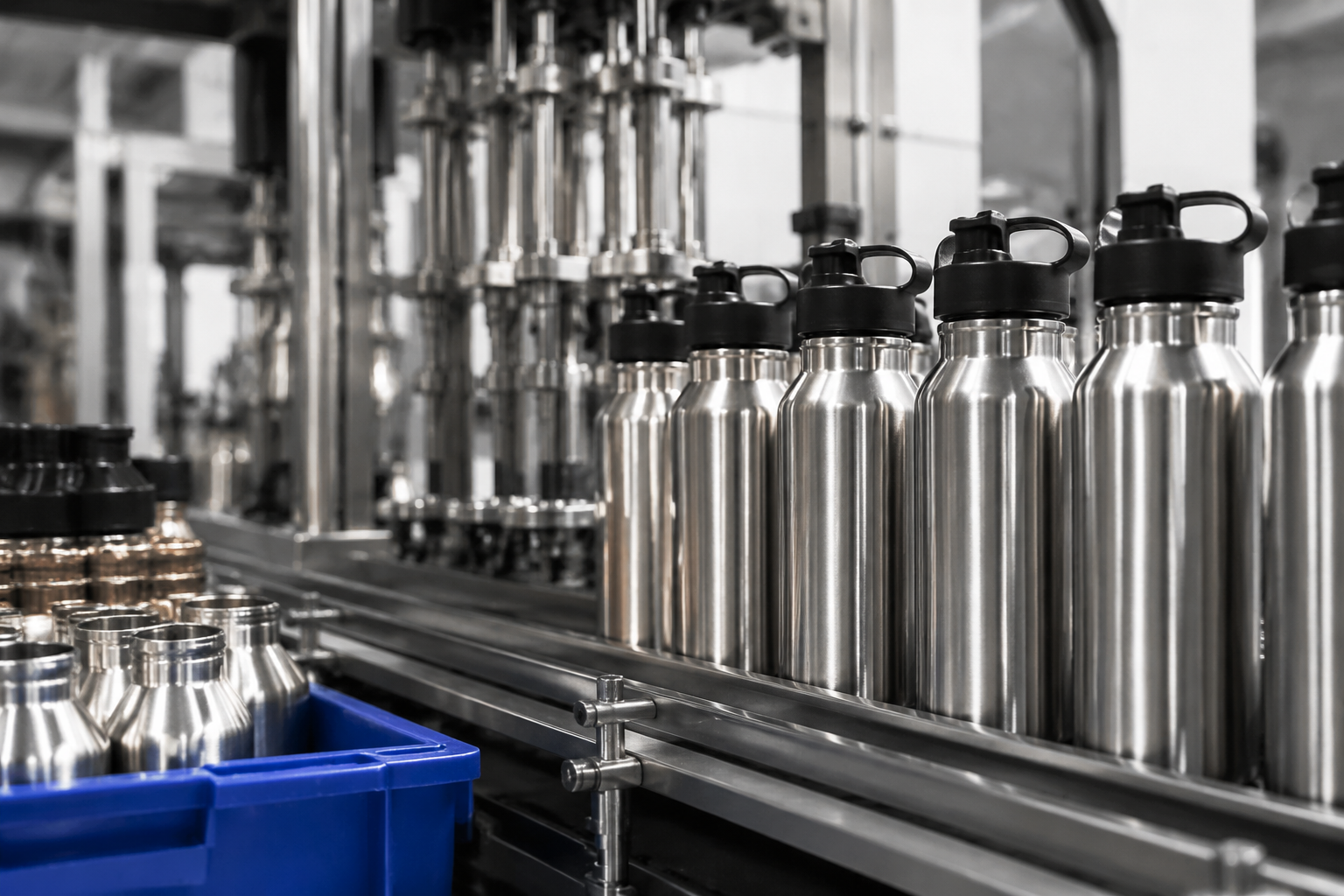
For a distributor sports water bottle program, keep the line tight. Three sizes and four colors sound flexible, but that creates 12 SKUs before the first carton is packed. If your first PO is 3,000 pcs, one model in two colors is usually smarter than six SKUs at 500 pcs each. The buyer flagged this exact issue last quarter after their warehouse had 1,180 slow-moving purple bottles left. Our Zhejiang production line can run around 420,000 plastic sports bottles per month, but every color change still needs hopper cleaning, pigment ratio checks, and separate QC tags at the packing table.
Use the application to choose the structure. A bulk gym water bottle for class check-in desks can use a simpler screw lid. A customized sports water bottle for cycling or HIIT needs one-hand opening, a carry loop, and better impact resistance; we run a 1.2 m drop test on the cap side because that is where failures show first. For distributors gym water bottle projects, do not over-customize the first run unless the buyer has already tested sell-through. MOQ looks harmless on paper, but 5,000 pcs with a custom mold and 18-day lead time can tie up cash fast.
Material grade changes everything
Material is where buyers under-spec the PO. “BPA-free” is the wrong question to ask. Ask for the resin code, food-contact report, heat range, and recycled-content ratio before we open a mold file in CAD. For Europe and North America, we usually quote Tritan, PP, PE, 304 stainless steel, or borosilicate glass by bottle style; last month QC pulled 12 random caps from the line because the PO said “clear plastic” but the approved sample was Tritan TX1001.
Tritan is the safer pick for a transparent custom sports water bottle that still looks shelf-ready after 30 dishwasher cycles. It costs more than PP, but odor and clouding complaints drop fast. PP works for a bulk fitness water bottle when the buyer is chasing price and the body is opaque or semi-transparent. PE is soft and squeezable, common for bike bottles, but the scratch marks show up after one rough carton rub test. For stainless steel, 304 inner wall is the normal export spec; 316 can be quoted, but the math usually fails unless the brand is selling a marine or medical-positioned bottle. We run 304 sheet on the standard vacuum line at 0.4-0.5 mm, and buyers still flag dents when they choose a 1-piece mailer instead of a 5-layer carton.
Ask for a written compliance package before deposit. For EU buyers, that usually means LFGB or EU 10/2011 food contact, REACH for restricted substances, and sometimes BSCI factory audit documents. For US buyers, FDA food-contact conformity and, for kids-related programs, CPSIA or ASTM references may apply. A customized fitness water bottle sold through a gym is still a consumer product; “promotional only” does not remove compliance risk. We’ve seen this go sideways: one buyer sent artwork with “BPA FREE” in 6 mm letters, but their file had no FDA report number, so the shipment sat 9 days while the lab reissued the PDF.
Wall thickness also matters. For Tritan sports bottles, we commonly see 1.8-2.4 mm wall thickness depending on shape; the caliper reading on the shoulder tells us more than the catalog photo. Stainless vacuum bottles often use 0.4-0.5 mm inner and outer 304 stainless steel, with thicker gauges available if dent resistance matters more than weight. If your target retail price is USD 14.99, you can afford better material. If your giveaway cost target is under USD 1.20 FOB China, you cannot demand premium resin, a flip cap with silicone seal, and five-color printing on a 3,000 pcs MOQ. The line cannot eat that cost.
Capacity, dimensions, and hand feel
Capacity is not just a label on the carton. It sets the mold size, carton volume, freight cost, hand weight, and cup-holder fit. A 1,000 ml customizable sports water bottle photographs well, but once QC fills it on the line, the sample sits close to 1.25 kg with cap and straw. Some gym buyers flag that weight for treadmill users. A 500 ml custom gym water bottle carries easily, but for 60-minute strength classes the math does not work; members come back asking for refills.
For fitness brands, we run 650-750 ml most often for plastic sports bottles. That size fits most side pockets, works in women’s and men’s gym bags, and keeps the filled weight under control. For shaker bottles, 600 ml is common because it leaves around 80-100 ml headspace for powder mixing without leaking into the flip cap. For stainless vacuum bottles, 600-800 ml sells well in gym retail, while 950 ml fits outdoor and endurance programs better. Last season one buyer pushed for 1,200 ml for a yoga chain; we pushed back after the packed carton hit 18 kg.
Check three physical dimensions before approving a mold or stock model: body diameter, mouth diameter, and total height. A body diameter under 74 mm is safer for car cup holders. A mouth opening of 45-55 mm handles ice and cleaning brushes without making the cap look oversized. Total height above 260 mm creates shelf and carton trouble; we have seen 12 bottles per carton turn into 9 because the lid added 8 mm. If you are building a distributor fitness water bottle line for regional gyms, carton efficiency beats a dramatic silhouette.
Hand feel is harder to write on a PO, but you can still control it. Matte spray, powder coating, silicone sleeves, frosted texture, and grip ribs all change perceived value; specify the surface code and ask for a wet-hand check. A customizable gym water bottle for paid retail should not feel slippery after condensation. A bulk sports water bottle for an event can be lighter, but the cap still needs a clear grip area. Request two pre-production samples: one filled with water for handling and one empty for checking balance, printing, and shelf look. QC pulled a sample last month where the logo was fine, but the bottle rocked 2 mm on a glass table.
Cap system and leak rules
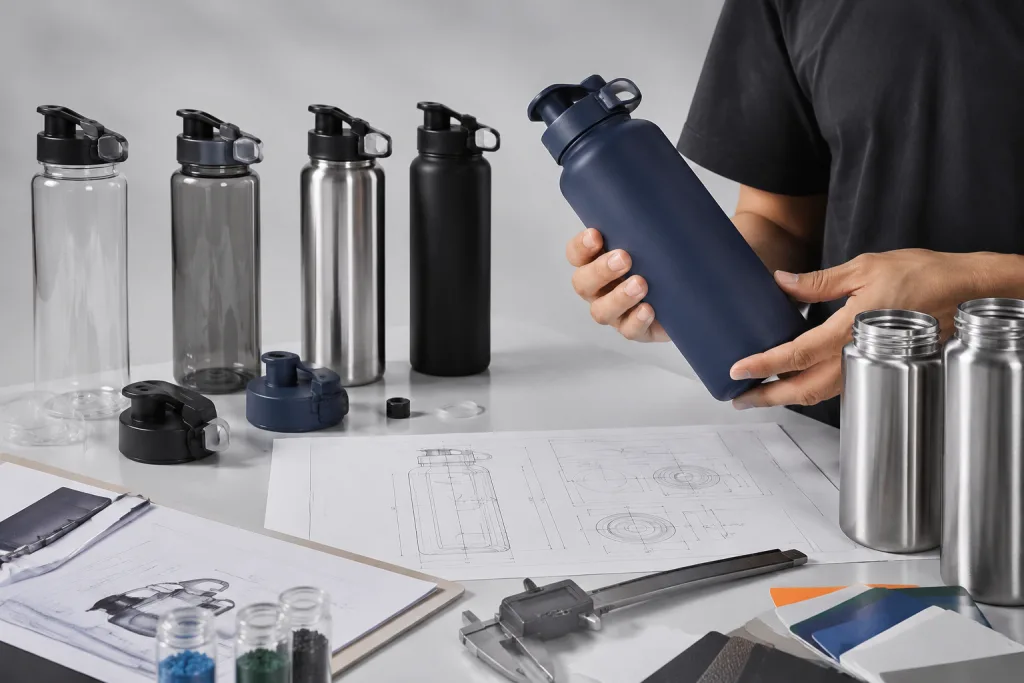
The cap causes more after-sales claims than the bottle body. We see it every season. A low-cost cap can wreck an otherwise solid custom made shaker bottle, especially when the buyer only approved the cup weight and forgot the closure drawing. Define the closure system on the spec sheet: screw cap, flip lid, push-button lid, straw lid, spout lid, or shaker lid with grid. Each one needs its own mold check, gasket size, assembly step, and leak test; on our line, QC measures the silicone ring with a digital caliper before the first 50 pcs move to packing.
For gym chains, flip lids sell well because members can open them with one hand, but we test for drop impact and accidental opening. The buyer will flag this fast if bottles pop open inside a gym bag. Straw lids are common for a custom sports water bottle, but the silicone straw and air valve add 2 extra failure points and can hold odor after protein drinks. Shaker lids need deeper thread engagement because users shake protein powder hard, not politely. A custom logo shaker bottle should be tested with water and a powder-like load, not clean water only. We run a practical internal test: 30 seconds inverted shaking, then 10 minutes upside down at room temperature before batch approval.
Write the gasket material into the spec. Food-grade silicone is the usual choice; TPE appears in some lower-cost caps, but the math does not work if it saves USD 0.015 and creates 3% returns. Ask whether spare gaskets can ship at 1-2% of order quantity. This matters for distributors shaker bottle programs because lost seals make the bottle look defective even when the body is fine. QC pulled one sample last month where the PO said “black seal,” but the artwork file showed translucent silicone; that small typo held packing for 6 hours.
For leak testing, do not accept “100% leakproof” as a casual promise. Wrong question to ask. Define the test: filled to 90% capacity, cap tightened to normal hand torque, inverted for 10 minutes, no visible dripping. For shaker bottles, add shake testing. For sports lids, add open-close cycle testing, such as 1,500 cycles for the flip mechanism on a mid-range product. China factories can meet clear standards. We cannot meet standards that were never written down on the QC checklist.
Decoration line by line
Decoration is the point where brand owners get excited and procurement starts asking for risk control. A custom fitness water bottle can take silkscreen printing, heat transfer, UV printing, laser engraving, water transfer, embossing, debossing, or a full-color wrap, but the bottle material decides half the answer before artwork even reaches our prepress desk. The wrong question is “which decoration looks best?” The better question is “which one survives the buyer’s wash test and still hits the target cost?” On our line, QC checks the first 20 pcs against a 0.5 mm position mark from the seam before mass printing starts.
Silkscreen is our daily workhorse for one- to three-color logos on plastic and stainless bottles. It works well at 1,000 pcs and above, and the math starts to look better once the screen charge is spread across 3,000 pcs. Small text under 1.2 mm can fill in, especially on a curved 74 mm diameter body where the squeegee pressure is not even across the print area. Laser engraving is strong on powder-coated 304 stainless, and QC pulled samples after 50 dishwasher cycles with no logo peel, but it will not reproduce full-color graphics. Heat transfer gives a wider color range for a customized gym water bottle with lifestyle artwork, though setup cost is higher and the surface temperature has to stay controlled on the fixture.
For a custom logo shaker bottle, look hard at the measurement marks. If the bottle has ml and oz markings, decide whether they are molded, printed, or made as a transparent window style before the mold quotation goes out. Printed marks can rub if the wrong ink system is used; we have seen this go sideways when a buyer approved the logo but forgot the 500 ml scale in the artwork layer. Molded marks cost more upfront but last through normal use. If your shaker is sold with supplements, a 20 ml error on volume marks turns into bad reviews fast.
Artwork files should be vector AI, PDF, or EPS. Define Pantone codes, print size in mm, position from base or seam, and acceptable color tolerance, not just “same as sample” on the PO. A practical tolerance is Delta E under 2.0 for strict retail programs, while about 70% of promotional jobs we ship accept a visual match against a signed Pantone reference. For a customizable fitness water bottle ordered by several franchise locations, we usually run one common mold and one shared base color, then change only the logo panel. That keeps MOQ tighter and cuts lead time from about 18 days to 12 days after artwork approval.
Pricing, MOQ, and freight math
FOB price is only one line on the cost sheet. A vendor fitness water bottle can quote at USD 0.85, USD 2.40, or USD 6.80 FOB Ningbo or Shanghai based on resin, capacity, cap structure, logo process, and packaging. If two offers are 25% apart, the wrong question is “which factory is cheaper?” We run a gram-weight check on the scale first: material grade and bottle weight, then cap parts, printing method, carton quantity, and inspection terms. Last month QC pulled a 650 ml PP sample that was 7 g lighter than the approved sample; that “saving” showed up as soft sidewalls.
From China, a basic 650 ml PP bulk sports water bottle usually sits around USD 0.75-1.30 FOB at 5,000 pcs. A 750 ml Tritan customized sports water bottle is normally USD 2.20-3.80 FOB when we use an existing mold and a one-color silk print. A stainless vacuum custom gym water bottle can run USD 4.20-8.50 FOB, with the gap coming from powder coating thickness, lid design, and wall gauge. A bulk shaker bottle is commonly USD 0.95-2.20 FOB; odor-resistant material, mixing grids, or private mold parts push it up. The line checks Tritan clarity under a 6000K inspection lamp because buyers have flagged “gray-looking” bottles even when the resin spec was correct.
MOQ comes from material color, molding setup, logo process, and packaging, not from a factory trying to make life hard. For existing molds, 1,000 pcs per color is workable on 18 of our regular plastic sports bottle styles. Stainless steel color coating usually starts at 2,000-3,000 pcs per color because one powder-coating booth change takes roughly 45 minutes and wastes about 1.5 kg of powder during cleanup. A custom made shaker bottle with private mold can require USD 3,000-12,000 tooling and 5,000 pcs MOQ, depending on lid complexity and thread tolerance. We have seen this go sideways when a PO says “blue” but the buyer expects Pantone 2925 C.
Freight can change the winner. A 750 ml plastic bottle may pack 48 pcs per master carton, while a bulky straw lid bottle may pack only 24 pcs, so the cheaper FOB item can lose on CBM. If you ship to Amazon FBA or regional gym warehouses, ask for carton dimensions, gross weight, FNSKU labeling options, and pallet loading estimates before deposit. We measure cartons with a tape at the packing table, not from a catalog drawing, because a 10 mm carton height change can affect pallet count. Our standard lead time in Zhejiang is 25-35 days after sample approval for repeat molds, plus 3-7 days for logo sample preparation. Peak season before summer can add 7-10 days, and the math does not work if your retail launch needs goods in 18 days.
Inspection before balance payment
Put QC terms in the purchase order before we cut steel for the logo fixture. Do not leave it for the day defects show up. For fitness brands and gym chains, we usually write in signed pre-production sample approval, 2 inline checks while the line is running, plus final random inspection before the 70% balance payment. The basic inspection level is usually AQL 2.5 for major defects and AQL 4.0 for minor defects, but critical defects such as oily residue inside the bottle, sharp mouth rims over 0.2 mm burr, cracked caps, or any leaking after a 30-minute inverted test should be zero tolerance.
Define defect categories in plain words. Major defects include leakage, wrong logo position by more than 2 mm, Pantone color mismatch outside the signed chip, unstable standing base on a glass plate, cap misfit, visible scratches over the agreed size, or carton labeling errors. Minor defects can be tiny print dust under 0.5 mm, small flow marks near the injection gate, or color variation inside tolerance. For a distributor gym water bottle program, carton labels are not minor if the goods pass through 3 warehouses. Wrong SKU labels can cost more than a small cosmetic flaw; we have seen one buyer flag 126 cartons because “BK-750” was typed as “KB-750” on the PO.
Ask for production photos, material certificates, and the packing list before you book inspection. Simple request. For customized shaker bottle orders, QC should count the mixing balls or grids by carton, not just look at the outside master carton; missing accessories happen when the packing team is pushing 900 pcs per hour before cut-off. For distributors fitness water bottle orders, check that each color and logo version is separated on the pallet with A4 pallet cards, stretch film, and clear SKU marks on 2 carton sides.
Payment terms should match risk. A normal structure is 30% deposit and 70% balance after inspection but before shipment. If you need special packaging, barcode labels, or retailer compliance, send the manual before quotation. We can build the labor time, label scan check, and carton cost into the price early; the line hates surprises after cartons are printed. Adding retailer rules after production starts usually means 12 days turns into 18 days, with rework fees and 2 tired teams arguing over who missed the email.
Send your sports bottle spec sheet for review
We will check material, MOQ, logo method, packaging, and FOB cost before you commit to a production order.
Frequently asked questions
What MOQ should we expect for a vendor fitness water bottle order?
For existing molds, the practical MOQ is usually 1,000 pcs per model and color for plastic sports bottles, and 2,000-3,000 pcs per color for stainless steel powder-coated bottles. A bulk fitness water bottle with simple one-color printing can sometimes run at 500 pcs, but the unit price rises and color options become limited. For a private mold custom made shaker bottle, expect 5,000 pcs MOQ and tooling around USD 3,000-12,000 depending on cap complexity, measurement marks, and body shape. If your gym chain has 20 locations, start with one shared bottle color and location-specific logo printing only after you confirm sell-through.
Which material is best for a custom gym water bottle?
There is no single best material. For retail-quality transparent bottles, Tritan is a strong choice because it is clear, BPA-free, and more odor-resistant than basic PP. For low-cost member giveaways, PP keeps FOB cost down, often around USD 0.75-1.30 at 5,000 pcs. For premium gym merchandise, 304 stainless steel vacuum bottles give better perceived value and insulation, usually USD 4.20-8.50 FOB China. For a custom shaker bottle, PP is common, but ask for food-contact compliance and odor testing. If the bottle touches supplements, lids and gaskets matter as much as the body material.
How long does production take after we approve the sample?
For repeat molds, normal mass production takes 25-35 days after artwork approval and signed pre-production sample. Logo sampling usually adds 3-7 days. If you need a customized sports water bottle with a new color, special lid, or retailer packaging, plan closer to 40-50 days. Private mold projects can take 35-60 days for tooling before mass production starts. Sea freight from Ningbo or Shanghai to North America or Europe can add 25-40 days on the water, plus port and inland time. For summer campaigns, place orders at least 90 days before the goods must be in gyms.
Can you make different logos for franchise gym locations?
Yes, but the cost depends on how you split the order. The most efficient setup is one bottle model, one body color, one cap color, and different logo artworks by location. For silkscreen printing, each logo usually needs its own screen charge, often USD 30-80 per color depending on size. If every location wants a different bottle color, MOQ becomes the problem because each color may require 1,000 pcs or more. For a customizable gym water bottle program, keep the physical bottle standardized and personalize the logo panel, barcode sticker, or paper insert.
What inspection standard should a gym chain require?
Use AQL 2.5 for major defects and AQL 4.0 for minor defects, with zero tolerance for critical defects such as leakage, contamination, cracked plastic, sharp edges, or unsafe odors. For a bulk gym water bottle order, inspect at least appearance, logo position, color, cap fit, leakage, carton labels, barcode readability, and packing count. For a customized shaker bottle, add shake testing and accessory count checks for mixing balls, grids, or powder compartments. Inspection should happen after at least 80% of goods are packed and before balance payment. A clear checklist prevents the common argument over what is “acceptable.”