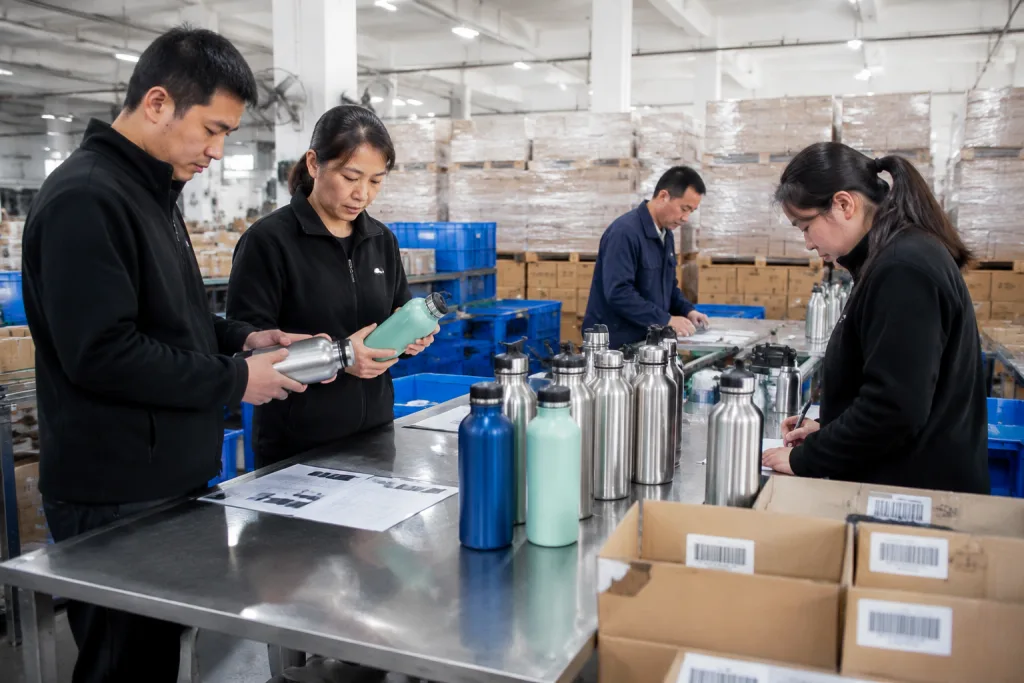
Key Takeaways
- A usable RFQ should list capacity, material grade, wall thickness, decoration method, packing, Incoterm, and MOQ from 1,000 units
- Sampling should confirm logo position, lid fit, leak test, carton drop resistance, and barcode/FNSKU placement before PO
- Bulk POs need separate line items for bottle body, lid, decoration, packaging, spare parts, testing, and shipment terms
- AQL 2.5/4.0 inspection, REACH/LFGB checks, and 25–35 day lead time reduce avoidable vendor drink bottle disputes
A vendor drink bottle order usually goes wrong before the line is even scheduled. The RFQ says “custom logo,” the approved sample skips the carton mark check, or the PO forgets the laser engraving size in mm, PMS number, lid type, and AQL level. We saw one PO last month with “black lid” typed twice, but the buyer expected a flip lid on the 750ml bottle and a screw lid on the 500ml bottle. Cartons were already packed. That argument is expensive.
If you buy custom drinkware for retail, corporate programs, hospitality, sports, or distributor channels, you need each idea turned into a controlled line item before sampling. BottleForge Industrial manufactures in Zhejiang, China, with 300,000 units/month drinkware capacity, typical MOQ from 1,000 units per SKU, and 25–35 day bulk lead time after artwork approval. We run logo files through AI/PDF artwork review, check lid fit with a go/no-go gauge, and lock carton marks before mass production. Ask for “better price” after that, not before. Otherwise the math doesn’t work.
Start with a usable RFQ
Your RFQ is not a mood board. It is the file that decides whether a canteen supplier quotes the job or guesses and pads the price. For a vendor drink bottle program, start with the commercial facts: target market, annual forecast, first order quantity, delivery window, and Incoterm. If you need FOB Ningbo, write FOB Ningbo. If you need DDP to Germany or FBA prep to the United States, say it before pricing, because our freight sheet changes fast once the carton mark, pallet height, and Amazon label work come in. We had one PO last month with “FOB Shanghai” typed in the header and “DDP Hamburg” in the notes. QC did not catch that. Sales did, two days before PI.
Then define the product. A custom canteen RFQ should include capacity, material, finish, lid style, insulation requirement, and decoration, but do not leave those words naked. For stainless steel, specify 304 inner and 201 or 304 outer if corrosion and margin matter. For vacuum bottles, normal wall thickness is often 0.4–0.5 mm inner and 0.5–0.6 mm outer, depending on shape and size; the line checks this with a digital micrometer before polishing. For plastic sports bottles, ask whether the resin is Tritan, PP, PE, or PETG, and confirm BPA-free documentation. Short version: “500 ml bottle” is not enough. The math doesn't work if the buyer expects Tritan, a flip lid, and a soft-touch finish after we quoted basic PP.
Put the basic PO line items into the RFQ early:
- Item: 750 ml stainless steel vendor drink bottle, matte powder coat
- Decoration: 1-color silkscreen, 70 x 45 mm, PMS 286C
- Packing: 1 pc/white box, 24 pcs/export carton
- Compliance: LFGB or FDA food contact, REACH for coating if sold in Europe
- Inspection: AQL 2.5 major, 4.0 minor, random pre-shipment inspection
This is where 6 out of 10 new buyers lose a week. “Canteen customizable” can mean a logo only, a new color, a private mold lid, or a full packaging set with insert card and barcode sticker. We run those as separate cost lines because tooling, print setup, and packing labor hit different stations. A good canteen manufacturer in China will price each customization separately instead of hiding it in one vague unit price. Ask for the split. If the buyer flagged a $0.38 increase on the carton, we can point to the 5-layer K=A board and 24 pcs/export carton instead of arguing by email.
Shortlist suppliers without romance
You will meet three types of canteen vendors: trading companies with 20 supplier contacts, small assembly shops, and factories running their own welding and coating lines. None is automatically the safe choice. A trader can handle 6 mixed SKUs better than a factory that only wants full-carton repeat work. A factory gives tighter control when the order depends on lid tooling, laser weld depth, vacuum leak testing at -0.08 MPa, and powder-coat color matching under a D65 light box. Match the supplier to the risk in the order. Not the nicer sales deck.
Ask each canteen vendor for factory type, audit status, monthly capacity by SKU, main export markets, and how they lock material batches before production. For larger distributor canteen programs, ask for current BSCI, ISO 9001, or Sedex documents, then check the company name and address against the PI. We once saw a PO typo list “304 stainess” and QC pulled the sample because the buyer’s own spec sheet said 304 stainless. Audits are not magic. They will not make a crooked logo print straight, but they do show whether someone is checking incoming steel, coating thickness, and packing before the container door closes.
At BottleForge in Hangzhou, Zhejiang, we usually quote in three buckets: existing mold with custom logo, existing mold with custom color plus retail box, and modified/private component with its own drawing. The math changes fast. A standard customized canteen might need 7–10 days for sample preparation and 25–35 days for bulk, while a new lid mold can add 20–35 days for tooling before production starts. On the line, our sample room checks lid fit with a 0.02 mm caliper and runs the first vacuum test before we send photos, because we have seen this go sideways when a buyer approves only the color render.
Build your comparison sheet with MOQ, unit price, mold cost, sample cost, decoration cost, packing cost, testing cost, FOB port, and payment term, but ask for notes beside each number. Good canteen suppliers should break this out without acting offended. If a quote only says “customized drinkware USD 3.20,” the buyer flagged nothing because there is nothing to check: maybe powder coating is included, maybe barcode labels are not, maybe the carton is 5-layer K=K instead of the 7-layer export carton your club-store account asked for. That quote is cheap only until the first claim.
Price without line items is not a quote. It is a future argument.
This matters more for canteen distributors and distributor growler buyers who resell into 4 or 40 accounts. You need repeatable specs, not one lucky shipment. We ship repeat programs with locked carton marks, saved Pantone records, and the same AQL 2.5 inspection checklist, because the second reorder is where weak suppliers usually expose themselves.
Turn concepts into sample orders
After you narrow the list to 2–3 canteen manufacturers, place sample orders. Do not sign off on a 3D rendering as if it were a production sample. A rendering shows the idea; a physical sample shows whether the line can make it. For a vendor drink bottle, we run the sample through the same checks our QC table uses: lid thread feel by hand, 0.3 mm logo position tolerance on the curved body, powder coat orange peel under a light box, and carton protection after a 76 cm drop test.
Write the sample PO almost like a small production PO. Include the SKU name exactly as your ERP will show it, Pantone or coating code, decoration method, capacity tolerance in ml, inner box type, master carton mark, and courier account. If you are testing a customizable growler or custom growler, ask for the actual cap, silicone gasket hardness, handle style, and retail box dieline planned for bulk. We have seen this go sideways: the buyer approved a generic lid sample, then asked for a custom lid in mass production, and QC pulled 18 pcs leaking at the 24-hour inverted test.
Useful sample PO line items include:
- Pre-production sample: 3 pcs, actual material and actual coating, not leftover shop-floor bodies
- Decoration trial: silkscreen with mesh count, laser engraving with logo size in mm, or heat transfer with film supplier named
- Packaging mock-up: color box or kraft box, plus printed carton mark if your warehouse scans by side label
- Spare parts: 2 extra lids and 2 silicone gaskets for fit check on the torque gauge
- Courier: DHL on your account, FedEx with declared sample value, or UPS when your office blocks DHL delivery
Typical sample fees are USD 50–150 for existing mold stainless bottles with logo. Private mold or special color trials cost more, and the math does not work if you expect bulk-order tooling accuracy from a USD 80 logo sample. Sample time is usually 7–12 days after artwork file and payment; our coating line books Pantone trials in 2-day batches, so a matte cream bottle can wait behind 6 black powder-coat jobs. A canteen promotional order with simple pad print may ship sooner, but retail packaging and Pantone-matched coatings need more time.
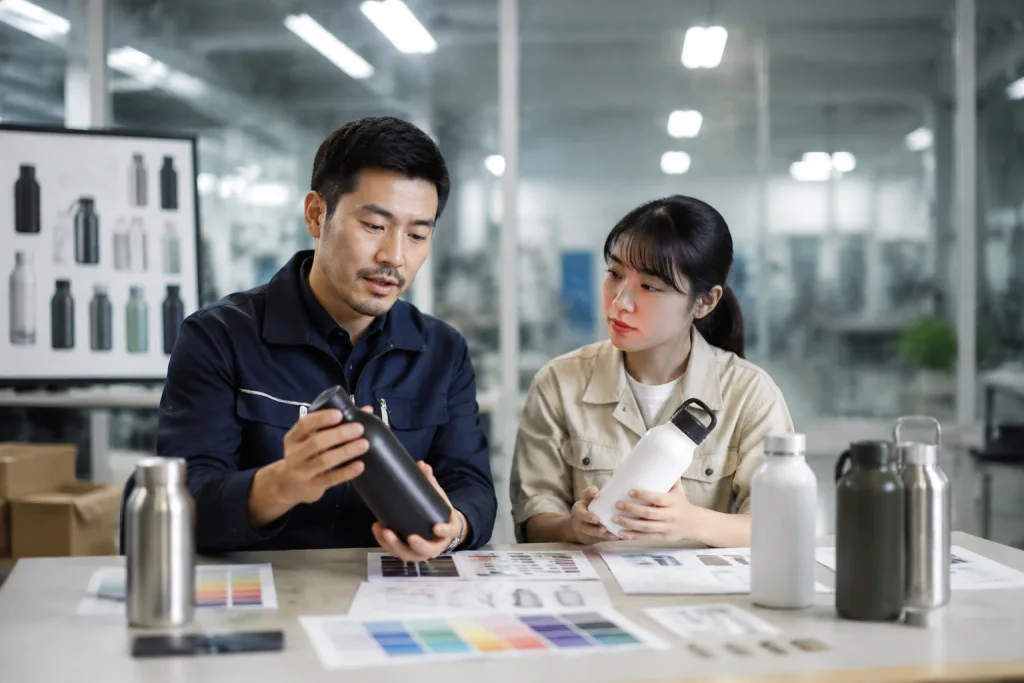
Take photos during your sample review and mark them with decisions. “Approved” is too weak. Write “approved for body shape, matte black coating, laser logo size 60 mm; lid color to change to black; carton needs FNSKU on short side.” We once had a PO typo where “short side” became “front side,” and the buyer flagged it only after Amazon intake rejected 42 cartons. That sentence prevents expensive misunderstanding in China and at your warehouse.
Price the PO by line item
Do not price a custom bottle as one flat number unless it is a shelf item with no artwork change. Ask the canteen manufacturer to break out the cost drivers: stainless steel grade and body weight, coating process, lid build, carton spec, and lab testing. We run the first sample across a 0.01 kg bench scale and check wall feel before quoting, because 18 g less steel on a 750 ml body changes the price and the buyer will feel it. A 750 ml double-wall bottle may quote at USD 3.10 FOB for 3,000 pcs with simple laser logo, but the same bottle with gradient coating, retail box, insert leaflet, and spare straw may land at USD 3.65–4.20 FOB.
Your bulk PO should list the core bottle and add-ons separately. Same invoice. Clear spec. Last March, QC pulled the sample because the PO said “navy matt” while the approved Pantone card was gloss navy, and that small typo cost 2 days on the coating line. For example:
- Line 1: 5,000 pcs 750 ml stainless vacuum bottle, 304 inner, 201 outer, matte navy coating
- Line 2: 5,000 pcs laser engraving, 55 x 35 mm, front center
- Line 3: 5,000 pcs retail kraft box, 350 gsm, 1-color print
- Line 4: 5,000 pcs barcode label, EAN or FNSKU, applied to box bottom
- Line 5: 1 set compliance testing, LFGB or FDA as market requires
- Line 6: 2% spare lids packed in master carton
This structure works for a customizable canteen, distributor drinkware, custom growler, or customized growler program. It saves trouble on repeat orders. If your sales team later asks for a canteen customized with a different logo, the line only needs new engraving film and a fresh 55 x 35 mm position check; the bottle, box, label, test, and spare lid lines stay locked. We have seen this go sideways when buyers send “same as last order” and quietly change the lid color.
For payment, most China factories still use 30% deposit and 70% balance before shipment. Larger repeat accounts can usually discuss better terms after 3–5 clean orders with no artwork holds, no chargeback fights, and no late balance payment. Be careful with 10% deposits from unknown canteen suppliers; the math does not work if they must buy 304 stainless coils, lids, cartons, and coating powder before production starts. The missing cash often comes back as cheaper coating, a 4.5 kg master carton instead of 5-ply export carton, or production pushed from 12 days to 18 days.
Lock artwork and packaging controls
Artwork mistakes are boring and expensive. A vendor drink bottle looks simple on the PO, then the logo bends 3 mm on the curved wall and the buyer flags it in pre-shipment photos. Silkscreen is the safe choice for 1–2 color graphics on straight bodies or a light curve; we run a 120-mesh screen and check the first 20 pcs before the line speeds up. Laser engraving stays clean on 304 stainless steel and survives washing, but it gives you metal color only. Heat transfer handles full-color artwork, though the setup cost and scrap rate jump fast. For canteen promotional jobs, simple wins. Tight ship dates punish clever artwork.
Send vector artwork in AI, PDF, or EPS format. Give the factory PMS numbers, print size in millimeters, logo position from the top or bottom edge, and orientation against the lid or handle. If you use a customized canteen with a carry loop, confirm whether the logo faces the loop, sits opposite the loop, or centers between the body seams. We once received a PO with “logo front” only; QC pulled the sample, and nobody on the line knew which side the buyer meant. Do not expect the operator to guess your brand rules.
Packaging needs the same discipline. North American retail buyers often ask for UPC labels and suffocation warning on polybags, usually with a 5 mm minimum text height on the warning. Amazon-focused orders need FNSKU labels, carton weight under 22.7 kg where practical, and barcodes that scan on the correct carton side. European buyers ask for recycling marks, importer address, language panels, and REACH documentation for coatings. A canteen distributor selling into 6 countries should build one master packaging checklist; changing instructions by email every week is how we see carton marks go sideways.
Before mass production, request a digital proof and one printed packaging sample. The proof should show dieline, barcode size, carton mark, gross weight, net weight, carton dimensions, and country of origin marking such as “Made in China.” For Zhejiang export production, we also check carton compression against the shipping route; our QC team uses a compression tester and flags cartons that crush below the agreed kgf value. A weak carton saves USD 0.05 and can destroy USD 5,000 of inventory. The math doesn't work.
Manage production and inspection
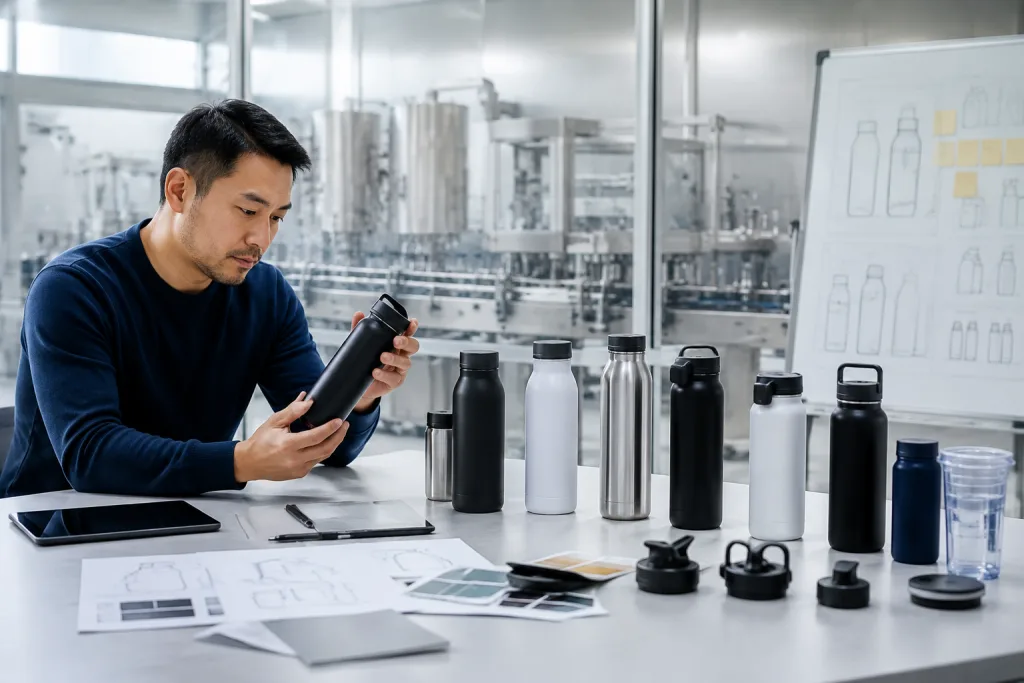
After deposit, the clock starts. For existing mold custom drinkware, a realistic production schedule is 3–5 days material preparation, 7–12 days body forming and welding, 5–8 days polishing and coating, 3–5 days decoration, and 3–5 days packing. These steps overlap on the line, but they explain why a real 25–35 day lead time is normal, not padding. We run 304 stainless coils through incoming gauge checks first; last month QC pulled 0.38 mm sheet against a PO that said 0.40 mm, and that alone cost 1 day. If a canteen factory promises 10 days for 20,000 coated bottles during peak season, ask which station they plan to skip.
Set production checkpoints in writing. Confirm the pre-production sample first, with the logo size measured in mm and the Pantone code signed off on the sample tag. Then confirm bulk material and coating color before the full run. Ask for mid-production photos showing actual units, logo position, packaging, and carton marks, not just a clean sample on a desk. Book final inspection when goods are 100% produced and at least 80% packed; we have seen this go sideways when a buyer approved cartons after spotting a PO typo, “vendor drink bootle,” only after 326 cartons were already printed.
AQL inspection should match your risk. For most vendor drink bottle orders, AQL 2.5 for major defects and 4.0 for minor defects is a practical baseline. Critical defects need zero tolerance. Major defects include leaking, wrong logo, sharp edges, serious dents, failed barcode scan, or wrong material. Minor defects include small coating specks within agreed limits, slight carton scuffing, or minor color variation. For vacuum bottles, add hot water temperature retention checks and vacuum failure sampling; QC usually fills 95°C water, logs the reading after 6 hours, then flags weak units before packing. For plastic canteen customizable items, add odor checks, cap torque testing with a torque meter, and a drop test from 1.2 m.
Testing depends on market. For Europe, ask about LFGB, REACH, and food-contact declarations. For the United States, FDA food-contact compliance and sometimes ASTM-related checks apply for children’s items. Kids bottles need tighter control on small parts, coatings, straws, and choking hazards. The wrong question is “Can you make it cheaper?” Ask which component gets downgraded. A responsible canteen supplier will warn you when a low-cost straw, ink, or lid gasket creates compliance risk; a weak supplier will just say yes and ship the problem in 12 kg master cartons.
Ship, receive, and reorder smarter
Shipping is not an afterthought. We have seen a distributor canteen order look fine at FOB Hangzhou, then lose margin at landed cost because the carton was 62 cm high, over 18 kg, and the side mark had one digit wrong. Ask for a packing list before final balance payment. It should show SKU, quantity, carton count, pieces per carton, gross weight, net weight, carton dimensions, and total CBM. For mixed customized drinkware orders, require carton-level SKU separation unless your warehouse has already approved mixed cartons in writing.
Choose shipping by margin and delivery date. Air freight can work for 500 urgent promotional units, but the math usually breaks on 5,000 stainless bottles once the forwarder quotes by chargeable weight. Sea freight from Ningbo or Shanghai is the normal route for Zhejiang production; we run most export pallets through Ningbo because the truck time from Hangzhou is predictable, about 3.5 hours on a clean day. If you are importing into Europe or North America, clarify who handles customs clearance, duties, and last-mile delivery. FOB gives you control. DDP is convenient, but check exactly what is included before you sign the PO.
Receiving should close the loop. Check 5–10 cartons on arrival, scan barcodes, inspect coating, test lids, and compare against the approved sample. Use the same method QC used on the line: pull the bottle under white light, check the logo edge, open and close the lid 10 times, then look for rubbing at the hinge. Report defects within 7 days with photos, carton numbers, and quantities. Vague complaints two months later are hard to settle fairly. Clear receiving data helps the buyer and factory clean up the next run.
For reorders, send the previous PO number, sample approval notes, artwork version, packaging version, and any defect feedback. A canteen manufacturer can keep a golden sample and production file, but you should keep your own records too; we once had a buyer reorder with “same as last time” while the old PO had a typo in the Pantone code, and the buyer flagged the color after packing. This is how you turn one custom canteen project into a stable vendor drink bottle supply chain instead of starting from zero every season.
Send your vendor drink bottle RFQ for review
Share your spec, target price, quantity, and delivery country. We will return a line-item quote with sample timing and MOQ options.
Frequently asked questions
What MOQ should I expect for a vendor drink bottle order?
For existing mold stainless steel or plastic bottles, a realistic MOQ is usually 1,000 pcs per SKU for one color and one logo. Some canteen vendors will quote 500 pcs, but unit price rises because coating, printing, packing, and setup costs are spread over fewer units. For custom color powder coating, 2,000–3,000 pcs is more practical. For private mold lids or a fully customized growler, tooling may require 5,000–10,000 pcs to make the cost sensible. If you are testing a market, start with one body mold and two colors instead of six SKUs.
How long does sampling and bulk production take in China?
For an existing mold vendor drink bottle, samples normally take 7–12 days after artwork approval and sample payment. Bulk production usually takes 25–35 days after deposit and final sample approval. Retail box printing, special coatings, or high-volume canteen promotional schedules can add 5–10 days. If tooling is involved, add 20–35 days for mold development and test shots before mass production. Zhejiang factories ship mainly through Ningbo or Shanghai, so sea freight scheduling should be added separately. Do not plan a launch date using production time only; include inspection, customs, and inland delivery.
Which decoration method is best for customized drinkware?
It depends on the logo, surface, and sales channel. Laser engraving is durable, premium-looking, and common on stainless steel bottles, but it cannot print PMS colors. Silkscreen is cost-effective for 1–2 color logos and can work well for canteen customized programs with simple branding. Heat transfer handles complex graphics and wraparound designs but costs more and needs tighter QC. UV printing can produce detailed color on some surfaces, but adhesion must be tested. For distributor drinkware, choose the method your customers can reorder consistently, not only the one that looks best in a mock-up.
What compliance documents should I ask from a canteen supplier?
For Europe, ask for food-contact testing such as LFGB where applicable, REACH information for coatings and components, and a declaration of conformity. For the United States, FDA food-contact compliance is the usual baseline, with extra caution for kids bottles under CPSIA and small-part rules. If the product touches hot liquid, confirm heat resistance for lids, gaskets, and straws. For stainless steel, ask for material grade confirmation such as 304 inner wall. A canteen factory should also support AQL inspection records, packing list, and production photos. For large retailers, BSCI or ISO 9001 documentation may be requested.
How should I compare quotes from canteen manufacturers?
Compare line by line, not only unit price. Check whether each quote includes bottle body, lid, coating, logo, packaging, barcode labels, testing, spare parts, export carton, and FOB port. One canteen manufacturer may quote USD 3.25 including laser logo and kraft box; another may quote USD 3.05 but charge USD 0.18 for box and USD 0.10 for barcode later. Also compare MOQ, sample time, bulk lead time, payment terms, inspection standard, and defect policy. A slightly higher quote from a controlled China factory can be cheaper than a low quote that misses carton specs or compliance.