Key Takeaways
- A 500-750 ml vendor double walled bottle usually fits 3,000 pcs MOQ with 35-45 day mass production
- Growlers need heavier gauge steel and stronger leak testing than standard canteen customized programs
- Powder coating adds about USD 0.35-0.70 per unit versus basic brushed stainless finish
- Distributors should compare landed carton cube, not only FOB unit price
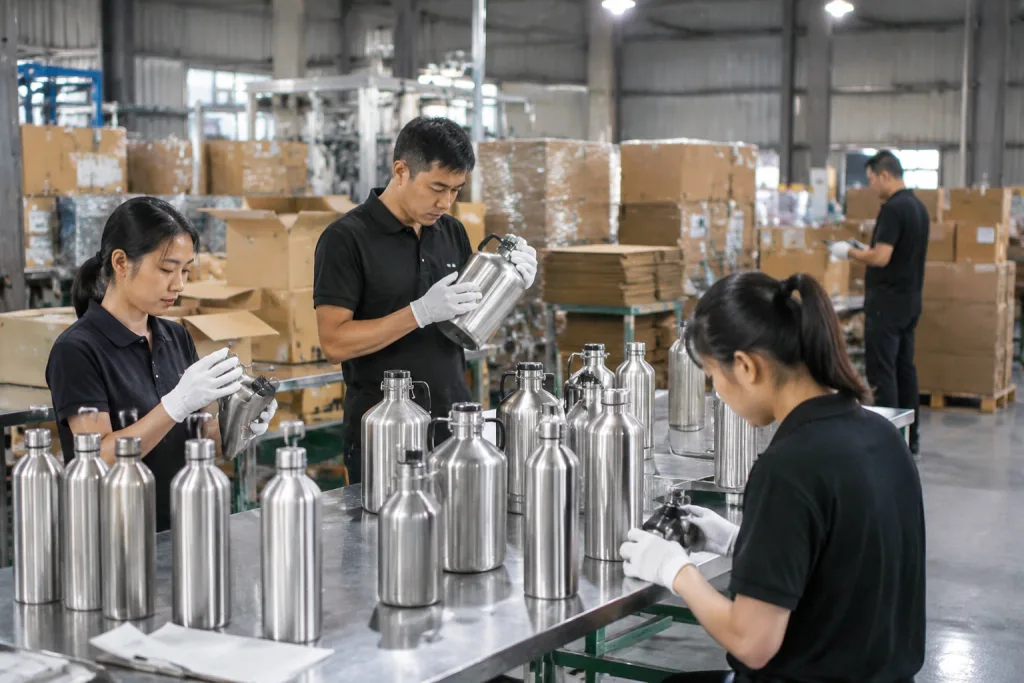
A vendor double walled bottle looks simple until one PO mixes a 500 ml canteen, a 750 ml sports bottle, and a 1.9 L growler. Same shelf photo, different job. On the line, the 500 ml body clears the rolling fixture fast, while the 1.9 L growler needs a wider vacuum chamber nest, a different lid torque setting, and a carton that can jump from 12 pcs to 6 pcs per master.
If you are buying custom drinkware for a brand launch, distributor program, or corporate promotion, the wrong question is “which bottle looks best?” Ask what spec will pass repeat orders. BottleForge Industrial in Hangzhou, Zhejiang builds stainless steel drinkware for export buyers who need repeatable specs; last month QC pulled a sample with a 0.4 mm lid gap that looked fine in the rendering but would not survive AQL inspection in China.
The real buying choice
Most buyers open the RFQ with “vendor double walled bottle,” then attach five reference images from 3 different production families. We see this weekly. One is a slim retail bottle for gyms with a 45 mm body diameter. One is a wide-mouth custom canteen for outdoor programs. One is a customized growler for breweries or camping retailers, usually with a heavier screw lid and silicone gasket. They all use vacuum insulation, but the line does not treat them the same.
The head-to-head decision should start with the job the product must do. A canteen promotional order for a bank does not need the same lid strength as a distributor growler sold through outdoor stores; this is the wrong question to ask if the buyer only compares FOB price. A canteen distributor serving school shops needs carton strength, low defect rates, and repeat colors that match the approved Pantone chip after 2 runs. A premium brand owner may accept higher unit cost for 304 stainless steel inside and outside, laser logo, retail gift box, and REACH-compliant coating. Last month QC pulled the sample because the lid torque felt loose at 8 kgf·cm, and the buyer flagged it before shipment.
Here is the practical split. A 500-750 ml canteen customizable program is usually the safest first project because the MOQ, carton cube, and freight risk stay under control. A 900-1,200 ml bottle fits sports and worksite use, but it starts to punish you on shipping volume; one 40HQ holds fewer cartons, and the math doesn’t work for low-margin promo jobs. A 1.9 L customizable growler is a different product class: thicker steel, more welding stress, higher vacuum failure risk, and stricter lid sealing checks. We run a water-leak test upside down for 30 minutes, and that is where weak lids show up.
At our Zhejiang facility, a normal custom drinkware line runs about 450,000 stainless units per month across bottles and tumblers, plus growlers on separate fixtures. For export orders from China, we usually quote 3,000 pcs MOQ per model and color, with sample lead time around 7-10 days after artwork confirmation. That is the baseline you should use when comparing a canteen manufacturer against another canteen supplier. We ship plenty of clean orders, but we’ve seen this go sideways when the PO says “matte black” and the artwork file says “BK-02 powder coating.”
Spec table buyers should use
A spec table stops fuzzy buying. Ask 6 canteen vendors for a “good quality double wall bottle” and you will get 6 prices that do not match. One factory quotes 201 outer steel, another quotes 304 inside and outside, and a trading vendor leaves out the color box. Cheap is not always cheap. Last month our incoming team caught a PO typo that changed “304 inner” to “201 inner” before the 0.01 mm digital caliper even came out.
| Spec | Custom canteen 500-750 ml | Sports bottle 900-1,200 ml | Customized growler 1.9 L |
|---|---|---|---|
| Typical wall | 0.4-0.5 mm 304 inner | 0.45-0.55 mm 304 inner | 0.55-0.7 mm 304 inner |
| Best use | Retail shelf with color box; gifting orders with logo control; canteen promotional runs where unit cost matters | Fitness bottles with carry lids; worksite bottles that take dents; outdoor orders needing grip coating | Brewery refill programs; camping sets with wide lids; distributor growler lines sold by case |
| Common MOQ | 3,000 pcs/color | 3,000 pcs/color | 1,500-3,000 pcs/color |
| FOB range | USD 3.20-5.80 | USD 4.60-7.80 | USD 8.50-15.00 |
| Logo options | Laser for bare steel; silkscreen for 1-2 solid colors; UV print for gradients | Laser for matte powder coat; silkscreen for simple marks; wrap print when the artwork must run around the body | Laser for brewery names; pad print for lid marks; metal badge when the buyer accepts tooling cost |
| Key risk | Color consistency | Drop dents | Lid leak and vacuum yield |
These FOB prices fit mid-volume China production, not luxury retail builds or leftover trading stock. If a canteen suppliers quote lands 25% below the range, ask what moved: steel grade, coating system, lid material, carton ply, inspection level, or payment term. We see this go sideways when the buyer compares USD 4.60 with USD 3.80 and later finds the cheaper line used a lighter 3-ply carton instead of the 5-ply export carton printed on the packing spec.
For Europe, ask for LFGB or EU food-contact documentation where needed, plus REACH coating declarations. For North America, request FDA food-contact conformity and CPSIA or ASTM review if the product is positioned for children. A distributor drinkware buyer should also put ISTA-style drop expectations into the carton spec for heavier growlers; QC pulled the sample after a 76 cm corner drop once, and the lid was fine but the color box crushed at the seam.
Canteen versus growler use cases
A customized canteen wins when the buyer needs low carry weight, clean decoration, and sane carton math. We ship the 500 ml and 750 ml formats most often because they fit retail shelves, conference bags, and 2-piece corporate gift boxes without forcing a taller master carton. On the line, a 750 ml canteen usually lands in a 78-82 mm body diameter, so the logo jig still holds steady during rotary screen printing. Mixed colors matter too. A distributor ordering 4 colors at 1,000 pcs each has less dead cash than one oversized SKU sitting in the rack for 9 months.
A customized growler makes sense when capacity and shelf value beat freight efficiency. Breweries, camping shops, and outdoor membership clubs can defend the higher FOB cost because the customer expects a bigger, heavier product in hand. A 1.9 L vacuum growler can weigh 720-950 g before packaging, depending on wall gauge and lid construction. That weight changes the quote fast: one buyer flagged a 14.8 kg master carton because their domestic courier charged the next bracket above 15 kg after tape and corner protectors. The math gets tight.
For a canteen promotional program, do not overbuy the spec. A heavy 0.7 mm outer wall or a complex handle lid is the wrong question to ask if the bottle is for office onboarding. You need a clean powder coat, a logo that survives 100 tape tests, and leak testing on every unit. QC pulled one sample last quarter where the logo passed adhesion but sat 3 mm off center; the buyer cared more about that than the lid upgrade. For a retail distributor canteen, the checklist changes: barcode accuracy, hangtag consistency, color master control, and cartons that survive warehouse movement.
A distributor growler should be treated like a higher-risk item. Ask your canteen manufacturer or growler supplier how they test vacuum performance after welding and polishing. At BottleForge, we run hot water vacuum screening and 100% leak checks on insulated vessels before final packing; the inspector records failed units by carton number, not just by shift. We have seen this go sideways when a PO typo changed the lid code from G19-S to G19-SH and nobody caught it until pre-shipment photos. That does not make defects impossible, but it catches the predictable failures before the goods leave Zhejiang, China.
Materials and lid details
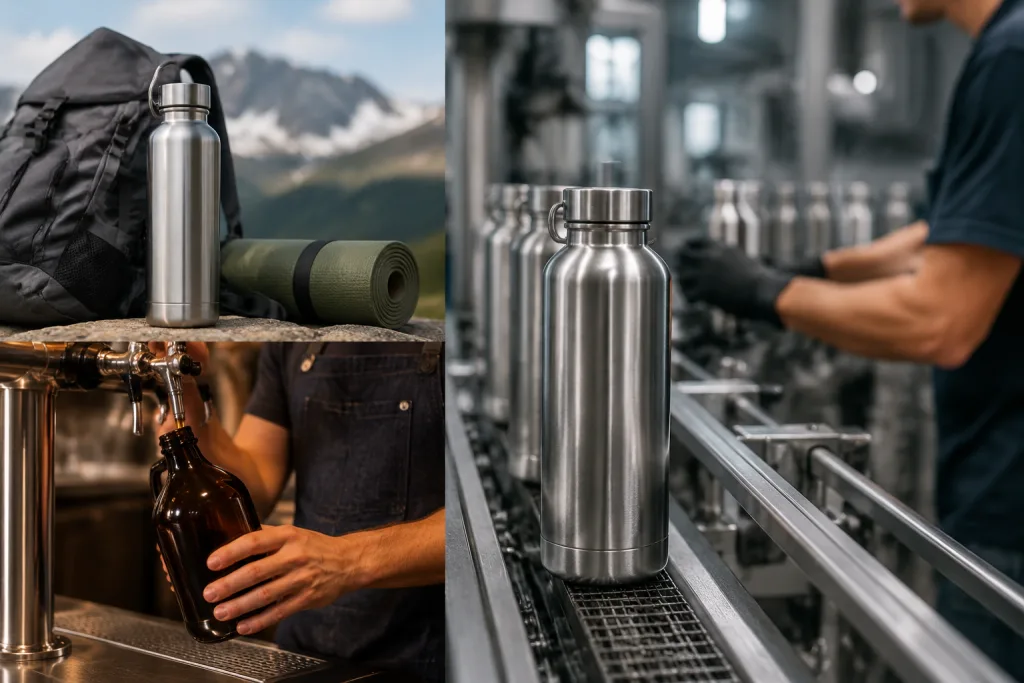
For export double walled bottles, we run 304 stainless steel on the inner wall because it touches drinking water, coffee, tea, or carbonated drinks. On cost-down POs, 201 stainless sometimes shows up on the outer wall; last month one buyer even wrote “201 outer OK” in the spec but forgot to mark the finish. For dry indoor promo orders, MOQ 3,000 pcs, that can work. For outdoor retail, I still push for 304 outside. The math doesn't work when a coastal customer sends 18 rusty return photos over a 0.18 USD saving.
The lid is where buyers under-spec. A canteen customized project may call for a PP lid, stainless cap, bamboo top, flip straw, or handle loop, and each one changes the test sheet. PP needs food-contact documentation. Bamboo needs moisture control; QC pulled one sample at 14% moisture and we rejected the carton before packing. Straw lids add 2-4 silicone parts, so there are more leak points around the vent and bite valve. For carbonated growlers, talk pressure early. We have seen standard vacuum growlers go sideways when a buyer expected 12-hour pressurized storage from a lid built for normal hot water use.
Ask for silicone ring hardness, not just PMS color. A typical sealing ring may use food-grade silicone around 50-60 Shore A, checked with a Shore A durometer on the line. Too soft, and the gasket flattens after 3 closing cycles. Too hard, and the lid feels stiff, so customers force the thread. Thread quality matters too. A rough thread may pass the first inverted leak test, then annoy customers after one week of use because the cap catches at the same 2 mm burr.
For finishes, powder coating is the workhorse for custom drinkware. It gives better grip and stronger color options than basic spray paint, and we usually check it with a 3M tape pull plus a 500 g abrasion rub before shipment. Brushed stainless costs less and hides scratches better, but it has weaker shelf pull. Laser engraving is durable and clean. Silkscreen saves money on larger logos, while UV print works for full-color art only if the buyer accepts extra abrasion testing. A serious canteen supplier should explain that trade-off before taking your deposit.
Customization costs and artwork traps
Customizable drinkware pricing is not just the bottle body. We quote the body, artwork setup, logo method, coating, packaging, inserts, barcode labels, and inspection as separate lines because that is where POs get messy. A simple laser logo may add USD 0.10-0.25 per unit depending on size and position. A one-color silkscreen logo may add USD 0.08-0.18. Full-wrap printing or gradient coating can push the line slower by 600-900 pcs per shift, and individual name personalization often needs a separate Excel name list checked against the carton plan. QC pulled 12 laser samples last month because the buyer’s PO said “logo 35 mm wide” while the artwork file measured 38 mm.
For a custom canteen, the biggest artwork trap is placing a logo across a curved shoulder or taper. Bad spot. It may look fine in a flat PDF, then stretch during printing when the screen meets the radius. For a customizable canteen with a powder coat, run contrast testing before you approve the sample. Light gray logos on matte white bottles look premium on a MacBook screen and weak under 4,000K warehouse lighting; we have seen buyers flag this only after the first 200 pcs came off the line.
For a custom growler, the trap is scale. A logo that works on a 500 ml bottle can look lost on a 1.9 L body. Buyers ask us to enlarge artwork after samples, then find the print area crosses a weld line or exceeds the screen frame. The math does not work. On one 1.9 L growler, our screen frame allowed 110 mm height, but the revised logo needed 128 mm and landed 6 mm into the seam area. Fix this before mass production by approving a 1:1 dieline, not just a mockup.
Packaging is another hidden cost. A white box may add USD 0.18-0.35. A printed retail box may add USD 0.45-0.90 depending on paper, size, and quantity. FNSKU labels for marketplace programs are simple, but the label must sit on the correct box face and scan before shipment. We run the Zebra scanner at packing, not after the container is sealed. For distributor drinkware programs, carton marks and mixed-SKU packing instructions should be locked before the pre-production sample; we have seen this go sideways when a buyer changed “2 colors per carton” to “4 colors per carton” after the carton label plates were already made.

Quality control before shipment
Clear inspection terms keep supplier calls from turning into opinions. For most B2B drinkware orders, we run AQL inspection with a written defect list, not a WeChat promise. A common setting is AQL 2.5 for major defects and 4.0 for minor defects, with critical defects at 0. Critical means unsafe material, sharp edges found by the cotton-glove swipe test, broken glass if applicable, contamination inside the bottle, or leakage during a 30-second inverted water test. Major means a leaking bottle, wrong logo, obvious dent over 1 mm, failed barcode scan, or color outside the approved Delta E range.
Do not wait until final inspection to define standards. Your canteen manufacturers should receive approved color chips, logo position drawings with mm measurements, packaging files, and barcode data before production starts. If you approve only a photo, the buyer and factory will argue later over whether the logo sits 3 mm too low or the beige looks too yellow under warehouse lights. We have seen this go sideways. A canteen factory in China can make consistent goods, but the line needs measurable references on the workbench, not screenshots.
For double wall vacuum products, ask for these checks: 100% leak test at the assembly line, vacuum insulation sampling, coating adhesion test with 3M tape, lid torque check using a torque meter, internal cleanliness check with a white swab, and carton drop sampling. A practical insulation test is filling the bottle with 95°C water and measuring temperature after 6 or 12 hours under controlled room conditions. Do not compare those numbers to retail claims unless the test method is identical. This is the wrong place to save 20 minutes.
At BottleForge in Zhejiang, a typical 3,000-10,000 pc order has in-line checks during forming, welding, polishing, coating, decoration, and packing. QC pulled the sample at each stage because a polishing scratch caught after logo printing becomes scrap, not rework. Final inspection can be performed by your own QC team, a third-party inspector, or our internal QC using your checklist. If you are a new canteen distributor, pay for third-party inspection on the first order. The USD 250-400 fee is cheaper than sorting rejected goods in Rotterdam, Hamburg, Toronto, or Los Angeles, where the math does not work once labor hits EUR 18 per hour.
How to compare supplier quotes
Put every canteen quote into one sheet before you look at price. We ask buyers to fill the same columns: FOB port, steel grade, brim capacity versus usable capacity in ml, unit weight in g, coating type, logo method, inner box spec, carton quantity, carton dimensions in cm, sample cost, tooling cost if any, MOQ, lead time, payment term, and inspection standard. Our QC team checks unit weight on a 0.1 g bench scale because a “500 ml” bottle can hide 18 g less steel. Without those fields, the lowest price is often the order that costs more after rework, air freight, or claims.
A fair quote for a vendor double walled bottle should say clearly whether the supplier is a manufacturer or a trading company. Trading companies fit small mixed orders, maybe 3 colors across 2 lid styles, but repeat custom drinkware needs direct factory engineering support. If you need a canteen customizable line with stable lids and repeat colors, get the production team involved before the sample is made. We have seen this go sideways: the buyer approved a lid from one workshop, then bulk came from another mold with a 0.35 mm thread gap, and QC pulled the sample at assembly.
Payment terms matter. Standard China export terms are often 30% deposit and 70% balance before shipment, or against copy of bill of lading for established accounts. Lead time is usually 35-45 days after deposit and approved pre-production sample for normal stainless bottles. Peak season before summer and Q4 gifting can push that to 50-60 days, especially for powder coating and printed boxes. The line books coating by color; one buyer changed matte sage to Pantone sage green after the PO, and that typo cost 6 days.
Use samples properly. Order one blank sample to judge the shape, then one decorated pre-production sample to approve color, logo, lid, and packaging. Do not skip the second step on a customized drinkware order. A USD 80 sample delay is annoying; a 5,000 pc wrong logo shipment is expensive. This is the wrong place to save money. On our side, we run the decorated sample through 3M tape pull, 24-hour water leak check, and carton drop check before we ship bulk photos for approval.
Send your bottle spec for a factory quote
Share capacity, finish, logo, packaging, target MOQ, and market. Our Zhejiang team will check feasibility and quote with practical export terms.
Frequently asked questions
What MOQ should I expect for a vendor double walled bottle?
For most stainless vacuum bottles, expect 3,000 pcs per model and color. Some standard canteen custom programs can start at 1,000-2,000 pcs if you accept existing colors and basic laser logos, but FOB pricing will be higher. Growlers may also start at 1,500 pcs if tooling already exists. For private color powder coating, printed retail boxes, or custom lid parts, 3,000-5,000 pcs is a more realistic planning number. Sample lead time is usually 7-10 days after artwork approval, and mass production is commonly 35-45 days after deposit and pre-production sample approval.
Is a canteen manufacturer better than a trading company?
For repeat customized canteen or distributor drinkware orders, a direct canteen manufacturer is usually better because engineering, QC, and production scheduling are closer to your project. You can discuss wall thickness, lid fit, coating adhesion, and AQL standards with the people making the goods. A trading company can still help if you need many unrelated items in one container or very small trial quantities. The practical test is simple: ask for unit weight, steel grade, carton dimensions, inspection flow, and defect classification. Real canteen manufacturers answer with numbers; weak canteen vendors answer with vague promises.
What is the best logo method for canteen promotional orders?
For canteen promotional orders, laser engraving is the safest if the bottle is stainless or powder coated and the design is one-color. It is durable, clean, and usually adds about USD 0.10-0.25 per unit. Silkscreen is cheaper for large simple logos, often USD 0.08-0.18 per unit, but it needs adhesion testing. UV print is better for full-color brand artwork, though abrasion resistance depends on ink and surface finish. If the order is going into retail, approve a physical decorated sample and run a 3M tape test before mass production.
Can I source a custom growler and custom canteen together?
Yes, but do not assume they share the same production risk. A custom canteen in 500-750 ml is easier to form, decorate, pack, and ship. A custom growler uses more steel, has a larger vacuum chamber, and puts more stress on the lid seal. If you combine them, align the finish and logo style but inspect them separately. Use different AQL defect notes for growlers, especially leakage, lid torque, dents, and handle strength. Also compare carton cube: 1,000 growlers may occupy more shipping space than 3,000 smaller canteens.
What certifications should European and North American buyers request?
For Europe, request food-contact documentation such as LFGB or EU 1935/2004 support where applicable, plus REACH declarations for coatings and accessible materials. For North America, ask for FDA food-contact compliance and CPSIA or ASTM review if the product is marketed for children. BSCI or ISO 9001 factory documentation can support retailer onboarding, but it does not replace product testing. For every order, keep the approved sample, material declarations, packing list, and final inspection report together. That file is useful if customs, retailers, or distributors ask questions 6 months later.