Key Takeaways
- A standard 18/8 double wall bottle at 3,000 pcs usually lands around $1.55-$2.30 FOB before freight and duties.
- MOQ often starts at 500 pcs for stock molds, then rises to 3,000-5,000 pcs when you change lids or packaging.
- Real lead time is 35-65 days for stock builds and 50-90 days for custom builds from China to the US or EU.
- Ask for REACH, LFGB, FDA declarations, and AQL 2.5 inspection if you want fewer chargebacks and returns.
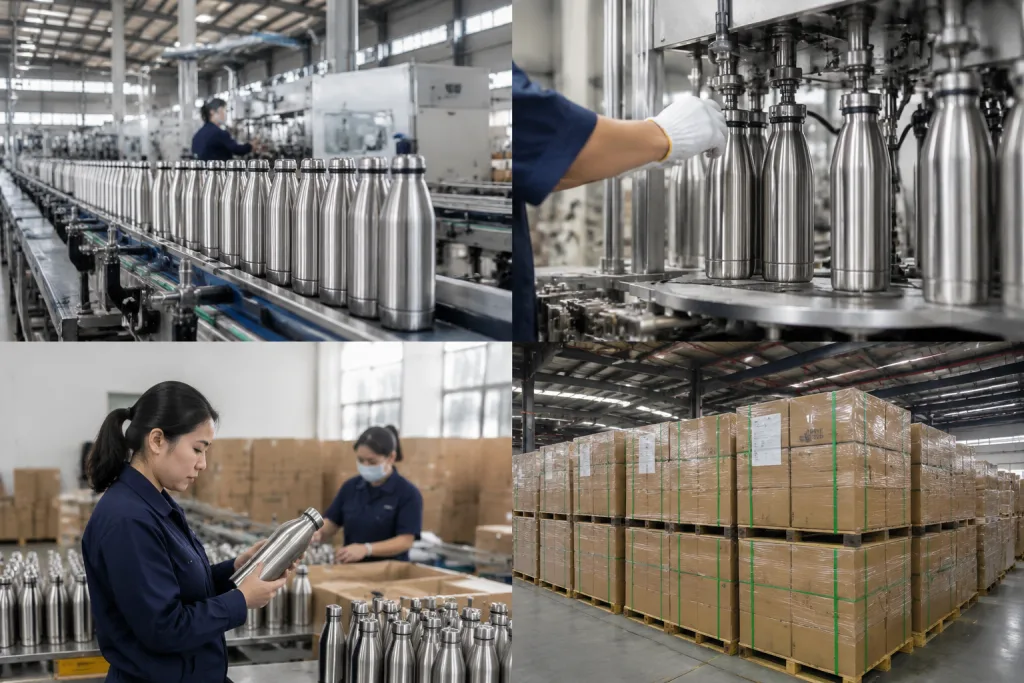
A vendor double wall bottle looks simple until the quotes hit your desk and the totals do not line up. We see this on 8 out of 10 new RFQs: one factory shows a low body price, one adds powder coating, color box, and FDA testing after the PO, and another moves lead time from 25 days to 38 days because the flip lid mold is tied up. Normal China sourcing. It happens even faster when you compare a canteen manufacturer in Zhejiang with a trading desk that has no vacuum line, no helium leak tester, and no inspector standing at the packing table.
If you buy custom drinkware for Europe or North America, chasing the cheapest headline price is the wrong question to ask. Lock the cost stack, MOQ, and schedule before artwork approval, or the math goes sideways after the first pre-production sample. A solid canteen supplier will break down where the money goes: 304 stainless thickness in mm, lid tooling, logo process, 5-layer export cartons, LFGB or FDA work, and freight. We run this check before the line opens, because QC once pulled a sample with a 0.4 mm thinner outer wall than the buyer signed off, and nobody wants that call at 6 p.m.
What Drives The Bottle Price
The base price comes from two parts first: steel and lid. For a standard 500 ml or 750 ml vendor double wall bottle, 18/8 stainless steel, 0.4 mm inner and outer walls, and a PP lid usually land at $1.55-$2.30 FOB from China when you buy 3,000 pieces or more. At 500 pieces, the same build often moves to $2.40-$3.40 because the line still needs setup, trim loss, and packing labor, but the cost is spread over fewer units. We run this on a 0.4 mm coil check with a digital micrometer; QC pulled one sample last month at 0.36 mm, and the buyer flagged the vacuum hold risk fast.
Decoration is where buyers burn money. Laser engraving usually adds $0.08-$0.18 per piece. One-color silk screen sits around $0.12-$0.25, depending on logo size and ink coverage. Full-color wrap print can add $0.35-$0.80 if the artwork covers most of the body and the curing pass slows the line. Powder coating adds $0.18-$0.40, while a soft-touch finish can add another $0.10-$0.20. If you want a canteen custom order with gift box packaging, budget another $0.20-$0.60. Canteen promotional jobs can look cheap on paper, but carton quality and barcode labels still hit the landed cost; we had one PO with “white box” typed as “white boc,” and that typo cost 2 days of confirmation before mass packing.
Ask the canteen supplier for a line-item quote, not one blended number. If decoration, carton, and test fees are buried, the math doesn't work for a real comparison.
For brand owners, the cheapest quote is usually the one missing the most. For distributor drinkware programs, insist on FOB, packing method, and sample charge written next to each SKU. Short sentence. We’ve seen this go sideways when a buyer approved a 24 pcs/carton layout, then found the carton weight passed 18 kg and the warehouse pushed back on manual handling.
MOQ Tiers That Change Everything
MOQ moves with tooling, color count, and whether we run an existing mold. On a stock double wall body, our Zhejiang line can hold 500 pieces because the neck ring, bottom fixture, and polishing jig are already set. Add a new lid, silicone sleeve, or shaped base, and the order usually jumps to 3,000 or 5,000 pieces. The math doesn't work under that. One lid mold can sit at 18,000-35,000 RMB before the first carton is packed.
- 500 pieces: logo on stock body, good for samples and small retail tests. FOB often $2.40-$3.40, with QC pulling 3 pre-production samples before laser marking starts.
- 1,000-3,000 pieces: mixed colors, custom box, cleaner carton loading. FOB commonly $1.95-$2.85, and we can usually pack 24 pieces per export carton without wasting space.
- 5,000-10,000 pieces: locked color plan and dedicated packaging. FOB often $1.45-$2.10, but the buyer needs a real sell-through plan, not just a lower quote on the PO.
If you are a canteen distributor or canteen vendor selling into retail, promo, and campus channels, the 1,000-3,000 band is the practical zone. You get enough volume to protect margin without holding 10 pallets for 90 days. We ship plenty of 10,000-piece quotes, but we've seen this go sideways when the buyer flagged slow movement after 6 weeks and asked us to “store the balance” in Hangzhou.
One working rule: if the decoration changes every quarter, keep the bottle body standard and change only the sleeve, insert card, or laser mark. Simple wins. QC can approve a new laser position with a 0.5 mm tolerance check, while a new body shape means mold trial, leak test, drop test, and another round of buyer sign-off. That is how customizable drinkware stays manageable and how a customizable canteen line avoids dead stock after the first campaign.
Lead Time From Sample To Sail
Lead time is controllable, but only when we split it into sample, line time, and vessel time. For an existing mold, we run a normal sample in 3-7 days, assuming the laser logo file is clean and the lid color already sits in our parts rack. A pre-production sample with your artwork, color box, insert card, and carton mark takes another 5-10 days; QC pulled one last month because the PO said matte black but the AI file called out Pantone 426C. Bulk production for a vendor double wall bottle usually runs 20-35 days after deposit and artwork approval.
If you need new tooling for a lid or a special carry handle, add 15-25 days. Tooling itself can cost $1,500-$6,000 depending on cavity count and complexity, and this is where the math doesn't work if the MOQ is only 1,000 pcs. From China to the US or EU, ocean freight often adds 25-40 days port to port, plus local delivery. So a realistic landed timeline is 35-65 days for stock builds and 50-90 days for custom builds. In Zhejiang, factories often quote faster than inland plants because our gasket, powder coating, and carton suppliers are within a 2-hour truck run, but peak season in China still adds 7-10 days if you miss a booking window.
Air freight solves emergencies, not budgets. It can cut transit to 5-10 days, but on a carton-heavy canteen custom order, freight can exceed the product value; we saw 18 kg master cartons priced higher than the bottles inside. For a canteen promotional run or Amazon launch, I would rather see the buyer book a slower ocean move and keep the margin intact. We've seen this go sideways.
Ask your canteen supplier for a written schedule with milestone dates: sample approval with date stamp, 304 stainless arrival, bulk start on the line, AQL 2.5 QC, carton close, and vessel booking. Vague lead time is how people lose a season, and the buyer usually flags it only after the launch window is already gone.
Specs That Protect Margin
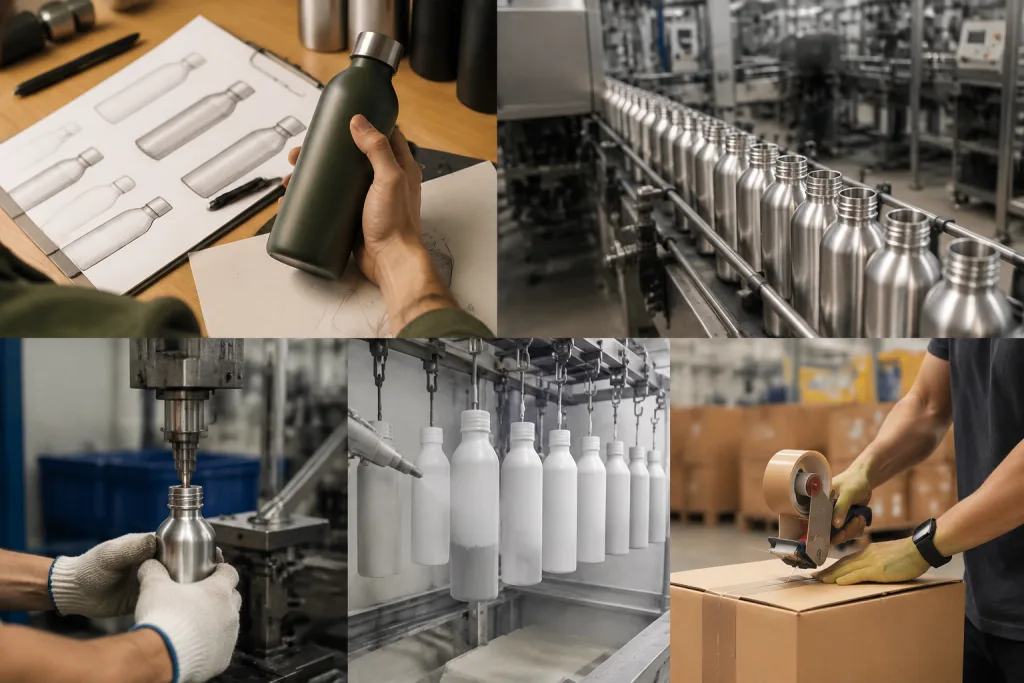
Specifications decide whether the bottle survives daily use or only looks good in the sample photo. For a proper double wall vacuum build, ask for 18/8 stainless steel with wall thickness around 0.35-0.45 mm; on our line, QC checks this with a digital micrometer before polishing. If the body is too thin, you get dents and a higher reject rate. Too thick, and the math doesn't work: weight climbs, carton weight climbs, and sea freight follows. For a 750 ml unit, a finished weight around 320-420 g is common, depending on lid and coating.
Lid design matters more than most first-time buyers expect. A screw lid with PP and silicone is fine for a promotional canteen, but a leakproof flip or sports cap may cost $0.20-$0.55 more per piece, and buyers still ask us why the quote moved. For a custom growler or customizable growler style, closure strength and gasket material matter more because the user handles it harder. If you are selling to Europe, ask for REACH and LFGB support. For the US, ask for FDA food contact declarations and, where relevant, BPA-free resin data. Do not trust a marketing sheet; request test reports with the same model code as the PO.
- Use AQL 2.5 for major defects and 4.0 for minor defects, and make sure the inspection booking does not list the wrong color code.
- Confirm vacuum retention with 95°C water for 6 hours, drop resistance at 1.0 m, and lid torque with a torque meter before shipment.
- Check logo wear after 50 wash cycles if the product is customized drinkware for retail; QC pulled the sample twice on one matte black job because the print softened at the edge.
That is the gap between a canteen customizable program that sells once and a customized canteen line that gets reordered. We've seen this go sideways when the buyer approves only the photo sample and skips the pre-shipment report.
How To Judge The Supplier
Not every canteen supplier owns a canteen line. Some trading offices quote fast, then disappear when you ask for weld photos. Ask who can walk you past the laser welding station, the vacuum pump gauge, and the final AQL 2.5 records. A real vendor double wall bottle factory can explain seam overlap in mm, leakage count per 1,000 pcs, and why one 750 ml bottle runs 18 seconds on the line while a wide-mouth shape takes 24 seconds.
Look for ISO 9001 on quality management and BSCI if your retail customer checks social compliance. For Europe, ask how they record REACH items and packing waste weight by carton; we normally list carton kg and polybag grams on the packing file because buyers flag missing data. For North American programs, ask for a 1.2 m carton drop test and barcode placement if you plan to use FNSKU labels or distributor-specific labels. A reliable canteen factory should show defect rate by process step, such as 0.6% polish scratch and 0.2% lid leakage, not hide behind one pass/fail number.
Ask for two items before you place a serious order: a current sample from the latest tooling and a written packing spec with carton size, GW/NW, and label position. Then ask for production photos from the last 30 days. QC pulled the sample? Good. If the supplier refuses line-item transparency, the math doesn't work; we have seen a USD 0.18 cheaper quote turn into 12 days of rework after the buyer found mixed lids in 23 cartons. In China, a solid canteen vendor is proud to show the factory floor; a weak one talks only about price.
For canteen manufacturers serving Europe and North America, the best signal is not a polished website. It is repeat-order control. We check the golden sample against a digital caliper reading, lid torque, powder coat color card, and carton compression result, because resin, cartons, and 304 stainless prices move every month. The buyer flagged it once: same PO item code, different straw length. That small mismatch can hold a shipment for 7 days.
Buying For Brands And Distributors
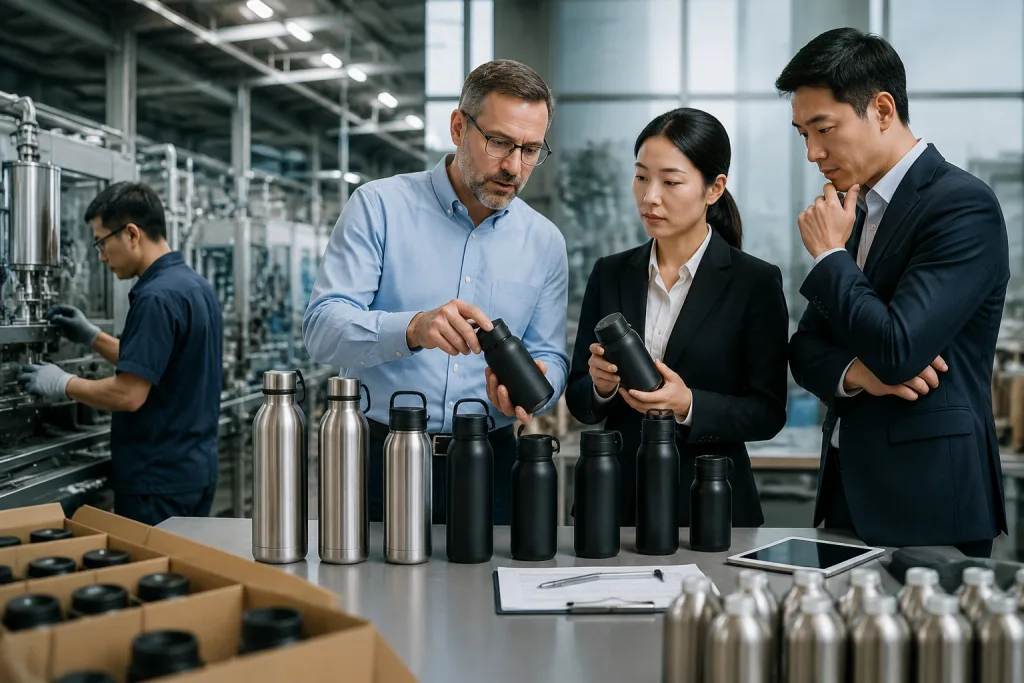
Match the buying route to the channel. For a canteen distributor selling Q4 corporate gifts, we run 500 pcs with a one-color logo, standard white box, and a 7-day pre-production sample approval; that is usually enough. For a brand owner building a retail line, start at 3,000 pcs and freeze the lid, coating, carton size, and barcode position before the deposit hits. For a canteen promotional buyer, keep the bottle body plain and spend the budget on print registration and ship-date control. We have seen buyers chase 6 lid colors on a first PO, then argue over a $0.08 carton increase after QC pulled the packed sample. The math doesn't work.
For custom drinkware launches, I tell buyers to treat the first PO as a market test, not a full range. Start with one body, one lid, and one carton spec. Split color into 2 or 3 variants unless your sell-through data proves more; our line changeover for powder coating takes about 45 minutes per color, and that time lands in the cost. A custom growler or customized growler line follows the same rule, just with a larger inner box and a heavier freight hit, often 12 kg vs 18 kg per master carton depending on capacity. The same applies to a custom canteen or customizable canteen: each extra option adds artwork checks, packing labels, and one more place for a PO typo like “mat black” to slow the order.
- 500 pcs: pilot SKU, fast decision, FOB about $2.40-$3.20; we usually keep this to 1 logo position and 1 carton mark.
- 3,000 pcs: balanced launch, better unit cost, FOB about $1.85-$2.60; this is where custom color and retail carton testing start to make sense.
- 10,000 pcs: export program, stronger tooling leverage, FOB about $1.45-$2.05; lock the AQL 2.5 inspection plan before mass packing.
If you sell through canteen distributors or distributor drinkware channels, keep one spec sheet for every sales rep. Boring document. Big impact. It stops price drift, cuts wrong claims, and makes reordering from a canteen vendor in Zhejiang cleaner when the second PO comes 60 days later. We ship repeat orders faster when the spec sheet lists body diameter in mm, coating code, lid material, carton dimensions, and logo Pantone. China has plenty of capable factories; the real test is whether the supplier holds the same numbers on the second order, not just the sample order.
Request a real quote with MOQ and timeline
Send your target volume, artwork, and destination port. We will quote FOB, packing, and lead time from China with no hidden line items.
Frequently asked questions
What is a fair FOB price for a vendor double wall bottle?
For a standard 18/8 stainless steel double wall bottle, a fair FOB range is usually $1.55-$2.30 at 3,000 pcs and $2.40-$3.40 at 500 pcs. Laser engraving may add $0.08-$0.18, one-color print $0.12-$0.25, and powder coating $0.18-$0.40. If the quote looks much lower, check whether carton, inner tray, and testing are excluded. For a real comparison, ask for the same body size, same lid, same decoration method, and the same packing method. A canteen supplier in China should be able to itemize all of that clearly.
How long does it take from sample approval to shipment?
If the mold already exists, a sample usually takes 3-7 days and a pre-production sample takes another 5-10 days. Bulk production is commonly 20-35 days after deposit and final artwork approval. Ocean freight from China to the US or EU adds about 25-40 days port to port. That means a stock order can land in 35-65 days, while a custom order can take 50-90 days. If you need a new lid mold, add 15-25 days and often $1,500-$6,000 in tooling. Peak season in Zhejiang can add another week if you book late.
What MOQ should I expect from a canteen factory?
For a stock bottle body with logo decoration, 500 pcs is common. Once you change the lid, color, or packaging, 1,000-3,000 pcs is more realistic. Full custom builds with special lid tooling often start at 3,000-5,000 pcs, and some canteen manufacturers will only quote 10,000 pcs if the shape is highly customized. In practice, the best MOQ depends on how much change you want. If you only need a canteen customizable program for a short promotion, keep the body standard and customize the print or box instead of the mold.
Which certifications matter for Europe and North America?
For Europe, ask for REACH support and, if the buyer requires it, LFGB-related food contact testing. For North America, ask for FDA food contact declarations and BPA-free resin data where relevant. On the factory side, ISO 9001 is a useful baseline, and BSCI helps with social compliance reviews. On the product side, ask for vacuum retention, leak, and drop test reports. If you are ordering customized drinkware for retail, AQL 2.5 for major defects and 4.0 for minor defects is a sensible inspection level. Do not accept a certificate list without the actual reports.
Can I use one bottle design for both promotional and retail orders?
Yes, and that is often the smartest route. Keep one bottle body, one lid, and one carton size, then change the decoration and insert card for each channel. A canteen promotional run can work at 500 pcs with simple print, while a retail launch may need 3,000 pcs for better pricing and packaging efficiency. The goal is to avoid turning every campaign into a new mold. Many canteen distributors use the same base SKU for corporate gifts, distributor drinkware programs, and online retail. That keeps replenishment easier and reduces dead stock.