Key Takeaways
- A practical vendor coffee tumbler MOQ starts at 1,000 pcs per color for powder-coated stainless steel
- 304 stainless steel at 0.5 mm inner wall and 0.4 mm outer wall is a normal retail-grade travel tumbler build
- Laser engraving is safer for 500-5,000 pcs logo orders; full-wrap printing needs tighter artwork control
- Plan 35-50 days production after deposit and artwork approval for custom coffee mug bulk orders
A vendor coffee tumbler looks simple until your team has to sign off the powder coat, lid snap force, logo position, 5-ply carton drop test, barcode sticker, and ship date for 8,000 units. Coffee brands usually ask for a cup that can sit on a retail shelf without looking cheap. Corporate-gift buyers care about a clean delivery window; last month one buyer flagged a 3 mm logo shift on the pre-production sample before QC pulled the sample back to the line.
From our Hangzhou, Zhejiang production desk, the issue is not finding a coffee mug supplier. China has hundreds. The wrong question to ask is “who has the lowest unit price?” The harder work is checking whether the contact controls the coffee mug factory, then locking the spec sheet tightly enough that your bulk travel tumbler order ships as quoted, not as someone on the line guessed from a blurry PO.
What Are You Actually Buying?
Ask us for a vendor coffee tumbler and we are not quoting one item. We are quoting a double-wall stainless steel cup, plastic lid tooling, finish, logo process, packing method, and export paperwork. “Tumbler” is too loose. A 12 oz slim office cup, a 16 oz café retail cup, and a 20 oz car-cup-holder travel mug run through different fixtures on the line; last month QC pulled a 20 oz sample that fit our gauge but failed the buyer’s 76 mm cup-holder test.
For coffee brands, the common sizes are 12 oz, 16 oz, and 20 oz. Corporate-gift buyers usually land on 16 oz or 20 oz because the hand feel is better and the carton math still works. A typical 20 oz stainless travel tumbler weighs 280-340 g before packaging. If a quote comes in at 245 g, don’t celebrate yet. Ask for wall thickness, material grade, and a cut-open sample photo; we’ve seen this go sideways when the buyer approved price before checking the 304 stainless inner wall.
Here is the practical checklist before you request pricing:
- Capacity: state oz and ml, because factories in China build the drawing in metric and our caliper check is in mm.
- Material: 304 stainless steel inner wall, 201 or 304 outer wall, PP lid, silicone gasket, with the grade written on the PO.
- Finish: powder coating, spray painting, electro-polished steel, or UV print wrap; each needs a different curing or print setup.
- Logo: laser engraving, silk screen, pad print, heat transfer, or UV print, with artwork size and Pantone code confirmed before sampling.
- Use case: retail shelf, employee gift, event giveaway, subscription box, or café merchandise, since packing drop-test needs are not the same.
A bulk coffee tumbler for resale needs a tighter spec than a basic coffee mug promotional giveaway. Retail buyers notice lid wobble, thin coating, weak insulation, and messy logo edges. Gift recipients may not check with calipers, but they will complain if the lid leaks in a bag. Pick the quality level before asking 10 suppliers for the cheapest quote; the math doesn’t work if you compare a 0.45 mm wall sample against a lighter promo cup with a loose silicone gasket.
Which Factory Type Fits You?
You will see at least 6 labels online: coffee mug manufacturer, coffee mug manufacturers, coffee mug oem manufacturer, coffee mug supplier, coffee mug distributor, and coffee mug distributors. People use them too loosely. A supplier directory or coffee mug supplier list gives you names, not proof of who owns the welding jigs, vacuum chambers, powder coating guns, or final carton inspection.
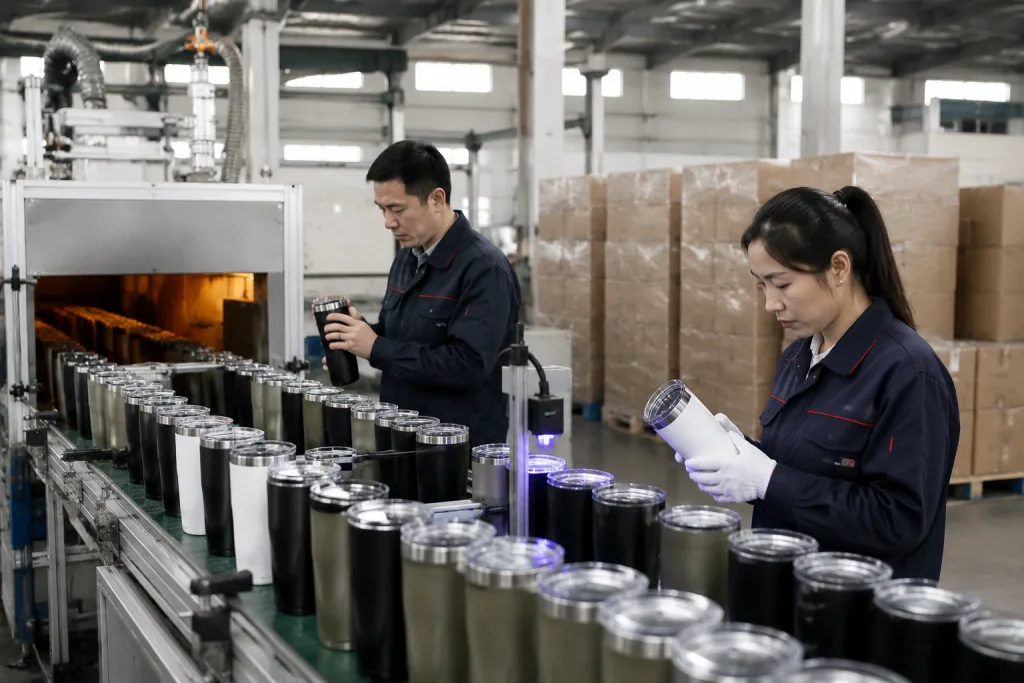
A real coffee mug factory can answer questions about welding, vacuum testing, coating line capacity, and AQL inspection without sending every detail to another workshop. At BottleForge Industrial in Zhejiang, we run stainless forming, vacuum insulation, coating, assembly, and packing coordination on the travel tumbler line. Normal monthly capacity is about 450,000 stainless drinkware units, depending on size mix and decoration complexity. Last month QC pulled 32 samples from a 20 oz batch after the Helium leak tester showed 2 borderline pieces, so we held the lot before packing.
If you need coffee mug factory direct pricing, be honest about order size. This is where buyers push back. Factory direct does not mean a 300 pcs trial gets the same quote as a 30,000 pcs annual program; the math doesn't work once we count color changeover, carton printing, and 2 hours of line cleaning. For most custom travel tumbler orders, 1,000 pcs per color is a realistic starting MOQ. For molded lids, custom shapes, or exclusive color development, MOQ can move to 3,000-5,000 pcs because tooling, testing, and line setup become more serious.
Use this filter when choosing the factory type:
- Trading company: useful for 200-500 pcs mixed-item orders, but weaker when you ask for wall thickness, lid torque, or a 0.3 mm logo position tolerance.
- Factory with export team: better for repeat bulk coffee travel mug orders and private label programs, since sales can walk to the line and check the packing spec before the PO typo becomes 80 cartons of wrong inserts.
- Distributor: faster for domestic stock, often 3-7 days, but limited when you need custom 304 stainless material control or a retail box matched to your brand color.
- OEM factory: best when you need drawings, tooling, Pantone color matching, and repeatable QC, especially when the buyer flagged the same lid fit issue twice.
For coffee brands and corporate buyers in Europe and North America, the sweet spot is usually an export-ready factory in China with BSCI audit experience, REACH awareness, and English documentation. You do not need a perfect brochure. You need clean samples, clear tolerances, and someone who will say your requested deadline is unrealistic when production needs 18 days, not the 12 days written on the first PO.
How Should You Specify Quality?
Quality problems usually start before the sample room even cuts metal. If your RFQ says “20 oz tumbler, logo, good quality,” we can see 4 different quotes land on the buyer’s desk by 5 p.m. One line may price 304 inner and 201 outer stainless steel. Another may shave the wall to win by USD 0.18. Another may use a lid slider that rattles when QC shakes it 10 times. The numbers matter.
For a retail-grade bulk travel mug, we normally recommend 304 stainless steel inner wall, 0.5 mm inner thickness, 0.4 mm outer thickness, copper or vacuum insulation based on the heat target, and a food-contact PP lid with a silicone gasket that sits flat in the groove. We run the caliper check on the cut rim before polishing, because 0.1 mm missing there shows up later as weak insulation or a soft body feel. A practical insulation benchmark is hot water at 95°C staying above 55°C after 6 hours under room temperature testing. Do not promise 12-hour heat retention unless the sample has been tested with your exact model and lid.
Food-contact compliance should match your market. For the EU, ask about LFGB and REACH-related material declarations, including the plastic lid and color coating, not just the steel body. For the US, ask for FDA food-contact material documentation and, where relevant, ASTM-style performance or safety expectations. If the tumbler is for children, the requirements change; this is the wrong question to ask if the buyer only says “make the adult cup smaller.” Last spring, QC pulled a kids lid sample because the drinking spout edge measured too sharp after trimming.
Inspection should be written into the purchase order, not left in a WeChat message from sourcing. For most coffee mug in bulk programs, use AQL 2.5 for major defects and AQL 4.0 for minor defects. Major defects include leakage after an upside-down test, sharp edges at the rim, cracked lids, wrong logo position over 2 mm, coating peel that exposes metal, or carton marking that does not match the PO. Minor defects include dust points in coating under the agreed limit, light scratches below an agreed size, or color drift within the approved Pantone tolerance. We have seen this go sideways when a PO typed “black lid” but the approved sample had a clear lid.
Do not approve mass production from a beauty photo. Approve it from a physical pre-production sample, a color code, a logo proof, and a written packing specification that shows carton size, inner box material, and barcode position.
If you are buying for a corporate-gift deadline, add a carton drop test requirement. A common standard is 1 corner, 3 edges, and 6 faces from 60-80 cm depending on carton weight. Boring paperwork. Then one day 600 cartons arrive with crushed gift boxes, and the buyer flags the pallet photos before customs clearance. The math does not work if replacement cartons take 12 days and your event is in 8.
What Customization Is Worth Paying For?
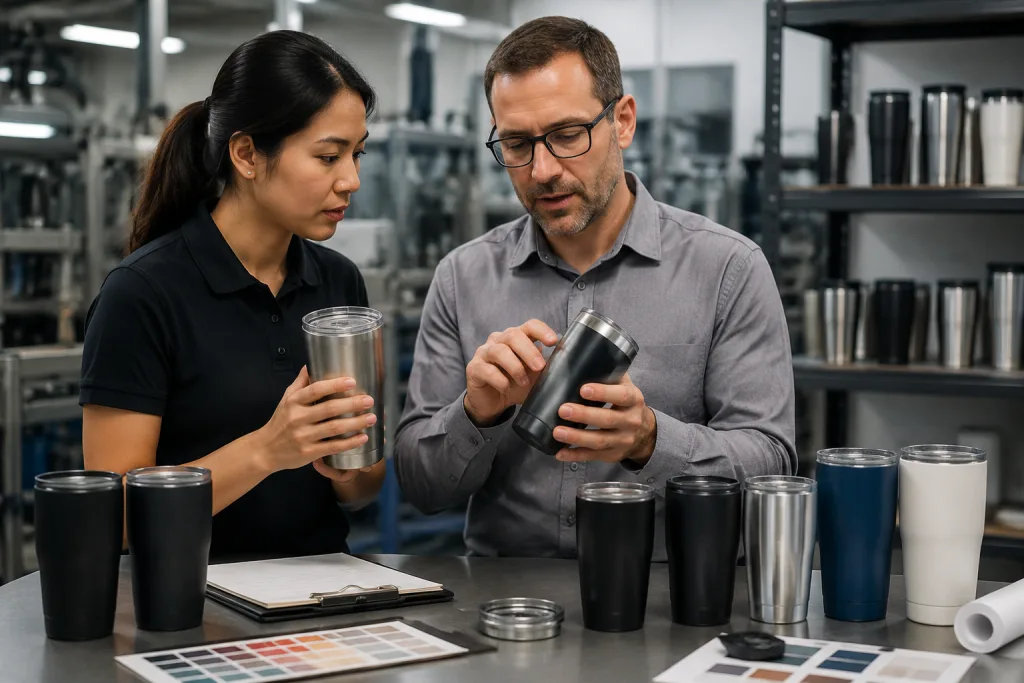
Coffee mug custom work gets cheap or expensive fast, depending on the decoration route. The wrong question is unit price only. We’ve had a buyer approve a flat PDF, then QC pulled the sample because the 38 mm logo warped on a tapered body and broke across the powder-coat texture near the grip line.
For 1,000-5,000 pcs, laser engraving is usually the safest option. No ink layer. Better wash resistance than basic print. On our Hangzhou line, a fiber laser set at 55W gives a clean mark on powder-coated 304 stainless steel, but the color is fixed by the exposed metal or base contrast. If your brand book needs exact PMS 186C, silk screen or UV printing is the better call.
Silk screen works well for simple one-color logos, especially on straight-wall tumblers where the jig holds the cup within about 0.5 mm. Expect a setup charge of roughly USD 40-80 per color per artwork, depending on the factory and film work. UV print handles richer graphics and full-wrap artwork, but sample approval must check seam alignment, fingernail scratch marks, and rub test results. Heat transfer looks sharp in photos; we’ve seen cheap transfers lift after 20 dishwasher cycles.
For coffee mug customizable and coffee mug customized programs, separate three levels of customization before you ask for a quote:
- Logo only: lowest risk, fastest lead time, usually 1,000 pcs MOQ, and the sample room can finish it with our standard laser jig.
- Color plus logo: needs Pantone matching, a sprayed coating sample, and 3-5 extra approval days because the buyer often flags gloss difference under D65 light.
- Shape, lid, or tooling: real OEM work, often 5,000 pcs MOQ or more, with CNC prototype review before steel mold cost makes sense.
Coffee mug custom made does not automatically mean a new mold. Many buyers do better with a proven factory mold, a stronger finish, custom packaging that passes a 90 cm drop test, and clean brand placement. For a first order, spend on coating quality and lid reliability; the math doesn’t work if a USD 0.18 cheaper lid causes 3% leakage claims. Save custom tooling for repeat programs after sell-through is proven.
If you want coffee mug private label or coffee mug private labeling, decide where the brand mark goes: tumbler body, bottom stamp, care card, gift box, master carton, or every touchpoint. Be precise. Last month a PO said “logo on carton,” and the buyer meant four-side shipping marks, not only the long side. Retail buyers often need GS1 barcode space. Amazon-style prep usually means FNSKU labels, suffocation warnings for polybags, and carton weight limits under 15-18 kg.
What Should A Real Quote Include?
A real quotation is not “USD 4.20, FOB Ningbo” pasted into WhatsApp. It should pin down the tumbler so another engineer on the line could match it against the drawing, caliper reading, and approved sample. If the offer has no steel grade, no lid structure, no box spec, and no AQL 2.5 inspection terms, this is the wrong question to ask. You do not have a quote. You have bait.
For a standard 16 oz powder-coated stainless vendor coffee tumbler from Zhejiang, we normally see FOB China at USD 3.20-5.80 for 3,000 pcs, depending on lid design, wall thickness, finish, logo method, and packaging. A 20 oz model with a premium lid and gift box may land around USD 4.20-7.50 FOB. These are not promises; 304 stainless, RMB/USD rate, and powder coating pass rate move the number. Last month QC pulled a 0.42 mm inner wall sample against a 0.50 mm spec, and the cheap quote stopped looking cheap fast.
Your RFQ should ask for:
- FOB port, usually Ningbo or Shanghai for our Zhejiang shipments.
- MOQ per color and per logo, for example 1,000 pcs per powder color if the line needs a separate spray setup.
- Sample cost and sample lead time, typically 7-12 days for logo samples after artwork is confirmed.
- Mass production lead time, normally 35-50 days after deposit and sample approval.
- Carton quantity, gross weight, carton size, and CBM, checked against the final packing method.
- Included packaging: white box, kraft box, color box, sleeve, or gift set.
- Payment terms, commonly 30% deposit and 70% before shipment.
If you are comparing a bulk coffee mug, bulk coffee tumbler, and ceramic coffee mug bulk option for the same campaign, compare landed cost instead of FOB alone. Stainless travel tumblers cost more per unit, but they break less and feel stronger in a client gift pack. Ceramic mugs can look cheaper on paper, then the math fails when 2.5 kg cartons get hit with parcel damage claims; we have seen this go sideways after a buyer ignored the drop-test result.
A good supplier should spell out what is excluded. Third-party inspection, special lab testing, palletizing, DDP freight, and individual mailer boxes are usually extra. Ask before the carton dieline is approved. Once our packing team has locked a 24 pcs master carton and the buyer adds single mailer boxes, the CBM changes, the freight quote changes, and nobody enjoys that revised PI.
How Do You Control Delivery Risk?
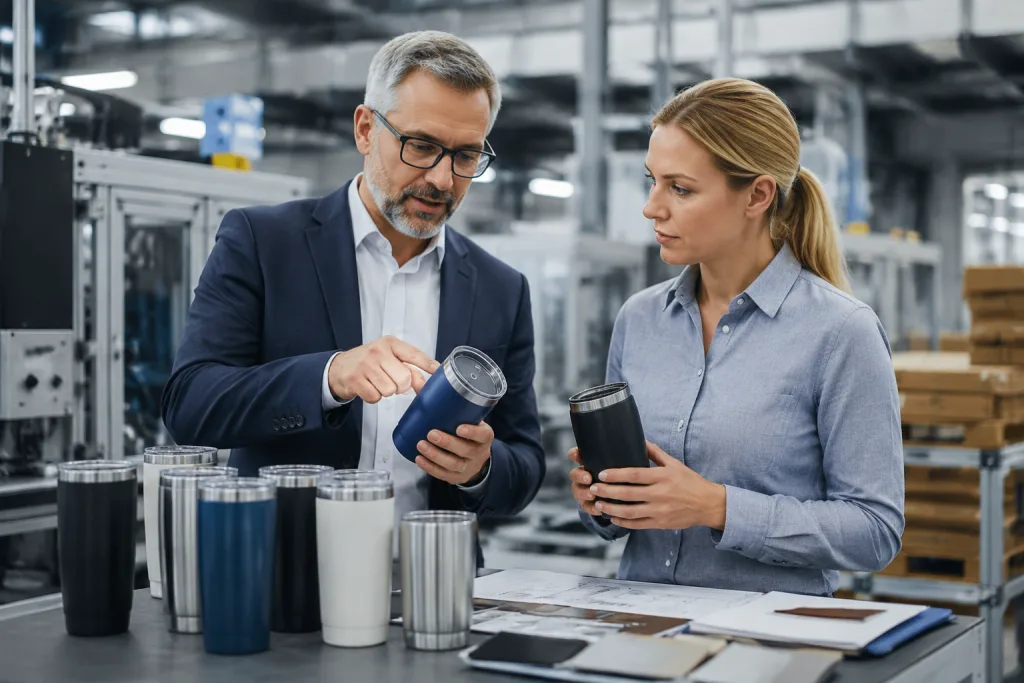
Delivery risk is bigger than line speed. It sits in sample approval, lids and cartons being ready, QC timing, vessel booking, and the buyer’s own sign-off chain. We see 6 or 7 late orders each season start the same way: the buyer takes 9 days to approve the sample, then asks us to “keep original ship date.” The planner has already booked the powder-coating line and the laser jig. This is the wrong question to ask.
For a normal custom bulk travel tumbler order, build the calendar backward from the shelf date. If your event is June 20 in Chicago or Hamburg, artwork approval in late May is already risky. Allow 7-12 days for a logo sample, 35-50 days for mass production, 3-5 days for final inspection and booking, and 25-40 days for ocean freight depending on destination and routing. Air freight can rescue a deadline, but the math gets ugly fast when 2,000 pcs move by air at 8.6 kg per master carton.
Use a simple milestone checklist:
- Day 0: final spec sheet locked, PI confirmed, and quote version matched to the PO.
- Day 1-3: deposit paid, vector artwork checked, and Pantone code confirmed under the light box.
- Day 7-12: pre-production sample finished, with logo position measured in mm from the rim.
- Day 13-16: buyer approval received, or QC pulled the sample for one round of correction.
- Day 17-50: mass production runs through coating, logo printing, assembly, and packing on the line.
- Day 51-55: AQL inspection completed and shipment booking sent with carton count and CBM.
If you work with a coffee mug promotional products campaign, ask your sales team whether the date is a hard event date or a preferred warehouse date. Those are not the same. A hard trade-show date may justify air shipment for 500 urgent pieces and ocean shipment for the balance. A preferred warehouse date usually does not. We’ve seen this go sideways when the buyer flagged the deadline only after the forwarder had released the SO.
Confirm carton labeling before packing starts. Corporate buyers often need department codes printed beside the PO number. Retailers may need carton sequence marks, while e-commerce programs may need FNSKU, carton content labels, and “Made in China” marking. We can print these on a Zebra label printer or direct on the carton, but not after 320 cartons are taped and stacked on pallets. One PO typo can cost a full afternoon.
Buyer Checklist Before Deposit
Before you pay the deposit, take 30 minutes and check the boring lines on the PI. This is where procurement managers earn their salary. We have seen a PO typo change 500 ml to 550 ml, and QC only caught it because the caliper reading did not match the approved sample. A coffee mug supplier directory or online coffee mug supplier list can introduce you to vendors, but your purchase order is what protects the order.
Use this checklist for a vendor coffee tumbler project:
- Model number, capacity, dimensions, and weight are written on the PI, with capacity tested to the fill line in ml.
- Material grade is stated: 304 inner stainless, outer grade, PP lid, silicone ring.
- Wall thickness or target weight is confirmed in mm or g, not left as “standard.”
- Color is confirmed by Pantone, RAL, or approved physical sample under a light box.
- Logo size, placement, method, and artwork file version are listed, including laser depth or print color count.
- Packaging style, insert card, barcode, and master carton marks are approved, with carton size and gross weight checked.
- MOQ, unit price, tooling fee, sample fee, and payment terms are written, not discussed only on WhatsApp.
- AQL level, inspection timing, and responsibility for failed inspection are agreed before the line starts.
- FOB port, freight handover, and required documents are clear, including Hangzhou pickup or Ningbo/Shanghai loading plan.
If you are new to working with a coffee mug oem manufacturer in China, ask for photos or 10-second videos at three points: raw body before coating, logo production, and final packed cartons. We run this for repeat buyers too, because one buyer once flagged a matte black batch after seeing gloss reflection in a phone video from the coating line. It is not a replacement for inspection, but it catches obvious misunderstandings early.
Be careful with over-customizing the first purchase. A first order of 1,000-3,000 pcs should prove the model, finish, lid, packaging, and supplier communication. The wrong question is “Can we make it unique?” The right question is whether the line can repeat it without defects at AQL 2.5. Once the product sells or the gift feedback is good, you can move into exclusive colors, custom lid molds, or larger bulk coffee mug annual contracts. Factory relationships improve when both sides can repeat a successful spec instead of rebuilding the product every order.
A reliable supplier should push back when needed. If your artwork has 0.2 mm strokes and is too thin for laser, if your deadline needs air freight, or if your target price means a weaker lid, you should hear that before deposit. We have seen this go sideways: the buyer wanted a lower price, the lid gasket was downgraded, and QC pulled 18 leaking samples from 200 pcs during the water test. Silence is not service. It is risk transferred to you.
Send Your Tumbler RFQ Before You Lock Artwork
Share capacity, quantity, logo file, target delivery date, and packaging needs. We will return a practical FOB quote and production route.
Frequently asked questions
What MOQ should I expect for a custom vendor coffee tumbler?
For stainless steel travel tumblers, a realistic MOQ is 1,000 pcs per color for logo-only customization. If you need a custom powder-coated color, expect 1,000-3,000 pcs depending on coating setup. Custom lid tooling or body shape can move the MOQ to 5,000 pcs or more, plus tooling charges. Very small orders below 500 pcs are usually handled from stock by distributors, not by a coffee mug factory direct production line. For coffee brands testing a retail item, we usually suggest 1,000 pcs with one color and one decoration method first.
Is laser engraving better than printing for coffee mug custom orders?
Laser engraving is usually better for durability and clean execution on powder-coated stainless steel. It is a good fit for 1,000-5,000 pcs corporate-gift and retail orders because there is no ink layer to peel. Printing is better when you need exact brand colors, multi-color artwork, or a large graphic area. Silk screen works well for simple one-color logos, while UV print is better for full-color designs. The right choice depends on your artwork, not just price. Always approve a physical sample because curved tumbler bodies can distort logos.
How long does a bulk coffee travel mug order take from China?
Plan 7-12 days for logo sample production and 35-50 days for mass production after deposit and sample approval. Add inspection and export booking time, usually 3-5 days. Ocean freight to North America or Europe may add 25-40 days depending on port and season. Air freight is faster, commonly 5-10 days after pickup, but the cost can be painful on stainless tumblers. If your event date is fixed, start at least 90 days ahead. Zhejiang factories can move quickly, but approval delays still consume the calendar.
What certifications should I ask a coffee mug manufacturer for?
For EU sales, ask for food-contact documentation such as LFGB test reports where applicable, plus REACH-related material declarations for coatings and components. For the US, ask for FDA food-contact material support and relevant safety documentation for plastic lid parts and silicone gaskets. Factory audits such as BSCI can matter for corporate buyers, especially in Europe. Also ask whether the supplier works under ISO-style quality procedures, even if not formally certified. Match testing to your exact model and material; an old report for a different lid is not enough.
Can I order coffee mug private label packaging for retail?
Yes, but define the packaging early. A private label order may include a bottom logo, branded care card, color gift box, barcode, carton marks, and country-of-origin label. For retail, provide dielines, Pantone colors, barcode files, and any retailer packaging rules before sample approval. A simple white box may add only a small cost, while a printed color box can add USD 0.20-0.60 per unit depending on board quality and quantity. For Amazon-style programs, confirm FNSKU labels, polybag warnings if used, and carton weight limits before packing starts.