Key Takeaways
- Specify 304 stainless steel, 0.45-0.55 mm inner wall, and lid leak testing at 100% for travel tumbler orders
- For custom powder coating, plan 35-45 days after artwork approval and keep MOQ around 1,000 pcs per color
- Use AQL 2.5/4.0 inspection with carton drop testing before balance payment on bulk coffee travel mug shipments
- For corporate gifting, confirm logo method, carton strength, barcode labels, and spare lid ratio before mass production
A vendor coffee travel mug looks simple until QC pulls 80 pcs from the first lot and finds loose lids, chipped powder coat around the bottom radius, 2-hour heat retention below spec, or master cartons crushed after a 76 cm drop test. Coffee brands and corporate-gift buyers often catch this after artwork approval and a 30% deposit. Bad timing. The factory can still correct part of it, but your launch date starts getting squeezed.
We run travel tumbler production in Hangzhou, Zhejiang, and the same problems show up on new Europe and North America projects: lid tolerance off by 0.3 mm, powder coating too thin on the lip, or a PO saying “matte black” while the approved sample was Pantone 433C. We’ve seen this go sideways. Specify the mug like a buyer, not a consumer; China has plenty of coffee mug manufacturers, but line control beats a glossy catalog every time.
The lid fails first
Most complaints on a vendor coffee travel mug start at the lid, not the stainless body. The body passes vacuum test, paint adhesion, and carton drop, then QC pulls the sample and finds a wet tissue under the cap. A buyer asks for a “leakproof coffee mug custom made for commuters,” but the sample gets a soft desk test. Real users toss it into a 74 mm car cup holder, a backpack side pocket, or a meeting-room tote with a laptop inside. That is where a weak gasket gets expensive.
For a bulk coffee travel mug, do not treat “spill resistant” and “leakproof” as the same claim. They are not. A flip lid can stop splash from walking to the train, then leak after 30 seconds upside down. A screw lid with a silicone ring has a better shot, but only when the thread tolerance stays within 0.15 mm and the gasket hardness matches the drawing. We run a simple test on pre-production samples: fill with 80°C water, close lid, invert for 30 seconds, shake 10 times, then check white tissue paper for visible moisture.
Write the lid details into your purchase order. Specify food-grade PP, Tritan, or AS based on transparency and heat demand; our tool room once caught a PO typo where “AS clear lid” became “ABS clear lid,” and that would have failed the buyer’s hot-water check. Require silicone gaskets, not cheap TPE rings that deform after 20 dishwasher cycles. Ask for 2% spare lids on retail and corporate-gift jobs because replacement requests hurt your brand more than the part cost. The math is simple.
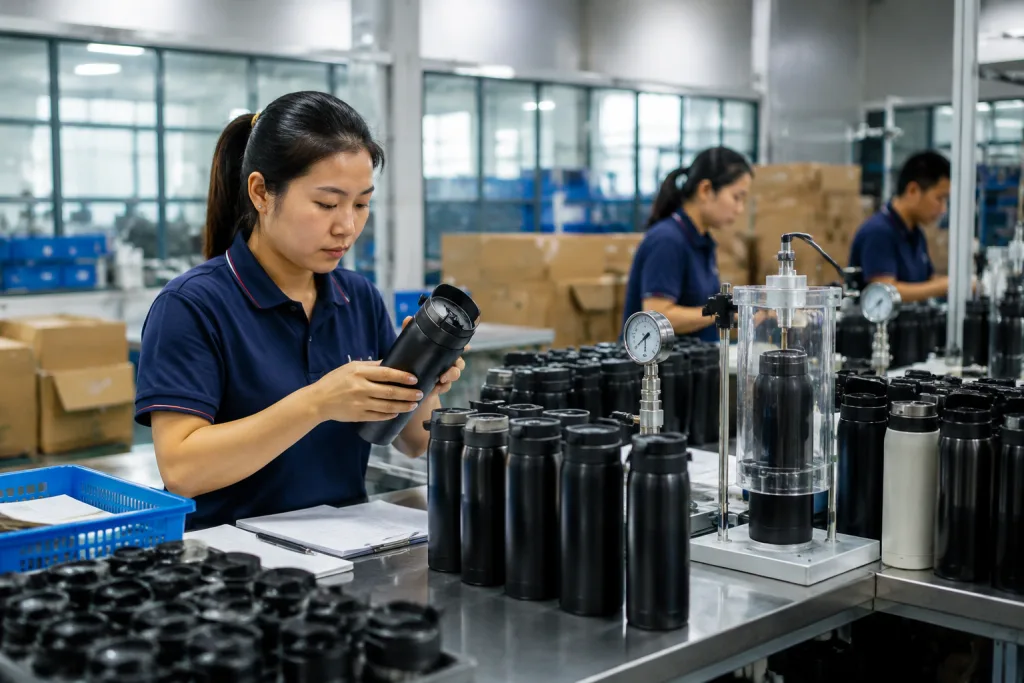
If you are comparing a coffee mug supplier directory or a coffee mug supplier list, ask each supplier how lids are tested in mass production. “Random check” is the wrong answer. For our Zhejiang line, lid assembly and water leakage are checked at 100% before packing on travel tumbler orders above 5,000 units. We use a pressure squeeze bottle, tissue check, and a 30-second inversion station beside the packing table. That one control step prevents more customer complaints than any premium finish.
Vacuum insulation quietly underperforms
Heat retention problems don’t show up like leaks. The mug looks clean, the logo passes the 3M tape test, and the buyer only hears about it when coffee turns lukewarm before 10 a.m. We’ve seen this go sideways on “coffee mug factory direct” quotes at USD 0.18 lower than the next supplier: thinner steel, weak vacuum draw, and no hot-water hold test on the line. QC pulled 32 samples from one trial order last year; 7 looked perfect but failed the 6-hour temperature check.
A dependable bulk coffee tumbler usually uses double-wall 304 stainless steel for the inner liner and 201 or 304 stainless steel for the outer wall. For a serious coffee brand, we push back hard on anything except 304 inside. Typical wall thickness should sit around 0.45-0.55 mm for the inner wall and 0.40-0.50 mm for the outer wall, depending on shape. Too thin saves a few cents. The math doesn’t work if 1 carton comes back dented after a drop test from 80 cm, or if the buyer flags a soft feel during pre-shipment inspection.
Ask for a temperature curve, not a slogan. A common 20 oz travel tumbler test is: fill with 95°C water, close the lid, keep at 20°C room temperature, and measure after 6 hours. A practical pass target is 55-60°C after 6 hours for many lid styles. Fully sealed thermos designs can do better, while open sip lids lose heat through the mouthpiece. If a coffee mug manufacturer promises “12 hours hot” on every travel lid, ask for the test method, sample size, and lid code; we run this with a digital probe thermometer and record results cup by cup, not from one showroom sample.
Vacuum failure also shows up as condensation. Add cold water, wait 10 minutes, and check whether the outer wall sweats. If it does, the vacuum is gone. On mass production, vacuum testing should happen before coating, because one failed cup after powder coating wastes finish cost and blocks space on the hanging line. At BottleForge Industrial in China, our travel tumbler capacity is about 600,000 units per month, but we still slow inspection on new custom molds; the first batch is where insulation drift shows up, especially around the welded bottom seam measured with a 0.02 mm feeler gauge.
Coating chips before the campaign ends
Corporate-gift buyers usually judge the finish before they ask about 304 stainless, and I don’t blame them. The mug sits on a conference table with your client’s logo facing outward. If the coating chips after 1 dishwasher cycle or 7 days in a car cup holder, the whole project feels cheap, even when the steel body passes. We had a buyer flag this on a 3,000 pc bank promo because QC pulled the sample and found a 2 mm chip right on the logo side.
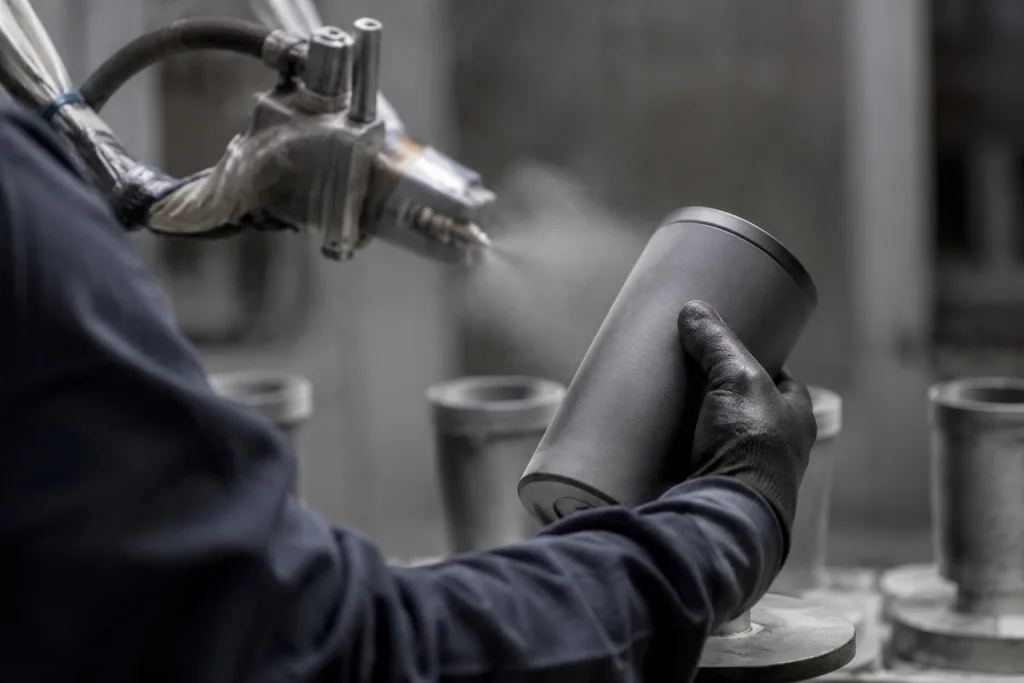
Powder coating is the safer daily-use finish for a bulk travel mug. Better grip than polished steel. Better scuff resistance than most spray paint. But the math doesn’t work if the line skips pretreatment or rushes the oven. We run alkaline degreasing first, then check coating thickness with a digital film gauge; the target should usually sit around 60-90 microns. Curing temperature matters too. If the oven is set to 180°C but the part only reaches temperature for 8 minutes instead of 15, adhesion can look fine on day one and fail after shipping.
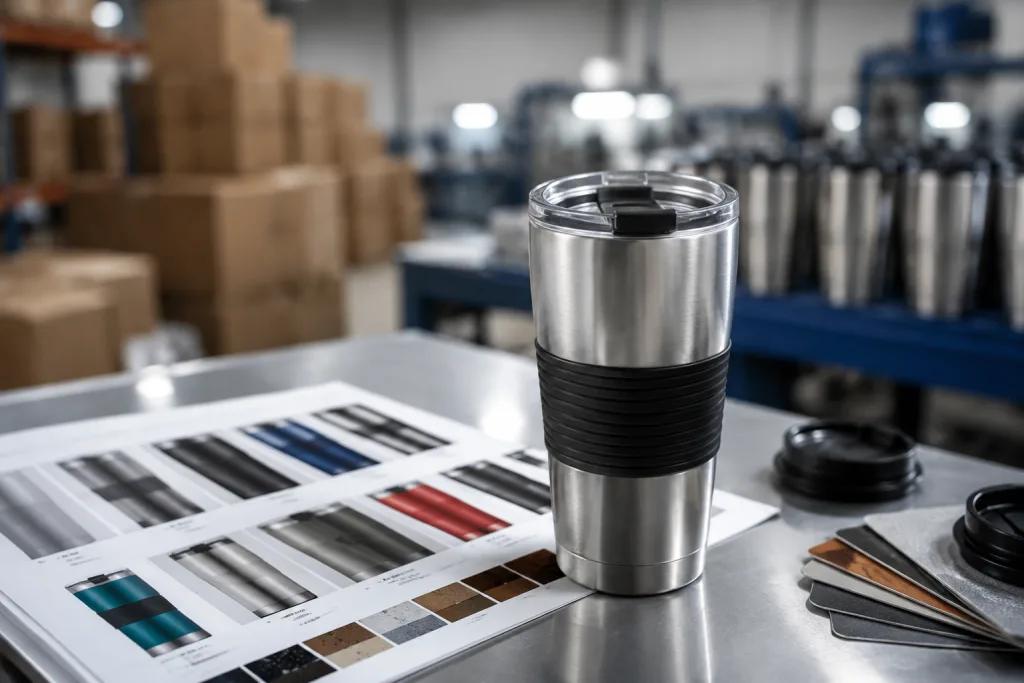
For a coffee mug customized with brand colors, approve a physical color chip or pre-production sample under daylight before mass production. Pantone matching on metal is not exact like paper printing. Matte black and navy are safer than cream if the mug will sit in a dusty warehouse for 18 days before delivery. Light colors show fingerprints fast. Metallic coatings photograph well, but we’ve seen this go sideways across a 10,000 pc run when the buyer expected every lid and body to match like injection-molded plastic.
Put coating tests into the QC checklist. A cross-hatch adhesion test to ISO 2409, a 3M tape pull, and a simple rub test with 95% alcohol are realistic, but don’t leave them as pretty words on the inspection sheet. The inspector should cut the grid with a 1 mm cross-hatch cutter, press the tape flat, then record the pull result before packing approval. If you sell through distributors, ask for carton abrasion protection too: each tumbler should go into a polybag or kraft sleeve before the individual box. A good coffee mug promotional products order is not just the logo. It is the mug still looking new when the recipient opens it.
Logos distort on curved steel
Logo problems show up fast on tapered steel. A coffee mug custom logo that looks clean in a flat PDF can stretch near the lower radius, break on 80-mesh powder texture, or sit 3 mm off the visual center because a handleless tumbler has no obvious “front.” We see this most on coffee mug private label runs where the cup has to look retail-ready, not like a cheap event freebie. QC pulled one 20 oz sample last month where the buyer’s round icon turned slightly egg-shaped after printing near the bottom taper.
Match the decoration to the wall shape and coating. Laser engraving stays sharp on powder coat, but it cuts through to the steel or base layer, so the logo color is not printed ink. Silk screen works for one- or two-color logos on straighter walls, usually with a setup charge around USD 45-80 per color; our line uses a curved screen jig and still rejects prints if the edge bleeds over 0.5 mm. Heat transfer is better for gradients and complex artwork, but it needs tighter surface control and may cost USD 0.35-0.90 per unit depending on size. Full-wrap sublimation is a separate product route, and the math does not work for every stainless tumbler construction.
For coffee mug customizable projects, ask for an artwork placement drawing with millimeter dimensions: logo width, height, distance from rim, and position against the sip opening. Simple request. For corporate gifting, we usually advise 45-60 mm logo width on a 20 oz tumbler, measured with a soft ruler around the curve before the film is made. Bigger is the wrong question to ask sometimes; oversized logos wrap too far around the body and half the mark disappears in listing photos.
Before mass production, request one gold sample with final coating, final logo, final lid, and final packaging. Do not approve decoration on a raw steel blank if your production mug will be matte powder coated. We ship the gold sample with a signed sticker on the carton, because we have seen this go sideways when a PO says “black logo” but the approved mockup shows dark gray. If you are a coffee mug distributor serving 6 end clients, this one habit prevents the ugly call where the end buyer says, correctly, that the delivered logo does not match the approved visual.
Packaging loses the shipment
About 7 out of 10 new buyers chase unit price and leave export packaging until the freight forwarder sends photos of crushed cartons. Too late. A bulk travel tumbler order is heavy, tall, and weak at the rim; we see rim dents first when the inner grid has 3-5 mm of play. If the master carton is soft or the dividers sit loose, mugs rub for 30 days on the water plus 4-6 days in port handling. The buyer then flags it as a coating or finish defect, but QC pulled the sample and the rub marks came from packing.
For North America and Europe, lock the retail or gift box before artwork approval. A plain white box cuts cost, but a kraft gift box usually fits coffee brands better on shelf. For e-commerce and corporate drop shipping, use a 5-ply mailer or reinforced individual box; we run edge-crush checks with a carton compression tester before mass packing. Master cartons should commonly use K=K or BC flute for heavier drinkware, with gross weight kept around 12-15 kg where possible. The math doesn't work when a 19 kg carton saves a few cents but arrives with crushed corners.
Carton drop testing is not optional. A practical pre-shipment test is 10 drops from 76 cm for cartons under 10 kg or adjusted according to ISTA-style internal requirements. If your order ships to a fulfillment center, confirm FNSKU labels, carton labels, country of origin marking, and barcode scan quality before packing starts; last March, the buyer flagged one PO where “Made in China” was missing on the outer carton. Re-labeling 8,000 cartons in a warehouse costs more than printing correctly in Zhejiang.
For a coffee mug in bulk program, write the packing method into the proforma invoice: one piece per polybag, one piece per gift box, 24 pieces per master carton, with carton size and estimated gross weight. Put it in black and white. If your supplier cannot give carton dimensions before production, they are not ready for serious FOB planning; our line usually has a trial carton packed with a tape gun and scale before the first 500 pcs are sealed. A coffee mug factory should know packaging, not treat it as cleanup work after production.
Compliance gets checked too late
Compliance failure feels boring until it holds a 20,000 pc shipment at the forwarder or the retail buyer rejects cartons after AQL 2.5. Coffee brands and corporate buyers selling in Europe and North America need more than a sales rep saying “food safe” on WeChat. A vendor coffee travel mug touches 95°C coffee, lips, hands, and sometimes a kid’s backpack pocket. Match the test plan to the destination market before we run mass production; QC pulled one lid sample last year and found the silicone ring was not the same grade listed on the report.
For the EU, ask for LFGB or EU food contact testing, plus REACH checks for coatings and restricted substances where the finish is painted, powder coated, or rubberized. For the US, FDA food contact expectations apply, and 3 out of 10 retail buyers we deal with still ask for California Proposition 65 review. If the mug is marketed to children, ASTM and CPSIA points come into the discussion, especially coatings, straw tips, and small parts under 31.7 mm. For corporate programs, BSCI or Sedex audit status matters when the end client has responsible-sourcing rules; we’ve had a PO typo list “Sedex 4P” when the buyer actually meant Sedex 4 Pillar.
Do not assume every coffee mug oem manufacturer keeps fresh test reports for every SKU. This is the wrong question to ask. Ask whether the report matches your exact body, lid, gasket, coating, and color code. Reports expire, get tied to a different material, or cover a Tritan lid when your order uses PP. Ask for the report number, lab name, sample description, and issue date; our document controller checks these against the BOM before deposit, not after the line starts. If your custom color uses a new coating, a previous 304 stainless steel report does not cover it.
Social compliance is separate from product compliance. A factory audit does not prove the mug is food safe, and an FDA-style material report does not prove labor standards. If you are building a coffee mug private labeling line for retail distribution, keep both files ready before purchase order release. China export production moves fast; testing still takes 7-12 working days, and a failed coating result can push delivery from 12 days to 18 days while we switch paint, clean the spray booth, and rerun the sample panel.
Cheap quotes hide missing controls
A low unit price is not automatically bad. Some designs are plain, and a mature coffee mug factory with 6 welding stations and an automatic powder line can run them efficiently. The problem starts when the quote leaves out the controls that decide whether the shipment can be used: 304 stainless verified by material report, lid leak testing on a vacuum jig, coating cross-hatch checks, signed pre-production samples, 5-layer export cartons, inspection time, and a lead time the line can actually hit. We have seen this go sideways when a buyer saved USD 0.18 per pc, then QC pulled the sample and found the lid gasket was 0.6 mm thinner than approved.
Compare coffee mug manufacturers on one sheet. Ask for FOB Ningbo or Shanghai price, MOQ by color, sample charge, any tooling charge, logo setup cost, production lead time, carton dimensions, and payment terms. For a 20 oz stainless bulk coffee mug with powder coating and one-position logo, a realistic China factory-direct range might be USD 3.20-5.80 FOB depending on lid, finish, order quantity, and packaging. If a quote sits 25% below the other 4 suppliers, the math usually does not work. Last month a buyer flagged a USD 2.86 offer; the carton size was missing, and the PO had “single wall” typed where the spec said “vacuum insulated.”
MOQ matters too. For standard shapes, we can usually support 1,000 pcs per color for coffee mug promotional orders, with 35-45 days mass production after sample and deposit approval. Custom molds or unusual lids need more time, often 60-75 days including tooling and first-article checks. If your campaign date is fixed, this is the wrong question to ask: “Who is cheapest?” Ask who has a free mold slot, lid stock in the right color, and enough coating capacity that week. Do not spend 21 days browsing a coffee mug supplier list and then expect a 15-day custom production miracle.
Use AQL inspection before paying the balance. A common setup is AQL 2.5 for major defects and 4.0 for minor defects, with critical defects at zero tolerance. Define major defects clearly: leaking lid after 30 seconds upside down, wrong logo position over 2 mm tolerance, visible coating chip larger than 1 mm, failed barcode scan, wrong carton mark, or insulation failure after a 6-hour hot-water test. A good coffee mug supplier will not be offended by this. The factories that object to written QC standards are telling you something useful; we ship for buyers who write those standards into the PO before deposit.
Send your tumbler spec before quoting.
Share size, lid style, logo file, quantity, and destination market. We will flag the weak points before your purchase order is locked.
Frequently asked questions
What MOQ should I expect for a vendor coffee travel mug?
For an existing stainless travel tumbler shape, a realistic MOQ is 1,000 pcs per color for powder coating and logo decoration. Some coffee mug factory direct offers may quote 500 pcs, but color consistency and unit cost usually suffer. For a fully coffee mug custom made project with a new lid, handle, or body mold, expect 3,000-5,000 pcs and tooling charges from about USD 800 to USD 4,500 depending on complexity. If you only need a test campaign, choose a stock mold and customize the logo, sleeve, insert card, and carton labeling first.
Which logo method is best for corporate-gift travel tumblers?
For most corporate-gift buyers, laser engraving on powder coat is the safest method because it does not peel and handles daily use well. Silk screen is better when you need exact brand colors on a simple one- or two-color logo, usually with USD 45-80 setup per color. Heat transfer is useful for gradients or larger graphics, but you should test adhesion on the final coating. For a coffee mug promotional order above 2,000 pcs, approve one pre-production sample with final logo size, location, coating, and lid orientation before mass production starts.
How long does bulk coffee travel mug production take in China?
For standard travel tumbler models in China, plan 35-45 days after deposit, artwork approval, and sample approval. Add 7-10 days for sample production and courier time if you need a physical gold sample. Custom molds, unusual coatings, or retail packaging can push the project to 60-75 days. Sea freight to North America or Europe may add 25-40 days depending on port and season. If your launch date is fixed, lock artwork and packaging before the deposit; late logo changes are the most common cause of missed deadlines.
What should be included in a QC checklist for coffee mug bulk orders?
Your QC checklist should include material grade, capacity tolerance, lid leakage, insulation performance, coating appearance, logo position, barcode scan, carton marks, and drop-test results. For AQL inspection, many buyers use 2.5 for major defects and 4.0 for minor defects, with critical defects at zero tolerance. Define numbers where possible: logo position tolerance within 2 mm, coating free from visible chips at 30 cm viewing distance, and 100% lid leak test before packing. For coffee mug distributors, also check inner-box condition because damaged gift boxes create immediate client complaints.
Is private labeling different from a normal custom logo order?
Yes. Coffee mug private labeling usually includes more than a logo on the tumbler. You may need a branded gift box, UPC or EAN barcode, care card, product insert, carton label, master carton shipping mark, and sometimes FNSKU labeling for fulfillment. A normal coffee mug customized giveaway can ship in plain boxes with a logo only. For private label retail, allow extra time for dielines, barcode testing, packaging proofing, and compliance files. The unit price may rise by USD 0.20-0.80 depending on box structure, printing, inserts, and packing labor.