Key Takeaways
- A reliable vendor coffee mug brief should specify capacity, 304 stainless steel, wall thickness, lid material, logo method, carton strength, and AQL before pricing.
- For a 1,000-3,000 pcs bulk coffee travel mug order, expect FOB China pricing to move sharply with lid design, coating, and logo coverage.
- Do not approve mass production from a photo; require 3-5 physical pre-production samples with leak, heat-retention, and decoration checks.
- Use AQL 2.5 for major defects and 4.0 for minor defects, with carton drop testing before final payment.
Your buyer wants a vendor coffee mug that looks retail-ready, lands on schedule, and does not leak inside a laptop bag. Fair ask. We’ve seen it go sideways at the sample table: 18/8 body weight came in 23 g under spec, the push-button lid rattled, the logo failed 3M tape pull, or QC pulled a carton after a 1.2 m drop and found 4 dented cups.
This is how we run one order for a coffee brand or corporate-gift buyer at a coffee mug factory in Zhejiang, China: confirm the tumbler spec, fix the quote, prove the decoration, control the line, then inspect before shipment. BottleForge Industrial runs travel tumbler lines in Hangzhou, Zhejiang with capacity around 90,000 units/month, typical MOQ from 1,000 pcs per color, and 30-45 day production after sample approval. One buyer once flagged a PO typo, “matte balck,” after we had already made the spray card. Catch it early. The math doesn’t work after coating starts.
Start with the buyer brief
Say the job is a 16 oz travel tumbler for a roasted coffee brand building a holiday gift set. Not just a bulk coffee mug. The buyer needs a cup that feels retail-ready on shelf, clears a 135 mm espresso machine opening, holds heat for a 45-minute commute, and takes a clean logo across 3,000 units without ghosting after powder coat. We ship this kind of program out of Hangzhou, and the line will ask one simple question first: what drawing are we running from?
The first mistake is asking a coffee mug supplier for a unit price before the product is locked. This is the wrong question to ask. A usable brief calls out 16 oz or 20 oz capacity, double-wall vacuum insulation, food-contact 304 stainless steel inner wall, outer wall in 201 or 304 stainless steel with the grade chosen for cost target, powder coating, lid type with press-fit or threaded structure, sip cover style, retail box spec, and master carton limit under 15 kg. For a coffee mug custom made order, state the logo size in millimeters. Do not just send an AI file. Last month a buyer sent “logo same as sample” on the PO, and QC pulled the sample because the artwork measured 52 mm wide while the approved mockup was 45 mm.
For this scenario, I would quote a 16 oz bulk coffee tumbler with 304 inner and 201 outer stainless steel, 0.4 mm inner wall, 0.5 mm outer wall, PP lid with silicone gasket, powder coating at 60-80 microns, and laser engraving at 45 x 28 mm. Clear enough. If the client needs coffee mug private label packaging, add a 350 gsm color box with barcode area, plus a recycled paper insert sized to stop lid rattle during the 76 cm drop test. We run the coating check with a thickness gauge before packing; if the finish comes out at 48 microns, the math does not work for a premium gift set.
Keep the brief boring and measurable. A coffee mug customizable program goes sideways when the buyer approves a mood board instead of a technical specification, then asks why the sample took 18 days instead of 12 days. Put the mm, material grade, carton weight, logo process, and packaging callouts in the first brief.
Price the real tumbler
After the brief is locked, build the quote line by line. For a 16 oz vendor coffee mug at 3,000 pcs, a realistic FOB Ningbo or Shanghai range might be USD 3.20-4.80 per unit depending on steel grade, lid structure, coating, logo process, and packaging. If a coffee mug factory direct quote comes in at USD 2.10 for the same description, ask what got cut. We ask that question first. Last month QC pulled a sample from a low quote and found the outer wall was 0.35 mm instead of the 0.45 mm on the approved drawing; the price looked good, but the math did not work after vacuum failure and dent complaints.
Here is how the cost moves in a normal bulk travel tumbler project. Laser engraving may add USD 0.08-0.18 per unit, depending on logo size and whether we run it on the fiber laser once or twice. One-color silk screen often lands around USD 0.06-0.15, but it still needs 3M tape adhesion testing after curing. A retail box can add USD 0.25-0.60 depending on paper, print coverage, and insert. A threaded leak-resistant lid can add USD 0.35-0.90 compared with a basic press lid. These are not small details when you buy coffee mug in bulk; on 3,000 pcs, a USD 0.40 lid change is USD 1,200 before freight.
MOQ matters too. At BottleForge Industrial in Zhejiang, a standard bulk travel mug color usually starts at 1,000 pcs, while a custom Pantone powder coating is more sensible at 2,000-3,000 pcs because powder waste and line cleaning are real costs. We run the coating line with 18-22 kg of powder loaded, and changing from matte black to PMS 186C red means booth cleaning, rejected first pieces, and lost line time. A coffee mug promotional products order with mixed colors can be done, but splitting 1,000 pcs into five colors is rarely efficient. We have seen this go sideways when the buyer wanted 200 pcs per color and still expected the same unit price.
If you are comparing a coffee mug supplier directory or coffee mug supplier list, normalize the quote. Ask every vendor to quote the same Incoterm, same packaging, same AQL requirement, same logo method, and same sample policy. Better yet, send a one-page cost sheet with 12 locked fields, including carton size, gross weight, lid type, and whether the pre-production sample fee is refunded after PO. Otherwise you are comparing guesses. The buyer flagged it once when one PO said “white box” and another vendor read it as “white retail box”; that typo moved the quote by USD 0.32 per unit.
Approve samples before deposits scale
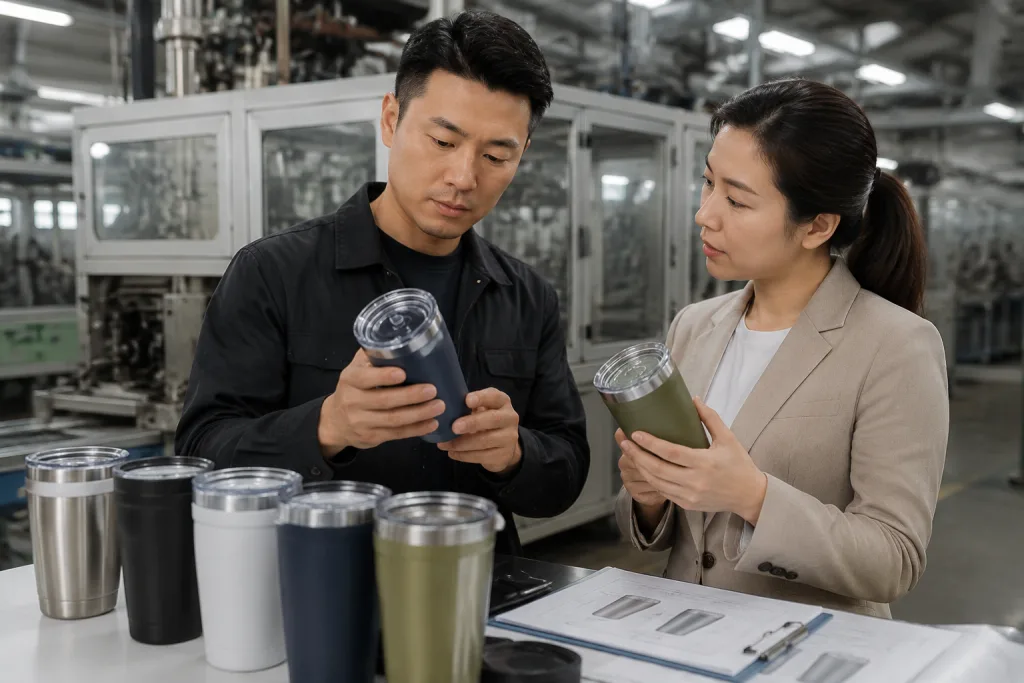
For a coffee brand or corporate-gift buyer, the sample stage is where you stop an expensive mess before it reaches cartons. I would not approve a coffee mug customized production run from renderings. We ask for 4 physical samples: one for the marketing desk, one for fit and function testing, one for packaging review, and one signed golden sample kept beside the line in China. QC writes the approval date on masking tape under the base. Simple habit. It saves arguments later.
A proper sample check is simple but strict. Fill the tumbler with 95°C water, close the lid, invert it for 60 seconds, then shake it for 15 seconds over white A4 paper. A travel tumbler with a sip hole is usually spill-resistant, not fully leakproof, so do not let the carton copy promise the wrong thing. Measure capacity to the brim and practical fill line with a 500 ml measuring cylinder. Weigh the unit on a 0.1 g bench scale. Check powder coating thickness with a gauge, usually aiming for 60-80 microns. Check logo placement within ±1.5 mm if it is laser engraved; we have seen buyers flag a 2 mm drift when the logo sat too close to the seam.
For heat retention, “all-day hot” is the wrong claim to approve. Test 95°C water at room temperature around 20-22°C, then measure after 6 hours with a probe thermometer. A good double-wall vacuum bulk coffee travel mug should commonly remain above 55-65°C, depending on lid geometry and capacity. If the lid has a wide sip opening, heat loss increases. The math doesn’t work the same as a narrow screw cap.
Sample timing is usually 7-10 days for an existing mold with laser logo, and 12-18 days for custom color plus printed packaging. If you are doing coffee mug private labeling for a launch date, sample approval is the date that controls the whole calendar. We run the schedule from that signature, not from the PO date, especially when the PO still has “matte balck” typed in the color line.
Lock artwork and packaging
Artwork looks easy until QC opens the first carton and finds the logo sitting 8 mm too low. For a coffee mug custom project, we ask the buyer to sign a flat artwork proof with logo width in mm, distance from the top rim, handle or seam reference, Pantone code, box dieline, barcode zone, warning text, and country-of-origin mark. North America and Europe buyers often ask for Made in China on the cup, the color box, or the master carton. Lock it before the line starts. Changing this after pad-print film is made usually costs 2 days and a new setup fee.
Laser engraving is the safe choice for a premium stainless travel tumbler because it will not peel after dish soap, hand sweat, or a few months in a car cup holder. Silk screen works for bold graphics, but QC should run 3M tape testing and alcohol rub testing before mass production; last month our inspector pulled 20 samples and rejected 3 because the red ink softened after 15 rubs. Full-wrap heat transfer can look retail, but curved bodies raise the reject rate, especially near the seam. If the order is a coffee mug promotional campaign with a short deadline, I recommend laser engraving or one-color screen print. Chasing gradients on a 12-day schedule is the wrong fight.
Packaging is a product component, not a loose item to fix at the end. For a corporate-gift bulk coffee mug, choose the box by channel: individual white box for low-cost gifting, kraft box for simple eco positioning, or full-color gift box when the buyer needs shelf appeal. For ecommerce or distributor handling, we run 5-ply export master cartons, add corner protection when the gift box edges crush in drop testing, and print carton marks with SKU, color, quantity, gross weight, net weight, carton size, and purchase order number. One buyer once sent a PO with “matte balck” on the carton mark file; the line copied it, and receiving flagged every carton.
If units go into Amazon-style fulfillment, add FNSKU labels, suffocation warning on polybags where applicable, and keep carton weight below the platform limit; we usually target under 15 kg unless the buyer gives a stricter routing guide. For coffee mug distributors, clean carton labeling cuts receiving disputes because the warehouse scans first and asks questions later. A good coffee mug oem manufacturer should ask for label position, carton weight, and PO mark before you chase them. We’ve seen this go sideways.
Control production on the line
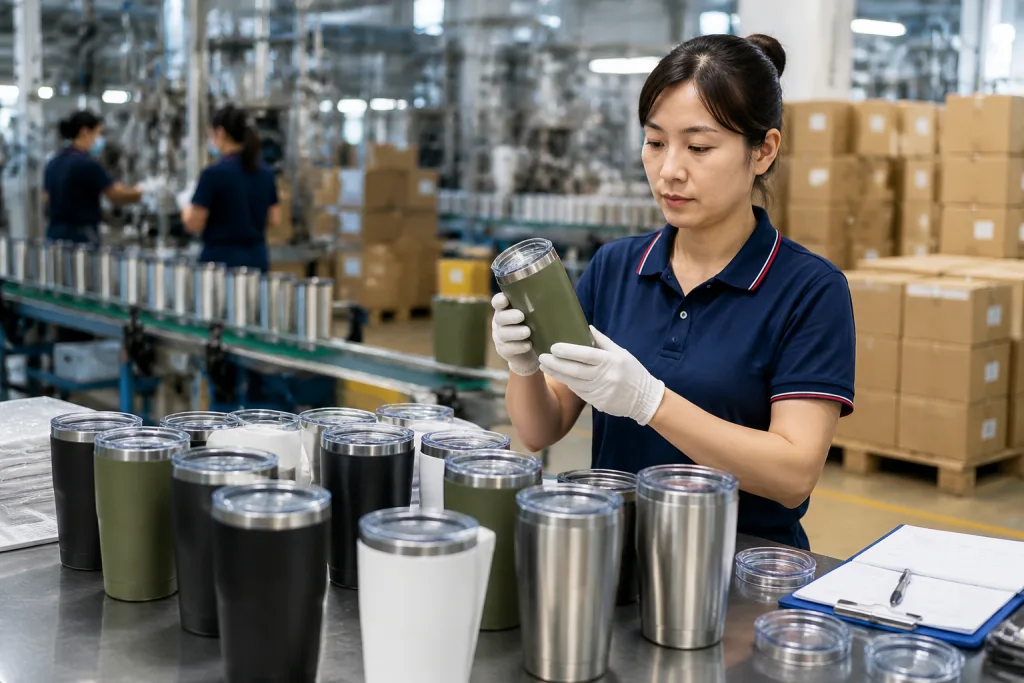
After deposit, the order leaves the sales chat and goes onto the line schedule. For this vendor coffee mug case, we run incoming steel inspection first, then body forming, welding or shaping, vacuum pumping, polishing, coating, decoration, assembly, and packing. QC checks the 304 stainless coil thickness with a micrometer, usually at 0.50 mm or 0.60 mm depending on the spec sheet. Bad parts start early. Scratches under powder coating, weak vacuum, loose lid gaskets, and silicone with dust on the sealing edge will still be bad after you put them in nicer cartons.
For a 3,000 pcs vendor coffee mug order, I would set three checkpoints. First, approve a pre-production sample made with the real steel, real lid, real silicone, and final logo method, not a showroom sample from last season. Second, run inline inspection when 20-30% of units are completed; QC pulled the sample from coating last month and found 7 logos sitting 1.5 mm off center, which is still fixable at that stage. Check coating adhesion, logo position, lid fit, and vacuum performance. Third, do final random inspection when 100% of goods are produced and at least 80% packed.
Factory metrics decide whether the shipment lands on time. BottleForge Industrial in Hangzhou, Zhejiang typically schedules standard travel tumbler production at 30-45 days after pre-production sample approval, depending on season and packaging. China export peaks before Christmas and before Chinese New Year can add 10-20 days if you book late. We have seen this go sideways: a buyer spent 18 days arguing over USD 0.06, then asked us to ship 12 days earlier by air without paying the freight gap. The math does not work.
Compliance belongs in the production file, not just the sales deck. For Europe, ask about LFGB or EU food-contact testing and REACH for coating where relevant; our lab usually needs 5-7 working days once QC cuts the samples from the finished batch. For the United States, many buyers request FDA food-contact conformity and sometimes ASTM-related packaging or children-specific requirements if the design is for kids. BSCI or ISO 9001 audit status helps, but it does not replace order-level QC. The buyer flagged this once because the PO said “FDA lid,” while the artwork file named the item as a kids tumbler, which changed the test discussion.
Inspect before the balance payment
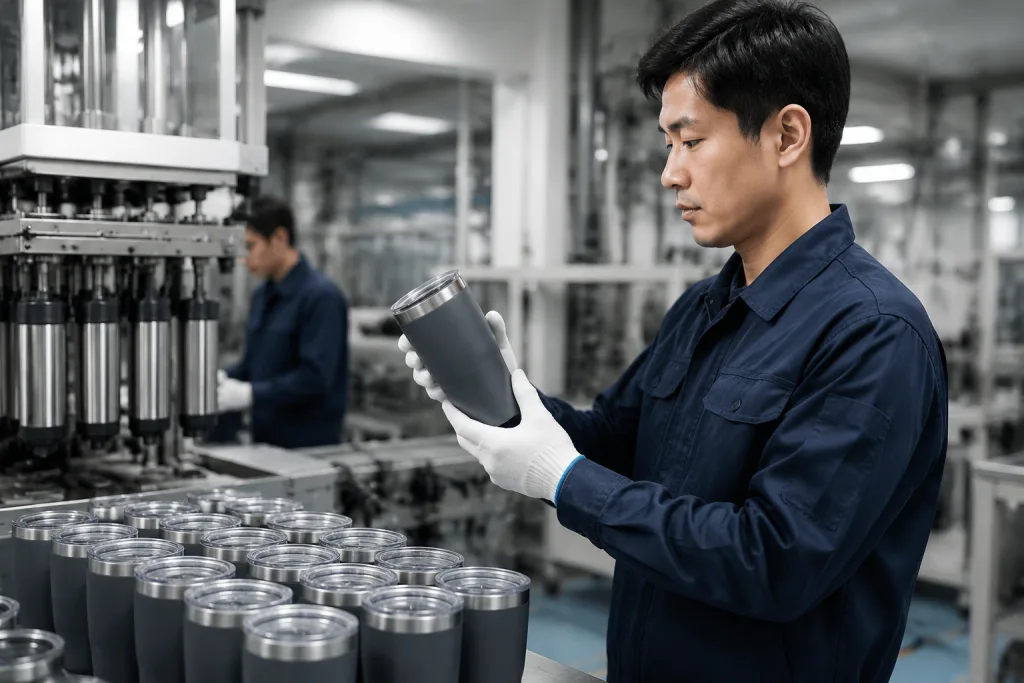
The final inspection is your last practical leverage before the balance payment. Use a written AQL plan, not a loose “check quality” line on the PO. For drinkware, most importers we work with set AQL 2.5 for major defects and 4.0 for minor defects under ANSI/ASQ Z1.4 or ISO 2859-1 sampling. Critical defects stay at zero tolerance: sharp rim burrs found by a cotton-wipe test, metal chips in the cup, wrong material against the 304 stainless spec, leakage after a 30-second invert test, chemical odor from the gasket, or inner packaging that hides a safety issue. This is the wrong place to save USD 180 on inspection.
For this bulk coffee tumbler order, the checklist should be specific enough that QC can work at the packing table without guessing. Check appearance under a light box; confirm height and mouth diameter with a digital caliper in mm; verify capacity with a measuring cylinder; weigh the sample on a 0.1 g scale; assemble the lid 10 times; seat the silicone gasket by hand; test coating adhesion; measure logo position from the bottom edge; scan the barcode with a handheld scanner; match carton marks against the shipping mark file; inspect master cartons for crushed corners and wet stains. Run the leak or spill test against the product claim. For printed logos, we run a cross-hatch adhesion test with 3M tape where it applies. If courier handling is expected, do a carton drop test from 76 cm on one corner, three edges, and six faces.
Set acceptance rules before inspection day. If 125 units are sampled from a 3,000 pcs lot, the inspector needs the defect table in hand, with minor issues separated from major and critical issues. A 0.5 mm dust point inside one color box is not the same problem as a flip lid that pops open after shaking. We have seen this go sideways when the buyer only wrote “acceptable quality” and then flagged 27 samples for different reasons after the report came out. A coffee mug distributor cares about shelf sell-through; a corporate gift buyer also cares that 3,000 recipients open the same clean box with the logo facing the same way.
Do not release the balance until the report is reviewed line by line. If defects exceed AQL, require sorting, rework, and reinspection, with photos of the reworked cartons and a new sampling record from the line. QC pulled the sample for one order last month because 18 lids out of 125 had loose gaskets, and the math did not work for a gift-program deadline. A reliable coffee mug manufacturers group will not take this personally. Serious factories expect professional buyers to inspect before final payment.
Ship without creating new problems
Shipping is where a clean factory order still gets expensive. Confirm Incoterms before we book cartons: FOB Ningbo, FOB Shanghai, CIF, DDP, and EXW put cost and risk in different hands. For experienced importers, FOB China is cleaner because your forwarder takes over after the goods are on board. For a 500 pcs corporate-gift buyer with no logistics person, DDP works, but the quote needs duties, taxes, delivery address limits, and liftgate charges written out. We had one buyer flag this after the warehouse refused a pallet because the DDP address was a downtown office, not a loading dock.
A 3,000 pcs 16 oz bulk travel tumbler order usually takes 8-12 cubic meters when we run standard white boxes and 5-layer export cartons. QC weighs the packed carton on a 60 kg bench scale before the forwarder gets the CBM sheet. Sea freight makes sense if your calendar allows 35-45 days. Air freight can save a launch date, but it adds USD 1.50-4.00 per unit or more in peak season. For a coffee mug promotional order, the math often breaks right there.
Before loading, check the commercial invoice, packing list, HS code, carton count, gross weight, net weight, and shipping marks. Do it line by line. If your order includes coffee mug private label packaging, the brand name and SKU must match the purchase order exactly. Last month QC pulled a sample carton because the PO said “Matte Black 16oz” and the carton mark printed “Matt Black 16 oz.” Small typo. Big warehouse headache.
The strongest vendor coffee mug projects end with no drama. The approved sample matches production, cartons scan on the first pass, defects stay inside AQL, and the buyer has reorder data from the line sheet, carton photos, and inspection report. We ship the same spec faster next round because nobody is guessing. That is the difference between buying a cheap mug once and building a repeatable coffee mug factory direct program with a manufacturer in China.
Send your tumbler brief for a factory quote
Share capacity, quantity, logo file, packaging needs, and delivery market. We will return a practical FOB quote and sample plan.
Frequently asked questions
What MOQ should I expect for a custom vendor coffee mug?
For a standard stainless travel tumbler with your logo, 1,000 pcs per color is a practical MOQ at many factories in Zhejiang, China. If you need custom Pantone powder coating, retail box printing, or a new lid color, 2,000-3,000 pcs is more realistic because coating changeover and packaging setup costs are fixed. For coffee mug promotional products, some suppliers may offer 500 pcs, but unit price can rise 15-35% and color options may be limited. If you want coffee mug private labeling with a full-color box, ask whether the box MOQ is separate from the tumbler MOQ. Sometimes the tumbler MOQ is 1,000 pcs but printed packaging is economical only from 2,000 pcs.
How do I compare quotes from coffee mug manufacturers fairly?
Send the same specification sheet to every coffee mug manufacturer: capacity, steel grade, wall thickness, lid type, coating, logo method, packaging, test requirements, Incoterm, and order quantity. A USD 3.30 quote and a USD 4.10 quote may not describe the same product. One may include 304 inner steel, 80-micron powder coating, individual color box, and AQL inspection support; the other may use lighter material and a plain white box. Ask for net weight per unit, carton size, sample cost, production lead time, and FOB port. A professional coffee mug supplier should answer these without drama. If the answer is vague, the quote is not ready for purchasing.
Is laser engraving better than printing for a coffee mug custom order?
For stainless travel tumblers, laser engraving is usually the safest choice because it removes the coating cleanly and will not peel during normal use. It is good for logos, names, and simple artwork, typically adding around USD 0.08-0.18 per unit depending on size and quantity. Silk screen printing is better when you need a solid color logo on bare steel or coated surfaces, but you should require tape adhesion and alcohol rub testing. Heat transfer or full-wrap printing can look more colorful, but it has higher setup cost and higher reject risk. For a 1,000-3,000 pcs coffee mug customized order with a deadline, laser is often the lower-risk option.
What quality defects are most common in bulk coffee travel mug orders?
The common defects are coating scratches, dust under paint, logo misalignment, weak laser contrast, loose lids, silicone gasket deformation, odor from plastic parts, poor vacuum performance, and crushed gift boxes. For a bulk coffee travel mug, I would classify leakage, sharp edges, wrong material, unsafe odor, and incorrect capacity as major or critical defects. Minor defects may include tiny coating specks outside the main logo area, but the standard should be written before inspection. Use AQL 2.5 for major defects and 4.0 for minor defects, then test a defined sample size. Do not rely on factory photos alone; photos rarely show lid fit, odor, or vacuum failure.
Can one coffee mug oem manufacturer support retail and corporate orders?
Yes, if the factory has both production control and packaging flexibility. A retail coffee brand may need barcodes, color boxes, product manuals, carton labels, and repeatable color matching. A corporate-gift buyer may need individual name engraving, event cartons, or split shipments to several warehouses. Ask the coffee mug oem manufacturer for monthly capacity, MOQ by color, sample lead time, packaging options, and whether they can support FNSKU or distributor carton labels. At BottleForge Industrial, standard travel tumbler lead time is usually 30-45 days after sample approval, while more complex coffee mug private labeling projects should be planned with 45-60 days including sample and packaging approval.