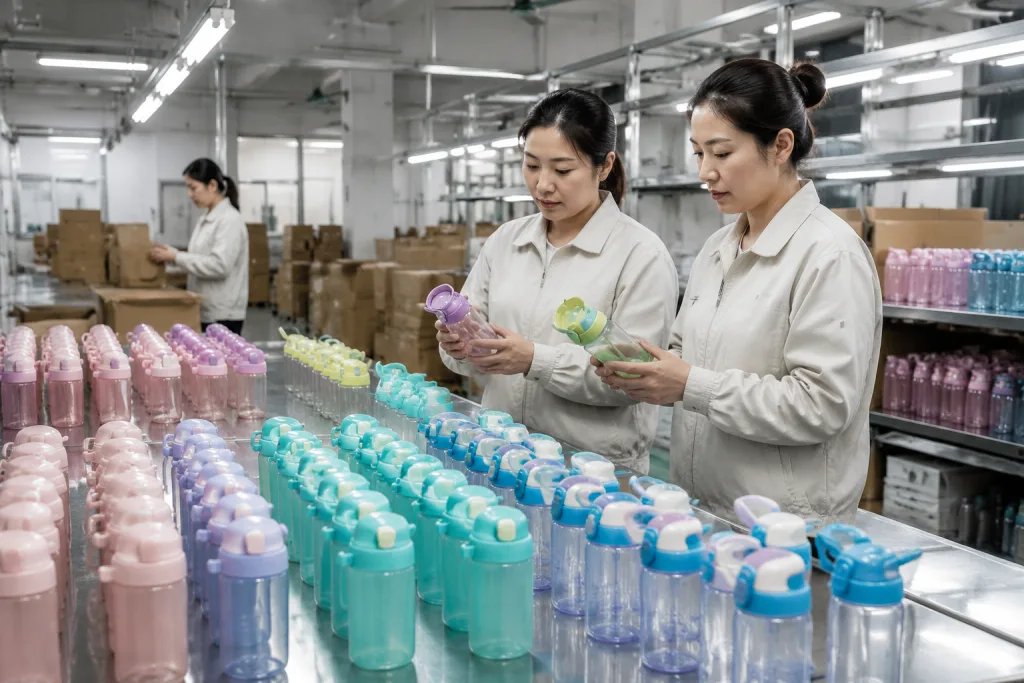
Key Takeaways
- Plan MOQ from 3,000 pieces per color for most custom children water bottle projects
- Ask for LFGB, REACH, CPSIA or ASTM support before approving tooling or deposit
- Budget 25-35 days for mass production after artwork and pre-production sample approval
- Choose lid structure first; it drives leakage rate, mold cost, and carton packing
If you buy for a school district, camp group, museum shop, or kids-product import program, one weak bottle is not just a slow SKU. It turns into 37 parent emails, a customs hold, or a recall call nobody wants at 8 p.m. A vendor children water bottle order needs tighter control than an adult sports bottle order because the user drops it from lunch tables, chews the spout, and expects the lid to survive a backpack crush. QC pulled one sample last season after the silicone straw measured 1.6 mm thinner than the approved drawing. That small miss leaked.
Start with four decisions, but do not treat them as a checklist: material grade with wall thickness, lid safety with bite-test details, decoration method with rub resistance, and compliance documents tied to the exact SKU. Price matters. Still, the math doesn't work if a USD 0.18 saving gives you cracked caps after 30 days instead of a clean 6-month sell-through. From our Hangzhou, Zhejiang line, we see school buyers do better when they freeze the spec sheet before artwork; one PO even had “PP lid” typed while the approved sample used Tritan, and the buyer flagged it before mass production.
Start with the user age
A bulk children water bottle for kindergarten students is a different job from a bottle for 10-year-old field trips. Age drives capacity, grip diameter, lid opening force, straw length, and strap choice. We’ve seen this go sideways when a buyer approved one “kids size” for 3 grades; QC pulled the sample after the 62 mm strap buckle cracked in the drop test.
For ages 3-6, we run 350-450 ml most often. A body diameter around 65-72 mm fits small hands better, and the flip lid should open with a 1.2-1.8 kg push on the force gauge, not a stiff adult-style button. For ages 7-12, 500-650 ml makes more sense because refilling during school is not always easy. A custom school water bottle over 750 ml looks strong in a catalog, then the buyer flags it as “too heavy” once it is filled; the math doesn’t work for smaller children.
For school district buyers, the wrong question is “how big can we make it?” Ask where it fails during daily use. If children carry bottles in backpacks, we check leak testing and lid lock design first, usually with 8 filled samples laid sideways after the vacuum leak tester. If the bottles are handed out at events, simple one-hand drinking and clear care instructions matter more. For a retail importer, shelf appeal still sells, but a cartoon-shaped lid with 4 hidden grooves creates cleaning complaints fast.
One practical test is simple: fill the approved sample, put it in a child-size backpack with paper inside, shake it for 3 minutes, then leave it on its side for 30 minutes. If the paper is wet, the design is not ready for children water bottle wholesale, no matter how clean the logo print looks under the 3M tape test.
Choose material before chasing price
Most custom children water bottle projects we quote land in three material buckets: Tritan plastic or stainless steel. Aluminum still appears, but less often than 5 years ago. The wrong move is picking the cheapest line on the quotation sheet before checking the age range, test standard, and return risk. Last month our QC bench had three samples lined up with the same 450 ml artwork, and the cheapest one failed the drop test at 1.2 m.
Tritan works well for a bulk kids water bottle because parents can see the liquid level and the bottle stays light in a school bag. It also gives the mold room for ears, handles, grip ribs, or cartoon shapes. A 450 ml Tritan bottle with PP lid and silicone straw usually lands around USD 1.35-2.20 FOB China depending on lid complexity, packaging, and order quantity. Ask for BPA-free confirmation, then ask if the supplier can support LFGB, FDA, REACH, and CPSIA documentation when needed. We run the lid fit with a go/no-go gauge; 0.3 mm too loose on the straw hole is enough for a buyer to flag leakage.
Stainless steel costs more, but it takes abuse better. For a custom kids bottle, 304 stainless steel is the standard inner material. A single-wall 500 ml bottle may use 0.4-0.5 mm sheet, while a vacuum insulated version often uses 0.4 mm inner and 0.5 mm outer wall. A 350-500 ml insulated children bottle usually sits around USD 3.20-5.80 FOB depending on cap, coating, and printing. On the line, we check wall thickness with a micrometer before polishing; if the outer wall slips from 0.5 mm to 0.42 mm, the math does not work after dent claims.
Aluminum is light and low cost, but the inner liner needs tight control. For younger children, 8 out of 10 buyers we deal with now prefer Tritan or 304 stainless steel because the compliance conversation is cleaner. A serious children water bottle manufacturer should not push one material for every order. They should ask your age group, market, wash method, and target price first. We have seen this go sideways when a PO says “dishwasher safe” but the artwork file was built for hand-wash aluminum only.
Cheap material is not the same as low landed cost. Failed testing, returns, and replacement shipments are where the real loss shows up; one rejected 3,000 pcs lot can wipe out the saving from USD 0.18 cheaper material.
Lids decide most complaints
When buyers ask us why a children water bottle vendor order failed, the lid is usually the answer. The bottle body is not where we see trouble first. QC pulled 32 complaint samples from one school promo order last May: 21 had lid leaks, 6 had loose straws, 3 had broken buttons, and 2 had missing gaskets after dishwasher testing.
For a bulk school water bottle, keep the lid simple. A flip straw lid sells well, but the straw should need an adult’s pull force to remove, or the exposed piece should be large enough to stay out of small-part trouble. For younger children, skip loose decorative charms and thin silicone plugs unless your lab has already checked the small-parts rule for that market. We’ve seen this go sideways when a buyer loved a cute bear charm; the line stopped because the charm ring opened at 18 N in a pull test.
Ask your children water bottle supplier for the gasket material, gasket hardness, and spare gasket plan. Silicone is standard, but “silicone” on a spec sheet does not save a bad groove. A 0.8 mm shallow gasket groove can pop out after 20 wash cycles; a 2.5 mm deep groove can trap juice residue and bring parent complaints. We run a Shore A durometer check on incoming gasket batches because one hard batch can turn a good lid into a leaker.
Leak testing belongs in the purchase order. Write it there. At BottleForge Industrial in Zhejiang, China, a common internal check is 100% lid assembly inspection plus random finished-product leak testing by carton; the QC table uses inverted bottles for 30 minutes after a 1.2 m drop check on sample pieces. For export orders, buyers often specify AQL 2.5 for major defects and AQL 4.0 for minor defects. If your order is for a public school program, set critical defects at zero tolerance, especially for broken sharp plastic, detached small parts, or foreign matter. The math doesn’t work if 3,000 bottles ship and even 12 lids create safety calls.
Decide early whether the bottle must fit car cup holders, backpack side pockets, or lunch bags. This is not a packing detail. A 74 mm base may pass most car cup holders, while an 82 mm base gets flagged fast, and a tall flip lid can add 18 mm that ruins a lunch-bag fit. We had one PO typo list “72 mm max height” instead of “72 mm max diameter”; the buyer flagged it only after the pre-production sample landed.
Decoration has real trade-offs
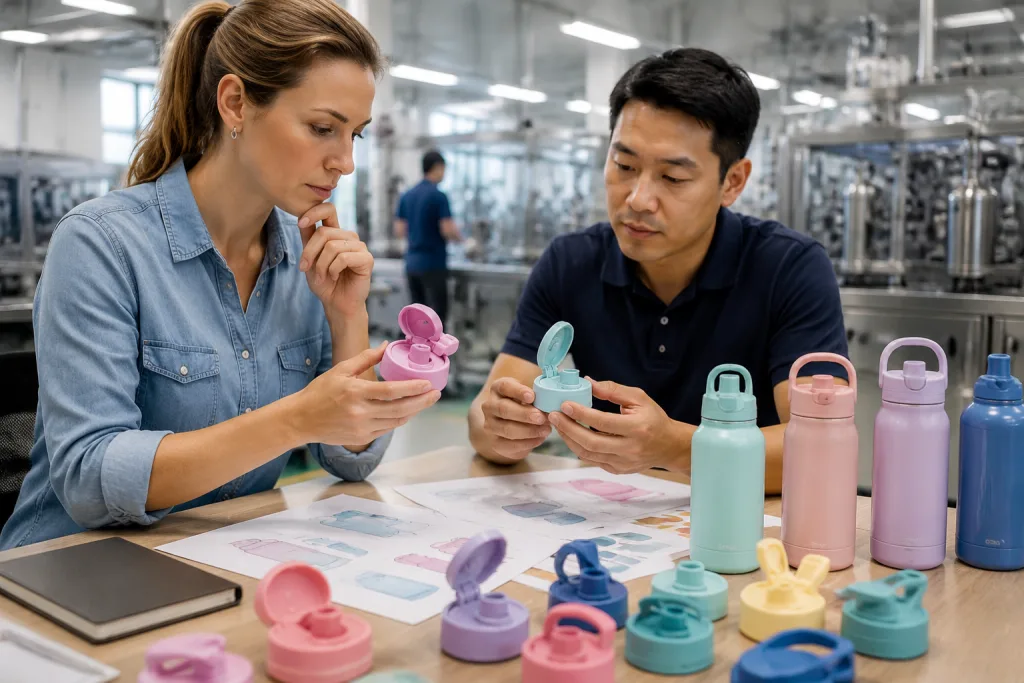
A custom logo kids bottle can take silk screen printing, heat transfer, UV printing, laser engraving, water transfer, or powder coating with print. The right choice comes down to the bottle material, artwork file, rub test target, and landed cost. We run this check before quoting because a 0.8 mm line in the logo may pass on a flat PP panel but break on a curved 500 ml Tritan body.
For school names, district logos, and simple one-color graphics, silk screen is still the safest method. Clean result. Stable cost. A normal setup charge is USD 30-60 per color per design, and our print room usually asks for 1 mm minimum line width before making the screen. For full-color mascot artwork, heat transfer or UV printing gives sharper detail, but QC pulled samples before where the buyer flagged peeling on powder-coated stainless steel after the 3M tape test. Test first.
Laser engraving works well on stainless steel but not on clear plastic. It feels durable and looks premium, but the finish is usually tone-on-tone, not colorful. For children water bottle promotional stock for a sponsor campaign, bright printing may beat lifetime wear resistance. For paid retail, the math changes. We have seen this go sideways when a buyer picked UV print for a school shop item, then asked why the artwork looked tired after backpack abrasion.
Do not approve mass production from a digital mockup alone. Ask for a pre-production sample using actual material, actual lid color, actual print size, and actual packaging. For children water bottle customized orders, Pantone matching is not magic. Plastic resin, powder coating, and ink reflect light differently; our QC desk checks this under a D65 light box, not under the office ceiling lamp. A reasonable tolerance is close visual match under D65 light, not a promise that every surface reads exactly the same.
For children water bottle customizable programs with multiple schools, keep the bottle body common and change only the logo. That reduces MOQ pressure and color drift between batches. A shared 500 ml body with 10 school logos is easier to control than 10 different bottle shapes, and the line can keep one carton size, one insert card size, and one barcode position. This is the boring answer, but it ships cleaner.
Compliance is a buying filter
For children’s products, compliance is not paperwork you collect after the carton labels are printed. It is the first vendor filter. A children water bottle factory should be able to talk through food-contact standards and children’s product rules from the sample stage, including whether the lid gasket is silicone or TPE and whether the mouthpiece is 6 mm or 9 mm thick.
For the U.S. market, ask about FDA food-contact material support, CPSIA, lead and phthalate limits where relevant, and ASTM F963 if the bottle design has toy-like parts or attached accessories. For Europe, ask about LFGB, EU food-contact regulation, REACH, and EN 14350 when the design moves toward young-child drinking equipment. Not every bottle needs every test. The wrong question is “do you have certificates”; ask which parts were tested, because QC once pulled a straw cap where the pigment code on the BOM did not match the lab report.
If you are a children water bottle distributor importing into 3 or more countries, avoid vague claims like “all certificates available.” Ask for test reports showing the tested model number, material description, test date, and laboratory name. Reports older than 2-3 years may still support a file, but they are thin backup for a new custom made kids bottle with different materials or pigments; we have seen this go sideways when a buyer approved blue on the PO and the factory line ran Pantone 2995C instead.
Factory audits matter too. BSCI, ISO 9001, or Sedex-style social compliance can reduce onboarding friction for retailers and school procurement teams. They do not replace product testing, but they show whether the manufacturer has basic process control. BottleForge Industrial can support typical third-party inspections in Zhejiang before shipment, including packaging checks, barcode scans, carton drop checks, and AQL inspection coordination; on the line we usually scan 80-120 barcodes per style before the inspector seals the cartons.
If a children water bottle vendor tells you testing is unnecessary because “other customers shipped it,” be careful. Customs and retail compliance teams do not accept someone else’s luck as evidence, and neither should your buyer. We ship containers every month, and the math does not work if one failed report holds 3,000 bottles at the warehouse door.
MOQ, lead time, and packing
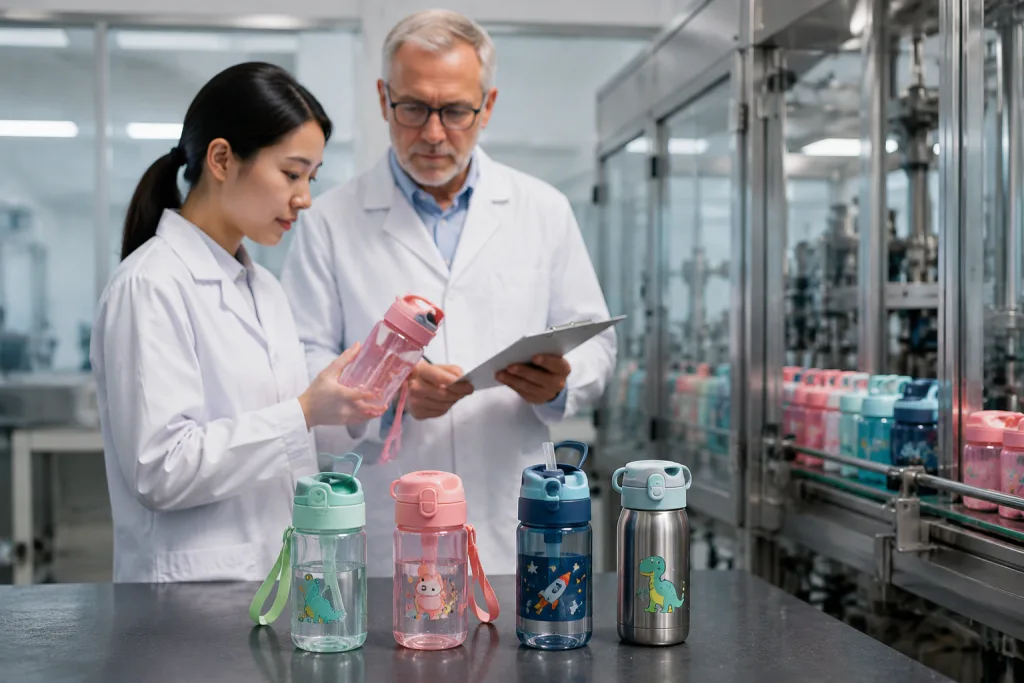
MOQ is where good ideas hit factory math. For a standard mold children water bottle bulk order, 3,000 pieces per color is a normal starting point. Stock colors sometimes work at 1,000-2,000 pieces because we run those pigments every month, but custom PMS colors, new lids, or private molds change the numbers fast. A private lid mold can cost USD 2,000-8,000 depending on structure; a full custom body mold goes higher. Last April, one buyer asked for 800 pieces in 4 colors with a silicone straw lid. The math didn't work. The line would have spent more time washing the injection machine than making bottles.
Our Hangzhou operation in Zhejiang has partner production capacity of roughly 600,000 drinkware units per month across stainless steel and plastic programs, but capacity is not a free slot on the line. Normal production for a custom kids water bottle is 25-35 days after deposit and sample approval. Add 5-10 days for pre-production sampling and another 25-35 days for ocean freight to North America or Europe, depending on port and season. QC pulled a 350 ml PP sample last week because the straw was 2 mm too long and touched the bottom, so sample approval took 12 days vs 7 days. Small detail. Real delay.
Packing should be locked before the quotation is final. A plain opp bag saves cost, but school buyers often push back because teachers need to hand out bottles by class without opening a mixed carton. Individual white boxes work better for that job. Retail importers usually ask for color boxes, hang tags, care cards, warning labels, UPC labels, or FNSKU labels for marketplace fulfillment. Each line item changes labor time and carton size; our packing table team scans FNSKU labels one by one, and a 3 mm label shift has failed Amazon-style prep checks before.
For a bulk kids bottle shipment, carton weight should stay practical. A carton above 16-18 kg is hard on school staff and warehouse teams, especially when boxes get stacked 5 layers high on a 1.1 m pallet. For insulated stainless steel bottles, we often see 24-48 pieces per master carton depending on bottle size and box style. For Tritan bottles, 48-72 pieces works if the lid shape nests cleanly. We've seen this go sideways when a buyer chose a tall flip lid after the carton plan was set, and the master carton grew by 40 mm.
Ask for FOB Ningbo or FOB Shanghai pricing if shipping from Zhejiang, China. EXW quotes look lower, then the buyer gets hit with inland freight, export handling, and documentation costs. One PO came in with “FOB Hangzhou port” typed on it, which sounds neat but is not how we ship drinkware export cartons; we corrected it before booking the truck to Ningbo.
How to compare vendors
Do not start vendor comparison with the prettiest catalog. We run a 100-point scorecard: 25 for compliance support, 20 for lid engineering, 15 for sample accuracy, 15 for communication speed, 15 for inspection history, and 10 for lead time that matches the line schedule. Price gets one column. Last month a buyer pushed for a USD 0.06 saving, then QC pulled the sample and found the straw cap torque was 0.18 N·m under spec. The math did not work.
A reliable children water bottle supplier answers direct questions without dancing around them: What is the material grade? What is the MOQ by color? Which parts touch drinking water? What is the wall thickness in mm? What test reports match this model? Can you ship spare lids or silicone gaskets? What happens if inspection finds a 6% major defect rate? We ask these before sampling, because one PO once said “PP lid” while the sample room had a Tritan lid on the bench.
For children water bottle distributors, consistency beats one lucky first shipment. If you plan repeat orders, ask whether the children water bottle factory keeps Pantone color chips, print screens, and sealed approved samples on file. Ask how many years they retain molds, and whether they notify you before changing resin supplier or lid components. We keep golden samples in a labeled cabinet by customer code; when the line drifts 0.5 mm on a logo position, the buyer flags it fast.
China has more than 300 children water bottle suppliers quoting export orders, and some are trading companies without direct production control. That is not automatically a problem. The wrong question is “factory or trader?” Ask who can stop the line when QC finds scratched coating, short shot lids, or carton drop-test failures. A professional children water bottle manufacturer should accept a video factory review, third-party inspection, and sealed golden sample process.
If you are choosing between several children water bottle vendors, send the same RFQ to each one: capacity, material, lid type, logo method, packaging, test requirements, delivery term, and target market. Add hard details, such as 500 ml, 304 stainless, 3,000 pcs per color, LFGB, and Amazon FBA carton marks if those apply. The vendor who asks 5 useful follow-up questions is usually safer than the one replying in 10 minutes with the lowest number. We have seen that go sideways.
Send your kids bottle RFQ for review
Share capacity, age group, market, logo, and target delivery date. We will check the practical risks before quoting.
Frequently asked questions
What MOQ should I expect for a custom children water bottle?
For standard molds, plan around 3,000 pieces per color for a custom children water bottle. If you use existing bottle colors and only add a one-color logo, some factories can accept 1,000-2,000 pieces. Custom Pantone body colors, special lids, or private packaging usually push MOQ higher because resin mixing, coating setup, and print setup all need minimum runs. For a school district with several campuses, one smart approach is to keep one bottle color and change the school logo. That can make a children water bottle wholesale program easier to manage without forcing each school into a full MOQ.
Which material is best for bulk school water bottle orders?
For younger students, Tritan and 304 stainless steel are the two most practical choices. Tritan is lighter and usually cheaper, often around USD 1.35-2.20 FOB China for a 450 ml bottle with a standard lid. Stainless steel is stronger and can support insulation, but a 350-500 ml vacuum bottle may cost USD 3.20-5.80 FOB depending on finish and cap. For a bulk school water bottle that will be given free to students, Tritan is often enough. For retail resale or premium district programs, stainless steel usually gives better perceived value and longer service life.
Can I make a children water bottle customized with different school logos?
Yes, but structure the program carefully. The most cost-effective way is to use one bottle model, one body color, one lid color, and change only the printed logo. If each school wants a different bottle color, your MOQ and production risk increase quickly. For children water bottle customized programs, expect a setup charge per logo, commonly USD 30-60 per color for screen printing. Ask for one approved pre-production sample per logo group or at least a printed strike-off sheet. Also confirm carton labeling so warehouse teams do not mix school names during distribution.
What tests should a children water bottle vendor provide?
At minimum, ask for food-contact support for your market: FDA-related material support for the U.S., LFGB or EU food-contact testing for Europe, and REACH where relevant. For children’s use, CPSIA and lead or phthalate checks may be needed depending on material, coating, and decoration. If the design includes toy-like accessories, small detachable pieces, or novelty parts, ASTM F963 may become relevant. The test report should match the material and model you are buying. A report for a different bottle from 2021 is not strong evidence for a new custom logo kids bottle produced today.
How long does a bulk kids bottle order take from China?
A normal bulk kids bottle order from China takes about 5-10 days for sampling, then 25-35 days for mass production after approval and deposit. Ocean freight to North America or Europe often adds 25-35 days, while air freight is faster but expensive for drinkware because cartons are bulky. If you need delivery before a school term, work backward at least 90 days from the handout date. Add more time for third-party testing, district artwork approval, FNSKU labeling, or custom retail packaging. Rush orders are possible, but they reduce your room for inspection and correction.