Key Takeaways
- A practical borosilicate glass bottle bulk MOQ starts at 3,000 pieces per model for custom color and packaging
- Typical FOB China pricing runs USD 2.10-4.80 depending on sleeve, lid, decoration, and retail box
- High borosilicate glass should be 3.3 expansion grade with 2.0-2.8 mm wall thickness for drinkware
- Allow 35-45 days production after artwork, sample approval, and 30% deposit
A borosilicate bottle looks simple on a product page. On a PO, it gets messy fast. A 550 ml glass body, bamboo lid, silicone sleeve, logo print, retail box, and 1.2 m drop-test line can turn into 5 cost versions when the spec sheet leaves out wall thickness, sleeve coverage, or carton layout. We once had QC pull a sample because the 2.2 mm body wall was quoted, but the buyer’s artwork file showed a full-wrap sleeve that needed a different mold fit.
If you are sourcing a vendor borosilicate glass bottle program for a wellness brand or sustainable retail chain, the factory spec lines decide margin, claims risk, and whether the bottle survives inbound handling. That sounds blunt, but we’ve seen this go sideways over small things: a bamboo lid tolerance off by 0.4 mm, a PO typo listing “matte black” while the approved sample was “matte charcoal,” or a retail box failing the corner crush check after 8 kg stacking. BottleForge manufactures in Zhejiang, China, and we treat glass sourcing as an engineering file first, not a catalog chat.
Start with glass grade
The first spec line should not be capacity or logo. Put the glass grade first. For a vendor borosilicate glass bottle, write “high borosilicate 3.3 glass” on the RFQ and PO, not loose wording like “heat resistant glass.” We have seen buyers approve a sample, then the PO says “glass bottle” only; QC pulled the incoming tube stock and the supplier tried to switch to cheaper soda-lime. The 3.3 number refers to the coefficient of thermal expansion, around 3.3 × 10^-6/K. Lower expansion gives the bottle better shock resistance when hot water hits a room-temperature body.
For normal wellness retail, we run 3.3 borosilicate with a temperature resistance claim of -20°C to 120°C. Some suppliers print 150°C or 180°C on a spec sheet, but the assembled bottle is the real limit. The lid gasket, sleeve, adhesive, coating, and print ink often fail first; last April, our line rejected 64 lids because the silicone gasket curled after a 100°C soak test. If you sell tea, detox drinks, or office hydration bottles, use this wording: “hot water fill up to 90°C, not for boiling or microwave use unless separately tested.” That wording saves arguments with Amazon reviewers and import QA teams.
A borosilicate glass bottle factory should confirm wall thickness with a caliper, not by eye. For 350-750 ml bottles, 2.0-2.8 mm is common. Below 1.8 mm, the bottle feels light but gets ugly in carton drop tests; we have seen 7 breaks in a 50-carton pre-shipment check after the buyer pushed for lighter freight. Above 3.0 mm, the math does not work for most retail programs because weight and freight cost climb fast. For a 550 ml custom glass water bottle, 2.3 mm wall thickness is a sensible starting point.
If you are comparing borosilicate glass bottle manufacturers in China, ask for a material declaration, migration test history, and production photos from the actual forming line. Not showroom shots. Real line photos show the tube cutting station, flame forming area, and annealing tunnel, and the date card should match your order week. A borosilicate glass bottle vendor that only sends lifestyle images has not given you enough to approve a purchase.
Capacity changes more than volume
Capacity looks like a marketing decision. On the line, it changes mold cost, packing size, freight efficiency, sleeve tooling, and shelf fit. A 500 ml bottle is not a short 750 ml bottle. The diameter, shoulder radius, thread finish, lid size, and carton grid all move; last month QC pulled a 500 ml sample that fit the sleeve but rocked 3 mm in the inner tray.
Most wellness brands choose 350 ml, 450 ml, 550 ml, 650 ml, or 750 ml. For sustainable retailers, we see 550 ml and 650 ml sell better because they feel solid without turning into a dumbbell. A 750 ml borosilicate glass bottle customized with silicone sleeve and bamboo lid may weigh 520-650 g before liquid. Fine for home, yoga studio, and office use. The math doesn't work for running belts or children’s backpacks; one buyer flagged the 650 g sample after a 12-piece courier carton came in at 9.8 kg.
For borosilicate glass bottle wholesale programs, keep one neck finish across multiple capacities if the design allows it. A common 45-55 mm mouth means shared lid inventory, fewer gasket mismatches, and cleaner replacement-part planning. If every size gets its own cap shape, your MOQ multiplies fast. At BottleForge in Zhejiang, China, a shared lid system can reduce tooling spend by USD 600-1,500 across a small range, and our gasket gauge check stays on one spec instead of chasing three silicone ring diameters.
Here is the buyer impact: one 550 ml customizable glass water bottle with shared bamboo lid may run at 3,000 pieces MOQ. Three sizes with three exclusive lids can push the realistic MOQ to 9,000-15,000 pieces because the cap, gasket, sleeve, and packaging all need separate setup. We have seen this go sideways when a PO listed “same lid” but the artwork file named three lid SKUs. If your first order is market validation, standardize the hardware and customize the visible surfaces.
Lids decide the complaint rate
On a custom borosilicate glass bottle, roughly 7 out of 10 complaints we see are not about the glass body. They are about the lid: leaking in the carton, odor after hot filling, swollen bamboo, cracked PP insert, loose carry handle, or a silicone gasket sitting loose in the cap groove. The lid is not decoration. Treat it like a working part, the same way QC treats the 70 mm mouth diameter or the thread gauge on the line.
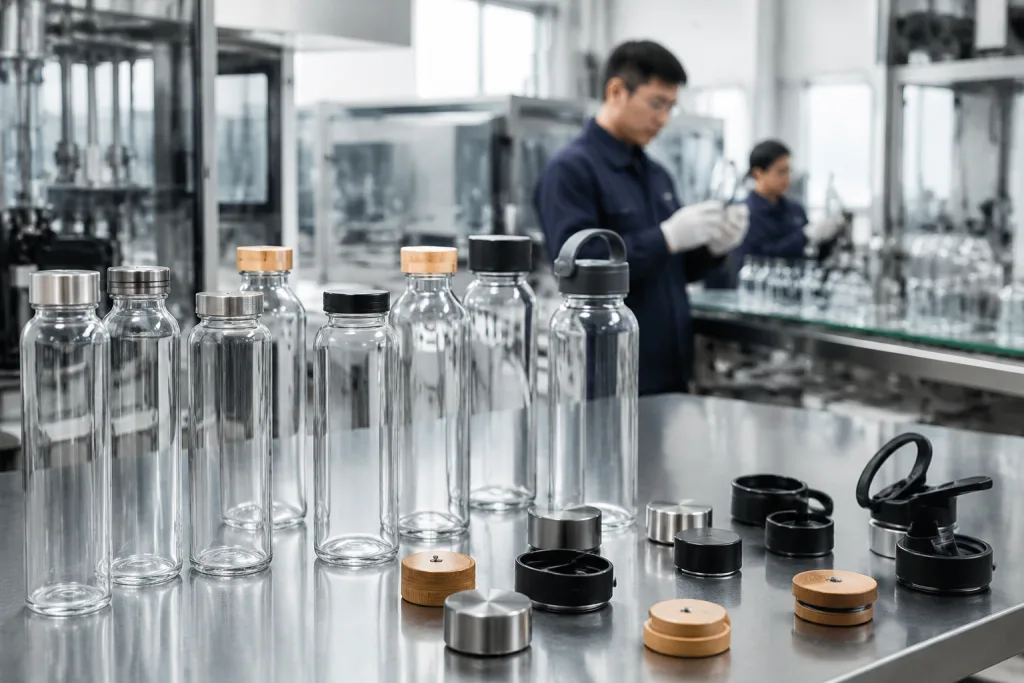
Common choices are bamboo with PP inner thread, stainless steel lid, PP flip lid, stainless handle lid, and tea infuser lid. Bamboo sells well for wellness and gift channels, but the math doesn't work if the cap is bare or under-dried. We ask for food-contact coating, moisture content control around 8-12%, and a removable silicone gasket so the end user can clean it. Do not accept bare bamboo touching liquid. It stains, holds odor, and we have seen buyers push back after 1,200 pcs arrived with a sour bamboo smell when QC pulled the sample from a sealed master carton.
For a borosilicate glass bottle custom project, we usually spec food-grade silicone gasket, LFGB or FDA-compliant inner plastic, and 100% leak testing on the assembly line. Our standard check is simple: fill to 80% capacity, tighten with the same torque used by packing staff, invert for 30 seconds, then wipe the thread with white tissue. No drama. For premium retail, add pressure simulation or transport vibration testing; we run this before mass packing because one loose gasket can soak 24 color boxes in a shipping carton.
If you are a borosilicate glass bottle distributor buying mixed colors, check lid color consistency before the goods are taped up. “Natural bamboo” varies, and buyers accept that, but you can set a color band and reject black knots, open cracks over 5 mm, or rough sanding marks. This is the wrong question to ask: “Is bamboo supposed to be identical?” Ask whether the borosilicate glass bottle supplier wrote those defects into the inspection checklist. We ship cleaner orders when the checklist says “no open crack over 5 mm” instead of leaving the merchandiser to argue after 38 cartons are packed.
Sleeves, coatings, and decoration
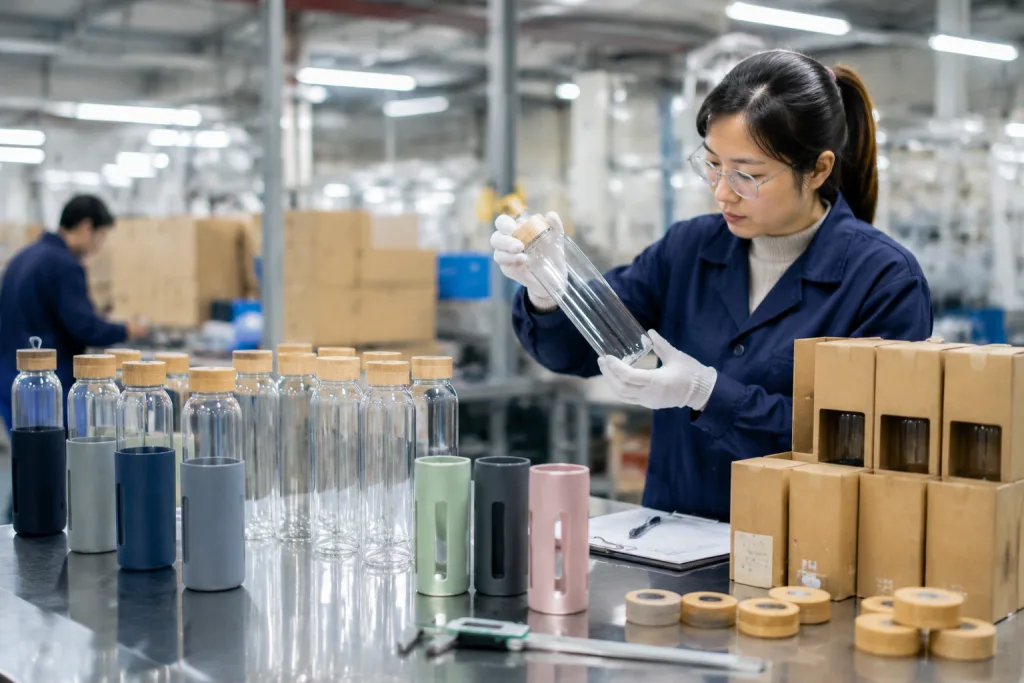
The decoration line is where 6 out of 10 borosilicate glass bottle promo jobs lose their margin. A one-color logo on clear glass is easy. We run that all week. A full silicone sleeve, gradient coating, metallic logo, retail color match, and individual barcode label means extra screens, curing time, sleeve fitting, and carton relabeling; QC pulled 32 samples last month just because the sleeve edge sat 2 mm higher than the buyer’s approved photo.
For logos, most buyers choose silk screen printing, heat transfer, decal, laser engraving on metal lid, or pad print on plastic. Silk screen works best for one to three colors, usually adding USD 0.08-0.25 per piece depending on logo size and color count. Laser engraving on a stainless or bamboo lid may add USD 0.12-0.35. Decal handles complex artwork, but the firing temperature and curing rack time need control, or the print edge turns yellow. We check this with a 3M tape pull and a 10x loupe. If you need a customized borosilicate glass bottle with Pantone-matched graphics, send vector artwork and mark the print position in millimeters from the base or shoulder; “centered on bottle” on a PO is how this goes sideways.
Silicone sleeves add grip and breakage protection, but they bring tooling and color-control problems. A sleeve mold can cost USD 500-1,200 depending on shape and coverage. Sleeve hardness is usually 40-60 Shore A. Too soft feels cheap and picks up carton dust; too hard fights the operator on the line and can stress the glass neck during fitting. For borosilicate glass bottle customizable ranges, keep the same bottle body and change sleeve color. That gives retailers choice without stuffing the warehouse with 8 slow-moving glass SKUs.
Coated glass looks good in a showroom, but we push back on it for sustainable retailers. Frosted coating, rubber paint, and gradient spray can scratch during dishwashing and shelf handling; we’ve seen black rubber paint fail after 18 wash cycles when the buyer expected 50. If you use coating, specify cross-hatch adhesion testing, rub testing, and dishwasher claim limits. Do not print “dishwasher safe” unless the complete assembled product has been tested after 20-50 wash cycles, including lid, sleeve, coating, and logo.
Testing belongs on the quote
A quote for borosilicate glass bottle bulk orders should show more than unit price and carton size. Put the test list on the quote. If the PI only says “glass bottle 500ml, 24pcs/ctn” and skips LFGB or FDA, our costing desk treats testing as excluded. We have seen buyers flag this after PO release, and the math does not work once the lab fee and 7-10 days are added late.
For Europe, buyers usually ask for LFGB food-contact testing, EU 1935/2004, REACH screening for restricted substances, and packaging compliance. For North America, FDA food-contact expectations and California Proposition 65 screening depend on the sales channel. If the bottle is for children, ASTM or CPSIA-related review may be needed, but this is the wrong question to ask if the design has a 2.8 mm glass wall and a removable silicone sleeve. Most glass bottles should not be sold for young children, testing or no testing.
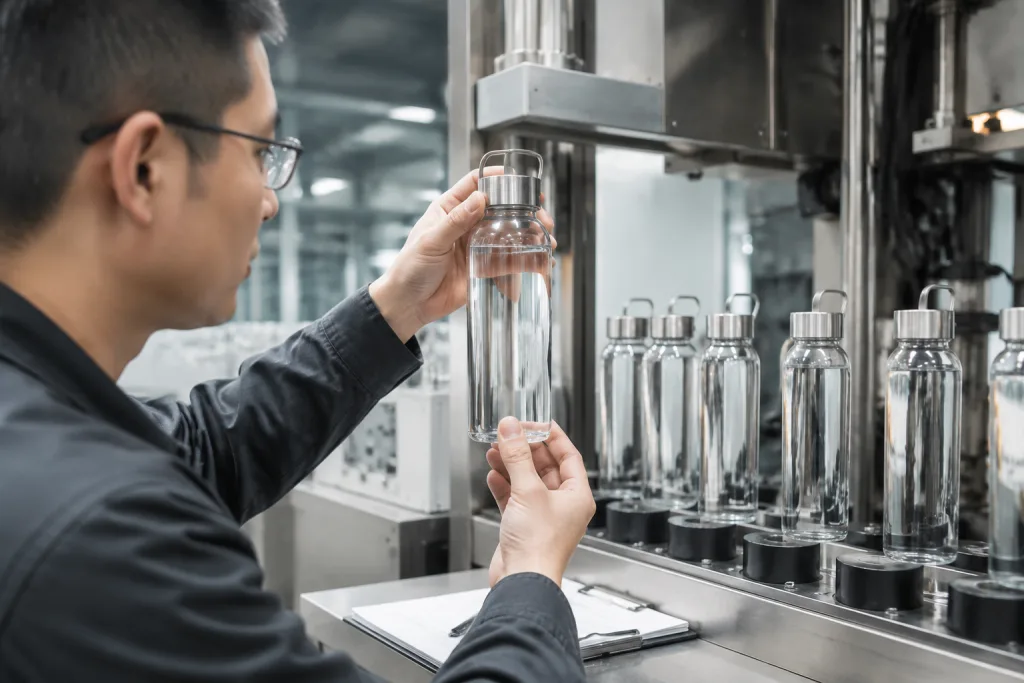
Factory QC should cover incoming glass inspection, lid component inspection, assembly leak test, visual defect sorting, and final AQL inspection. We run the leak test with bottles inverted for 30 minutes after the cap torque check, then QC pulls samples under the light box for bubbles, stones, rim chips, and logo shift over 1.0 mm. A practical AQL plan is critical defects 0, major defects 2.5, minor defects 4.0. Major defects include leaking, cracked glass, sharp edge, wrong logo, wrong capacity marking, or failed barcode. Minor defects include small print dust, slight sleeve color variation, or small carton scuffing within the agreed limit.
At BottleForge, our drinkware lines in Zhejiang support about 380,000 units/month across glass, stainless, and plastic programs, with borosilicate capacity scheduled by forming and decorating workload. For a bulk glass water bottle order, normal production lead time is 35-45 days after sample approval. Third-party inspection usually happens when 80% of goods are packed and 100% are produced. That timing matters. If SGS opens 20 cartons and finds 3 leaking lids before shipment, we can still hold the line, replace caps, and rework pallets instead of arguing after the container lands.
Packaging is not just branding
Glass bottle packaging has two jobs: sell on the shelf and get through the truck ride. Retailers usually start with the printed box. We start with the inner protection, because QC pulled 6 cracked necks from one trial carton last year when the insert was 1.5 mm too loose. For a distributor glass water bottle order, we usually run bottle in tissue or polybag, molded pulp or corrugated insert, individual color box, then export carton with 3- or 5-ply board.
Ask for carton dimensions, gross weight, cube, and loading quantity before you approve the order. A 550 ml bottle in retail box may pack 24 pieces per master carton with gross weight around 14-17 kg. That works for warehouse handling. Once a carton goes over 20 kg, buyers start pushing back; one EU buyer flagged “too heavy for female staff” right on the PO, and the math doesn't work if cartons get dropped during palletizing.
Drop testing should match your channel. For normal B2B wholesale, an ISTA-style carton drop from 60-80 cm on corners, edges, and faces is a fair internal test; we mark the impact points with a red grease pencil before the QC team opens the carton. For e-commerce single-unit shipping, retail box packaging is not enough. You need mailer protection or Amazon-style packaging validation, plus FNSKU or barcode labeling if shipping through marketplace warehouses.
Sustainable retailers often ask for plastic-free packaging. Fine. But be honest about breakage risk. Replacing a thin polybag with tissue is workable if the bottle finish is smooth and the color box has no sharp glue seam. Removing formed inserts to save paper is the wrong question to ask. A broken borosilicate glass bottle creates more waste than a properly designed pulp tray, and we have seen this go sideways on mixed-SKU cartons with 2 mm clearance gaps. A good borosilicate glass bottle manufacturer should help you cut plastic without pretending physics has changed.
Pricing, MOQ, and vendor control
For a vendor borosilicate glass bottle program, we quote base bottle, decoration, packaging, testing, and freight as separate lines. One blended price looks tidy on a PO, but it blocks cost control after the first shipment. We had a buyer flag a USD 0.18 jump on the second repeat order because the first supplier hid the kraft box and EVA insert inside one number. Bad setup.
As a working FOB China range, a 450-650 ml borosilicate glass bottle with bamboo lid and simple logo often lands around USD 2.10-3.20 at 3,000-5,000 pieces. Add a silicone sleeve and custom retail box, and the range usually becomes USD 3.00-4.80. Complex coatings, special lids, tea infusers, gift sets, or 4-way color splits can push higher because the line loses time changing jigs and cleaning spray guns. EXW prices may look cheaper, but for most European and North American buyers, compare FOB Ningbo or FOB Shanghai; the math gets messy when local trucking and export docs are left open.
MOQ depends on the customization layer. Stock clear bottle with stock lid may start at 1,000 pieces. Borosilicate glass bottle custom logo is usually 2,000-3,000 pieces. Custom sleeve color, custom box, and Pantone print are more realistic at 3,000 pieces per SKU, especially when the sleeve factory asks for 80 kg of silicone compound per color. New mold projects should be planned at 10,000 pieces or more unless your target retail price supports tooling amortization. Asking for a private mold at 2,000 pieces is the wrong question to ask.
If you are comparing borosilicate glass bottle suppliers, look beyond the first price. Ask for a signed golden sample, pre-production sample, defect standard photos, AQL level, spare parts policy, and batch traceability. QC pulled one sample last season with a 1.2 mm lid gap; the bottle passed visually, but it failed the carton drop test after 6 drops. A distributor borosilicate glass bottle buyer should also ask whether the supplier can hold repeat components for 6-12 months. The right borosilicate glass bottle vendors make replenishment boring. That is exactly what you want.
Send your glass bottle spec for factory review
Share capacity, lid, sleeve, logo, market, and target MOQ. Our Zhejiang team will check feasibility, price, and testing requirements.
Frequently asked questions
What MOQ should I expect for a custom borosilicate glass bottle?
For a simple logo on an existing bottle, expect 2,000-3,000 pieces. If you need custom sleeve color, Pantone-matched print, and retail box, plan for 3,000 pieces per SKU. A new glass mold is a different conversation and normally needs 10,000 pieces or more to make the tooling cost sensible. At BottleForge in Zhejiang, China, we can sometimes combine shared components across sizes to reduce risk, but color splits still matter. For example, 3,000 pieces split into six sleeve colors is usually inefficient because each color has setup waste, QC sampling, and packing complexity.
Is borosilicate glass really better than soda-lime glass for water bottles?
For reusable drinkware, yes, if the bottle is designed correctly. High borosilicate 3.3 glass handles thermal shock better than soda-lime glass and is commonly used for tea, coffee, and wellness drink bottles. That does not make it unbreakable. A 2.3 mm wall borosilicate bottle can still crack if dropped on tile or hit at the shoulder. The buyer advantage is better heat resistance, lighter weight at comparable strength, and a more premium material story. You should still specify wall thickness, drop-test packaging, and clear use warnings such as “not for freezer expansion” and “not for carbonated beverages unless tested.”
How much does a borosilicate glass bottle wholesale order cost?
A realistic FOB China price for 450-650 ml borosilicate glass bottle wholesale supply is USD 2.10-3.20 for clear glass, bamboo or stainless lid, and one-color logo at 3,000-5,000 pieces. Add a silicone sleeve and custom retail box, and USD 3.00-4.80 is more normal. Testing, inspection, spare lids, and e-commerce packaging can add cost but reduce claims. Be cautious with quotes below USD 1.80 for a “premium” bottle with sleeve and box. Something is usually missing: wall thickness, gasket quality, carton strength, inspection, or compliant material documentation.
Can I make a borosilicate glass bottle promotional gift without retail packaging?
Yes. For corporate wellness kits or event giveaways, many buyers use bulk inner packing instead of retail color boxes. A common setup is each bottle in tissue or polybag, separated by corrugated dividers, with 24 pieces per export carton. This can save around USD 0.20-0.60 per unit compared with a printed retail box, depending on box size and insert design. The risk is presentation and protection during final distribution. If the bottles will be re-shipped one by one, use individual boxes or mailers. If they go directly to an event site in master cartons, bulk packing can work well.
What documents should I ask from a borosilicate glass bottle manufacturer?
Ask for a material declaration for high borosilicate glass, food-contact test reports for glass, lid, gasket, and coating, plus REACH or LFGB reports if selling in Europe. For North America, ask for FDA-relevant food-contact documentation and Proposition 65 screening when required by your retailer. You should also request BSCI or factory audit information if your brand has social compliance requirements. On the production side, ask for a proforma invoice with FOB terms, approved artwork, golden sample photos, carton drop-test record, AQL inspection standard, and batch traceability code. These documents matter more than a nice catalog.