Key Takeaways
- A practical vendor beer tumbler MOQ is 1,000 pcs for stock shapes and 3,000-5,000 pcs for custom tooling
- 304 stainless steel at 0.45-0.55 mm wall thickness is the safe default for beer tumblers
- Logo approval should include Pantone, position tolerance, and 3-cycle dishwasher or rub testing
- Plan 7-10 days for samples and 30-45 days for bulk production after deposit and artwork approval
A vendor beer tumbler looks simple until your PO says 5,000 pieces, the buyer wants them in 21 days, and QC pulled the sample because the logo shifted 1.5 mm on the second carton check. You are not buying cups. You are buying a sellable SKU or promo item that must hold temperature, pass food-contact checks, survive sea freight, and still look right under warehouse LED lighting.
From our factory base in Hangzhou, Zhejiang, we get the same questions on 30 to 40 buyer calls a month: stainless or plastic, powder coat or polish, laser logo or screen print, 1,000 or 10,000 pieces, FOB Ningbo or delivered duty paid. China can run these orders fast, but the math doesn't work if the spec is loose before sampling; we have seen one typo on a PO turn a 12 oz tumbler into a 20 oz mold discussion after the line was already booked.
Start with the use case
The first buying question is not “what is the cheapest vendor beer tumbler?” That is the wrong question to ask. Start with “where will this cup be used, sold, and washed?” We run festival orders differently from retail gift sets; a 5,000 pcs brewery event order often cares more about fast unpacking and logo position, while a 1,200 set retail pack gets judged on shelf scratches, barcode placement, and carton drop damage. Skip that call and the math goes sideways: you pay for a lid nobody uses, or QC pulls the sample later because the rim feels sharp after polishing.
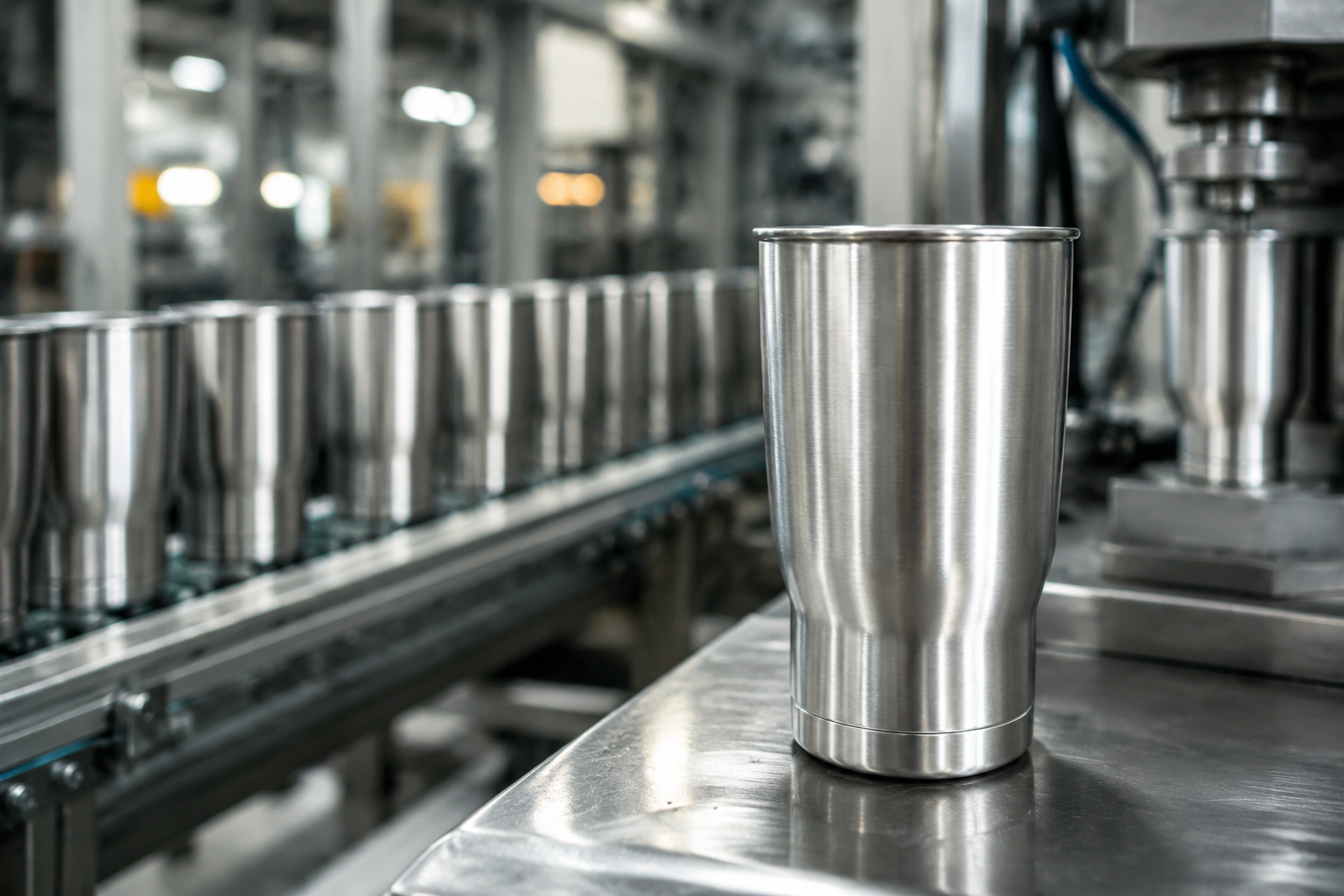
For beer service, most buyers land on 12 oz, 16 oz, or 20 oz. The 16 oz double-wall stainless tumbler moves fastest because it feels close to a pint, works with common taproom menus, and keeps beer cold without sweating on a wooden table. On the line, we usually check the base with a flatness gauge and keep the mouth rolled clean, because a 0.3 mm burr at the lip will get flagged faster than a small color shift in the logo. For camping or outdoor retail, the buyer may add a custom growler or customizable growler to the range, but the tumbler still needs a stable base, comfortable lip, and a lid choice that fits the actual use.
Procurement checklist:
- Define the channel: brewery merchandise, event promotion, retail pack, or distributor drinkware catalog. Each one changes packing, logo size, and acceptable MOQ.
- Confirm capacity in US fluid ounces and milliliters; do not rely on “pint style” wording. We have seen POs list 16 oz while the artwork brief says 500 ml.
- Choose whether the lid is required. A lid adds USD 0.25-0.55 and can push carton height up by 18-25 mm.
- Ask for weight tolerance, usually ±5%, before approving a sample. QC should weigh 5 pcs, not just the golden sample.
- Check cup holder fit if the product overlaps with travel tumbler use. A 74 mm lower diameter passes more car consoles than an 82 mm beer-only base.
If you also source canteen custom or canteen promotional items, keep the brief separate. A custom canteen gets judged on leak resistance and carrying comfort; a beer tumbler gets judged on mouthfeel, cold hold, and how the logo sits after powder coating. Same 304 stainless supply chain, different failure points. We have seen this go sideways when a buyer reused a canteen spec sheet and forgot to remove the “leakproof lid” line from the beer tumbler PO.
Material choices buyers actually face
For a vendor beer tumbler, 304 stainless steel is the normal choice for food-contact inner walls. We still see 201 stainless quoted on the outer wall, usually to shave USD 0.12-0.25 per pc on a 3,000 pcs order. Fine for dry indoor giveaways. Wrong for brewery merchandise or North American retail. Last June, QC pulled 8 pcs from a salt-spray check after 24 hours and the 201 outer wall already showed tea-colored spots near the bottom seam. If the program goes to humid markets or coastal regions, 304 inner and 304 outer gives you fewer claim arguments.
A serious canteen manufacturer or drinkware factory should state the grade clearly: 304, 316, 201, PP, Tritan, or glass. “Food grade metal” is not PO language; we have had a buyer flag that exact phrase during artwork approval and hold the deposit for 3 days. For stainless tumblers, ask for 0.45-0.55 mm wall thickness on mainstream items, checked with a digital caliper after cutting one sample open. Below 0.40 mm, dents show up faster during courier shipment and retail shelf handling. Above 0.60 mm, it feels premium, but the freight and material math gets ugly.
Plastic beer tumblers still make sense for stadium or low-risk event programs. PP is cheap and light, often below USD 0.80 FOB China for simple shapes at 5,000 pcs; we run these on simple injection molds with carton drop tests at 76 cm. Tritan is clearer and stronger, commonly USD 1.20-2.20 depending on wall thickness and mold polish. Stainless double-wall vacuum beer tumblers usually sit around USD 3.20-5.80 FOB Ningbo or Shanghai for 3,000 pcs, depending on lid, coating, and decoration.
Ask your canteen supplier or tumbler supplier for these documents before deposit:
- Food-contact declaration for FDA, LFGB, or EU 1935/2004 depending on market; check that the report name matches the item on the PI, not last year’s coffee mug.
- REACH statement for coating and exterior materials if selling in Europe; powder coating needs its own paperwork.
- Material test report from SGS, Intertek, TÜV, or similar lab; we ship smoother when the report shows 304 stainless and the tested color code.
- BSCI or Sedex audit if your retailer requires social compliance; some buyers ask for the audit number before they release artwork.
Zhejiang factories are strong in stainless drinkware, but buyers still need written material confirmation. China has excellent manufacturers and weak traders in the same search results. We’ve seen this go sideways: one PO said “304 stainless,” the trader’s worksheet said “201 outside,” and the line had already welded 600 pcs before anyone caught the mismatch.
What customization really changes
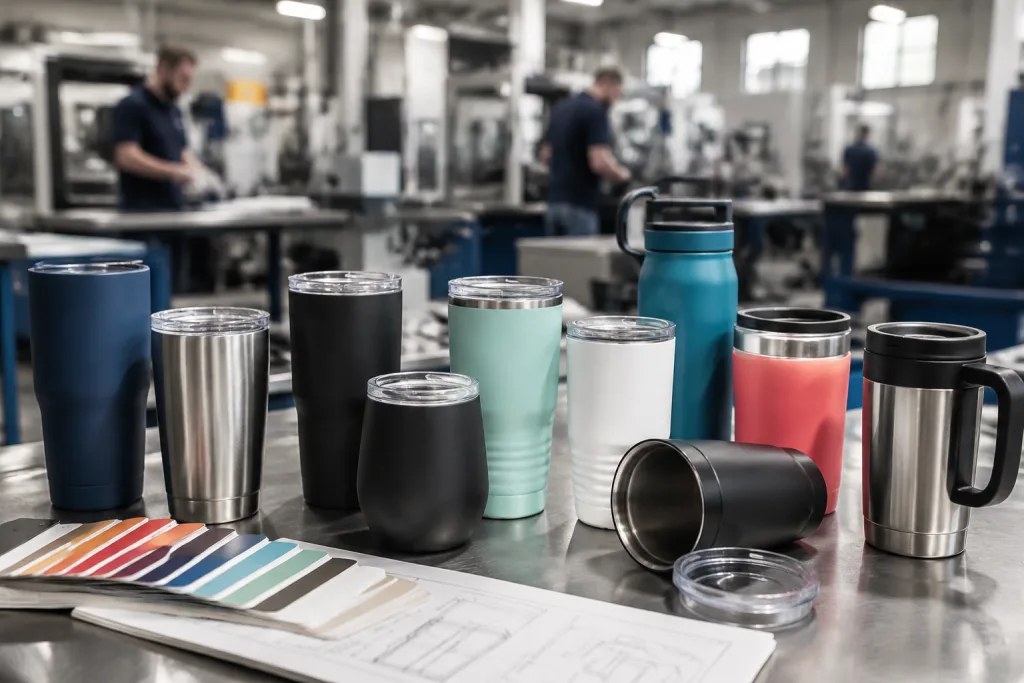
Customizable drinkware sounds broad, but a purchase order needs tight choices. For a vendor beer tumbler, we usually lock five items first: color, logo method, packaging, lid, and shape if the buyer is not using our stock body. Stock body first. A 20 oz tumbler can look like a new item with matte black powder coat, a 38 mm laser logo, and kraft box packing, without cutting steel. New tooling is where buyers lose money fast; one mold trial can add 18 days vs 6 days for stock sampling, and the CNC shop will not wait because the PO said “same as picture.”
Laser engraving is durable and clean on stainless or powder coat. We run it on the fiber laser for brewery logos, outdoor brands, and distributor growler sets when the buyer wants a no-peel mark. The catch is color: engraving shows raw metal or the coating underlayer, not Pantone ink. Silk screen printing costs less for single-color logos and stays sharp on straight walls; last month QC pulled a 500 ml sample where the screen logo drifted 2.2 mm near the seam, so wall shape matters. Heat transfer or UV printing works better for multi-color graphics, but approve adhesion tests on the actual powder coat. Curved coated surfaces punish lazy artwork.
For powder coating, MOQ is often 1,000 pcs per color for stock colors and 3,000 pcs per custom Pantone color. A canteen customized program with 6 SKUs should group colors across tumblers, canteens, and growlers to cut coating line changes; washing the spray booth and changing powder can eat half a shift. At BottleForge Industrial, a normal monthly capacity is about 420,000 stainless drinkware units across tumblers, bottles, canteens, and growlers, but color batching still affects delivery. We ship faster when the buyer accepts shared colors. If every item needs its own Pantone, the math does not work.
Decoration approval checklist:
- Confirm logo file format: AI, EPS, PDF vector preferred; JPG logos from a catalog PDF usually redraw poorly.
- Set logo size in millimeters, not “centered and large”; we need numbers such as 42 mm wide.
- State position tolerance, normally ±1.5 mm for screen print and ±1.0 mm for laser; QC checks this with a digital caliper.
- Approve a physical pre-production sample, not only a digital mockup; phone-screen color is not a coating standard.
- Run tape test, alcohol rub test, and 3 dishwasher cycles if dishwasher-safe claims are used; write the pass standard on the sample tag.
Customized drinkware is not hard, but it punishes loose artwork instructions. A canteen vendor can print what you send. It cannot guess what your brand manager meant. We have seen this go sideways over one typo on a PO, “matte navy” in the artwork file and “matte black” in the order sheet, with 1,000 pcs already lined up for coating.
MOQ, pricing, and quote traps
Buyers usually open with “what is your lowest MOQ?” We hear it on 7 out of 10 RFQs. Fair question, but this is the wrong question to ask by itself. MOQ has to sit beside unit price, lead time, and whether we can repeat the same spec on the next PO. For a stock vendor beer tumbler body, we can run 500 pcs if the powder color is already on our shelf and the logo is a simple 1-position laser mark. For stable B2B pricing, 1,000 pcs is the cleaner starting point. If the order needs a new powder color, new lid color, or custom printed carton, 3,000 pcs makes more sense because the line still needs color-change cleaning, carton die-line checking, and a first-article pull with calipers before mass production.
A useful RFQ should include capacity, material, finish, logo method, packaging, destination port, compliance market, and annual forecast. Send only “quote 16 oz beer tumbler with logo,” and the prices will not compare. We’ve seen this go sideways. One supplier quotes 201 outer wall; another quotes 304 outer wall. One includes a slide lid; another prices the cup only. One packs in 5-layer export cartons; another uses thin cartons that look fine in photos but crush after 2 warehouse transfers. Last month QC pulled a sample carton at 13.8 kg gross weight, and the buyer flagged corner denting after a basic drop check.
Typical FOB China ranges at 3,000 pcs are:
- 16 oz single-wall stainless beer tumbler: USD 1.60-2.40.
- 16 oz double-wall vacuum beer tumbler, powder coated: USD 3.20-4.80.
- 20 oz premium vacuum tumbler with lid and laser logo: USD 4.20-6.20.
- 64 oz customized growler: USD 8.50-14.50 depending on cap and coating.
Watch the quote traps. A low unit price can leave out logo setup, inner box, drop test packaging, export carton marks, FNSKU labels, or palletization. For Amazon or retailer orders, label work can add USD 0.05-0.18 per unit, and the math does not work if it appears after the deposit. For mixed distributor canteen and tumbler shipments, carton sorting and SKU labels need to be quoted upfront. We run a packing table check against the PO because one typo like “matte black” vs “metal black” can split a shipment into 2 wrong SKUs.
Good suppliers quote boring details. Bad suppliers quote a pretty unit price and discuss the missing costs after your deposit.
Quality checks before shipment
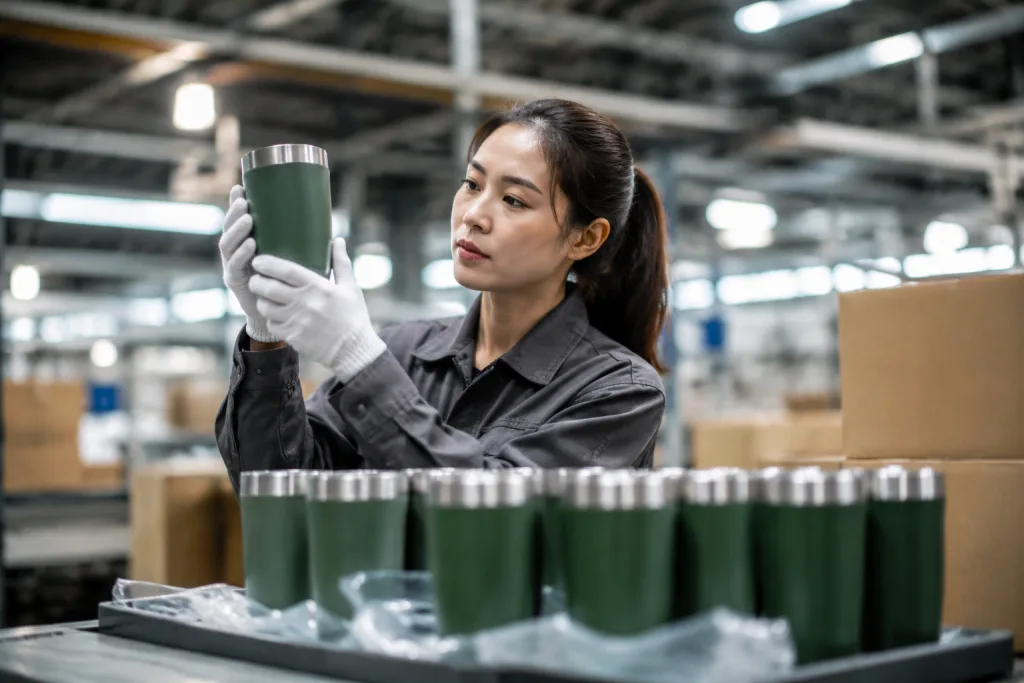
Do not start inspection after the cartons are sealed. We run vendor beer tumbler orders through 4 control points: incoming 304 stainless sheet check with a handheld XRF gun, a signed pre-production sample with logo position measured in mm, during-production inspection when the line hits about 30%, and final random inspection before the export cartons get strapped. For orders above 3,000 pcs or anything tied to a retail launch date, third-party inspection usually costs less than one rejected container; we had a buyer flag this after a PO typo changed “matte black” to “black,” and QC caught it before 1,200 pcs were packed.
Use AQL, not loose wording like “good quality.” A common final inspection level is AQL 2.5 for major defects and AQL 4.0 for minor defects under ISO 2859-1. Critical defects should be 0. For drinkware, critical defects include sharp edges, contamination, leaking lids where leakproof is claimed, wrong material, and unsafe packaging odor. Major defects include obvious dents, poor vacuum performance, severe logo misalignment, coating peel, and wrong carton marks. This is where the math doesn't work: accepting 2 leaking lids in a 125-pc sample sounds small until a retailer opens a case claim on 6 stores at once.
Inspection checklist for beer tumblers:
- Capacity test with water to brim and usable fill line if specified; QC uses a 1,000 ml graduated cylinder, not a kitchen cup.
- Vacuum insulation test, such as 95°C water with temperature drop measured after 6 hours, with the probe taped 20 mm below the rim.
- Coating adhesion cross-cut test on powder-coated samples, using 3M tape after the cutter makes the grid.
- Logo rub test with 75% alcohol for printed decoration; 20 back-and-forth strokes is our normal line check.
- Carton drop test, commonly 1 corner, 3 edges, and 6 faces from 60-80 cm depending on carton weight.
- Barcode scan and carton mark check for every SKU; the buyer once flagged a UPC that scanned to the old 16 oz listing.
If you buy from multiple canteen suppliers or canteen manufacturers in China, keep one inspection standard across all vendors. Same AQL sheet. Same defect photos. Same carton mark format. Otherwise your distributor drinkware line will look patched together, even if each factory “passed” its own soft checklist; we’ve seen this go sideways when two factories used different logo tolerance limits, 1.5 mm versus 3 mm.
Logistics and packaging decisions
Drinkware eats carton space. A 16 oz vacuum beer tumbler may weigh only 230-320 g, but freight is usually decided by volume, not scale weight. We normally run 24 pcs or 36 pcs per export carton. With retail inner boxes, a 24 pcs carton often lands near 58 × 40 × 28 cm, depending on the lid height and handle mold. Ask for gross weight, net weight, carton size, and CBM before you sign the PI. Simple check: QC pulled one 24 pcs carton last month and the caliper showed the insert tray added 6 mm per unit, which pushed the CBM up enough to change the sea freight quote.
FOB Ningbo and FOB Shanghai are common for Zhejiang production. For Europe and North America, sea freight is the normal choice from 1,000 pcs up unless the launch date is already burning. Air freight can cost more than the tumbler. If you need 300 urgent samples or a small replenishment, air shipment is fine, but the margin math does not work for repeat orders. We ship from Hangzhou to Ningbo by truck in about 3.5 hours on a clean day; a missed warehouse cutoff can turn a 12-day vessel plan into 18 days on the next sailing.
Packaging has to fit the sales channel. Bulk polybag packing works for event giveaways, but it looks cheap on a retail shelf. White box is safe for distributor drinkware. Color box fits shelf programs better, but artwork proofing, barcode placement, and FSC paper claims need checking before mass print. For Amazon FBA, each unit may need FNSKU labeling, suffocation warnings if polybags are used, master carton labels, and carton weight below platform limits, often 50 lb in the US. We have seen this go sideways when a PO had one digit wrong in the barcode, and the buyer flagged it only after 1,200 boxes were printed.
A canteen distributor carrying tumblers, custom canteen products, and customized growler SKUs should plan mixed containers early. Combining stainless bottles with beer tumblers can improve container fill rate, but carton strength has to match the stack plan. Heavy growlers should not sit on lightweight tumbler cartons during inland trucking in China or destination warehousing. On the line, we run a simple 5-layer compression check with a 15 kg top load; if the corner seam opens, that carton does not belong under growlers.
How to judge the supplier
A good canteen supplier should slow the order down in 2 or 3 spots. Annoying? Yes. Useful? Also yes. If a supplier says yes to 500 pcs custom Pantone coating, new lid tooling, retail box artwork, and 20-day delivery in the same breath, the math doesn't work. On our coating line, one color change means cleaning the spray gun, checking film thickness around 18-25 μm, and baking test pieces before QC signs the shade card. Real production has limits. Fake confidence costs more than a delayed sample.
When comparing canteen vendors, ask who actually controls stainless forming, polishing, vacuuming, coating, printing, and packing. Some exporters run their own lines; others pass the order across 3 workshops and hope the handoff is clean. Trading is not automatically bad, but customized drinkware needs one person responsible when the logo prints 2 mm off center or the lid gasket fails the leak test. BottleForge Industrial operates from Hangzhou, Zhejiang, close to major stainless drinkware clusters and Ningbo port, so we manage sampling, mass production, and container loading without adding 7 days of inland coordination. We have seen this go sideways when a PO says “matte black” but the approved sample was “powder black.”
Supplier questions worth asking:
- What is your normal MOQ for stock beer tumblers, custom canteen colors, and custom growler orders, and does that MOQ change by coating color?
- Can you provide pre-shipment inspection photos by AQL defect category, including scratches, logo shift, lid fit, and carton damage?
- What is your monthly capacity by product type, not just total factory capacity, such as 30 oz tumblers versus wide-mouth growlers?
- Do you have BSCI, ISO 9001, or retailer audit history, and when was the last audit closed?
- How many days for counter sample, pre-production sample, and bulk production, for example 5 days, 12 days, and 35 days?
- Can you quote FOB and DDP separately with carton-level data, including gross weight, carton size, and HS code?
For most B2B buyers, the safest path is boring: approve one stock shape, test one decoration method, place 1,000-3,000 pcs, inspect properly, then expand into canteen customizable, distributor growler, and wider custom drinkware programs. Start small. QC pulled the sample on one 2,000 pcs beer tumbler run because the laser logo was clean, but the carton mark had a 1-digit PO typo. Scaling works better after the first shipment proves the supplier can follow written details.
Send your beer tumbler RFQ for review
Share capacity, logo, quantity, market, and target ship date. We will return practical specs, MOQ, pricing, and sampling options.
Frequently asked questions
What MOQ should I expect for a vendor beer tumbler order?
For a stock stainless vendor beer tumbler, expect 1,000 pcs as a practical MOQ for stable FOB pricing. Some China suppliers may accept 500 pcs if the color is already in production and the logo is laser engraved. For custom Pantone powder coating, MOQ is usually 3,000 pcs per color. For a new mold or special lid, plan 5,000-10,000 pcs because tooling, testing, and setup cost must be spread across enough units. If you are a canteen distributor testing a new line, start with one capacity and one finish instead of splitting 1,000 pcs across four colors.
How long does production take after sample approval?
A normal timeline is 7-10 days for a logo sample, 3-5 days for buyer approval and payment paperwork, then 30-45 days for bulk production. Add 5-7 days if the order needs a custom color box, FNSKU labeling, or retailer carton marks. During peak season before summer promotions and Q4 gift orders, stainless drinkware factories in Zhejiang and other parts of China can become fully booked. For 10,000 pcs or more, book capacity at least 60 days before your required ship date.
Which logo method is best for brewery merchandise?
Laser engraving is the safest method for brewery merchandise because it resists moisture, cold handling, and repeated washing. It works especially well on powder-coated stainless tumblers. If your brand requires exact Pantone colors, silk screen printing is better for simple one- or two-color artwork, while heat transfer or UV printing can handle complex graphics. For any printed logo, request adhesion testing: tape test, 75% alcohol rub test, and at least 3 dishwasher cycles if you plan to make dishwasher-safe claims. Do not approve mass production from a screen mockup only.
Can I combine beer tumblers with custom canteen or growler SKUs?
Yes, and it often makes freight more efficient. A distributor canteen program can combine beer tumblers, customized canteen bottles, and customized growler items in one shipment if production schedules align. The practical issue is carton planning. A 64 oz growler is heavier and can damage cartons if stacked badly with lightweight tumbler boxes. Ask the supplier for carton dimensions, gross weight, CBM, and loading plan before mixing SKUs. Also keep each SKU’s barcode, carton mark, and inner packing separate to avoid warehouse receiving errors.
What compliance documents do European and North American buyers need?
For North America, request FDA food-contact conformity and, when relevant, ASTM or CPSIA support if the item could be marketed to children. For Europe, ask for LFGB or EU 1935/2004 food-contact testing, plus REACH statements for coatings and exterior materials. If selling through retailers, BSCI, Sedex, or ISO 9001 documents may be requested even when not legally required. Test reports should match the material and finish you are buying. A report for a plain stainless bottle does not automatically cover a powder-coated vendor beer tumbler with printed logo.