Key Takeaways
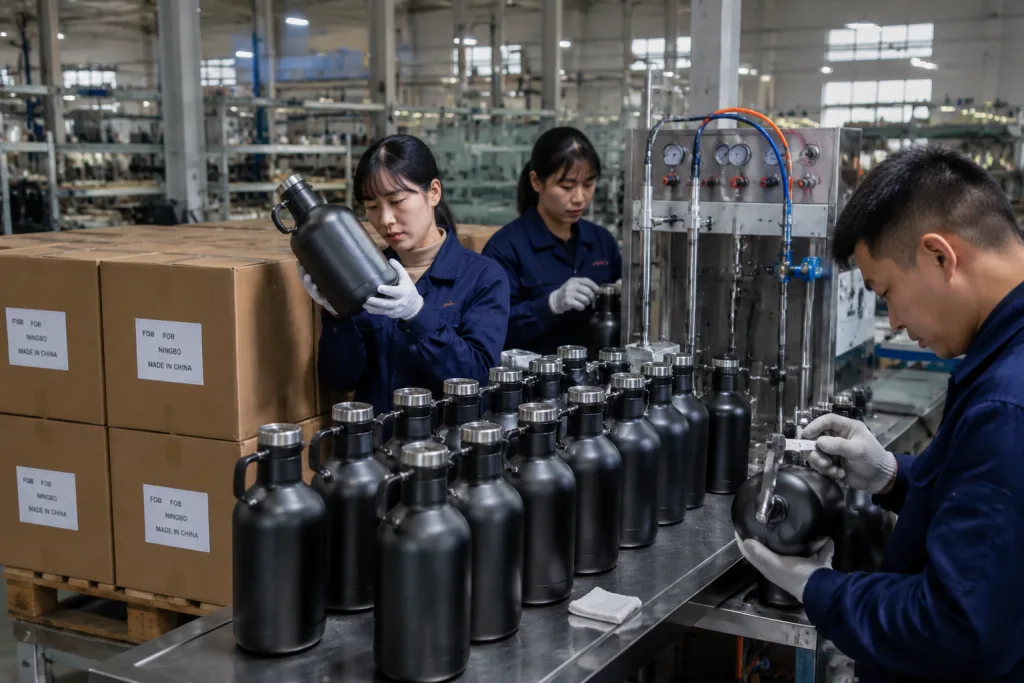
- A 64 oz stainless vendor beer growler usually lands at USD 5.80-9.40 FOB Ningbo at 1,000-5,000 pcs
- Realistic MOQ is 500 pcs for stock color logo work and 3,000 pcs for custom powder coating
- Normal production lead time is 30-45 days after deposit and artwork approval
- Logo, cap structure, wall thickness, carton spec, and AQL inspection can move cost by 8-22%
A vendor beer growler looks simple on a quote sheet: 64 oz, stainless steel, logo, carton packing. Then the buyer sends us 3 quotes with the same product photo, and the spread is 18%. That gap is usually not “factory margin.” We’ve seen one quote skip the inner coating spec, one use a 0.45 mm body wall instead of 0.55 mm, and one leave out the gift box, barcode sticker, and AQL 2.5 pre-shipment inspection. QC pulled the sample, weighed it on the bench scale, and the “same” growler was 42 g lighter. The math doesn’t work if you compare only the photo.
If you buy custom drinkware for breweries, retail programs, outdoor brands, or distributor drinkware channels, you need real cost and lead-time numbers before design approval. BottleForge Industrial in Hangzhou, Zhejiang works as a China canteen manufacturer and growler supplier, so I’ll keep this close to the line: what changes the unit price, where MOQ bites, and whether a step takes 12 days or 18 days. We run laser logo trials, check lid fit with a 0.2 mm feeler gauge, and confirm carton drop-test packing before a PO gets comfortable. Small details decide the landed cost.
Start With The Real Spec
Bad vendor beer growler quotes usually start with a weak spec sheet, not a crooked factory. If the RFQ says “custom growler, 64 oz, logo printed,” our costing desk in Hangzhou has to fill in the blanks: 304 or 201 steel, 0.45 mm or 0.55 mm wall, powder coat or spray paint, PP cap or stainless cap, white box or kraft box, AQL 2.5 or basic visual check. Those guesses become the unit price. We see this every month. QC pulled one golden sample last spring that looked fine on the bench, then failed the 30-minute inverted leak test because the buyer never locked the cap gasket spec.
For B2B buying, define the body first. A standard stainless steel growler uses 304 inner steel and 201 or 304 outer steel. For brewery retail, I would not put 201 on the inside. The math doesn't work once the product touches beer, coffee, kombucha, or acidic drinks; use 304 inner steel and ask for food-contact test documents before deposit. A normal formed body wall sits around 0.45-0.55 mm. Drop it to 0.40 mm and you might save USD 0.20-0.45 per piece, but dent resistance falls fast. Our line checks wall thickness with a digital micrometer after stretching, and the weak spots usually show near the shoulder radius.
Capacity needs a line on the PO. A 64 oz growler is not just “two liters.” Confirm brimful capacity versus usable capacity, because a 1,900 ml usable fill and a 2,000 ml brimful body are not the same product. We had a buyer flag this after receiving samples with “64 oz” printed on the carton, while the measuring jug showed only 1,860 ml to the safe fill line. For export cartons, dimensional weight can beat gross weight. A 12 pcs master carton for large growlers can push freight cost up if the carton grows by 2-3 cm on each side, and FedEx will charge by the tape measure, not your spreadsheet.
For a clean RFQ, send these points: capacity with brimful or usable marked, steel grade for inner and outer layers, single-wall or vacuum insulated construction, cap material with gasket type, coating color with Pantone code, logo method with artwork size in mm, packing style with carton quantity, carton drop-test expectation, destination market, and target inspection standard. Simple list. No poetry. It puts every canteen supplier on the same page, and it stops the buyer pushback we hear too often: “Your quote is 8% higher, but I don’t know why.”
FOB Cost By MOQ Tier
For a standard 64 oz single-wall stainless vendor beer growler from Zhejiang, we’d quote FOB Ningbo around USD 5.80-7.20 at 1,000 pcs and USD 5.20-6.40 at 5,000 pcs, based on one-color silkscreen logo and white box packing. That assumes the body is 304 stainless, the mold is already running, and the carton mark is clean. A vacuum insulated customized growler is not the same line item. Expect about USD 8.40-12.80 FOB, with the gap coming from cap structure, copper coating, spray finish, and whether QC pulled the sample after a 12-hour temperature hold or only did appearance checks.
MOQ is where buyers misread the offer. We hear this at least 6 times a month: “Can you do 300 pcs at the 1,000 pcs price?” The math doesn't work. A canteen vendor may accept 300 pcs if the body is in stock and you stay with an existing color, which is fine for a pilot launch. Unit cost jumps because the screen plate, carton sorting, and QC labor still sit on the order; the line also loses time changing ink and checking logo position with a 0.5 mm tolerance. A safer MOQ is 500 pcs per SKU for logo-only work, 1,000 pcs per color for repeatable pricing, and 3,000 pcs for custom powder coating matched to a Pantone reference.
Here is a practical cost stack for 1,000 pcs: base growler USD 4.90-5.80, powder coating USD 0.45-0.85 after film thickness check, one-position logo USD 0.12-0.35, cap upgrade USD 0.25-0.90, individual white box USD 0.18-0.35, and export carton USD 0.08-0.16 per unit. If you need a retail gift box with 350 gsm paper and color printing, add USD 0.45-0.95. Small thing, big headache: last April one PO had “mat black” instead of “matte black,” and the buyer flagged the finish only after the pre-production sample landed.
For distributor growler programs, do not chase the lowest first quote. Ask the canteen manufacturers to split body, decoration, packing, and tooling, then compare each line. We ship cleaner orders when the buyer approves a cost sheet before sampling, because nobody has to hide a cheaper cap gasket or thin carton to hit a target FOB. We’ve seen this go sideways. Saving USD 0.12 on packing can cost more when 2 cartons arrive crushed in a 50-carton inspection pull.
Decoration Changes Price Fast
Decoration is the first cost line that moves, and it moves fast. For vendor beer growler orders, the cheapest route is still one-color silkscreen on a smooth powder-coated body. At 1,000 pcs, we usually see USD 0.12-0.25 per piece, plus a screen setup fee of USD 30-60 per color. On our line, we print with a 90-mesh screen, and this works cleanly for brewery logos that stay off seams and deep curves. If the buyer wants a wraparound graphic, this is the wrong question to ask.
Laser engraving costs more, usually USD 0.25-0.60 per position, but the math works when the order goes into retail. You avoid ink adhesion trouble, and the finish looks sharper in hand. We run this on a fiber laser table, and it fits a customized canteen line sold through outdoor stores or a distributor canteen program where returns hurt. The tradeoff is simple: no color. Laser exposes the metal or the underlayer, so it will not carry full-color artwork.
Heat transfer and water transfer can handle full-color artwork, but they need tighter artwork control and extra curing time. For 360-degree artwork, budget USD 0.70-1.50 per piece depending on coverage. We have seen this go sideways when a buyer sends a city name list with 12 spellings and wants the first 500 pcs out the door. For a customizable growler with names, city marks, or event editions, variable laser marking is usually steadier than changing silkscreen plates every few hundred units.
Artwork approval should lock down logo size in millimeters, Pantone number, print position tolerance, and abrasion expectation before the line starts. QC pulled the sample and ran a 3M tape adhesion test after curing, then a light rub test, because that catches bad ink fast. For EU and North America, ink and coating compliance may need REACH, LFGB, FDA food-contact support, or customer-specific restricted substance lists. A good canteen supplier asks for the market first, then confirms the decoration.
Cap, Seal, And Leak Costs
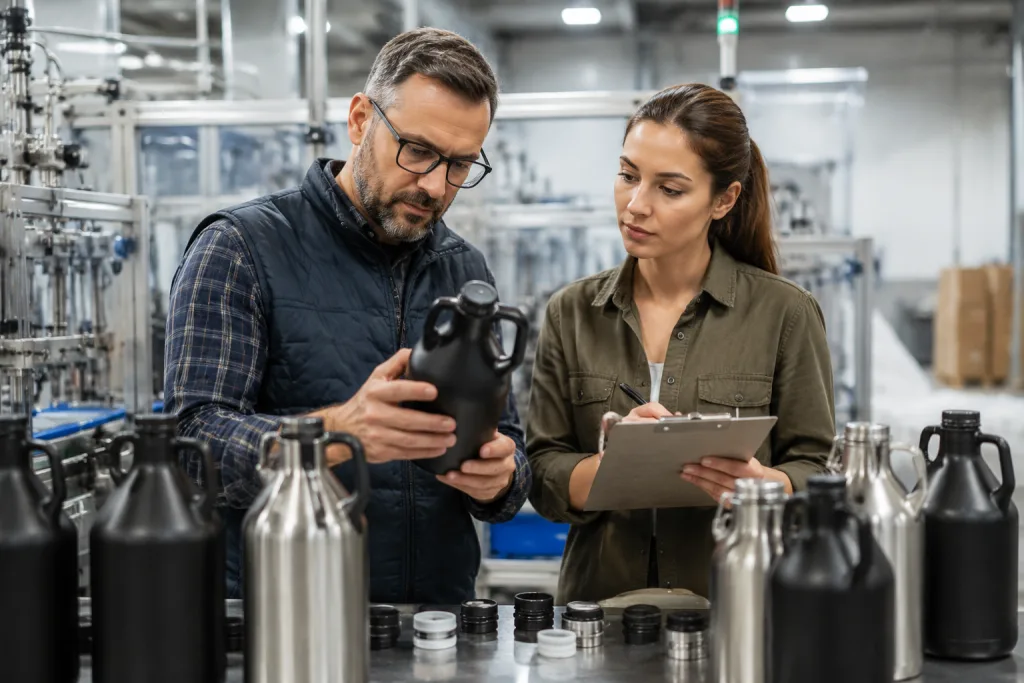
The cap is not an accessory. It is where complaints start. On our line, a basic screw cap with PP inner and silicone gasket usually adds USD 0.35-0.70 to a growler build; QC checks the thread with a go/no-go gauge before the cap bin is released. A swing-top style, stainless loop handle, or pressure-friendly cap can add USD 0.80-1.80. For canteen distributors and brewery gift shops, cap feel sells the piece before the buyer reads “304 stainless” on the spec sheet. We had one buyer flag a cap that sealed fine but felt gritty after 20 open-close cycles. He was right to push back.
For beer growlers, be careful with carbonation claims. This is the wrong question to ask: “Will it keep beer fresh for days?” Ask what pressure the cap and neck passed. Many stainless growlers are built for short-term transport, not long-term pressurized storage. If a supplier claims “keeps beer carbonated for days,” ask for pressure test data and cap seal structure. A typical leak test may use inverted water filling for 30 minutes, while a stronger internal pressure test may run at 30-60 kPa depending on design. We run the sample upright, inverted, then on its side in a plastic tray; one wet carton corner tells you more than a sales photo.
Silicone gasket quality also affects odor and repeat use. Food-grade silicone is cheap enough that cutting it is bad math, but low-grade gaskets can smell after 3 rounds of hot water washing at 80°C. For a custom canteen or custom growler program, ask for spare gasket pricing. It may be only USD 0.03-0.08 per piece, and including one spare gasket in the box can cut after-sales emails from 18 cases to 5 cases on a 3,000-piece shipment. QC pulled one black gasket sample last month because the edge flash measured 0.4 mm and trapped water after washing.
At BottleForge Industrial, our Hangzhou, Zhejiang team normally checks cap torque, gasket fit, and random leak testing before packing. We use a handheld torque meter on the first 20 pieces after line start, then spot-check every 500 pieces or each carton change, whichever comes first. For larger China export orders, we suggest AQL 2.5 for major defects and AQL 4.0 for minor defects, unless your retail customer requires a stricter plan. If the PO says “leak-proof” but the artwork brief says “pressure growler,” the buyer flagged it too late; we’ve seen this go sideways.
Production Timeline Without Guesswork
A normal vendor beer growler timeline is not “about one month” unless the color chip, body mold, cap insert, and export carton have all run before. For a new customized drinkware order, we plan 7-10 days for quotation, 2D drawing, and artwork cleanup; 7-12 days for pre-production sample; 3-5 days for sample review and written approval; 25-35 days for mass production; 2-4 days for internal QC and packing; and 1 day for loading at Ningbo or Shanghai. The buyer often asks us to “save a week” here. The math doesn't work if the powder coating line still needs a 180°C curing check and QC pulled the sample for logo adhesion with 3M tape.
That puts you at 45-65 calendar days before vessel departure when the order has a custom color or new packaging. For stock-color logo orders, 30-40 days after deposit is realistic. For 10,000 pcs with custom powder coating and gift box, 45-55 days production is safer. Our Zhejiang facility capacity for stainless bottles and growlers is about 450,000 units per month across mixed SKUs, but capacity does not cancel curing time, carton lead time, or inspection booking. We run full cartons through a 76 cm drop test, and one weak E-flute insert can hold the line for 3 days while the packaging supplier recuts.
Tooling can stretch the schedule. A fully new cap mold may need 25-35 days and USD 1,500-4,000 depending on complexity. A new body mold costs more and usually makes no sense unless your annual forecast exceeds 30,000 pcs. For most canteen customized programs, use an existing body and spend the money on finish, cap color, or retail packaging. We have seen this go sideways when a buyer approved a new cap on screen, then flagged a 0.6 mm thread bite issue after the T1 sample arrived.
Build your launch calendar backward from the retail delivery date. If you need goods in a North American warehouse by May 1, sea freight, customs, inland trucking, and possible inspection rework can take 35-50 days after China port departure. Do not place that purchase order in late March. We had one PO last season with “Matte Black” typed as “Matt Black,” and that small wording gap cost 2 days while the buyer confirmed the Pantone and carton mark files.
Compliance And Inspection Budget
Compliance costs are boring line items, but they cost less than one rejected container. For a vendor beer growler sold in Europe, buyers usually ask for LFGB food-contact testing, REACH checks on coating and inks, and sometimes BSCI or Sedex factory social audit files. For the United States and Canada, FDA food-contact expectations, California Proposition 65 screening, and customer-specific chemical lists can apply. One certificate does not cover every market. We had a buyer flag this after their PO said “EU + CA,” while the attached test report only covered 304 stainless steel body contact under LFGB.
Testing cost depends on scope. A basic food-contact test on stainless and silicone may run USD 180-450 per material set through a recognized lab. Coating or ink chemical testing can add USD 150-400. If you change the gasket material, coating supplier, or ink system, the old report may not be valid. This is where the math doesn't work: saving USD 0.03 on a new silicone ring can force a fresh test report and delay shipment by 7-10 days. We run gasket lots by batch card, shore hardness reading, and incoming material label, not by whatever the market stall has that week.
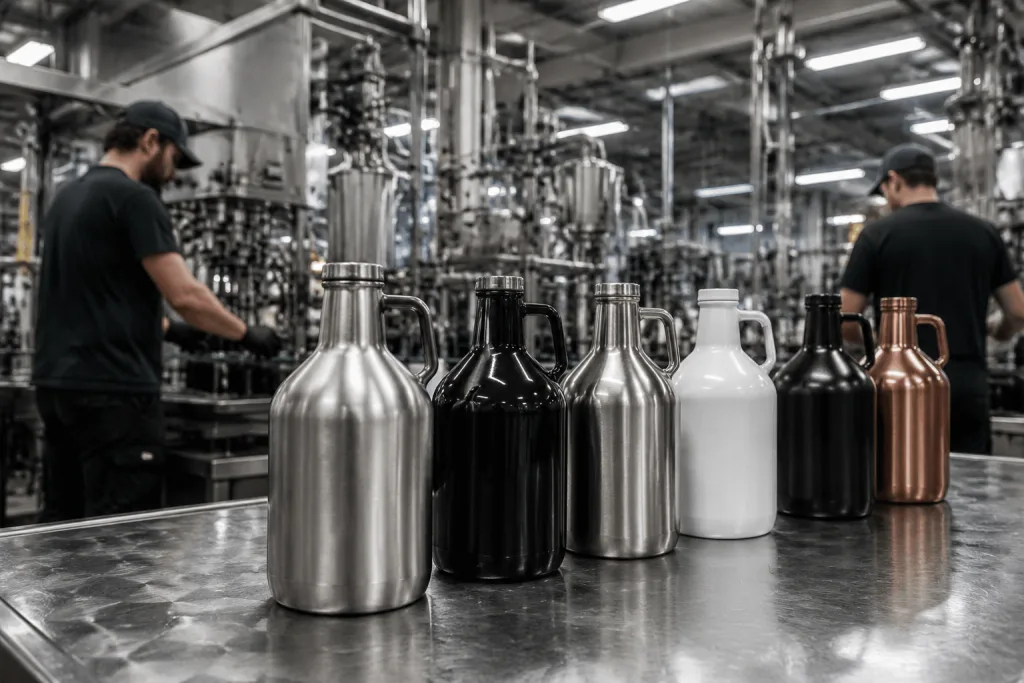
Third-party inspection also belongs in the budget. For a 1,000-5,000 pcs order, a one-day pre-shipment inspection normally costs USD 250-350 in Zhejiang or nearby China regions, before travel surcharges. The inspection should check quantity, workmanship, logo position, carton markings, barcode scanning, leak performance, coating adhesion, and drop-test condition. Expand that checklist with exact limits: logo tolerance within 2 mm, 3M tape adhesion result, 24-hour upside-down leak test, and master carton gross weight. If you ship to Amazon FBA or retail DCs, add FNSKU, carton label, and pallet requirements before the line starts packing.
Inspection cannot fix a poor specification. It only measures against what you approved. Put the golden sample, signed artwork, packing layout, AQL level, and defect photos into the purchase file. QC pulled the sample once and found the carton mark said “grower” instead of “growler”; nobody caught it because the PO file had no approved carton PDF. Give the canteen factory and your inspector the same target, or the inspection report will only document the mess.
Where Buyers Lose Margin
Margin usually leaks through small assumptions. We’ve seen a buyer approve a low FOB price, then QC pulled the packing sample and found no inner boxes on the quote. That added USD 0.18 per pc on a 1,200 pcs beer growler order. The logo cost covered one side, but the brewery wanted front and back positions. The carton passed a local drop test, then failed export stacking at 5 layers because the flute was too soft. Another common trap: a supplier says yes to 500 pcs custom color, then the coating line sits idle because the spray plant will not run under 3,000 pcs without charging a setup fee. The math doesn’t work.
The fix is dull paperwork. Good. State Incoterms, usually FOB Ningbo or FOB Shanghai for our region. Put payment terms, sample approval rules, carton dimensions, barcode position, and inspection rights on the PO before the deposit lands. We once had a PO typo that said “matte back” instead of “matte black”; the buyer flagged it during artwork proofing, not after powder coating, which saved 12 days of rework. If you are a canteen distributor serving 6 brewery accounts, ask whether the factory can run different logos under one shared body color. That cuts MOQ pressure and keeps repeat orders moving.
For customizable drinkware programs, build the range in modules. Keep one body, two cap options, and three coating colors, then swap logo files by account. On the line, that means we change the laser jig or silk-screen film instead of restarting material purchasing, coating trials, and cap matching. Faster orders come from controlled choices. A distributor drinkware catalog with fixed bodies and clear decoration zones usually ships cleaner than a catalog promising unlimited customization.
China sourcing works well when both sides remove guesswork. BottleForge Industrial can support vendor beer growler, customizable canteen, customized canteen, and related canteen promotional orders, but the strongest projects start with a target price, annual forecast, and launch date. Those 3 numbers tell us whether to recommend stock molds, custom coating, or a tighter MOQ plan. If the launch date is 45 days out and the forecast is 8,000 pcs, we run the plan one way; if the buyer wants 600 pcs in 18 days, we say so early.
Send Your Growler Spec For A Costed Quote
Share capacity, logo method, MOQ target, market, and delivery date. We will return FOB pricing, sample timing, and production lead time.
Frequently asked questions
What is a realistic MOQ for a vendor beer growler order?
For a stock-body vendor beer growler with one logo, 500 pcs is usually workable, but 1,000 pcs gives better FOB pricing and more stable production scheduling. If you need custom powder coating, Pantone matching, or retail gift box printing, plan on 3,000 pcs per color. Some canteen suppliers will quote 300 pcs, but the unit price may be 20-35% higher because setup, QC, and carton handling do not shrink with quantity. For distributor growler programs with several brewery logos, ask whether one shared body color can be produced in 3,000 pcs and split into 500 pcs logo lots.
How much should I budget for a custom growler from China?
For a 64 oz single-wall stainless custom growler, a fair FOB Ningbo range is USD 5.80-7.20 at 1,000 pcs with one-color logo and white box. At 5,000 pcs, the same build may fall to USD 5.20-6.40. Vacuum insulated versions usually run USD 8.40-12.80 depending on cap, coating, and copper lining. Add USD 0.45-0.95 for color gift box, USD 0.25-0.60 for laser engraving, and USD 250-350 for a one-day third-party inspection in Zhejiang. Ocean freight, duty, and inland delivery are separate from FOB pricing.
Can one canteen manufacturer handle both growlers and canteens?
Yes, if the factory has stainless forming, polishing, coating, assembly, and leak-test capability in-house or under stable subcontract control. A canteen manufacturer that already produces custom canteen, sports bottles, and travel tumblers can often run a vendor beer growler using similar body-forming and coating lines. The main difference is cap sealing and capacity control. For procurement, this is useful because you can build a broader customized drinkware program with one supplier file, one audit package, and one inspection standard. Ask for monthly capacity, current export markets, and at least 3 recent mass-production photos, not just catalog renderings.
What lead time should I promise my retail or brewery customer?
For logo-only stock color orders, promise 30-40 days production after deposit and artwork approval, then add freight time. For custom coating, gift box, or new cap combinations, use 45-65 calendar days before vessel departure. If your customer needs goods in a North American warehouse, add 35-50 days for sea freight, customs, and inland trucking. Air freight is possible but expensive for 64 oz growlers because carton volume is high. A safe launch plan locks artwork, sample approval, barcode rules, and inspection booking before mass production starts.
How do I compare quotes from different canteen vendors fairly?
Put every quote into the same format: steel grade, wall thickness, capacity method, cap material, gasket material, coating type, logo method, packing, carton size, MOQ, lead time, Incoterms, and inspection standard. Then ask the canteen vendors to separate base item cost, decoration cost, packaging cost, and tooling. A quote that is USD 0.40 cheaper may exclude gift box, use 201 inner steel, or assume no third-party inspection. For EU or North American distribution, also compare compliance support such as LFGB, REACH, FDA food-contact documents, BSCI, and traceability records.