Key Takeaways
- Start with 304 stainless steel at 0.4–0.5 mm wall thickness for most vendor alcohol flask orders
- Plan MOQ at 1,000 units per SKU for standard flasks and 3,000 units for custom molds
- Use laser engraving for durable logos; use screen print or UV print when color accuracy matters
- Allow 25–40 days production plus 7–35 days freight depending on air, rail, or ocean routing
A vendor alcohol flask looks easy until our merchandiser has to sign off steel grade, cap torque, logo depth, carton drop test, retail label artwork, and delivery terms before a seasonal launch. Small misses show up late. For a distributor catalog, hotel minibar program, spirits promo, or gift set, we’ve seen this go sideways as 18 leaking caps in a 200-piece pre-shipment pull, a faint laser mark under 0.08 mm depth, or cartons crushed on the warehouse ramp.
I’d split the buy into four checks: product platform, compliance risk, branding method, and supply terms. BottleForge Industrial is a drinkware factory in Hangzhou, Zhejiang, China, with 480,000 units/month combined stainless bottle and flask capacity, standard MOQ from 1,000 units per SKU, and typical custom lead time of 25–40 days after sample approval. The wrong question is “which flask is cheapest?” We run the line by SKU and finish, so a brushed 304 stainless flask with laser logo and neutral box is not the same job as a painted flask with PMS match, barcode sticker, and gift sleeve; QC pulled that exact sample last month because the PO said matte black but the artwork file said satin black.
Start with the product platform
Your first decision is not the logo. It is the product platform on the PO: pocket hip flask, round canteen, growler, or bottle-style spirits container. We run 4 oz and 8 oz vendor alcohol flask programs most often for promotional retail; the buyer usually wants them to fit a gift box insert cut on a 1.5 mm greyboard die. A custom canteen for outdoor events is more often 12 oz to 32 oz, where strap lugs and cap feel start to matter. A custom growler or customized growler for breweries typically starts at 32 oz and runs to 64 oz, with a wider mouth, deeper thread, and a cap system that survives a 24-hour leak test upside down.
The trade-off is simple. Smaller flasks ship cheap, engrave cleanly on the fiber laser, and fit gift sets without fighting the foam tray. Larger canteen custom and distributor growler items carry better shelf value, but they need thicker walls, better leak testing, and stronger cartons; QC pulled one 64 oz sample last month because the master carton crushed 9 mm at the corner after a drop test. If your buyer is a canteen distributor or beverage distributor, do not force one SKU to serve every channel. This is the wrong question to ask. A 6 oz flask works for a spirits brand activation; it is not a hiking canteen.
For stainless alcohol flasks, we normally recommend 304 stainless steel for the inner body and cap contact area. 201 stainless can lower the FOB price by roughly 8–15%, but the math does not work if the item touches alcohol and then sits in a warehouse for 90 days. Typical body thickness is 0.4 mm for standard promotional flasks and 0.5 mm for heavier retail programs; our caliper check is at the trimmed body edge before welding, not after polishing. For canteen customized orders, 0.5–0.6 mm is more realistic because dents become a complaint when the body diameter increases.
If you need a canteen customizable program across several sizes, keep the same cap thread and carton style where possible. Same finish too, if the brand team will accept it. It cuts tooling noise, speeds inspection, and makes reorders easier for canteen distributors in Europe and North America; we have seen this go sideways when a buyer changed “matte black” to “satin black” on one PO line and the line packed 2 finishes into 1 mixed shipment.
Choose materials before chasing price
About 7 out of 10 B2B buyers start with “quote your cheapest vendor alcohol flask,” then add the real spec later: food-contact safe, no metallic taste, matte coating, gift box, engraved logo, low defect rate. Wrong order. We run into this every month on the line in Hangzhou; once the PO says “304 stainless” but the approved sample was 201, the math does not work. A canteen manufacturer in China can quote almost any target price, but the useful quote starts with the material standard you will accept at incoming QC.
For North America, ask your canteen supplier to confirm FDA food-contact suitability for stainless steel and coatings. For Europe, REACH is the practical baseline for coatings, inks, silicone seals, and painted accessories. If children may use a related customized drinkware item, ask about ASTM F963 or relevant EN requirements, even if the flask itself is not a kids product. For alcohol flasks, we check stainless grade, soldering or welding residue control, cap gasket material, and passivation quality; QC pulled one 6 oz sample last quarter because yellow residue showed inside the neck under a 5 mm inspection light.
Plastic caps and funnels are where small suppliers cut cost first. A cheap funnel can smell stronger than the flask body. If your gift set includes a funnel, cup, PU sleeve, or retail insert, put those materials in the RFQ with the MOQ and packing method. Do not let a canteen vendor decide after price approval. We have seen this go sideways: the buyer approved the flask, then flagged the funnel odor during AQL 2.5 inspection, and the shipment sat 12 days instead of the planned 3. Good canteen suppliers list every contact material in the quotation, not just “food grade.”
Surface finish affects compliance and durability. Powder coating gives solid color coverage and a better hand feel, but it needs adhesion testing; we use a 3M cross-hatch tape test before bulk packing. PVD plating looks premium, especially gunmetal and copper tones, but fingerprints and scratches show faster. Brushed stainless is safer for a distributor canteen program because light handling marks from the assembly table are less visible. If the product is a canteen promotional giveaway, brushed finish with laser logo often beats a complicated coating that fails after 18 kg cartons rub during transit.
Match branding to the channel
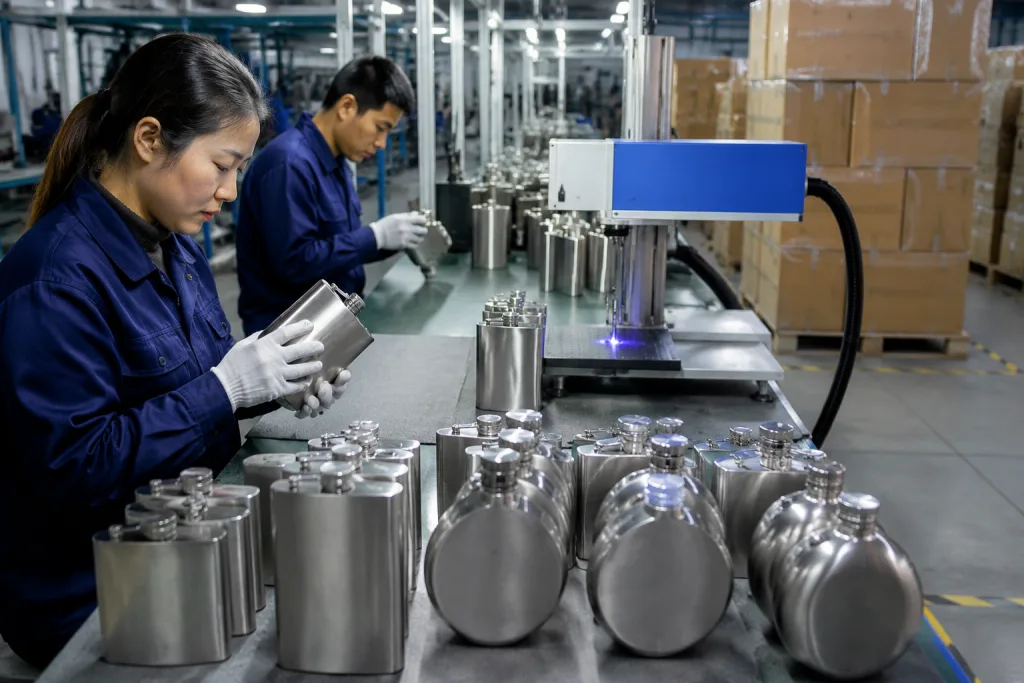
Logo decoration is where buyers over-spec the order. A flask does not need every method on the sheet; it needs the one that survives the channel. For a vendor alcohol flask packed for retail, laser engraving is usually the cleanest call. It leaves no ink migration risk, runs well on brushed stainless, and still looks sharp after the box gets handled in transit. On our line, the CO2 laser holds about ±0.2 mm on the logo path when the body curve is mild.
Screen printing fits better when you want a one- or two-color logo and need to keep the unit cost down. On a standard 6 oz flask, a one-color print usually adds about USD 0.08–0.18 per unit FOB China, depending on artwork size and order volume. Laser engraving sits around USD 0.12–0.35 per unit. UV print handles gradients and promotional artwork, but curved surfaces need a proper jig, and QC pulled the sample if the logo edge bled more than 0.3 mm. The buyer flagged that fast.
For a canteen customized or customizable growler program, the decoration area is larger, so the math changes. Big UV prints look strong online, but they can scratch when the product rides in an outdoor gear bag with bottle openers and keys. Laser logos look more restrained, yet they hold up better for distributor drinkware that may sit in a warehouse for 60 days or more. Embossed or debossed metal badges are possible, but the MOQ jumps to 3,000–5,000 units because mold and assembly setup eat time and money. That is the wrong question to ask if the customer only wants a short run.
Ask for a decoration proof on the actual finish, not a PDF. A black matte coat, brushed steel, and copper PVD all throw the same logo differently under factory lights. In our Zhejiang sample room, we usually turn pre-production samples in 5–7 days for standard shapes. For custom mold canteen factory work, first samples may take 15–25 days because tooling checks and fit tests come first. We ship better once the proof is on the real body.

Set the quality gate early
Quality control for a vendor alcohol flask should feel boring. Drama at final inspection usually means the PO left room for guessing. Put the inspection method straight into the purchase order: AQL level, leak test time, visual defect limits, coating adhesion, carton drop test, and barcode scan check if the product goes to retail or FBA-style distribution. We once had QC pull 32 samples because the PO said “normal scratches accepted” but gave no viewing distance. Bad wording. Use 30 cm viewing distance under a D65 light box, and the argument disappears.
For most B2B flask and canteen manufacturer orders, we run AQL II with critical defects at 0, major defects at 2.5, and minor defects at 4.0. Critical defects include leaking, sharp edges, wrong material, strong odor, and contamination inside the body. Major defects include wrong logo placement at more than 1.5 mm off the approved artwork, visible dents, bad cap fit, color mismatch beyond approved sample, and retail box damage. Minor defects include light scratches outside the approved viewing distance, small print specks, or slight carton scuffs. The buyer often asks, “Can we inspect less to save cost?” Wrong question. One leaking flask in a 24-piece retail carton costs more than the inspection fee.
Every production batch needs a 100% leak test. No shortcut here. For alcohol flasks, we prefer water filling plus cap inversion for 30 minutes because it catches poor thread engagement and gasket problems before the line packs the goods. Vacuum tests work better for insulated drinkware, but most flat flasks are single-wall. For custom canteen and customized canteen products with screw caps, add torque testing with a digital torque meter. A cap that feels tight at the bench may loosen after 18 days on the water plus truck vibration from Ningbo port.
Packaging needs its own pass or fail rules. A gift box can look fine on the sample table and still fail a 76 cm carton drop. If you sell through canteen vendors or regional distributors, cartons can be handled 8–12 times before reaching the final account. Use 5-ply export cartons for heavier growlers and keep gross carton weight under 15 kg where possible. Last quarter, our packing line found corner crush on 7 cartons after a drop test because the insert was 1.2 mm too thin. Zhejiang factories ship large volumes out of Ningbo and Shanghai, but port convenience does not fix weak carton design.
Know the real cost stack
FOB is not the quote. For a vendor alcohol flask, we ask the merchandiser to split unit price, mold or jig charge, logo setup, sample cost, packaging, China inland freight if excluded, and testing fees. Last month QC pulled a 6 oz flask sample where the PO said “laser logo,” but the quote hid a USD 85 logo fixture charge in the tooling line. If one supplier sends one soft number, the math does not work against another canteen factory quote.
For reference, we run a standard 6 oz 304 stainless flask with brushed finish, laser logo, and white box at about USD 1.25–2.10 FOB China for 3,000 units, depending on steel thickness and cap construction. A painted retail gift set with funnel and color box often sits at USD 1.85–3.20, and the color box alone can add 18–28 mm to carton height. A 32 oz custom growler spreads wider, often USD 4.80–9.50 FOB, because body forming, cap style, insulation, and coating all move the cost fast.
MOQ is not just sales policy. It starts at the coil rack, powder coating booth, printing jig table, and carton supplier. BottleForge generally accepts 1,000 units per SKU for existing flask and canteen customizable models, 2,000 units for custom color coating, and 3,000 units or more for new molds. Some canteen manufacturers will take 500 units, but we have seen the unit price jump 20–40%, and the line will push that order behind a 12,000-piece program.
Freight can fool the buyer. A small flask packs well; retail gift boxes eat container space. Ocean freight is usually the right call for 3,000+ units when your launch calendar can take 30–35 days on water plus inland trucking. Air freight works for 300 urgent samples or a small reorder, but it can wipe out the margin on distributor canteen programs. Before approving the quote, ask for carton size, gross weight, and HS code; one buyer flagged a 2 kg carton weight error that changed the DHL estimate by USD 420.
Pick suppliers by evidence
A canteen supplier does not win the order by saying yes to every line on the RFQ. They need to show how the flask moves from CAD drawing, hand sample, tooling sign-off, press forming, leak test, packing, inspection, then export booking. When you compare canteen suppliers in China, ask for proof on the table: BSCI or Sedex status if your retailer needs it, ISO 9001 process documents if they have them, 2 recent inspection reports showing actual defects, and photos from the line with the date card visible. QC should be able to pull a sample and measure wall thickness with a digital caliper, not send the same 6 catalog pictures again.
Trading companies have a place for mixed gift sets. For repeat vendor alcohol flask business, you still need to know who controls the metal forming, mirror polishing, powder coating, and final packing. A direct canteen manufacturer should answer wall thickness, weld type, cap gasket material, and past defect rate in the same afternoon. We run this check on 304 stainless flask bodies before polishing; if the seam mark is still visible under the 600-grit belt, the line stops. A weak canteen vendor sends beauty shots and goes quiet when the buyer asks why 0.45 mm was quoted instead of 0.5 mm.
For distributor drinkware and distributor growler programs, reply speed matters because your customer may change artwork, carton marks, or delivery split 3 days before the PO is locked. Ask how many export sales engineers follow production, not how many salespeople sit on Alibaba chat. At BottleForge in Hangzhou, Zhejiang, our export team works with production planning directly; standard order status is updated at material arrival, logo approval, mass production start, inline inspection, and final inspection. We ship updates with photos from the packing table, carton weight, and the latest CBM, because one buyer once flagged a PO typo: “matte gunmetal” became “matte gray” and the math did not work for their bar-chain rollout.
References help. Product evidence helps more. Request a sample from the same mold, same finish, and same logo method, then test it like your customer will. Check cap fit after 24 hours with water inside. Rub the printed logo with a dry cloth and then with 75% alcohol if the application is bar or spirits related. Smell the inside after opening. If you are buying customizable drinkware for a premium account, skipping these checks is the wrong question to ask; QC pulled 12 samples last month where the logo passed tape test but failed alcohol rub after 30 seconds.
Build the RFQ like a contract
A strong RFQ saves more money than hard bargaining. It tells the canteen manufacturers what to cost out, so nobody quotes a cheap number based on missing specs. For a vendor alcohol flask, put capacity in ounces and milliliters, stainless grade, wall thickness target in mm, cap and gasket material, finish, logo method, logo size, packaging, carton marks, compliance market, inspection standard, Incoterm, destination port, and required delivery date. We once had QC pull a 6 oz sample that measured 5.7 oz to the brim; the buyer’s PO said “6oz” only, so the line had to stop while both sides argued usable volume versus full capacity.
If you need a canteen promotional set, spell out every part in the box: flask body, funnel, cups, sleeve, color box, insert card, barcode sticker, master carton, and pallet requirement. If you need FNSKU labels or retail barcodes, say so before sampling, not after the cartons are taped. For North American warehouse receiving, a missing label can trigger a USD 0.50–2.00 chargeback per unit even when the flask passes AQL 2.5. We ship these sets with a handheld scanner check at packing; if the barcode reads only on the flat sample but not on the curved sleeve, the buyer will flag it.
For custom drinkware and customized drinkware programs, attach artwork in vector format and state Pantone colors, not “same as picture.” For a custom growler or customizable canteen, add lid drawings or reference dimensions if the cap must fit an existing accessory; give the thread OD, pitch, and gasket compression target in mm. This is the wrong question to ask: “Can you match our old cap?” Send the cap. Our mold room uses calipers and thread gauges, but a photo from a retail listing will not protect the order.
Define approval points before anyone cuts steel or orders cartons. We run quotation approval, digital artwork proof, physical sample approval, pre-production sample if needed, inline inspection at 20–30% completion, and final inspection before balance payment. Payment terms vary, but 30% deposit and 70% before shipment is common for first orders from China. Once the relationship is stable, better terms can be discussed, but the first order should protect both sides with clear specs, measurable acceptance criteria, and a signed sample tag; we have seen one typo on a PO, “matte black” versus “matt black,” turn into 18 cartons of rejected stock.
Send your flask RFQ for a factory review
Share capacity, logo, market, quantity, and delivery date. We will return a practical FOB China quote with sampling and inspection notes.
Frequently asked questions
What MOQ should I expect for a vendor alcohol flask order?
For an existing stainless flask mold, a realistic MOQ is 1,000 units per SKU if you accept standard finishes and one logo method. For custom color coating, 2,000 units is more practical because coating lines need setup volume and color loss allowance. For a new shape, special cap, embossed badge, or fully customized canteen mold, plan on 3,000–5,000 units. Some canteen vendors may quote 500 units, but the FOB price often rises 20–40%, and sample-to-production consistency can suffer. If you are testing a distributor canteen or canteen promotional program, start with an existing shape and spend your budget on better packaging and inspection instead of tooling.
Is 304 stainless steel necessary for alcohol flasks?
For most B2B alcohol flask programs, yes, 304 stainless steel is the safer default for all liquid-contact parts. It has better corrosion resistance than 201 stainless, especially when alcohol sits in the flask for days or when the product is washed repeatedly. 201 stainless can reduce unit cost by around 8–15%, but it creates more risk for odor, staining, and customer complaints. If your item is purely decorative, 201 may be discussed, but for functional custom drinkware it is not where I would save money. Ask your canteen manufacturer to state the steel grade on the quotation and keep material certificates with the production file.
Which logo method is best for a spirits brand promotion?
Laser engraving is usually best for a vendor alcohol flask when durability and a premium look matter. It works well on brushed stainless and PVD finishes, and it avoids ink adhesion issues. For high-color spirits branding, screen print or UV print may be better, but you should test rubbing resistance, especially if the product will be handled in bars where 75% alcohol cleaners are common. A one-color screen print may add about USD 0.08–0.18 per unit, while laser engraving often adds USD 0.12–0.35 depending on size. For canteen promotional orders, approve a physical decorated sample before mass production, not just a digital mockup.
How long does production take from China to my warehouse?
For standard flask or canteen customizable models, sample preparation usually takes 5–7 days after artwork confirmation. Mass production is typically 25–40 days after sample approval and deposit, depending on finish, packaging, and order size. Ocean freight to North America or Europe commonly adds 25–35 days port-to-port, plus inland transport and customs clearance. Air freight can arrive in 5–9 days but is expensive for heavy customized drinkware or growlers. If your launch date is fixed, work backward from warehouse delivery, not vessel departure. For a first order, add at least 7 days of buffer for inspection findings, label changes, or carton revisions.
What should I inspect before paying the balance?
Before balance payment, inspect against the approved sample and purchase order. Use AQL II with critical defects at 0, major at 2.5, and minor at 4.0 for most distributor drinkware orders. Check 100% leak testing records, cap fit, inside cleanliness, odor, logo position, coating adhesion, color match, barcode readability, gift box condition, carton strength, and carton marks. For a custom growler or customized canteen, add torque checks on lids and drop testing for packed cartons. Ask for inspection photos of defects, not only passed units. A serious canteen supplier should accept clear inspection standards before production starts, not debate them after goods are packed.