Key Takeaways
- A 5,000-piece vacuum bottle order usually needs 35-45 days after artwork and sample approval
- Use AQL 2.5 for major defects and AQL 4.0 for minor defects unless your retailer requires tighter limits
- 304 stainless steel at 0.45-0.55 mm outer wall thickness is a practical starting point for mid-market bottles
- Confirm carton drop test, FNSKU or barcode placement, and REACH/FDA/LFGB needs before mass production
You are not buying a bottle. You are buying a shipment that has to leave Ningbo on the booked ETD, pass AQL 2.5, match the signed PPS, and avoid chargebacks from retailers. We see buyers miss this on about 6 out of 10 new vendor checks. A low quote looks nice on the spreadsheet; the wrong question is “what is your best price?” Ask who controls the order file, carton mark, logo position in mm, and inspection limit sample. QC pulled one sample last month because the laser logo sat 3 mm off the approved artwork. Small miss. Big argument.
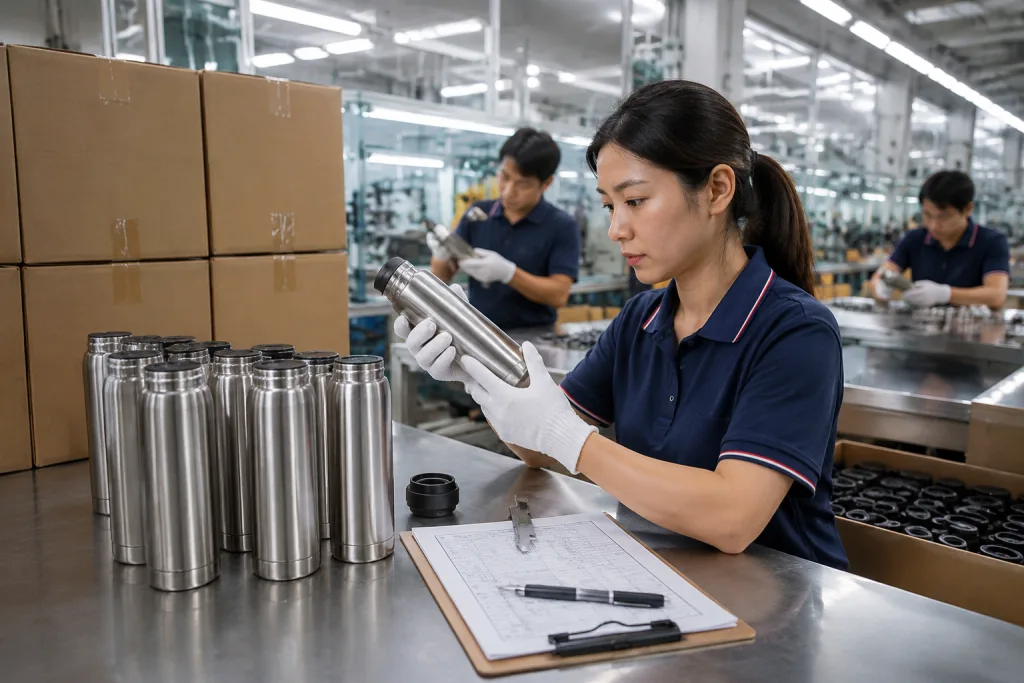
Take one real order: 5,000 pieces of 750 ml stainless steel vacuum bottles for a European outdoor distributor. BottleForge Industrial runs production in Hangzhou, Zhejiang, China, with a typical MOQ of 1,000 pieces per color and monthly capacity around 600,000 units. On the line, we check cup body height with a digital caliper, run the vacuum test before powder coating, and weigh random cartons at 11.8 kg against the packing list. The buyer once flagged a PO typo: “matte black” on page 1, “satin black” on page 3. That kind of detail decides whether the order ships in 28 days or slips to 35 days. The numbers below are the ones to settle before you pay a deposit.
Start with the buying situation
Say you are a canteen distributor selling into outdoor retail accounts in Germany, the Netherlands, and Canada. You need one 750 ml bottle with matte powder coating, laser logo, individual kraft box, and master cartons that can survive pallet shipping. The landed-cost target is tight. So you send 6 vacuum insulated bottle vendors in China the same RFQ and ask for FOB Ningbo pricing.
Good start. Still thin. A canteen supplier cannot quote cleanly without steel grade, lid construction, insulation target, carton strength, and the compliance market. We see this go sideways when the buyer sends only a photo and “same as this” in the email. A cheap canteen vendor may answer in 20 minutes because they priced the lowest passable build: thinner stainless steel, lighter lid, basic coating, and no special test reports. QC pulled one sample like this last season; the outer wall measured 0.38 mm on the micrometer, not the 0.50 mm the buyer thought they were getting.
For this case, we would set the working specification as 304 stainless steel inner and outer body, 750 ml capacity, double-wall vacuum insulation, 0.50 mm outer wall, 0.40 mm inner wall, copper lining optional, PP lid with silicone sealing ring, and powder coating at 60-80 microns. That is a practical custom drinkware spec for distributor drinkware programs where the bottle needs a solid handfeel without adding dead weight. On the line, we run coating thickness checks with a digital film gauge; 45 microns looks fine in photos, but it scratches faster in carton rub testing.
At BottleForge in Zhejiang, we price this kind of canteen customized order from a confirmed technical sheet, not only a photo. For 5,000 pieces, a realistic FOB China range might be USD 4.20-5.60 per piece depending on lid, coating, box, and logo method. The buyer flagged this exact point on a PO once: “kraft box” was typed, but they expected 350 gsm paper with an E-flute insert, while the quote used a lighter white-card insert. The math doesn't work if the packaging spec is fuzzy. If you ask for a custom growler or customized growler at 1.9 L, the price and carton volume change sharply, so do not use bottle pricing as a proxy for growler pricing.
Turn the idea into specs
The first control document should be a plain product specification sheet. It does not need design work. It needs zero guesswork. We like buyers who lock decisions early because one missing line on a spec sheet can turn into 2 extra samples, 12 days vs 18 days, and a fight after AQL 2.5 inspection.
For a custom canteen or customizable canteen, write the capacity tolerance, body diameter, total height, mouth opening, finish, logo size, logo position, packaging, and compliance requirements with numbers the line can check by caliper. For example: 750 ml ±3%, body diameter 78 mm, height 285 mm, mouth 45 mm, matte black powder coat, laser engraving 45 x 28 mm centered opposite the seam, individual kraft box with EAN sticker, 24 pieces per export carton. Small detail, big result. We once had a PO typo showing 75 mm body diameter instead of 78 mm, and QC pulled the sample before tooling because the carton insert no longer fit.
Logo method matters. Laser engraving is durable and clean for stainless surfaces. Silkscreen can hit a Pantone color, but we run 3M tape and abrasion checks on powder coating before approving bulk. Heat transfer gives more detail, adds cost, and raises setup risk. For canteen promotional projects, buyers often choose silkscreen to match a campaign color, then regret it when the buyer flagged scratches after 50 rubs with a wet cloth. If the bottle is for retail, I usually push buyers toward laser or one tested color print. The math doesn't work if the logo looks good on day one and fails at receiving inspection.
Packaging also needs engineering. A canteen factory can make a good-looking box that collapses during ocean freight if the board is too thin. For North American distributor canteen orders, we normally recommend 350-400 gsm paperboard for individual boxes and a 5-layer export carton when the carton exceeds 12 kg. The carton tester tells the truth. If the shipment goes to Amazon FBA or a 3PL, confirm FNSKU, suffocation warning if polybags are used, carton labels, and maximum carton weight before production starts; we have seen a 16.8 kg carton rejected because the buyer's routing guide capped it at 15 kg.
This is where customizable drinkware becomes operational, not decorative. Every customization changes at least one factory step: unit cost, sample timing, QC gauge, or packing line speed.
Sample approval is not decoration
We still see about 6 buyers out of 10 approve a sample with, “Looks good.” That is not sample approval; that is a mood. A proper approval checks the sample against the PI, artwork file, carton mark, and last signed spec sheet. For a canteen customizable program, approve each point separately: function with a 30-minute leak test, appearance under the light box, logo size in mm, color against the swatch, packaging fit, and labeling text. We had one PO where “matte black” was typed as “mate black.” QC pulled the sample before the line started.
Pre-production samples usually take 7-12 days after artwork confirmation if existing molds are used. A new lid mold or unusual body shape can add 20-30 days. For a standard 750 ml stainless bottle from a China canteen manufacturer, the key sample checks are practical: fill volume with a graduated cylinder, lid fit with the silicone ring seated flat, leak test after inversion for 30 minutes, coating feel, logo edge sharpness under a 10x loupe, box fit, and barcode scan. Simple checks catch expensive trouble.
Color approval is where customized drinkware orders often slow down. A Pantone number is not a physical finish. Matte powder coating, glossy paint, and plastic lid parts reflect light differently, so the same “PMS 485C” can look like 2 colors on one bottle. If color is critical, ask for a sprayed color plate and approve it under D65 lighting. The buyer flagged this once on a 5,000-piece red bottle order after retail photos looked off-brand; the math does not work when rework costs more than the color plate.
For insulation, set a test method. We run a common internal check with 95°C water filled to nominal capacity, lid closed, room temperature 20°C ±2°C, then record temperature after 6 hours and 12 hours using a probe thermometer. A mid-range vacuum bottle should often hold above 65°C after 6 hours, depending on shape, mouth size, and copper lining. Wide-mouth custom growler products lose heat faster than narrow bottles, so copying one benchmark across all SKUs is the wrong question to ask.
Approve the sample with written tolerances, not memory. Your inspector cannot reject a defect that was never defined on the sheet.

Price the order like freight exists
FOB price is one line on the worksheet. A canteen supplier quoting USD 0.18 less per piece can still lose the order on landed cost if the master carton grows by 40 mm, the packing ratio is weak, or QC pulls 3 leaking samples from a 200-piece pre-shipment check. For 5,000 pieces of 750 ml bottles, we usually see around 11-14 cubic meters depending on box size and carton layout. Freight eats margin fast.
Ask each canteen vendor for the same cost breakdown: unit price, logo setup, sample fee, mold fee if any, inner box cost, carton size, pieces per carton, gross weight, CBM, payment terms, production lead time, and FOB port. Get it in writing on the PI, not buried in a WeChat message. In Zhejiang, FOB Ningbo is often cleaner for factories around Hangzhou; we run trucks there in about 3.5 hours when the warehouse releases before 10:00 a.m. Shanghai can work for some forwarders, but the math needs to include inland trucking, gate cut-off, and any extra warehouse handling.
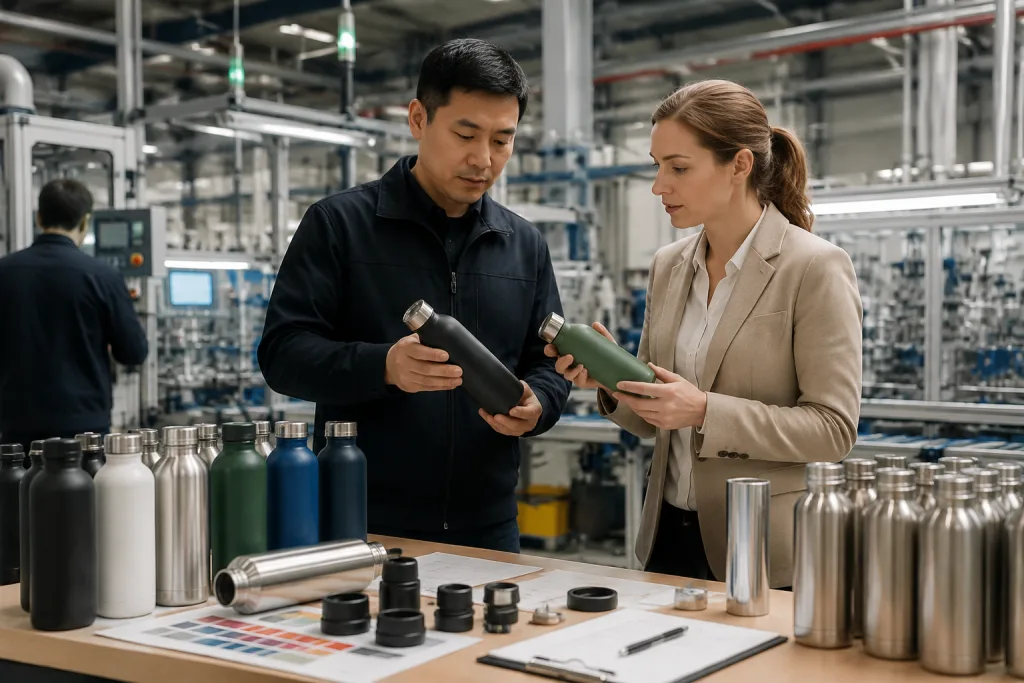
MOQ needs a sober conversation. For BottleForge Industrial, standard vacuum bottle MOQ is usually 1,000 pieces per color for existing models, 3,000 pieces for some special powder colors, and 5,000-10,000 pieces if a private mold or new lid assembly is required. Buyers ask for 300 pieces with 4 colors and 2 logos; we have seen this go sideways because the coating line still needs masking, jig setup, and a first-article color check under the D65 light box. Smaller orders can happen, but unit cost rises because coating, printing, packing, and line setup do not shrink neatly.
For distributor growler or customizable growler programs, carton volume matters even more. A 64 oz growler looks good in a catalog, then the buyer flags the landed cost after seeing 6 pieces per carton and a bulky foam insert. Before confirming a customized growler, ask for packed dimensions, gross weight, and carton drop-test method, then calculate landed cost per sellable unit instead of staring at FOB per unit.
A serious canteen manufacturer will not hide these numbers. If a vendor avoids carton data until after deposit, slow down and ask why; this is where 12 days of clean planning can turn into 18 days of freight and packing arguments.
Lock production before metal cutting
After the deposit lands, we do not cut metal until four files are locked: signed PO, print artwork, carton mark, and approved sample. Basic rule. Still, we see about 3 out of 10 canteen distributors ask to move a logo from 42 mm to 48 mm, edit box copy, or change label wording after 304 stainless coils are already booked. That is where orders get messy. The buyer flagged “matte balck” on one PO last spring, and QC pulled the sample before the line made 5,000 wrong cartons.
For this 5,000-piece order, a normal Zhejiang canteen factory schedule can run like this: 3-5 days for stainless steel material preparation, 7-10 days for forming and welding, 3-5 days for vacuum pumping and heat retention screening, 5-7 days for polishing and coating, 3-5 days for logo and assembly, then 3-5 days for final packing and inspection. Total production is usually 35-45 days after sample approval, depending on season and coating capacity. In peak months, the coating booth is the choke point; 12 color lots move slower than 4, and the math does not work if the buyer expects 18 days just because the launch date changed.
The hard steps are plain factory work. Body forming must hold wall thickness within spec, and our line checks it with a micrometer before welding. Welding must be clean enough to avoid weak seams. Vacuum pumping must stay stable. Coating must be cured correctly, usually around 180-200°C depending on powder system. Silicone rings must be food-grade and seated flat; a 0.5 mm twist can fail the leak test. A customized canteen that looks perfect but leaks at 2% is not acceptable for retail. We have seen this go sideways.
If your order includes mixed colors, ask how the factory separates WIP, accessories, and cartons. We run color-line cards on each pallet, not just a note in the ERP, because black lids on green bottles still happen when 6 SKUs share one packing table. A simple color-line plan prevents wrong barcodes on blue cartons. For canteen promotional campaigns with fixed launch dates, request production photos at forming, coating, logo, and packing stages. Photos do not replace AQL 2.5 inspection, but they catch obvious drift before it becomes a full shipment problem.
Inspect against retail risk
Final inspection needs AQL numbers, not trust. For most B2B custom drinkware orders, AQL 2.5 for major defects and AQL 4.0 for minor defects works as a baseline. Critical defects stay at zero. If a retailer wants tighter limits, put them on the PO before we start the line.
For 5,000 pieces, an inspector working to ANSI/ASQ Z1.4 general inspection level II may pull 200 units. On one run, QC found a 0.3 mm burr at the mouth rim and that lot was stopped. Critical defects cover sharp metal burrs, contamination inside the bottle, wrong food-contact material, and severe leakage. Major defects cover failed leak test, weak vacuum performance, wrong logo, coating peel, missing barcode, or wrong pack-out. Minor defects cover small dust points, slight color shift within tolerance, or light carton scuffs that still sell.
A solid QC checklist for vacuum insulated bottle vendors covers capacity check, appearance check, lid torque feel, 100% carton count, random leak testing, random heat retention testing, coating adhesion cross-cut test, barcode scan, carton drop test, and carton mark verification. For EU orders, ask for LFGB, REACH, and food-contact declarations. For the US, confirm FDA food-contact expectations and, for kids products, ASTM and CPSIA where relevant. One test report does not cover every market, and that is where buyers get burned.
Final inspection should happen after 100% of goods are finished and at least 80% packed. If you check too early, the packing team can still swap inserts or miss a barcode. If you wait until the container is sealed, you have no room to push back. On our floor, we usually inspect after the carton sealer runs for 2 hours and the buyer flagged it; vendors who resist that timing usually know the risk already.
Ship what you can receive
The last step is simple: make the shipment receivable. The warehouse, retailer, or marketplace must be able to identify, scan, count, and rack the goods without calling the buyer at 7 a.m. We see this fail on about 1 in 12 distributor drinkware orders, usually because a carton label, PO number, or color code does not match the receiving file. QC pulled one sample carton last month and the barcode scanned fine, but the printed SKU was missing the final “BK.” That is enough to stop a receiving line.
Before booking, confirm commercial invoice, packing list, HS code, carton count, gross and net weight, CBM, pallet requirement, shipping marks, and consignee details. If the goods go to an Amazon or 3PL warehouse, carton labels must match the routing guide exactly, down to label size and placement. If they go to a canteen distributor warehouse, ask whether cartons need item number, color, PO number, and barcode on two adjacent sides. We run a 100 mm label check on the packing table because buyers have flagged labels placed 20 mm too low for their scanner.
For this 5,000-piece order, choose loose cartons in a container for lowest freight, or palletized cargo for cleaner receiving. Pallets add cost and volume, often 8-15% more CBM, but they cut carton damage and reduce unloading labor at destination. The math does not work for every program. For premium custom canteen retail programs, palletizing usually pays back because crushed gift boxes trigger chargebacks. For price-driven canteen promotional orders, loose loading can pass if we use 5-layer export cartons, 12 kg max per carton, and the forwarder does not throw them like scrap.
Keep a golden sample, final inspection report, production photos, and shipping documents in one folder. Claims show up 60 days later, after the line has moved to the next PO and the operator who packed the first carton has forgotten the job. You need evidence. The best vacuum insulated bottle vendors make that evidence easy to retrieve, with carton photos, AQL 2.5 notes, and loading pictures tied to the PO. The weakest canteen vendors treat shipping as the end of responsibility. For a long-term sourcing program from Zhejiang or elsewhere in China, choose the factory that can repeat the order cleanly, not only the one that wins the first quote by USD 0.12.
Send your bottle spec before you quote
Share capacity, finish, logo, packaging, market, and target quantity. BottleForge will return a practical FOB China quote and production path.
Frequently asked questions
What MOQ should I expect from vacuum insulated bottle vendors?
For existing stainless steel bottle models, expect 1,000 pieces per color as a practical MOQ from many China factories. Special powder coating, custom lids, or retail gift boxes often push the MOQ to 3,000 pieces. Private molds can require 5,000-10,000 pieces because tooling, trial runs, and material purchasing need scale. If a canteen factory accepts 300 pieces with full customization, check whether it is using stock goods, subcontracted printing, or a trading inventory model. Small MOQs are not automatically bad, but they usually mean higher unit cost and less control over color, logo position, and packaging.
How long does a customized canteen order take?
For an existing model with laser logo and standard packaging, plan 7-12 days for sampling and 35-45 days for mass production after approval. Add 5-10 days if you need a special color match, because coating plates and adjustments take time. Add 20-30 days for a new lid mold or unusual custom canteen body. Ocean freight to Europe or North America can add 25-45 days depending on port and season. A safe retail launch calendar should include inspection time, booking time, customs clearance, and warehouse receiving, not just factory production.
Which defects should I treat as critical in QC?
Treat food safety and user safety defects as critical with zero tolerance. Examples include sharp burrs on the mouth, metal contamination inside the bottle, non-food-grade silicone, severe leakage, broken lid components, and strong chemical odor. Major defects usually include wrong logo, failed heat retention, coating peeling, wrong barcode, missing accessory, or incorrect carton marks. Minor defects include small cosmetic marks within your approved limit. For a 5,000-piece order, many buyers use ANSI/ASQ Z1.4 level II with AQL 2.5 major and 4.0 minor, but retailer requirements should override your default.
Is laser engraving better than printing for promotional bottles?
Laser engraving is usually safer for stainless steel vacuum bottles because it is permanent, clean, and does not rely on ink adhesion. It works well for corporate logos, outdoor brands, and distributor canteen programs where durability matters. Printing is better when you need exact brand colors or large artwork, but it needs adhesion testing, rub testing, and clear color tolerance. For canteen promotional orders, one-color printing can be cost-effective at 3,000-5,000 pieces. For premium customized drinkware, I would choose laser unless the brand guide requires printed color.
What compliance documents should I ask canteen suppliers for?
Ask based on destination market. For EU sales, request food-contact declarations, LFGB testing where required, and REACH screening for coatings and accessible materials. For the US, ask for FDA food-contact suitability for stainless steel, PP, and silicone parts. If the product is for children, discuss CPSIA, ASTM, lead, cadmium, and small parts risk. If your company audits factories, ask for BSCI, Sedex, or ISO 9001 status, but remember that audit documents do not replace product testing. Match the test report to the exact material, coating, lid, and color you are buying.