Key Takeaways
- For most custom drinkware projects, realistic MOQ starts at 1,000 units per color and 3,000 units for new mold parts
- A good vacuum test target is less than 5 percent temperature drop variance across random checked samples
- Typical FOB Ningbo pricing runs from USD 3.20 to USD 8.80 depending on capacity, coating, lid, and packaging
- Plan 7-10 days for samples and 35-50 days for bulk production after deposit and artwork approval
You are not just buying a bottle. You are buying a repeatable retail product, a promotional SKU, or a distributor line that has to survive a 1.2 m drop test, dishwasher questions, logo claims, and margin pressure. We’ve seen this go sideways: QC pulled 32 samples from a 3,000 pcs run and found 5 caps weeping at the silicone ring after the pressure test. A vacuum insulated bottle vendor can look strong on a website and still miss on weld consistency, cap leakage, carton strength, or artwork approval that slips from 2 days to 7 days.
From our factory base in Zhejiang, China, we see the same issue on about 6 out of 10 new RFQs: buyers compare only capacity and FOB price. That is the wrong question to ask. A 500 ml office bottle, a 1.9 L custom growler, and a canteen promotional item do not run on the same line settings; the body gauge, lid thread depth in mm, powder coating, and AQL 2.5 checks need to match the job. The right vendor match starts with the use case, not the catalog photo.
Spec Table Before Supplier Shortlist
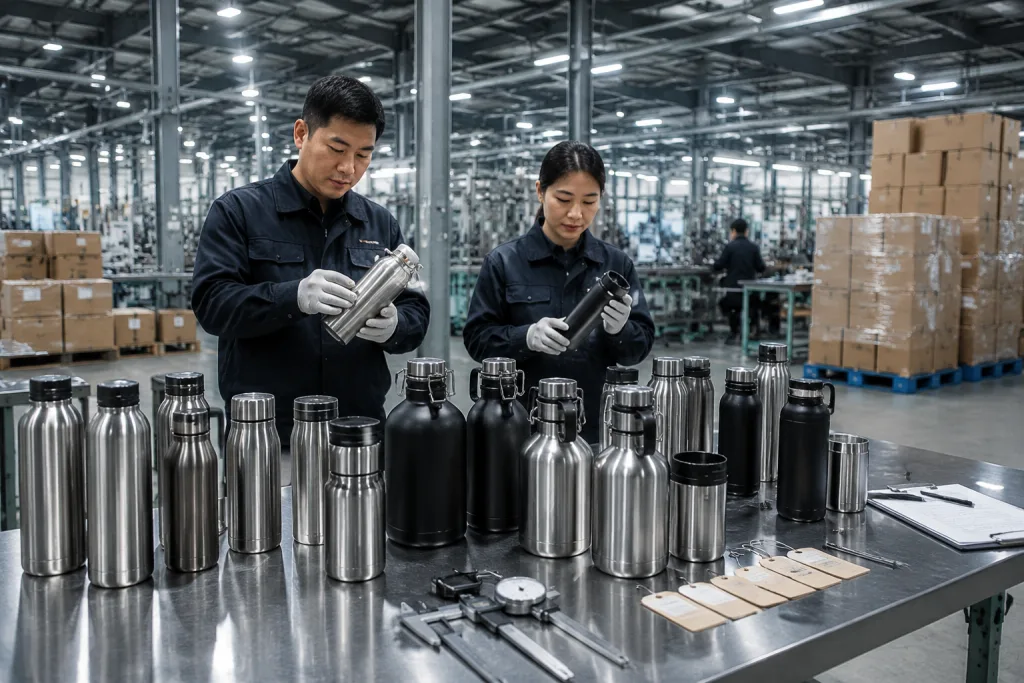
Put each vacuum insulated bottle vendor on the same spec sheet before you shortlist. If the quote only reads “304 stainless steel, keeps hot 12 hours,” push back. We see that line copied from old Alibaba files, and QC cannot check it without inner/outer steel grade, wall thickness, lid drawing, coating method, and test condition. Last month QC pulled the sample with a 0.38 mm inner wall against a PO that said 0.5 mm. Different bottle.
| Use case | Common size | Body spec | Best lid type | Typical FOB China | Good fit |
|---|---|---|---|---|---|
| Retail daily bottle | 500-750 ml | 0.4-0.5 mm 304 inner, 201 or 304 outer | Screw cap or sip lid | USD 3.20-5.60 | Brand owners; distributor drinkware lines with carton drop-test requirements |
| Outdoor canteen custom project | 800-1,200 ml | 0.5 mm outer shell, powder coating | Carry handle or straw lid | USD 4.30-7.20 | Camps and outdoor retail programs that need grip, strap clearance, and 24-hour leak checks |
| Custom growler | 1.2-1.9 L | Thicker shoulder, wider mouth | Threaded leakproof cap | USD 6.80-11.50 | Beverage brands; distributor growler buyers asking for stronger threads and thicker cartons |
| Promotional canteen | 500-900 ml | Cost-controlled 201 outer, 304 inner | Simple screw cap | USD 2.90-4.80 | Events and loyalty campaigns where MOQ, logo cost, and delivery date matter more than premium coating |
This table does not replace sampling. It is a gate. If a canteen supplier quotes a 1,000 ml powder-coated bottle at USD 2.10 FOB with full custom box and laser logo, the math doesn't work. We would check steel thickness with a micrometer, run a 95°C hot-water hold test, and ask for the coating report before opening the mold discussion. In Zhejiang, China, a price that low usually means thinner steel, weak vacuum yield, soft coating, missing compliance paperwork, or a PO typo like “201 inner” that nobody wants to catch after mass production.
Where Each Bottle Type Wins
The strongest vendor is not always the cheapest canteen factory. It is the factory that can match the bottle construction to the shelf, the promo brief, and the abuse level. An outdoor-store distributor canteen needs dent resistance; a 7-day corporate giveaway does not. For a premium retail brand, a canteen customizable program needs smoother powder, Delta E color control within about 1.0, and packaging that survives 5-layer pallet stacking. We had one buyer flag corner crush after a 620 kg pallet sat in Ningbo warehouse for 9 days. Fair pushback.
For daily retail bottles, we usually run 500 ml, 600 ml, or 750 ml. Those sizes sell cleanly to office, gym, and commuter buyers. They fit standard cup holders better than most 1 L bottles, and a 24 pcs master carton stays easier for warehouse staff to lift. If you are building a custom drinkware range for Europe, 500 ml and 750 ml usually move faster than odd sizes like 680 ml unless your channel data proves otherwise. QC pulled 32 samples last month for a 750 ml commuter order; the only buyer comment was a lid logo 1.5 mm off center.
For outdoor and school programs, a custom canteen or customized canteen with a handle lid makes more sense. Pretty curves are the wrong question to ask here. The buyer cares about grip, cap retention, and scratch resistance after the bottle bangs around in a backpack. Powder coating at 60-80 microns is a sensible target. Below 50 microns, we see early wear around the base ring after a 3M tape pull and 48-hour rub test. Above 90 microns, the math gets worse and the thread fit needs checking with a go/no-go gauge.
For beverage, brewery, and camping channels, a customizable growler or customized growler should be treated as its own product, not a stretched bottle. Wider mouths, reinforced shoulders, and stronger sealing gaskets matter because 64 oz bodies hit each other hard in transit. A distributor growler buyer should ask for carton drop-test results, especially if the inner dividers are under 3 mm E-flute. We have seen this go sideways: 18 cartons looked fine outside, then QC opened them and found shoulder dents where weak dividers folded during the 76 cm corner drop.
Vendor Capability Beats Catalog Size
A thick catalog can cover up thin engineering. We see this a lot. When you check canteen manufacturers or canteen vendors, ask what they run inside their own plant: body forming, TIG welding, vacuum, powder coating, lid assembly, or only final packing. Some vendors assemble caps, send coating to a shop 18 km away, and buy finished bodies from another canteen manufacturer. That is not a deal killer, but the control points move. Lead time moves too. The buyer flagged this once after QC pulled 32 bottles with shade drift between the body and cap ring.
At BottleForge Industrial in Hangzhou, Zhejiang, our current insulated drinkware capacity is about 300,000 units per month across bottle, tumbler, and growler lines, with standard MOQ at 1,000 units per color for existing molds. New mold development usually starts at 3,000-5,000 units depending on the cap, shoulder, and body geometry. These numbers decide line priority. A 1,000-piece repeat color can fit into a 12-day slot, while a new shoulder mold with a silicone carry cap is closer to 18-25 days before PP sample approval. The math does not work if a vendor promises custom tooling, new coating, retail box artwork, and shipment in 10 days.
Ask the vendor for a process map. For vacuum insulated bottles, the key steps are tube cutting, water expansion or stretching, welding, vacuum brazing, polishing, coating, logo application, assembly, and leak testing. The line should know where vacuum loss gets caught, not just say “we inspect everything.” On our side, QC uses a vacuum tester and hot-water hold check, then records failures by weld seam, base joint, or mouth area in the inspection sheet. If a canteen factory cannot point to that station, this is the wrong question to ask: catalog size will not protect your PO.
Ask about artwork workflows too. For canteen customized orders, delays usually start with a missing Pantone code, a 72 dpi logo, or packaging files sent after the sample is already approved. A practical vendor should send a dieline within 24-48 hours, a digital mockup before sampling, and a pre-production sample before bulk if the logo position or coating color is new. We have seen this go sideways from one typo on a PO: “matte black” on the order, “gloss black” in the email thread. For North America, if you need FNSKU labels or Amazon carton marks, confirm it before production, not after final inspection.

Price Lines You Should Challenge
FOB price needs a real breakdown, not one lump number. Stainless steel grade, capacity, lid material, coating, logo method, and packaging all move the quote; ask for the weight in grams, coating type, and box spec on the same line. If two canteen suppliers are 25 percent apart on the same drawing, this is the wrong question to ask: “Who is cheaper?” Ask what they changed. We had one buyer flag a USD 0.42 gap, and QC pulled the sample with a digital caliper—the outer shell was 0.38 mm, not the 0.45 mm shown on the drawing.
For example, a 750 ml double-wall bottle with 304 inner steel, 201 outer steel, powder coating, one-color silkscreen logo, and white box might quote around USD 3.80-4.60 FOB Ningbo at 3,000 units. Change to 304 outer steel and laser engraving, and you may add USD 0.35-0.70. Add a retail color box with insert and barcode, and another USD 0.25-0.55 is normal. A premium straw lid with Tritan or PP components can add USD 0.40-0.90 depending on structure. On our line, the laser station also slows output by about 900 pcs per shift versus silkscreen, so the math changes again when the logo wraps around the bottle.
Be careful with “same as sample” language. Too loose. If your approved sample has 0.5 mm outer wall thickness and the purchase order does not state it, a weak vendor may ship 0.4 mm to protect margin. That difference is not obvious in photos, but it shows up in dent complaints. We’ve seen this go sideways after a PO typo changed “0.50 mm” to “0.5 m”; the factory knew what the buyer meant, but nobody wanted to pay for the heavier coil when the price was already locked.
For promotional programs, cost control is valid. A canteen promotional project may not need 304 outer steel or gift packaging. Do not cut the gasket, vacuum test, or coating adhesion checks. Saving USD 0.12 on a lid seal is a poor trade if 2 percent of cartons generate leakage complaints. For distributor drinkware, replacement handling usually costs more than the original saving; one 1,200-unit order cost the buyer 18 days in replacement sorting because the line skipped the 24-hour inverted leak test.
Compliance And Inspection Reality
Compliance is not one certificate. It depends on the sales market and every part that touches the drink. For Europe, buyers usually ask us for LFGB, REACH, and food-contact declarations. For the United States, FDA food-contact compliance and California Proposition 65 screening come up often, especially after the buyer’s legal team reviews the spec sheet. Kids’ bottles are tighter. Age grading, paint, bite valves, and small cap parts can trigger ASTM or CPSIA-related checks; last month QC pulled a 480 ml kids’ sample because the straw plug failed the small-parts gauge.
A reliable vacuum insulated bottle vendor should keep material tests separate from factory audits. BSCI, Sedex, or ISO 9001 cover management systems and social compliance. They do not prove a silicone gasket passed food-contact testing. Match every test report to the BOM: 304 stainless body, PP cap, silicone gasket, coating, ink, and straw parts if the design has them. We run this check before mass production because we have seen buyers flag a PO where the cap was listed as PP, but the supplier report showed Tritan.
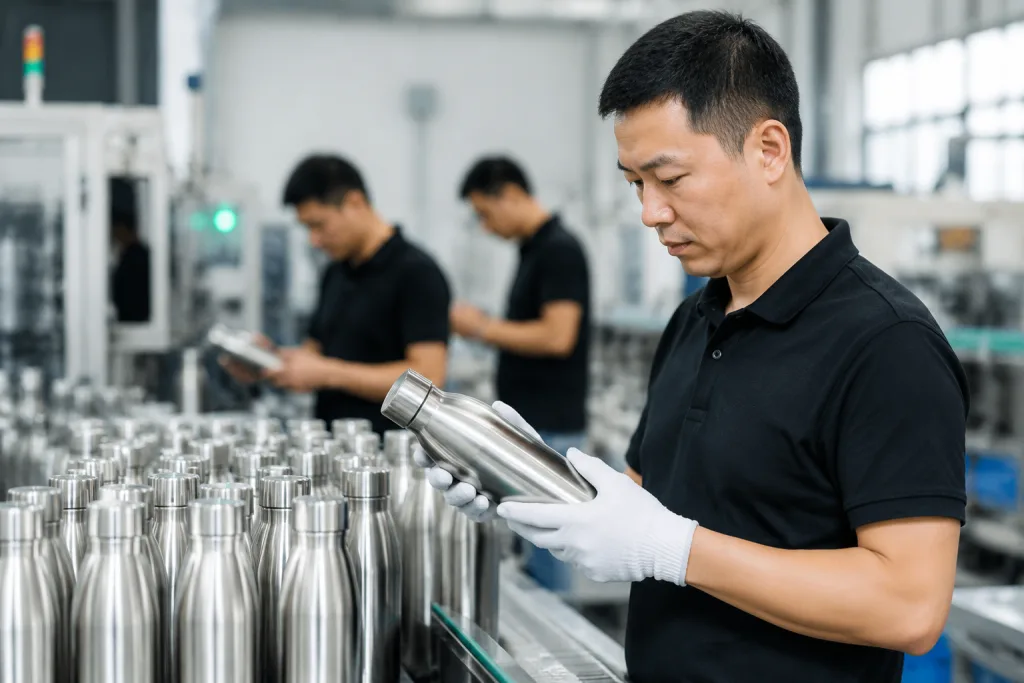
Inspection belongs in the purchase order, not in a WeChat message after the line is packed. For most B2B orders, AQL Level II with critical defects at 0, major at 2.5, and minor at 4.0 is a workable starting point. Critical defects include leakage, sharp edges, contaminated interiors, wrong material, or unsafe cap fit. Major defects include poor logo registration, coating chips, serious dents, wrong color beyond approved tolerance, and failed barcode scans. The buyer may push for 100% inspection, but on a 10,000 pcs order the math often works better with clear AQL rules plus a 30 pcs pre-shipment function check.
Vacuum performance checks should be simple and repeatable. We fill samples with hot water at 95°C, check outer wall heat transfer after 3-5 minutes with an infrared thermometer, then record retained temperature after 6 hours or 12 hours based on the claim. Touching the bottle wall is not testing. For larger customized growler orders, we sample more units because weld length and vacuum yield risk go up with body size; on 1.9 L growlers, the line usually needs extra pull tests around the bottom weld before packing.
Use-Case Fit For Distributor Programs
Distributors need fewer surprises than brand owners because you are selling the same bottle into 4 or 5 customer types at once. A canteen distributor may ask one SKU to cover corporate gifting, outdoor clubs, school events, and small retail shelves. That pushes us toward running stable existing molds, neutral powder colors, and logo methods with low setup risk. We’ve seen this go sideways when a buyer adds a new lid after the PP sample; QC pulled the sample, and the lid gasket sat 0.8 mm proud.
For canteen distributors and distributor canteen programs, the safest starting range is still three sizes: 500 ml, 750 ml, and 1,000 ml. Keep two lid options: a screw cap and a straw or flip lid. Six lids sounds good in a catalog. The math doesn't work if your warehouse team is picking spare straws, silicone rings, and mixed inner boxes from 3 pallets at 5 p.m. We run carton labels with size, lid code, and color code printed together because one typo on a PO can turn 750 ml black screw caps into 750 ml black straw lids.
Customizable drinkware still needs boundaries. Offer 6-8 standard powder colors instead of 30, and keep the Pantone match for accounts that can meet the MOQ. Offer laser engraving and one-color silkscreen first; use UV print only when the order value covers the fixture, film, and setup time on the line. A canteen customizable program works best when the base product is fixed and the decoration changes. If every account changes the cap, coating, box, and insert, lead time moves from 25 days to 38 days fast.
For distributor growler projects, freight decides the margin. A 1.9 L insulated growler can look profitable at FOB level, then lose money after ocean freight, warehousing, and parcel shipping. Ask for master carton dimensions before you quote your customer. We ship samples in a 6-unit test carton first if the filled carton is over 18 kg, because 12 large growlers per carton often come back with corner crush marks after the drop test. This is the wrong question to ask: “What is the unit price?” Ask what one sellable carton costs landed.
How To Run First Order
Your first order with a canteen supplier should prove the supply chain, not carry every decoration idea from the brand deck. Start with an existing mold, one or two colors, and one logo method. Keep it boring. On our line, that usually means a 500 ml or 750 ml body we already run, a powder coat matched by Pantone card under a D65 light box, and one laser or silk-screen logo checked at 0.2 mm tolerance. If the product sells, add the custom lid, silicone sleeve, or retail box in the second run.
A workable timeline looks like this: 2-3 days for quote and spec lock, 7-10 days for decorated samples, 3-5 days for sample review and revisions, then 35-50 days for mass production after deposit. Sea freight to Europe or North America can add 25-45 days depending on port, season, and route. Air freight works for urgent launch quantities, but the math often fails on stainless steel drinkware because a 12 kg carton does not carry enough retail value. We have seen buyers approve samples on day 12, then lose 6 days because the PO said “black” while the approved color chip was Pantone 426C.
Set the purchase order clearly. Include capacity, material grade, wall thickness target, coating type, Pantone or RAL color, logo size, logo position, packaging, carton marks, barcode or FNSKU requirements, inspection standard, and shipment term such as FOB Ningbo or FOB Shanghai. QC should not need to guess. Last quarter, QC pulled the pre-production sample because the artwork file showed a 38 mm logo, while the PO listed 35 mm and the carton mark had one digit missing in the SKU. If your buyer needs DDP pricing, ask for it as a separate line and confirm duty assumptions in writing.
The best long-term relationship is boring in a good way: stable drawings, honest defect reporting, predictable lead times, and no drama at final inspection. For a custom canteen, a canteen customized for a campaign, or a full customized drinkware line, choose the vendor that gives clear limits instead of soft promises. This is where we push back. If a supplier says yes to a new lid tool, 6-color retail box, 3 logo methods, and a 20-day ship date on the first order, we have seen that go sideways at AQL 2.5 final inspection. In China manufacturing, the supplier who says “no” to a risky shortcut is often protecting your brand more than the one who accepts every change on WeChat at 11 p.m.
Send Your Bottle Specs For A Practical Quote
Share capacity, material, logo, packaging, MOQ, and destination port. We will return a clear FOB quote with realistic lead time.
Frequently asked questions
What MOQ should I expect from a vacuum insulated bottle vendor?
For existing molds, a realistic MOQ is usually 1,000 units per color and 3,000 units per order if you want better pricing. For a new custom canteen body, new cap, or customized growler mold, expect 3,000-5,000 units minimum because tooling, testing, and production setup must be recovered. Some canteen vendors accept 500 units, but unit price is higher and color choices are limited. If you are testing a distributor drinkware program, start with one existing mold and one decoration method before paying for tooling.
How do I compare two canteen manufacturers quoting different prices?
Put both quotes into the same spec sheet. Compare steel grade, wall thickness, capacity tolerance, lid material, gasket material, coating thickness, logo method, packaging, AQL level, and FOB port. A USD 0.60 difference on a 750 ml bottle may come from 304 outer steel, thicker coating, or better packaging. It may also come from a canteen manufacturer leaving out testing or using a lighter body. Ask for sample weight in grams; it is a useful clue, though not a complete proof.
Which logo method is best for customized drinkware?
Laser engraving is durable and clean for stainless steel or powder-coated bottles, but it usually looks monochrome. Silkscreen is cost-effective for one or two colors and works well on canteen promotional orders above 1,000 units. UV print supports full-color artwork but needs careful adhesion testing, especially on textured coating. For retail custom drinkware, we often recommend laser engraving for premium lines and silkscreen for distributor canteen programs where price and repeatability matter more than photo-level artwork.
Can one canteen supplier handle Europe and North America compliance?
Yes, but only if compliance is planned before sampling. For Europe, ask about LFGB, REACH, and food-contact declarations. For North America, confirm FDA food-contact suitability and whether Proposition 65 screening is needed. If the bottle is for children, discuss CPSIA or ASTM-related requirements early. A canteen supplier should provide material-specific reports for stainless steel, silicone, PP, coatings, and inks. Do not rely on a factory audit certificate as proof that your exact customized canteen is compliant.
What lead time should I give my customer?
For a normal existing-mold vacuum bottle, quote 7-10 days for samples and 35-50 days for bulk production after deposit and artwork approval. Add 25-45 days for sea freight to Europe or North America. New molds, custom caps, complex retail packaging, or multiple colorways can add 15-30 days. If you are a canteen distributor with a fixed launch date, lock artwork, carton marks, and inspection requirements before deposit. Late FNSKU or barcode changes are a common avoidable delay.