Key Takeaways
- Specify vacuum performance as 95°C water, 24 hours, target above 45°C for 500 ml bottles
- Set logo artwork tolerance before mass production, not after 3,000 crooked prints arrive
- Use AQL Level II, 2.5 major and 4.0 minor, for normal drinkware inspection
- Expect 3,000 pcs MOQ for custom colors and 30-45 days production after sample approval
A vacuum insulated bottle supplier can look fine on a quotation sheet and still cause trouble after the first 5,000 pcs. We have seen weak vacuum hold, off-center logos, cap leaks, coating scratches, loose cartons, and missed ship dates turn into chargebacks and returns fast. If you buy custom drinkware for retail, promo, or distributor channels, this is not a small issue; it hits your margin and your buyer relationship in one shot. QC pulled a sample with a 0.3 mm lid gap last week. That bottle would have sailed through a pretty catalog photo and failed on the line.
BottleForge Industrial is based in Hangzhou, Zhejiang, and we work with canteen distributors, brand owners, and importers sourcing from China. Our view is blunt: most problems start as spec gaps, then show up as factory mistakes. A supplier can only build what you define, measure, and sign off. The wrong question is “who is at fault?” The better one is “what did the PO leave open?” The sections below break down the weak points and how to write a purchase spec before you pay the deposit.
The vacuum fails quietly
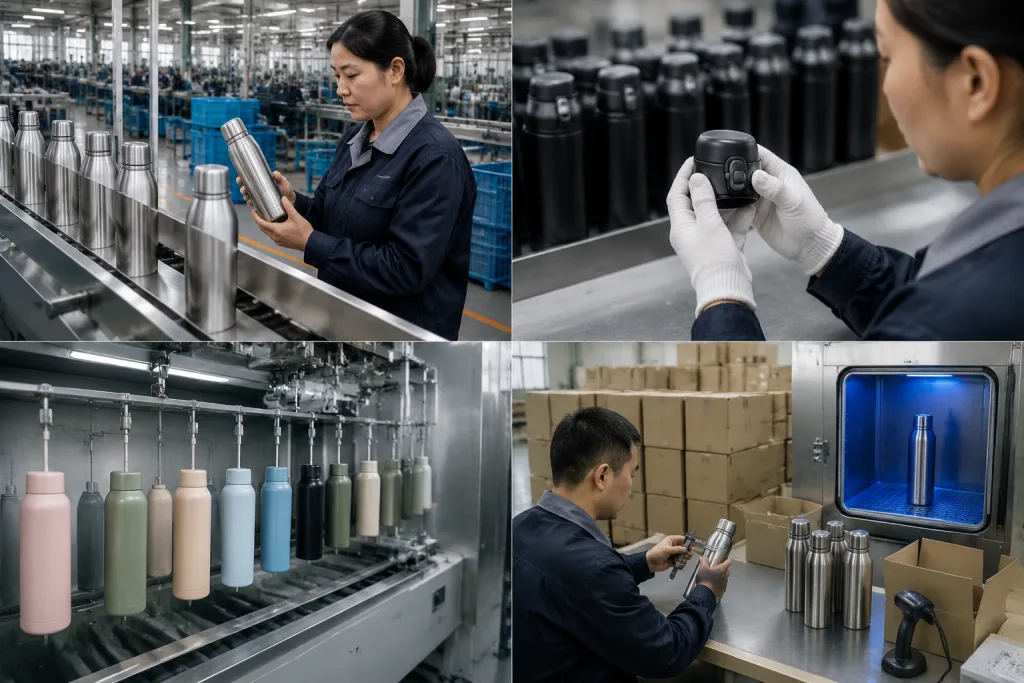
The worst insulated bottle failure is not a dramatic leak. It is the clean-looking bottle that passes a 3-second visual check, sits in your warehouse for 21 days, then comes back from the buyer because the tea is lukewarm by lunch. We’ve seen this go sideways. For a vacuum insulated bottle supplier, the vacuum layer is the product; if it fails, your canteen promotional campaign or retail launch is selling paint and logo work, not heat retention. QC pulled one 500 ml sample last winter that looked perfect under the LED bench lamp, but the thermal gun showed only 38°C after 24 hours.
Double-wall vacuum bottles usually use 304 stainless steel inside and 201 or 304 outside, depending on your price point. The inner and outer shells are welded, evacuated, sealed, then checked before the line moves to powder coating. Failures come from 0.2 mm pinholes, uneven laser welds, oil around the seal point, or dents from stacking semi-finished bodies in the wrong crate. A cheap canteen manufacturer may quote the right material grade on the PI, but process discipline decides whether the bottle performs. The math does not work if the supplier saves RMB 0.18 by skipping proper vacuum detection.
Do not accept vague wording like “keeps hot 12 hours.” Put the test into the spec. For a 500 ml bottle, we normally suggest filling with 95°C water, closing the lid for 24 hours at 20°C ambient temperature, and setting a minimum retained temperature of 45°C. For a 750 ml bottle, 50°C after 24 hours is a fairer target because larger volume retains heat better. On one PO, the buyer wrote “12H hot” in the artwork notes but forgot the actual test standard, so the merchandiser flagged it before mass production.
Add 100% vacuum detection during production, then random thermal testing before final inspection. For larger distributor drinkware orders, ask for test records by batch, not just one pre-production sample. At our Zhejiang facility network, monthly output for stainless insulated bottles is about 450,000 units, but capacity is the wrong number to chase first. Ask whether the canteen supplier records vacuum test failures and removes them before decoration. We run the bodies through a vacuum tester before coating because once a failed shell gets powder coated, packed in a 15 kg export carton, and shipped, nobody wins that argument.
Caps leak from tiny choices
About 7 out of 10 cap leak complaints we see get blamed on the factory first. Fair sometimes. But the leak often starts in the buyer brief: “sport lid,” “flip cap,” or “handle lid” is not a specification. Wrong question to ask. A canteen customizable program needs the lid construction, gasket material, closing torque in N·m, and the exact test method written on the PO. Last April, QC pulled the golden sample because the PO said “black sport cap” while the approved sample label said “black chug cap.” Two different molds.
The weak points are usually silicone gasket hardness, thread engagement, hinge pin strength, straw OD fit, air vent shape, and assembly pressure on the line. Food-grade silicone should normally sit around 50-60 Shore A for bottle gaskets; we check it with a Shore A durometer before pilot run. Too soft, and the gasket rolls out of the groove. Too hard, and it will not compress against the mouth finish. A lid that passes on the lab bench can fail after ocean freight because cartons were stacked under load for 35 days, especially when the top layer carries 9-11 kg per carton.
For standard screw lids, specify an inverted leak test: fill to 90% capacity, close at normal hand torque, invert for 30 minutes, then shake for 30 seconds. Simple test. For sport lids and straw lids, add side-position testing because end users throw bottles into backpacks and car seats, not display shelves. We run 12 samples per colorway on the first article check, and the buyer flagged one case where a 7.2 mm straw was matched with a 7.5 mm silicone seal. The math does not work. If the bottle is for kids or school use, ask about ASTM F963-relevant material requirements and small part risk, even if your product is not a toy.
Do not mix lids late in the project without new samples. We have seen this go sideways. A custom canteen body may have a mouth diameter of 54.0 mm, but a lid from another mold can still be off by 0.2 mm at the sealing surface. That is enough to create a slow leak after three backpack drops. Good canteen manufacturers in China will confirm thread drawings, gasket dimensions, and cap material before mass production; our tooling room checks the mouth with a digital caliper and go/no-go gauge before the line starts. If a canteen supplier only sends lifestyle photos, ask harder questions.
Decoration rejects hide in approvals
Logo rejects usually start before the line runs. Buyers sign a PDF mockup too fast, then act surprised when a 360° round bottle makes the mark look 1.5 mm off-center. A PDF is artwork approval, not production approval. For a customized drinkware order, we ask for a physical pre-production sample or at least a line proof shot on the actual bottle, with the real curve, coating texture, logo process, and color checked under a D65 light box. This applies to a custom canteen, a customized growler, or a distributor canteen range with 6 SKUs.
Silkscreen works for clean one- or two-color logos, as long as the body is straight and the powder coat is not too rough. On tapered bottles, the screen frame fights the curve; we have seen a 72 mm logo stretch at the tail end. Laser engraving gives a permanent mark, but the final shade shifts with coating thickness and the 304 stainless underneath. Heat transfer handles gradients, but the math does not work if the order is 500 pcs and the buyer wants retail-grade adhesion without paying for the extra test run. UV printing gives fine detail, but QC pulled samples after a drop test where the ink chipped at the shoulder.
Put decoration tolerances in the purchase order. For most custom drinkware, ±1.5 mm logo position tolerance is fair on cylindrical bottles, measured with a caliper from the bottom rim or center seam reference. Color should call out Pantone Coated numbers, but powder coating on stainless steel will not match paper exactly. We have had buyers flag a “wrong navy” when the PO said 296C but the approved screen image looked like 2955C. If brand color is strict, approve a coated metal chip, not a monitor image.
Define rejects before deposit. A 0.5 mm dust point on the back of a promotional bottle can pass. A 2 mm scratch through the front logo should fail. For canteen promotional orders, the end client often judges the bottle by the logo before they ever test heat retention, so decoration needs its own inspection sheet. Use AQL Level II with 2.5 major and 4.0 minor as a baseline, and list wrong logo, missing logo, severe color deviation, and peeling as major defects. A serious canteen manufacturer will sign that wording before deposit; arguing after the inspector opens 80 cartons is how this goes sideways.
Steel grade is not enough
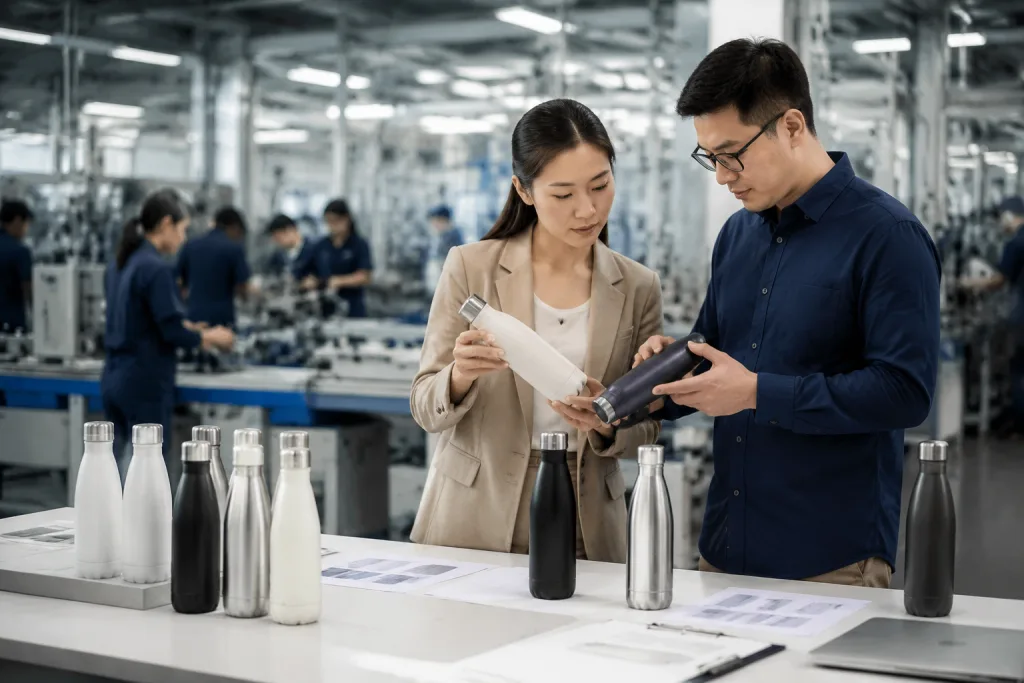
Buyers like clean material claims: 304 stainless steel, BPA-free lid, food-grade silicone. Those claims matter, but they do not close the file. A vacuum insulated bottle supplier should show where each material sits on the bottle, how QC verifies it, and which market rule the finished SKU is built for. We had one PO last March that said “food grade lid” but missed the gasket material; QC pulled the sample and the buyer flagged the odor after a 60°C water soak. Europe and North America do not treat “food grade” as a pass ticket.
For the inner wall, 304 stainless steel is the normal pick because coffee, tea, juice, and daily washing are hard on cheaper steel. Outer walls often run 201 stainless steel for price-driven promo jobs, or 304 when the buyer wants better corrosion resistance after salt-spray exposure. Typical wall thickness is 0.4-0.5 mm per stainless layer; we run thicker builds for outdoor bottles and custom growler programs that get tossed in truck beds. Thin steel saves money on the BOM. The math doesn't work if the buyer also wants low dent claims, because a 0.35 mm outer shell will show a drop mark from a 1 m bench test fast.
For EU buyers, ask for LFGB food-contact testing and REACH-related coating checks. For US buyers, ask for FDA food-contact compliance, plus California Proposition 65 risk screening when the channel calls for it. Big retailers often send a restricted substance list with 80-150 lines, and the coating supplier has to match that list, not just the bottle factory. We ship export lots with test reports tied to similar material batches within 12 months; a canteen vendor saying “we export to Europe” should not hand you a five-year-old report for a different lid resin.
The working spec should name the body material, lid resin, gasket compound, coating type, and required test standards. If you are buying a customizable growler with a stainless handle, call out the handle grade and rivet material as separate lines on the PO. Corrosion failures often start around welded handles, sharp rims, or inside threads where polishing was weak; on the line, we check those spots with a 10x loupe before the carton pack. In Zhejiang and other drinkware production areas in China, 40+ factories can buy similar steel sheets in Yongkang or Wuyi. The difference is incoming inspection, polishing control, and whether the factory rejects borderline coils before they become your inventory.
Cartons create after-factory damage
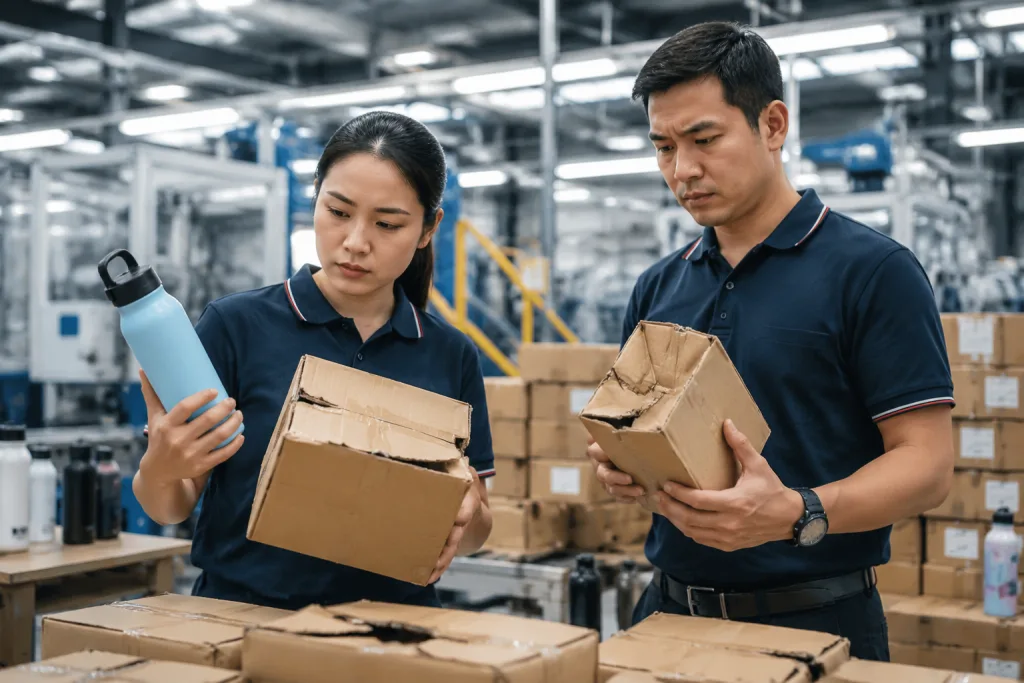
Some defects show up after the line is done. Bottles pass QC, then land at the buyer’s warehouse with chipped powder coating, dented bases, crushed gift boxes, or scuffed lids. We’ve seen this go sideways on 4,800 pcs: QC pulled the pre-shipment sample clean, but the outer carton wall tested soft at 5.2 mm, and the buyer flagged corner dents after the truck transfer. That is not bad luck. The carton spec was too light for the sales channel. Distributor growler shipments and Amazon FBA drinkware need different packing logic.
Start with the inner pack, master carton strength, carton drop test, and pallet plan. A common export setup is one bottle in a polybag or tissue wrap, then an individual white box or color box, packed 24 units per master carton for 500-750 ml bottles. For heavier customized growler items, 12 units per master carton may be safer. Five-layer K=A or K=K corrugated cartons are worth the small cost increase for ocean freight and warehouse handling. On our line, a 750 ml bottle carton usually lands around 15-18 kg gross; once it creeps past 20 kg, warehouse teams start throwing instead of placing. The math doesn’t work.
Ask for a 1A-style drop test approach: drop the packed carton from 60-80 cm on corners, edges, and faces, then inspect bottle coating, lids, and retail boxes. We run the test with a tape measure, a marked concrete floor, and 1 opened carton from the packed lot, not a “special” sample built by hand. If your sales channel uses FBA, add FNSKU labeling, suffocation warning on polybags where required, carton weight limits, and barcode scan checks. If you sell to distributors, make mixed-SKU cartons impossible to misread; one PO typo like “BK” instead of “BLK” can send 300 pcs to the wrong shelf.
Do not let packaging be the last line on the quote. A canteen distributor may save USD 0.12 per unit by removing the individual box, then lose USD 1.50 per unit in replacements and credits. For FOB Ningbo or FOB Shanghai shipments, we normally plan 30-45 days production after sample approval and another 3-7 days for booking and loading, depending on season. Packaging approval should happen before mass production, not while the vessel cutoff is already close. Last year, one buyer pushed box artwork approval to day 28; the cartons arrived 6 days late, and the finished bottles sat beside the packing line while the booking window moved from 12 days vs 18 days.
Low quotes move the failure elsewhere
Price pressure is normal. Nobody in procurement gets praised for overpaying. With customizable drinkware, a low quote usually hides the cost in a spot the buyer cannot see: 0.4 mm body steel instead of 0.5 mm, soft powder coating, recycled lid resin, skipped leak testing, lower line priority, or a 5-ply carton changed to 3-ply. We’ve seen this go sideways. QC pulled 80 bottles from a trial order last May, and 11 lids showed seepage after a 30-minute inverted test. The unit price looked good. The return bill did not.
For a 500 ml powder-coated vacuum bottle with one-color logo, realistic FOB China pricing often sits around USD 3.20-5.20 depending on steel grade, lid type, coating, packaging, and order quantity. A custom growler can range from USD 7.50-14.00 because capacity, handle structure, lid sealing, and carton volume change the math. If one canteen supplier is 18% lower than the other 4 quotes on your desk, ask what changed. Sometimes it is clean sourcing. Often it is one deleted step, like no 100°C hot-water leak test on the assembly bench.
MOQ also deserves honest discussion. For stock colors with laser logo, 500-1,000 pcs can work because we run those colors every week. For custom powder coating, expect 3,000 pcs per color because the coating line setup, 8-12 kg powder loss, and booth cleaning create real cost. For a canteen customized shape using a new mold, tooling can run USD 2,000-8,000, and the project may need 45-60 days before mass production. The buyer flagged this once on a PO, asking for 600 pcs in PMS 186C with a new cap mold; the math didn’t work.
Compare quotations line by line: material grade, capacity tolerance, lid type, decoration method, packaging, compliance tests, inspection responsibility, spare parts, FOB port, and lead time. Better yet, ask for the written spec sheet with wall thickness in mm, carton burst strength, AQL level, and logo position tolerance. A good canteen manufacturer will not always be the cheapest, but they should explain where the money goes. A weak canteen vendor says “same quality” and avoids written specifications. For B2B buyers, that is the warning sign.
Inspection must catch buyer risk
Final inspection is not scratch counting. It has to match the way the order can hurt the buyer after arrival. For a retail brand, QC should stare at coating dust, pinholes, barcode scan rate, and shelf-facing color match under a D65 light box. For a canteen distributor, the bigger risk is mixed cartons, missing lids, wrong spare straws, and a reorder that comes back 2 mm taller than the first batch. We have seen this go sideways: QC pulled 13 cartons from a 2,400 pcs order and found black lids packed with navy bottles because one line changed trays after lunch.
A practical inspection plan starts with pre-production sample approval. Then we run inline inspection when 20-30% of goods are finished, and final random inspection when 100% is produced and at least 80% packed. Use ANSI/ASQ Z1.4 or ISO 2859-1 sampling with AQL Level II as the common baseline. For drinkware, most of our export buyers set critical defects at 0, major at 2.5, and minor at 4.0. Critical defects include sharp edges, contamination, severe leaks, unsafe broken parts, or wrong material. Major defects include wrong logo, failed vacuum test, obvious dents, coating peeling, and non-scannable barcodes. One buyer once asked us to skip inline inspection to save half a day; the math does not work when 6,000 printed bottles already have the logo 8 mm too low.
Ask your vacuum insulated bottle supplier to support inspection with tools: temperature probe, torque check, barcode scanner, cross-hatch tape for coating adhesion, caliper, carton scale, and water leak station. Basic kit. On our line, the inspector records lid torque in kgf.cm, checks mouth diameter with a digital caliper, and scans the EAN code before sealing the master carton. If a supplier pushes back on a barcode scanner or leak station, you learned something before the goods ship.
BottleForge Industrial usually recommends a signed golden sample, sealed color chip, packaging sample, and written QC checklist for every customized canteen order over 1,000 pcs. Our Hangzhou, Zhejiang team can work under FOB Ningbo or FOB Shanghai terms, with typical sample lead time of 7-12 days for stock molds and 30-45 days for normal mass production after approval. That timing is realistic for China production when specifications are locked early. We still ask buyers to check the PO carefully, because one typo in a Pantone code or carton mark can cost 12 days versus 18 days once the packing materials are already printed.
Send your bottle spec for a factory review
Share capacity, lid type, logo method, quantity, and target market. We will flag the production risks before you commit tooling or deposit.
Frequently asked questions
What should I ask a vacuum insulated bottle supplier before placing an order?
Ask for the exact stainless steel grade, inner and outer wall thickness, lid material, gasket material, vacuum test method, coating process, MOQ, lead time, and available compliance reports. You should also ask whether the quotation includes individual boxes, master cartons, logo setup, and pre-shipment inspection support. For a 500 ml custom canteen, a serious supplier should be comfortable discussing 304 inner steel, 0.4-0.5 mm wall thickness, AQL inspection, and 30-45 days mass production after sample approval. If the canteen manufacturer only says “good quality” and avoids numbers, do not treat the quote as complete.
What MOQ is realistic for customized drinkware from China?
For stock bottle shapes and stock colors, many canteen suppliers can accept 500-1,000 pcs with laser engraving or one-color printing. For custom powder coating, 3,000 pcs per color is more realistic because the coating line needs setup, cleaning, and powder loss allowance. For a new custom growler mold, the MOQ may be 5,000 pcs or more, plus tooling of about USD 2,000-8,000 depending on shape and lid complexity. Zhejiang and wider China production can be flexible, but very low MOQ usually means stock components, limited colors, or higher unit cost.
How do I compare canteen vendors when all samples look similar?
Compare the failure controls, not only the sample appearance. Ask each canteen vendor for vacuum testing procedure, leak test method, coating adhesion test, packing drop test, inspection standard, and defect classification. Put the same spec in front of all vendors: 304 inner wall, defined lid material, Pantone color, logo tolerance of ±1.5 mm, AQL Level II with 2.5 major and 4.0 minor, and the same packaging. Then compare FOB price and lead time. Samples can be handmade carefully; mass production depends on repeatable process control and honest rejection of defective units.
Can one supplier handle canteen promotional and retail orders?
Yes, but the requirements are different. Canteen promotional orders often prioritize delivery date, logo accuracy, and acceptable cost, especially for events. Retail or distributor drinkware programs need stronger packaging, barcode accuracy, reorder consistency, spare lids, and compliance documents. A good canteen supplier should build different QC checklists for each channel. For example, a 2,000 pcs event order may need fast 25-30 day production using stock colors, while a retail order of 10,000 pcs may need carton drop tests, FNSKU or EAN barcode checks, and more formal AQL inspection.
What price range should I expect for a custom canteen or growler?
As a working FOB China range, a 500 ml powder-coated stainless vacuum bottle with one logo often lands around USD 3.20-5.20, depending on lid, steel grade, coating, and packaging. A customized growler is usually higher, often USD 7.50-14.00, because it uses more steel, larger cartons, stronger handles, and more demanding leak testing. Prices below the market are not automatically bad, but ask what changed. The answer may be thinner steel, 201 outer wall, cheaper lid resin, no individual box, weaker coating, or less inspection time.