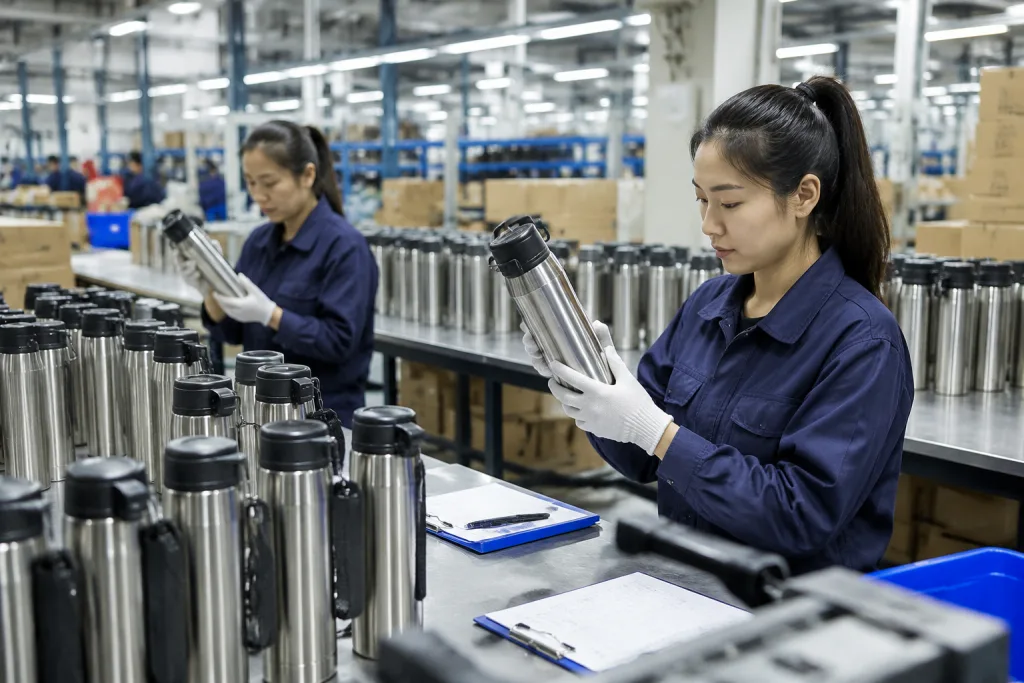
Key Takeaways
- A 500 ml double-wall bottle usually needs 0.45-0.55 mm inner steel and 0.50-0.60 mm outer steel for stable promotional quality
- Realistic MOQ for custom colors is 3,000 pcs per SKU; stock colors with logo can start at 500-1,000 pcs
- Vacuum performance should be checked at 95°C fill temperature, not vague 12-hour claims
- FOB Ningbo or Shanghai pricing is useful only when packaging, AQL level, and logo method are fixed
A vacuum insulated bottle promotional order looks simple until the quotation sheet lands in your inbox. You see 304 stainless steel, 500 ml, powder coating, laser logo, color box, 3,000 pcs MOQ, FOB Ningbo. Those lines set your margin, claim rate, freight bill, and reorder chance. Last Tuesday, our caliper check on the line found a 0.4 mm lid gasket gap on a sample that looked fine in photos.
As a canteen manufacturer in Zhejiang, China, we see buyers chase unit price and skip the spec sheet. Wrong question. A USD 0.18 saving does not work if the lid leaks at 2%, the coating scratches after 12 hours in a carton rub test, or QC pulls a crushed master carton before an Amazon drop check. Read the spec line by line before you send a custom drinkware PO; we have seen one typo, “matte black” vs “matt black,” hold up 18 days of production approval.
Capacity Line Controls Real Usage
The capacity line is not just a sticker spec. It drives mold choice, carton cube, lid torque, and how the bottle feels in one hand. For a vacuum insulated bottle promotional program, we run 350 ml, 500 ml, 750 ml, and 1,000 ml most often. The 500 ml size is still the safer corporate gift: it clears most car cup holders at about 72-74 mm body diameter, keeps the master carton under 12 kg, and does not feel like a hiking flask on an office desk.
For outdoor retail or canteen distributors, 750 ml and 1,000 ml move faster because the buyer is thinking trail packs, campus use, and worksite shifts. For events, banking campaigns, or staff onboarding, 500 ml usually wins on landed cost. We had one buyer push for 750 ml on a 10,000 pcs onboarding order, then the math broke when the carton size pushed the shipment from 12 CBM to nearly 18 CBM.
Watch nominal capacity. This is where orders go sideways. Some canteen vendors quote brim-full volume, while your customer expects usable volume. A bottle marked 500 ml may hold 530 ml to the rim but only 500 ml with safe headspace under the lid; QC pulled one sample last month that leaked after the lid torque tester hit 9 kgf·cm because the fill line was too high. Ask the canteen factory to state both rated capacity and brim capacity on the product drawing.
For distributor drinkware programs, capacity also changes pallet loading. A 500 ml bottle may pack 24 pcs per master carton; a 1,000 ml custom canteen may pack 12 pcs. That gap adds USD 0.25-0.60 per unit in ocean freight and warehouse handling, especially for North American shipments, and the buyer flagged it fast when our PO once had “24 pcs/ctn” copied into the 1,000 ml line by mistake.
Steel Grade Is Not Decoration
The stainless steel spec should name the grade and the exact part. On most customized drinkware orders, we run 304 stainless steel on the inner liner and the outer shell. Some low-cost quotes switch the outer shell to 201 and keep 304 inside. Fine for a 30-day canteen promotional campaign if the buyer accepts the risk. The math does not work for humid markets, coastal shelves, or retail bottles expected to survive 3-5 years. Last month QC pulled a salt-spray sample with small rust dots near the bottom weld after 24 hours; the PO only said “SS bottle,” so the buyer had little room to argue.
The buyer risk is simple: rust claims, weak welds, taste complaints, and missing test files. For Europe, ask for LFGB or EU food-contact test reports on every part touching liquid, including the inner wall, stopper, straw, and silicone ring. For North America, around 7 out of 10 promotional buyers ask us for FDA-grade food contact documentation, and children’s items may need ASTM or CPSIA review depending on the product category. We have seen this go sideways when the cap PP grade was changed after approval; the bottle passed, but the cap failed the paperwork check.
Wall thickness matters as much as grade. A practical spec for a 500 ml promotional bottle is 0.45-0.55 mm for the inner liner and 0.50-0.60 mm for the outer shell. Too thin, and dent complaints rise after cartons get stacked 5 layers high in a warehouse. Too thick, and you pay for extra steel and freight weight with little logo-value gain. For a custom growler or customized growler above 1.2 L, stronger wall thickness and a reinforced base deserve a real discussion because the filled weight is higher; our line usually checks this with a digital micrometer before vacuuming.
Ask your canteen supplier to state steel thickness tolerance, for example ±0.03 mm. If a quotation only says “304 stainless steel” with no wall thickness, you are not comparing the same bottle. This is the wrong question to ask: “Is it 304?” Ask where the 304 is used and what thickness the coil record shows. Good canteen manufacturers in Zhejiang keep incoming material checks, coil numbers, and micrometer readings on file; you should not have to chase them 3 times after the buyer flagged a typo on the PO.
Vacuum Performance Needs Test Conditions
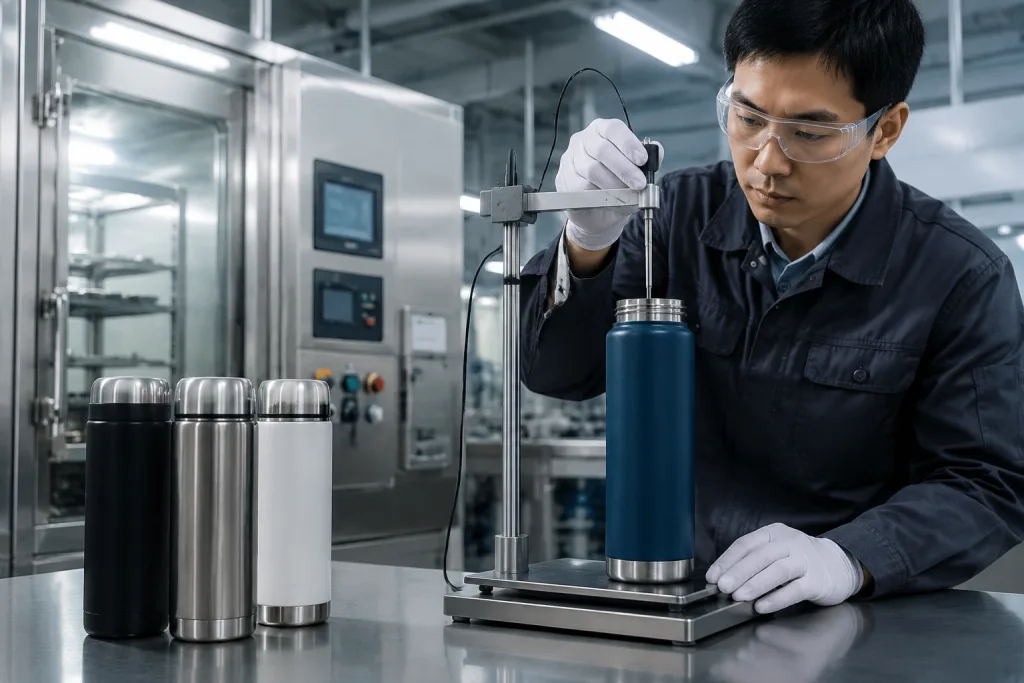
“Keeps hot 12 hours, cold 24 hours” is not a test method. It is a sales line, and this is the wrong question to ask. For a vacuum insulated bottle promotional order, the spec should read like a lab note: fill with 95°C water, lock the lid, hold the test room at 20°C ± 2°C, then record water temperature at 6 hours and 12 hours. On our line, QC uses a calibrated probe thermometer and writes the readings on the carton lot sheet before packing starts.
For a standard 500 ml double-wall bottle, we expect about 60°C or higher after 6 hours when the vacuum is stable and the lid seal is clean. Bigger bottles often hold heat better because the surface area is lower against the water volume. Wide-mouth bottles lose heat faster than narrow-mouth designs, especially when the lid has a 35 mm plastic insert sitting inside the stainless neck. QC pulled one sample last month where the silicone ring was 0.4 mm undersize; the bottle looked fine, but the 6-hour reading dropped to 54°C.
Vacuum failure usually does not show during visual inspection. Looks perfect. Still fails. Weak insulation can come from poor welding, micro leakage, or a bad vacuum sealing step after the body is welded. For export orders from China, we normally recommend 100% vacuum testing before packing for custom drinkware runs above 3,000 pcs. It adds labor, but the math doesn't work if you have to replace an entire corporate gift shipment after the buyer flags cold coffee in 500 staff bottles.
For a canteen customized program, ask how the factory rejects failed vacuum units. Some canteen suppliers run hot water with an infrared surface check; others do temperature retention sampling by carton, usually under AQL 2.5 if the buyer asks for inspection. For retail or distributor canteen orders, put the test condition into the purchase order. If the PO only says “good insulation,” you have no measurable acceptance standard, and we have seen this go sideways over one vague line typed by the buyer’s assistant.
Lid Design Decides Complaint Rate
The lid line on the spec sheet gets skipped too fast. This is the wrong place to save USD 0.03. In our after-sales log, about 6 of every 10 “bottle leak” claims we checked came from the lid: silicone rings not seated, flip caps cracking at the hinge pin, thread fit off by 0.2 mm, or PP parts carrying a plastic smell after hot-water testing. For promotional bottles, we run PP, Tritan, stainless steel shell with PP inner, and bamboo cover when the buyer wants a lower-plastic look.
If you are a canteen distributor selling to schools, gyms, outdoor clubs, or corporate wellness programs, ask one plain question: does the lid pass 360° rotation after filling? We fill to rated capacity on the line, tighten by normal hand torque, invert for 30 minutes, then shake for 30 seconds over white inspection paper. Simple test. It catches bad rings fast. For travel tumblers and sports lids, test them separately because vent holes and sip openings change the leak path; QC pulled one sample last month that passed upside down but dripped from the sip slider after a 20-second side shake.
Silicone quality matters more than the catalog photo. Food-grade silicone should pull out for cleaning with a fingernail, but it should not fall out when the user rinses the cap under a tap. A gasket thickness of 2.0-2.5 mm is common for many insulated canteen designs, but the exact number depends on thread geometry. The better shop-floor question is whether the gasket stays seated after 200 open-close cycles; we run that on a small cycle jig before approving a new lid mold.
For a canteen customizable range, standardizing lids across 500 ml, 750 ml, and 1,000 ml sizes cuts spare-part trouble. It also lets canteen distributors hold 1 lid SKU instead of 3, which matters when a school buyer asks for 48 replacement caps six months after delivery. If your campaign needs a premium feel, a stainless steel cap with internal PP looks cleaner than full plastic, but it usually adds USD 0.25-0.45 per unit FOB China. We’ve seen this go sideways when the PO says “metal lid” but the approved sample was PP inside and outside, so we now mark the lid structure in the PI line item.
Finish And Logo Change Economics
Surface finish is where a quote moves fast. Plain stainless steel is still the cheapest and it hides handling marks better; our QC team checks it with a 3M tape pull and a 30 cm visual check under line lights. Powder coating adds cost, but it gives the bottle the retail look buyers expect on a promotional shelf. Spray painting is cheaper than high-grade powder coating, but we have seen it chip after poor curing, especially around the bottom rim. For a vacuum insulated bottle promotional project, powder coating is usually the safer middle choice.
Logo method should follow order size, brand rules, and how the bottle will be used. Laser engraving is clean and permanent, and it works well for a single-position logo under 60 mm wide. Silkscreen is cheaper for one or two colors, but QC pulled samples before where the ink failed because the coating and ink system were not matched. Heat transfer or water transfer works for full-wrap graphics, but the setup cost is higher and color proofing needs tighter control with a signed PMS swatch. The buyer flagged this twice last year.
For a simple one-color logo on 1,000 pcs stock bottles, a canteen vendor may quote USD 0.08-0.15 per print position. Laser engraving may run USD 0.12-0.25 depending on logo size. Full custom colors normally need a higher MOQ because the coating line must be cleaned and reset; we lose about 2 hours when changing from matte black to a light Pantone color. At BottleForge Industrial in Hangzhou, Zhejiang, typical MOQ is 500 pcs for stock color laser logo, 1,000 pcs for stock color silkscreen, and 3,000 pcs for custom Pantone coating.
If you are building customizable drinkware for distributor programs, do not launch with too many color-logo combinations. Three colors with two logo options are easier to manage than twelve slow-moving SKUs, especially when a PO arrives with “navy” typed once and “royal blue” on the artwork file. We ship repeat programs every season, and this is where the math goes sideways. For a customizable canteen or customizable growler range, choose finishes that can run again in 90 days, not one-off colors that make reorders painful.
Packaging Is A Cost Spec
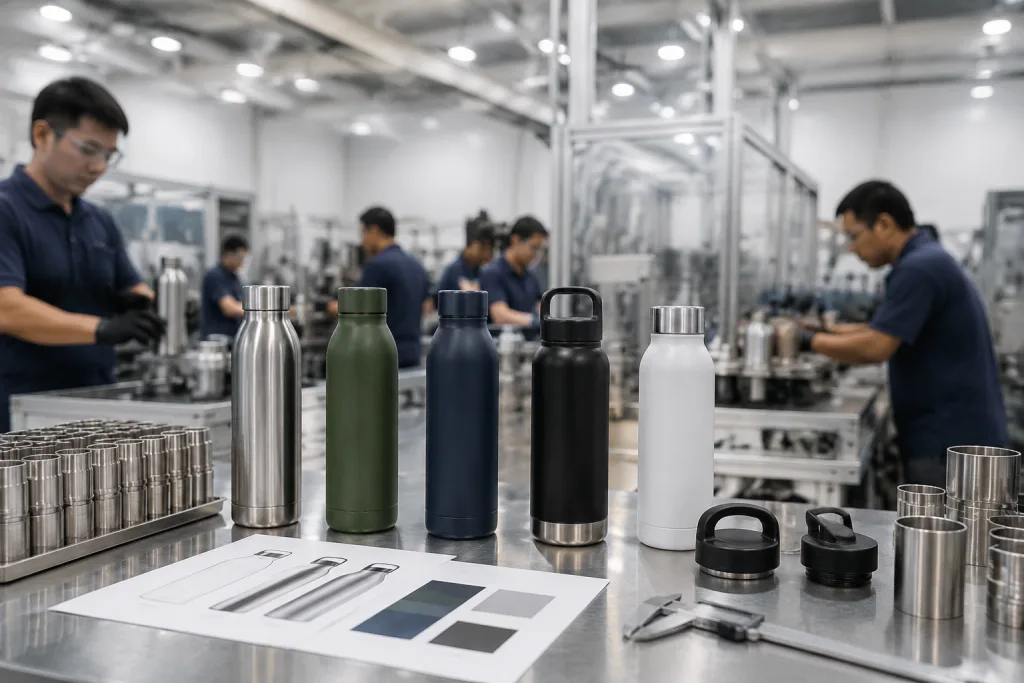
Packaging looks like a small line on the quote, but for distributor drinkware it is a cost spec and a damage claim waiting to happen. We run the cheap setup all the time: 1 pc in a 0.03 mm polybag, then white box or egg-crate divider. Retail color box costs more, and it does sell better on shelf. Gift box with EVA or pulp insert looks premium, but the carton gets fat fast; we have seen loading drop by 10-18%, from 1,180 cartons to about 990 cartons in a 40HQ.
For North American e-commerce, ask one direct question: will the bottle pass a 1.2 m drop test in final packaging, not in a lab sample box. QC pulled the sample last month after the lid corner cracked through a thin color box on the third drop. If it is going to Amazon FBA, lock barcode and FNSKU placement before mass packing. Relabeling 5,000 units after arrival burns money and patience. For European retail, confirm carton markings, recycling symbols, and language requirements before artwork approval; one buyer flagged a missing “Made in China” line after 36 cartons were already packed.
A typical 500 ml bottle in color box may pack 24 pcs per master carton with a gross weight around 8.5-10.5 kg, depending on wall thickness and lid design. The wrong question is “can you make the carton cheaper?” If your canteen supplier quotes low but uses soft 3-ply outer cartons, the math does not work after corner crush and wet-floor handling at the forwarder warehouse. For export from China, 5-ply master cartons are safer for mixed handling and long warehouse routes; we normally check burst strength with a simple carton compression tester before the line closes the first 50 cartons.
For canteen distributors, packaging also controls inventory work. If each unit needs a barcode, insert card, instruction sheet, and country-of-origin label, write every item on the spec sheet, including label size in mm and exact placement. We have seen this go sideways over a PO typo: “UPC on box” became UPC on the master carton only, and the buyer rejected the receiving batch. A canteen manufacturer cannot price accurately if packaging is described as “standard export carton.” Standard for one canteen factory may fail your retail customer’s shelf, scan, or warehouse rule.
Inspection Terms Protect The Order
The last spec lines look commercial, but they save orders when something goes wrong on the line. Put the Incoterm, payment term, lead time, inspection standard, and defect limits on the PO. For most B2B custom drinkware orders, FOB Ningbo or FOB Shanghai is the cleaner choice; mixing unit price with moving freight rates makes the math messy. We are in Hangzhou, about 2.5 hours by truck to Ningbo port on a normal day, so sampling pickups and container booking from Zhejiang stay practical. One buyer once sent a PO with “FOB Shanghai” in the header and “CIF LA” in the notes. QC caught it before deposit, not after cartons were sealed.
Lead time depends on the decoration route, not just bottle shape. Stock color logo orders often ship in 15-25 days after artwork approval if we run laser marking or 1-color silk screen on existing inventory. Custom color production is more commonly 30-45 days, plus 5-7 days if pre-production samples must move by DHL or FedEx before mass production. Our Hangzhou production network can handle about 300,000 stainless bottles per month across insulated bottles, custom canteen runs, and distributor growler projects, but the line gets tight before Q4. We have seen 12-day artwork approval delays turn a safe September ship date into an October fight for vessel space.
Use AQL inspection language. Do not ask for “good quality” only; this is the wrong question to ask. A practical standard is AQL 2.5 for major defects and AQL 4.0 for minor defects, with critical defects not accepted. Major defects include leakage during a 100% water test, failed vacuum after the hot-water hold check, wrong logo position over 2 mm from the approved artwork, serious dents, or unsafe sharp edges. Minor defects include small coating specks within agreed limits or slight carton scuffs. Last month QC pulled the sample set under a 0.65 mm feeler check on lid fit, and 3 units failed because the silicone ring was not seated flat.
Compliance belongs on the PO before deposit, not in an email after shipment. For EU buyers, REACH, LFGB, and packaging waste documentation may be relevant. For North America, FDA food-contact expectations, Prop 65 review for California sales, and ASTM considerations for kids products may apply. A serious canteen vendor will tell you which reports are still current and which need retesting for your exact 304 stainless body, powder coating, or logo ink. We ship enough promo bottles to know where this goes sideways: the buyer flags Prop 65 after cartons are packed, then everyone argues over who pays for retesting and warehouse storage.
Send your bottle spec sheet for factory review
We will check capacity, steel, coating, logo, packaging, MOQ, and FOB pricing before you commit to production.
Frequently asked questions
What is a realistic MOQ for a vacuum insulated bottle promotional order?
For stock bottle shapes and stock colors, a realistic MOQ is 500-1,000 pcs with laser engraving or one-color silkscreen. For custom Pantone coating, expect 3,000 pcs per color because the coating line needs setup, cleaning, and color-loss allowance. For a fully custom canteen with new mold, special lid, or custom growler structure, MOQ can move to 5,000-10,000 pcs depending on tooling cost. Some canteen suppliers offer very low MOQ, but they may be using mixed stock, limited colors, or manual logo work. That can be fine for a test campaign, but not ideal for a distributor drinkware program needing repeatable color and packaging.
How much should a customized canteen cost FOB China?
A standard 500 ml double-wall 304 stainless steel promotional bottle with powder coating and one-position logo often lands around USD 3.20-5.20 FOB China, depending on lid, coating grade, packaging, and order quantity. A 750 ml bottle may be USD 4.20-6.80, while a premium customized growler above 1.2 L can move above USD 8.00. Color box packaging may add USD 0.15-0.45 per unit. Laser logo may add USD 0.12-0.25. If a canteen factory quotes far below the market, check steel grade, wall thickness, lid seal, carton strength, and whether 100% vacuum testing is included.
Which logo method is best for promotional insulated bottles?
For most vacuum insulated bottle promotional orders, laser engraving is the safest choice because it is permanent, clean, and has low artwork risk. It works especially well on powder coating because the laser exposes the metal beneath. Silkscreen is better when you need exact brand colors, but it is less durable unless ink adhesion is properly tested. Heat transfer is suitable for full-wrap artwork or photographic designs, but MOQ and setup cost are higher. For customizable drinkware sold through distributors, laser engraving keeps operations simple because the same bottle can be decorated quickly for different accounts.
How do I compare canteen manufacturers without being misled by price?
Compare the same spec sheet, not just the same product photo. Ask each canteen manufacturer to quote capacity, steel grade, inner and outer wall thickness, lid material, coating type, logo method, packaging, carton size, AQL level, Incoterm, and lead time. A USD 0.30 cheaper quote may use thinner steel, weaker cartons, or no vacuum testing. Also ask whether the canteen supplier is a trading company, assembly workshop, or factory with welding, polishing, coating, and inspection control. A reliable canteen vendor should provide product drawings, test reports, sample timeline, and clear defect standards before deposit.
What lead time should I plan for distributor canteen programs?
For stock color bottles with a standard logo, plan 15-25 days after artwork approval and deposit. For custom color coating, retail packaging, or multiple SKUs, plan 30-45 days for mass production. Add 5-7 days for sample shipping if you need physical approval in Europe or North America. Ocean freight can add 25-40 days depending on destination port, and customs or warehouse intake can add another week. Canteen distributors should build a 60-90 day total planning window for seasonal promotions. If you need delivery before Q4, lock the PO early because China factory capacity tightens from August onward.