Key Takeaways
- A realistic MOQ for custom vacuum bottles is 1,000 pieces per SKU and color
- 304 stainless inner wall with 0.4 mm thickness is a normal B2B baseline
- Plan 35-45 days for mass production after sample and artwork approval
- Use AQL 2.5/4.0 inspection before balance payment, not after arrival
You are not buying “a bottle.” You are trying to get 5,000 or 50,000 units landed on time, with the logo centered within 0.5 mm, FDA or LFGB material paperwork in the file, cartons that survive stacking, and no fight over dents when the container is opened. This is where first orders with vacuum insulated bottle manufacturers go sideways. QC pulled one pre-shipment sample last month with a clean body, but the buyer flagged the carton drop corner because the inner divider was 2 mm too loose.
We run orders from RFQ to final inspection every week. BottleForge Industrial is based in Hangzhou, Zhejiang, and our factory network in China makes about 480,000 stainless drinkware units per month, with normal MOQ from 1,000 pieces per SKU. A real buyer guide should follow the line: quotation sheet, 304 stainless confirmation, logo proof, tooling notes, vacuum test, AQL 2.5 inspection, then shipment booking. The wrong question is “who has the cheapest bottle?” The better question is whether the supplier can ship the same approved sample 18 days later without changing the lid gasket, powder coating thickness, or export carton spec.
Start with the selling channel
The first question is not bottle shape. It is the selling channel. A 10,000-piece corporate gifting order gets judged on logo position and gift-box finish; a retail outdoor order gets judged on shelf scuffs, hang-tag copy, and carton crush; an FBA program gets punished when the FNSKU is 2 mm off-center or the carton side mark is missing. We’ve seen this go sideways: QC pulled 32 cartons after the buyer flagged unreadable barcodes on matte black boxes.
For this walkthrough, assume you are a canteen distributor in North America buying 10,000 units of a 750 ml vacuum insulated bottle for a private-label outdoor line. You want two colors, one laser logo, retail box, and FOB Ningbo shipment. Normal brief. We run this type of program in Zhejiang often, and the line will usually split color production by powder-coating batch, with a 500-piece pre-production run checked by caliper, gloss meter, and leak tester before mass packing.
The specification should be written before price negotiation, not after. This is the wrong question to ask: “What is your best price?” Start with capacity, mouth diameter in mm, lid type, stainless grade, finish, decoration, packaging, compliance market, and inspection standard. If you only send a photo, 6 factories can quote 6 different builds, including thinner outer walls, cheaper caps, lighter coatings, and 5-layer cartons instead of 7-layer cartons. The math doesn’t work. Those quotes are not comparable, and the buyer usually finds out during AQL 2.5 inspection when the carton weight or lid gasket thickness is off.
A practical baseline for this order would be: 750 ml capacity, 304 stainless steel inner wall, 201 or 304 outer wall depending on target price, double-wall vacuum insulation, powder coating, leakproof screw lid, laser engraving, individual white box, 24 pieces per export carton, carton drop test suitable for courier handling. For a canteen custom program, that level of detail blocks cheap substitutions that look fine in photos but fail in the warehouse. We ship plenty of bottles that pass the showroom test; the real test is after 18 days on the water and 2 warehouse transfers, when corner dents, loose lids, and rubbed logos start showing up.
Lock the bottle construction
Most buyer problems start inside the bottle, where the shortcut is buried after welding. For a customized canteen or custom growler, we run the inner liner in food-grade 304 stainless unless the PO says otherwise. QC pulled one batch last March because the XRF gun showed a supplier mixed lids and bodies from two steel lots. For EU buyers, we check LFGB or the right food-contact file before mass production. For the U.S., FDA food-contact expectations and California Proposition 65 screening can matter once the item goes into chain retail.
Wall thickness is not a spec-sheet decoration. A 0.35 mm inner wall and 0.4 mm outer wall can shave about USD 0.22 off a 10,000 pcs order, but the math does not work if cartons come back with side dents. For retail distributor canteen programs, we recommend around 0.4 mm inner and 0.5 mm outer on mid-size bottles, checked with a digital thickness gauge at the shoulder and lower body. Large customized growler formats, such as 1.9 L or 2 L, need stronger shells because the body deforms faster during transit, especially after 1.2 m carton drop testing.
Vacuum performance should be written as a test, not printed as a slogan. We fill with hot water at 95°C, close the lid, then read the probe thermometer after 6 hours or 12 hours in a 20°C room. For a 750 ml bottle, set a workable acceptance line such as water remaining above 65°C after 6 hours at 20°C room temperature. Cold retention claims need the same discipline if your color box says 24 hours; we have seen this go sideways when marketing approved the artwork before the line finished the vacuum sampling.
For a canteen manufacturer, lid engineering is often where the claim eats the margin. A cheap lid can save USD 0.18 per unit and create USD 8,000 in returns. Ask for silicone gasket grade, spare gasket MOQ, and a 30-minute inverted leak test result from the rack, not just a photo of a closed bottle. Plastic parts also need REACH or LFGB support for your market, and the buyer will flag it fast if the PO says black PP while the pre-production sample arrives in gray Tritan.
Price the order without guessing
For the sample order described above, we would price a realistic FOB China range at USD 4.10-5.60 per piece for 10,000 units. The spread comes from steel grade, coating, lid parts, carton burst strength, and decoration method. Small changes bite. A carry handle can add USD 0.18-0.35, a custom molded lid often needs a separate PP injection tool, and a copper-plated insulation layer can move cost by USD 0.25-0.45. Last month QC pulled a 750ml sample from the line and the lid gasket alone changed the quote by USD 0.07 because the buyer wanted thicker silicone.
MOQ is not just a factory rule. It ties back to 304 stainless sheet purchasing, powder coating booth setup, screen-printing fixtures, carton MOQ, and QC labor. For BottleForge Industrial, a standard canteen customized order usually starts at 1,000 pieces per SKU, while a new mold or fully canteen customizable lid may require 5,000-10,000 pieces. Custom color powder coating often needs 1,000 pieces per color; below that, the math doesn't work because we still run the spray gun cleaning, oven warm-up, and color loss on the same line.
Break the quote into visible parts. Ask the canteen supplier to show bottle cost, decoration cost, packaging cost, sample cost, mold cost if any, and inland freight to port. A serious canteen factory will not hand over every subcontractor invoice, but it should show enough for a clean comparison. We ship clearer quotes when the buyer sends a marked artwork file, Pantone code, carton requirement such as 5-layer K=A, and barcode position; one PO typo on “matte black” versus “gloss black” once cost 12 days of rework, not 3.
Payment terms are usually 30% deposit and 70% before shipment after passed inspection. For established canteen distributors, some suppliers discuss 20/80 after two or three clean orders, but open account on a first project is the wrong question to ask. FOB Ningbo or FOB Shanghai is common for Zhejiang factories. EXW looks cheaper on paper, then the buyer carries trucking, customs declaration, and export handling risk; we have seen this go sideways when a forwarder missed the Ningbo cutoff by 1 day after inspection passed under AQL 2.5.

Approve samples like production parts
A sample is not a souvenir. It is the control part for the order. For custom drinkware, the pre-production sample needs the same steel structure as bulk, the same lid gasket, the approved finish, the logo at the measured size, and the retail box if the timeline allows. We measure the logo with a digital caliper, not by eye. If you approve a plain 304 stainless sample and add powder coating after that, the approval is half-done.
For this 10,000-piece order, plan on 7-10 days for an existing-shape sample with laser logo, or 12-18 days if custom color matching is required. A new customized growler lid or special handle can take 25-35 days for tooling and first sample. On the spray line, a 0.03 mm change in coating thickness can shift the color enough for a retail buyer to flag it. Pantone matching on powder coat is approximate because metal substrate, gloss level, and coating thickness change the final color. If brand color is strict, agree on a Delta E tolerance before we cut the PO.
Logo method changes risk. Laser engraving is durable and clean on stainless or powder coating, but it cannot print full-color artwork. Silk screen printing costs less for simple promotional logos, yet QC should run an adhesion test, usually 3M tape plus a short rub test before bulk. Heat-transfer or UV printing handles complex graphics, but abrasion resistance must be checked on the same finish used in production. For canteen promotional orders, chasing the cheapest decoration is the wrong question to ask; we have seen this go sideways when the photo looked fine and the logo failed after 200 rubs.
Keep one signed sample at your office and one at the factory in Zhejiang. Both sides should confirm with photo, video, and a written spec sheet that shows color code, logo position in mm, lid version, carton mark, and barcode if used. Small detail, big trouble. Last spring, QC pulled the sample during final inspection because the PO had one typo in the matte black code. When the final inspection happens, the inspector compares mass production against the approved sample, not against a memory from a sales call.
Control decoration and packing risk
Decoration defects are where custom canteen orders start bleeding margin. We’ve had a 3,000-piece vacuum bottle run pass leak testing, then get held because QC pulled the sample and the logo sat 4 mm off-center under a steel ruler. Set measurable decoration limits before the line starts.
For laser engraving, define logo position from the bottle bottom or centerline, with tolerance such as ±2 mm. For screen printing, lock color, logo size, curing method, adhesion standard, and the exact defect limit, for example no more than 1 pinhole under 0.5 mm per logo. A simple 3M tape test after printing is not perfect, but it catches weak curing; we run it after the tunnel oven, not 3 days later when cartons are already sealed. For powder coating, request a cross-hatch adhesion test and rubbing test if the product is for retail shelves.
Packing deserves the same attention. A canteen vendor may quote a thin 3-ply carton to win price, while your distributor growler program needs 5-ply export cartons because the product is heavy. For a 750 ml bottle, 24 pieces per master carton may be fine. For 1.9 L growlers, 12 pieces per carton is safer. Carton gross weight should usually stay below 18 kg unless your warehouse accepts heavier handling; we once changed a 20.6 kg carton after the buyer flagged forklift clamp marks and two dented lids during AQL 2.5 inspection.
If you sell online, add barcode and FNSKU requirements early. Amazon-style prep needs scannable labels, polybag warnings if used, carton dimensions, and drop-test confidence for parcel networks; the wrong question is “can we save on the box?” because the math doesn’t work. For a canteen suppliers comparison, packing design is a real differentiator. Saving USD 0.12 on a box can create dent claims, chargebacks, and repacking labor that cost far more, and we’ve seen this go sideways from one typo on a PO where “FNSKU on unit” became “FNSKU on carton.”
Inspect before the balance payment
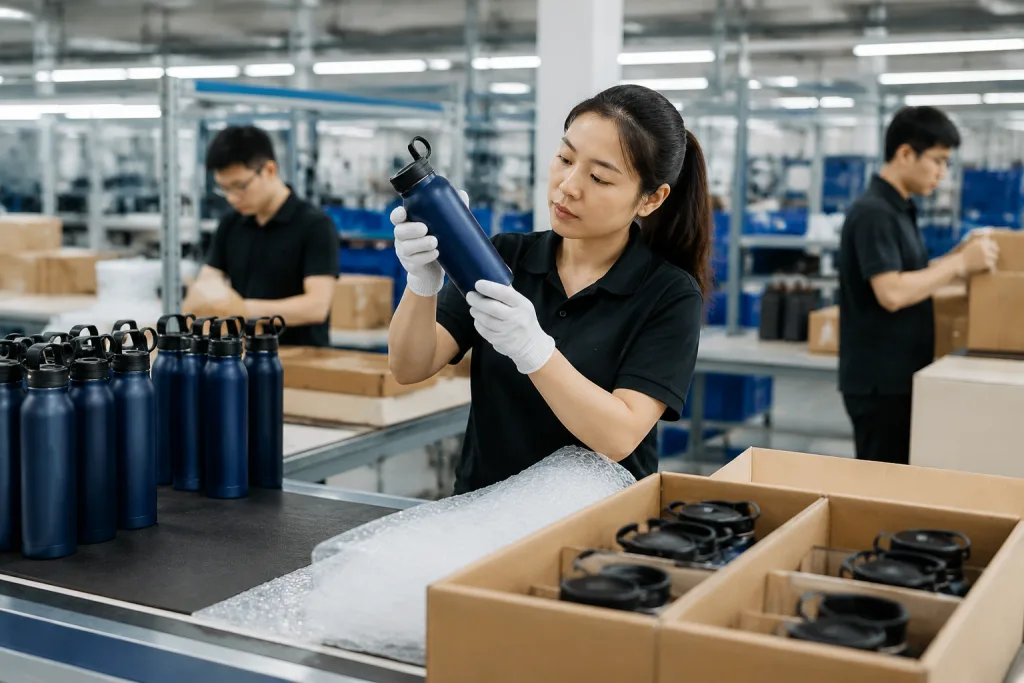
Do not wait until the container lands in Hamburg, Rotterdam, Los Angeles, or Toronto to find the problem. Run final random inspection when 100% of goods are produced and at least 80% packed. We normally set AQL 2.5 for major defects and 4.0 for minor defects; critical defects get zero allowance. Sharp metal burrs on the lip, leaking bottles, dirty inner walls, or wrong material should stop shipment. QC pulled one sample last winter with a 0.6 mm burr under the rolled mouth. That carton did not move.
For the 10,000-piece order, an inspector may check 200 pieces under a general inspection level II plan, depending on the exact AQL table and lot size. The checklist should cover capacity with a graduated cylinder, empty weight on a 0.1 g scale, body height and diameter with calipers, coating appearance under a D65 light box, logo position against the approved artwork, leak test, vacuum performance spot check, lid fit, odor, carton markings, barcode scan, and packaging drop condition. If your custom canteen has a retail box, inspect the box too: print color against the signed sample, spelling, UPC readability, glue seam strength, and crushing after a 76 cm drop test.
Ask the canteen manufacturer to run inline QC too. Final inspection catches problems. Inline inspection prevents them. At BottleForge Industrial, typical mass production lead time is 35-45 days after deposit and sample approval, but we push for an inline check around day 12-18 on larger customized drinkware orders. That is when the line can still adjust coating thickness, welding heat, and polishing pressure before 3,000 units are packed into master cartons. We have seen this go sideways when a buyer skipped inline QC and flagged a tilted logo only after pallet wrapping.
A pass result should release the balance payment. A fail result should trigger sorting, rework, replacement, or a negotiated discount only when the defect fits your sales channel. Be careful with discounts. If the goods damage your brand, a USD 0.20 credit does not fix the math. Last month a PO even had the Pantone code typed wrong by one digit; the buyer flagged it before payment, and that saved us from shipping 480 cartons in the wrong shade.
Plan reorder leverage early
Your first order should make the second order cheaper and faster to place. This is where experienced canteen distributors beat one-off buyers. Keep one final technical file with approved sample photos, AI artwork files, Pantone references, carton marks, inspection report, material declarations, and shipping documents. We see this go sideways when the carton mark only sits in a WeChat thread; last month QC pulled the sample and found the PO said “matte black” while the approved bottle was Pantone Black 6C with a soft-touch coating.
For a reorder, sampling can drop to 3-5 days if the bottle, lid, logo, coating, and packing stay unchanged. Production still needs 30-40 days depending on factory capacity and the coating line schedule. Before peak season, especially August to November for holiday promotional demand, book capacity earlier. Zhejiang factories move fast, but the math doesn't work when 6 coating lines are already full and every canteen vendor wants the same ship week.
If sales are strong, discuss annual forecasts with your canteen supplier before the next RFQ. A 40,000-piece annual plan gives the factory a reason to reserve 304 stainless steel sheet, stabilize pricing, and improve payment terms. It can also justify a custom mold for a canteen customizable lid, a stronger retail box, or a lower unit cost on a customized canteen body after the MOQ is split across 3-4 releases. If you are building a distributor drinkware line, not just filling one promotion, supplier stability matters more than squeezing the last USD 0.05.
The best vacuum insulated bottle manufacturers will challenge unclear specs instead of blindly saying yes. Good. That pushback feels slower at RFQ stage, but it saves time when the container leaves Ningbo without a lid fit issue, a 2 mm logo shift, or a failed AQL 2.5 inspection.
Send your bottle spec before you request pricing
BottleForge will review capacity, steel grade, logo method, MOQ, packing, and inspection points before quoting your custom drinkware order.
Frequently asked questions
What MOQ should I expect from vacuum insulated bottle manufacturers?
For standard stainless vacuum bottles, expect 1,000 pieces per SKU and color as a practical MOQ from many China factories. If you need a custom canteen with existing mold, laser logo, and standard carton, 1,000 pieces is usually workable. For custom powder colors, retail boxes, or a customizable growler with special lid parts, MOQ often moves to 3,000-5,000 pieces. A fully new mold can require 5,000-10,000 pieces because tooling, trial runs, and material loss must be covered. If a canteen vendor accepts 300 pieces at a very low price, check whether it is using stock goods, limited decoration, or trading leftover inventory.
How long does a custom drinkware order normally take?
For an existing bottle shape with one-color logo, plan 7-10 days for samples and 35-45 days for mass production after deposit and approval. Add 5-10 days if you need custom powder coating, color box proofing, or repeated artwork changes. Sea freight then adds roughly 25-35 days to the U.S. West Coast and 35-45 days to many European ports, depending on routing. Air freight is faster but often too expensive for stainless bottles because of weight and volume. A safe first-order calendar from RFQ to warehouse delivery is usually 75-100 days.
Which stainless steel grade should I specify?
For the inner wall that contacts drinks, specify 304 stainless steel as the normal baseline. Some premium orders use 316 stainless, especially for saltwater, marine, or high-acidity positioning, but the cost is higher and not always necessary. The outer wall may be 201 or 304 depending on budget and corrosion expectations. For retail or outdoor programs, I prefer 304 inner and at least a clearly declared outer material. Ask for material test reports, but also use incoming or third-party verification if the order is large. Material substitution is not common with good canteen manufacturers, but it is too expensive to ignore.
How do I compare quotes from different canteen suppliers?
Compare the same specification line by line. Capacity, inner and outer steel grade, wall thickness, lid material, gasket, coating type, decoration method, retail box, master carton, inspection level, and Incoterm must match. A USD 4.35 quote and a USD 4.85 quote may not be a real price difference if one uses 0.35 mm steel and a thin carton while the other uses 0.5 mm outer wall and 5-ply export packing. Ask for FOB port, sample fee, mold fee, payment terms, production lead time, and MOQ. Serious canteen vendors can explain the cost drivers without sounding defensive.
What QC tests should be mandatory before shipment?
At minimum, require visual inspection under AQL 2.5/4.0, leak testing, capacity check, logo position check, coating adhesion check, carton drop review, barcode scan if applicable, and a vacuum performance spot test. For a 750 ml bottle, you might test hot water at 95°C and record temperature after 6 hours at 20°C room temperature. Critical defects such as leaking, sharp burrs, contaminated interiors, wrong logo, or wrong material should be zero tolerance. For EU orders, include REACH and food-contact documentation. For children’s bottles, ASTM or applicable child-use requirements may apply depending on design and market.