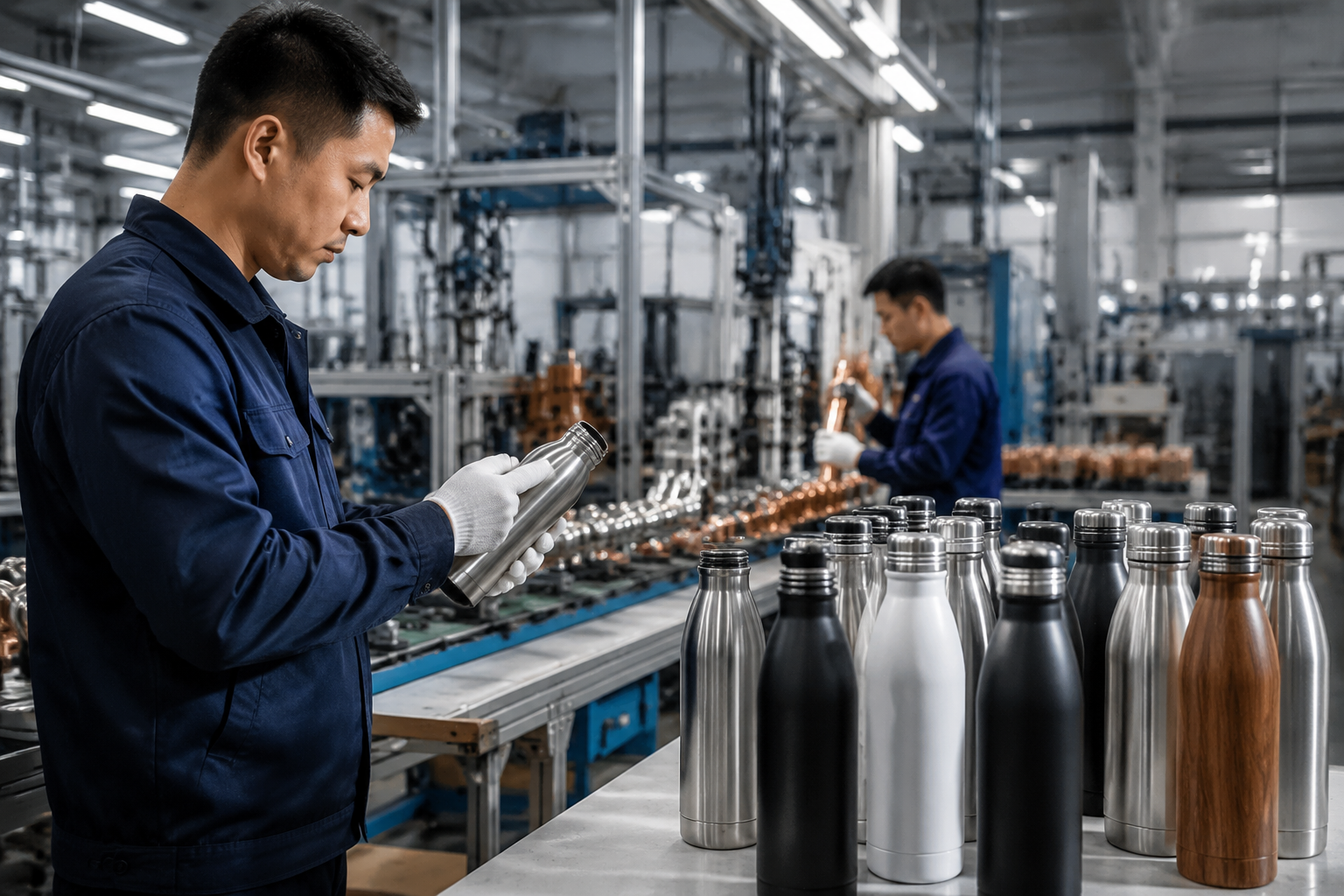
Key Takeaways
- A practical MOQ for customized canteen orders is usually 1,000-3,000 pcs per color
- 304 stainless steel should be confirmed for inner wall contact surfaces
- Normal production lead time is 25-35 days after sample and deposit approval
- Use AQL 2.5/4.0 inspection plus vacuum retention testing before shipment
You are not just buying bottles. You are buying a repeatable supply chain: 304 stainless thickness, vacuum hold time, logo position within ±1.5 mm, 5-layer export carton strength, FDA or LFGB files, and a supplier who answers when Ningbo port asks for one missing HS code line. A low unit price means little if QC pulled the sample after a 1.2 m drop test, the lid leaked, or the logo came out 3 mm off-center.
As a vacuum insulated bottle manufacturer in Hangzhou, Zhejiang, we see the same 4 buyer problems every month: MOQ written as “negotiable,” samples that look better than mass goods, lead times quoted as 12 days when the line needs 18 days, and canteen vendors saying yes before checking the mold room. China can move fast. The wrong question is “what is your cheapest price?” Ask about tooling, steel grade, AQL 2.5 inspection points, and carton test results before we run mass production.
Start With The Actual Use Case
The first procurement mistake is asking a canteen manufacturer for a price before the use case is locked. This is the wrong question to ask. A hiking club bottle, a retail travel tumbler, an employee gift, and a distributor growler sit on different drawings, even if the sales photo looks close. We run double-wall vacuum lines every week, but a 0.3 mm change on the lid gasket, a different powder coat, or a 5-ply export carton can move the cost and lead time. QC pulled one 750 ml sample last month because the carry loop flexed too much after a 12 kg pull test.
Start with the buyer question: Who uses it, where, and how often? For canteen promotional items tied to a 3-month campaign, a stock 500 ml or 750 ml body with silkscreen logo often makes the math work. For a retail line, we look harder at lid sealing cycles, powder coating abrasion, handle strength, and carton drop resistance. Small detail, big headache. One buyer flagged scuff marks after a 1.2 m carton drop test, then asked why the cheaper gift-box paper failed in warehouse handling.
- Office gift: 350-500 ml, simple lid, laser logo, 1-color box, usually 1,000 pcs MOQ per color.
- Outdoor canteen: 750-1,200 ml, wider mouth, carry loop, thicker coating tested with 3M tape after cross-cut.
- Custom growler: 1,200-1,900 ml, beer-safe interior, reinforced handle, 100% leak test on the line.
- Distributor drinkware: shared color palette across 2-4 sizes, barcode control, master carton marks checked against the PO.
For custom canteen projects, we ask for target market, sales channel, expected retail price, annual volume, and whether you need REACH, LFGB, FDA, or California Proposition 65 documentation. A canteen supplier in China quotes faster when these details are clear. A serious factory in Zhejiang will also push back when your requested feature adds cost but does not help the user. We have seen this go sideways: the PO said matte black, the artwork file said PMS 426C, and the buyer expected soft-touch coating without paying for it.
Checklist: define capacity, lid type, steel grade, decoration method, packaging, compliance market, target FOB price, and carton test standard before asking for mass quotes.
What Factory Numbers Should You Ask
A solid vacuum insulated bottle manufacturer should answer with numbers, not sales talk. Ask for monthly capacity, normal MOQ, sample timing, production lead time, and how QC runs inspection. If a canteen factory dodges those 5 points, we usually find the problem later in subcontracted polishing, late 304 stainless coil delivery, or a planner who booked the powder coating line too tight. We’ve seen this go sideways.
At BottleForge Industrial in Hangzhou, Zhejiang, a typical custom drinkware order starts at 1,000 pcs per color for stock shapes and 3,000-5,000 pcs for special color matching or more complex customized drinkware. New mold projects need stronger commitment because tooling, trial production, and fixture adjustment eat real line time; our mold room may spend 2 days just tuning a lid fixture by 0.3 mm. Our current output for stainless steel vacuum bottles and tumblers is about 450,000 units/month, depending on coating mix and lid complexity.
For normal OEM production, we run this rhythm: 5-7 days for standard sample with logo, 10-15 days for new color or lid adjustment, 25-35 days for mass production after deposit and sample approval, and 3-7 days for final inspection and booking. Sea freight to Europe or North America then adds roughly 25-45 days depending on port and season. One buyer pushed for 18 days on a 12,000 pcs two-color order; the math did not work after coating cure time, leak testing, and AQL 2.5 inspection. QC pulled the sample twice because the logo was 2 mm too low.
FOB Ningbo or FOB Shanghai are common for Zhejiang and eastern China suppliers. EXW can look cheaper, but your forwarder must handle local pickup, export declaration, and loading coordination; for first orders, FOB is cleaner. If you are a canteen distributor managing 8 or 12 SKUs, ask your canteen suppliers to quote by SKU, color, carton quantity, gross weight, and CBM. That gives your logistics team a landed cost they can use, not a pretty factory number that falls apart when the buyer flags a 14 kg carton limit.
Material Questions That Actually Matter
Most buyers ask for “stainless steel” on the RFQ. Too loose. For vacuum insulated bottles, we normally run 304 stainless on the inner wall because it touches water, coffee, tea, or beer. The outer wall can be 201 or 304 depending on target price, but 7 out of 10 mid-range export programs we quote use 304/304 because the corrosion story is cleaner and retail buyers understand it. Incoming coil is usually 0.4-0.5 mm per layer before forming; after stretching, QC checks the body with a digital thickness gauge at the shoulder and base, where the metal thins first.
For a custom canteen, the hidden parts cause the ugly emails. Ask for silicone ring hardness, cap material, straw material if used, gasket odor testing, and whether plastic parts are PP, Tritan, or another named material. We usually see sealing rings at 50-60 Shore A; if they are too soft, the cap passes the first leak test but fails after 20 open-close cycles. If you are sourcing a customizable growler for beer or kombucha, confirm that passivation and polishing do not leave metallic odor or welding residue. QC pulled one 64 oz sample last year because a tiny black welding dot sat inside the neck.
Vacuum performance needs a process check, not a sales promise. We fill with hot water, log the starting temperature with a probe thermometer, check again after the agreed period, and for some lines run automated vacuum detection before packing. For a 500 ml bottle, a realistic benchmark is keeping hot water above 55-60°C after 6 hours under room temperature conditions. Bigger bottles and narrow-mouth designs usually hold heat better; wide-mouth lids lose more heat. The wrong question is “how many hours?” without test conditions. We have seen buyers compare our 6-hour lab result against a competitor’s 12-hour claim with no room temperature, fill temperature, or lid type listed.
Coating is where good orders go sideways. Powder coating gives a tougher hand feel than basic spray paint, but the curing window has to be controlled; on our line, the oven chart matters more than the color swatch. Ask for cross-hatch adhesion testing, 3M tape pull, dishwasher claim limits, and abrasion expectations. If you want a canteen customized with gradient color, rubber finish, or metallic paint, accept that reject rates can rise by 2-5% compared with plain black or white. The buyer flagged this on a matte navy PO once because the approved sample said “soft touch,” while the order sheet typo said “silk paint.” Different finish. Different scrap rate.

Decoration Choices Without Guesswork
Logo decoration is where 3 out of 10 custom drinkware projects lose a week before sampling even starts. A buyer sends a 400 px PNG, the canteen vendor says yes, then QC pulls the first sample and the logo edge looks soft under the 10x loupe. Send vector artwork in AI, EPS, or PDF format, with Pantone references if color accuracy matters. Specify logo size in millimeters and placement distance from the base or lid seam; “centered on bottle” is how we end up arguing over 6 mm on the line.
Laser engraving stays clean on 304 stainless and powder-coated bodies, and we run it with a positioning jig when the logo has to sit 38 mm above the bottom curve. It works well for corporate gifts and distributor canteen programs where one return carton costs more than the engraving upgrade. Silkscreen printing costs less for a one-color logo on a flat zone, but we have seen it rub at the grip area after 300 abrasion cycles. Heat transfer handles gradients better. Full-wrap printing needs artwork distortion checked on the curved bottle wall, or the buyer flags the seam because the mascot’s face stretches by 4 mm.
For canteen customizable programs, decoration decisions should follow MOQ, not mood boards. A 1,000 pcs order with 10 logo versions is usually the wrong question to ask, because each version needs setup, film, alignment checks, and separate packing control. The math doesn’t work when the line stops 10 times for small logo batches. If you serve 5 regional canteen distributors, use one bottle color, one carton design, and different laser logos; we ship cleaner that way, and packing QC can check the PO sticker against the logo code without guessing.
Practical logo checklist
- Artwork file: AI, EPS, or editable PDF, not a screenshot pasted into a PO.
- Logo width: usually 25-60 mm depending on bottle size; confirm with a caliper on the curved print zone.
- Color reference: Pantone C or U, not “navy” or “light green.”
- Position tolerance: agree on ±1.5-2.0 mm for most bottle decoration, then let QC measure from the same base line.
- Approval: sign off on physical sample or high-resolution sample photos before mass production.
If your customized canteen must match packaging, website photos, and Amazon images, approve all colors under D65 daylight and 4000K indoor light. Powder coating, plastic lids, printed cartons, and digital screens will not match perfectly; we have seen a lid pass in the spray booth and look 1 shade darker beside a printed insert. Set a reasonable tolerance before bulk production. That saves the 18-day remake fight after a 12-day sample approval.
Quality Control Before The Container
Quality control should not start after cartons are taped. We run it from 304 stainless coil receiving, then welding, vacuuming, polishing, powder coating, assembly, and final packing. On our line, QC checks rim roundness with a 0.02 mm caliper before the bottle moves to leak testing; once bad vacuum welding passes into coating, final inspection is too late and the math doesn't work.
For B2B orders, set the inspection standard before the PI is signed, not after the goods are ready. ANSI/ASQ Z1.4 with AQL levels is a normal base. We often see AQL 2.5 for major defects and AQL 4.0 for minor defects on export canteen orders. Critical defects, such as unsafe sharp edges, leaking caps, or wrong material contact parts, should be zero tolerance. If your brand needs tighter limits, say it before pricing; a buyer once flagged this after a 12,000 pcs order was packed, and the extra sorting took 2 more days on 6 inspection tables.
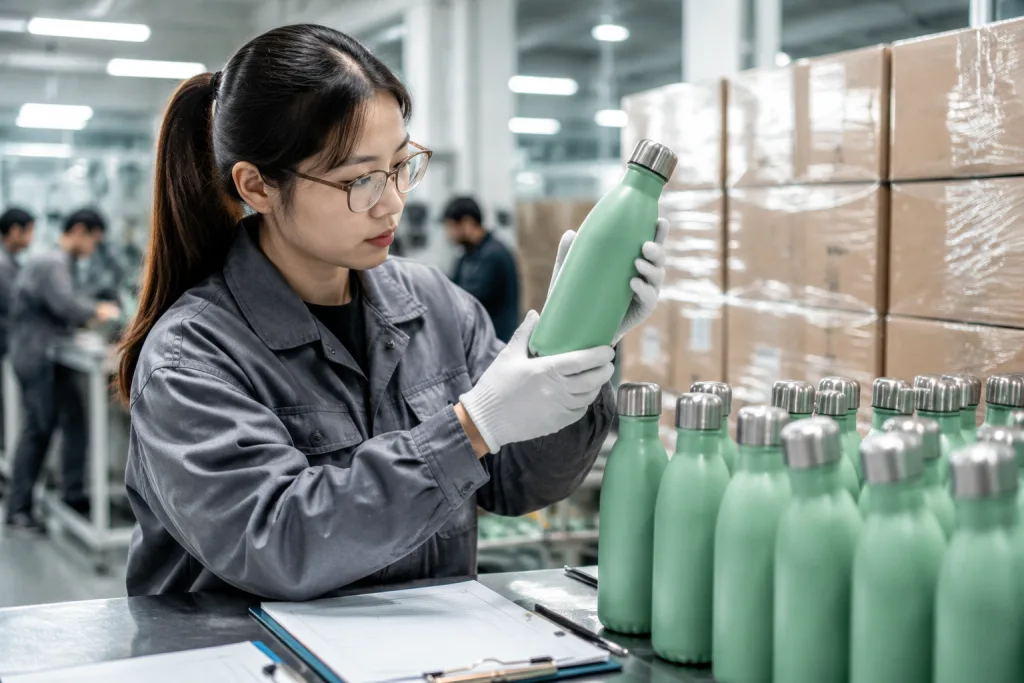
Ask your canteen suppliers for a real pre-shipment inspection checklist, not a one-page PDF with boxes ticked by hand. It should cover capacity check by measuring cup, weight check on a 0.1 g scale, visual coating check under 600–800 lux light, logo position, leak test, vacuum retention test, cap torque or function test, barcode scan, carton drop test, and carton mark verification. For children’s bottles or straw lids, add ASTM, CPSIA, or relevant market-specific requirements where applicable. QC pulled the sample last month because the PO said matte black but the carton mark printed “matt balck”; small typo, expensive relabeling.
Packaging is not decoration. For North America and Europe, master cartons go through 8–12 handling points before the buyer sees them. A typical export carton should use 5-ply corrugated board, with dividers or individual boxes if the coating is premium. If you ship to FBA or retail DCs, confirm FNSKU label placement, suffocation warning where needed, carton weight limits, and pallet height. We've seen this go sideways: saving USD 0.10 on a thin carton cost one customer USD 2.00 per unit in coating scratches, chargebacks, and warehouse relabeling after a 15 kg carton failed the corner drop.
Checklist: approve golden sample, define AQL 2.5 and AQL 4.0 rules in writing, require inspection photos with carton marks, confirm barcode scans, hold balance payment until inspection passes.
Pricing, MOQ, And Order Control
For a standard double-wall vacuum bottle from China, we usually see FOB pricing around USD 2.20-4.80 for 500-750 ml stock models with one-color logo printing or laser engraving. Bigger bodies, custom lids, premium powder coating, copper lining, retail boxes, and short color runs move the price up fast. A custom growler or customizable growler with handle and special cap often lands around USD 6.00-12.00 FOB, depending on capacity and finish. Last month QC pulled a 64 oz growler sample from the line; the handle rivet gap measured 0.6 mm wider than the approved sample, so that cap-and-handle set needed extra fitting time.
MOQ is not a punishment. It is how we run line changeover, coating batch loss, packing setup, and material buying without burning margin. For stock models, 1,000 pcs per color is a realistic starting point. For canteen customized colors, 3,000 pcs per Pantone color makes more sense because the powder coating room needs a clean batch, not 300 pcs of six colors. For a new lid or body mold, expect 5,000-10,000 pcs annual commitment plus tooling cost. We have seen this go sideways when a buyer asked for 8 Pantone colors at 500 pcs each; the math did not work after coating loss, carton labels, and 8 separate pre-shipment checks.
If you are a distributor drinkware buyer, do not build 12 SKUs before the first container ships. A cleaner first program might be 2 capacities and 3 colors using 1 shared carton structure. That is easier for a canteen factory to produce and easier for your warehouse to count with a handheld scanner. For distributor growler programs, keep caps and gaskets common across sizes where the design allows it. Replacement parts matter when you sell repeat volume. We ship gasket bags in 100 pcs inner packs, and buyers notice quickly when a 32 oz cap does not fit the 40 oz body they assumed was the same neck size.
Payment terms are usually 30% deposit and 70% before shipment for first orders. Established buyers with stable annual volume can negotiate better terms after 3-4 clean shipments with no overdue balance and no PO surprises. Do not chase the lowest quote among canteen manufacturers without comparing steel grade, wall thickness, lid material, coating process, inspection level, carton strength, and FOB port. This is the wrong question to ask if the quote sheet stops at unit price. A USD 0.18 saving can disappear fast if the factory uses thinner cartons or untested gaskets; we once had the buyer flag a 5-ply carton spec typed as 3-ply on the PO, and that one typo would have changed the drop-test result.
How To Choose The Right Partner
You need a canteen supplier who can say no. Good factories do this daily. If every request gets a fast “yes,” nobody is checking the line limits. A proper vacuum insulated bottle manufacturer will push back when a 0.18 mm logo stroke will blur in silkscreen, when a flip lid fails after 30 minutes on the leakage tester with carbonated water, or when matte powder coating cannot support a dishwasher claim. We have seen buyers flag this after launch, and the math does not work once 12 cartons are already in the retailer’s warehouse.
Before placing a PO, ask for the business license, factory audit status, product test reports, and sample references. BSCI, ISO 9001, and social compliance audits matter, but they do not replace product testing. For Europe, REACH and LFGB may be relevant depending on material contact. For the United States, FDA food contact expectations, CPSIA for children’s products, and California Proposition 65 review may apply. For Canada, check bilingual labeling if retail packaging is involved. QC pulled one sample last month where the PO said “304 stainless,” but the carton mark typed “340 stainless”; small typo, big buyer argument.
A good canteen manufacturer in Zhejiang or another China production hub should talk about risk before it becomes your problem. If 304 stainless sheet moves by RMB 800 per ton, if powder coating lead time shifts from 12 days to 18 days before Chinese New Year, or if carton artwork sits unapproved for 3 working days, you should hear it early. Silence is expensive in procurement. We ship better when the buyer knows the bad news on Tuesday, not after the vessel cut-off on Friday.
When comparing canteen vendors, request one sample from each using the same specification. Run the same check on all of them: fill with 95°C water, weigh the bottle on a 0.1 g scale, inspect the weld line under a desk lamp, smell the silicone gasket, scratch the coating lightly under the base, and test the cap in a bag for 2 hours. Simple test. This buyer-side check will remove 3 or 4 weak suppliers before you commit to 5,000 pcs. The right partner is not always the cheapest; it is the factory that can repeat the approved sample on mass production without QC sorting half the line.
Send Your Bottle Spec For A Factory Quote
Share capacity, quantity, logo files, target market, and packaging needs. We will reply with MOQ, FOB pricing, sample timing, and risk notes.
Frequently asked questions
What MOQ should I expect from a vacuum insulated bottle manufacturer?
For stock bottle shapes, expect 1,000 pcs per color as a practical MOQ. Some canteen vendors may offer 500 pcs, but the unit price usually rises because decoration setup, coating loss, and packing labor are spread over fewer units. For Pantone powder coating, 3,000 pcs per color is more realistic. For a new custom canteen mold or special lid, plan for 5,000-10,000 pcs annual volume plus tooling. If you are testing a distributor drinkware program, start with fewer colors rather than many small SKUs. A 3,000 pcs order split into 3 colors is usually easier to control than 10 colors at 300 pcs each.
How long does a customized drinkware order take from sample to shipment?
A normal timeline is 5-7 days for a logo sample on a stock bottle, 10-15 days if you need custom color matching, and 25-35 days for mass production after deposit and sample approval. Add 3-7 days for inspection, booking, and loading. Sea freight from China to Europe or North America often takes 25-45 days port to port, depending on route and season. Before Chinese New Year, add buffer time because coating lines, carton suppliers, and forwarders become tight. If your canteen promotional deadline is fixed, approve artwork, carton marks, and compliance documents before paying the deposit.
Which decoration method is best for a canteen customized with a logo?
Laser engraving is the safest option for durability, especially on powder-coated stainless steel. It has a higher setup cost than simple printing but resists peeling and works well for corporate gifts, retail lines, and distributor canteen programs. Silkscreen is cost-effective for one-color logos, usually on orders above 1,000 pcs, but it can wear faster if placed where hands rub constantly. Heat transfer is better for multi-color artwork, while full-wrap printing needs more sampling because curved surfaces distort designs. Send vector artwork and Pantone references. For most bottles, logo placement tolerance of ±1.5-2.0 mm is reasonable.
What compliance documents should canteen suppliers provide?
At minimum, ask for food-contact material declarations and recent test reports for stainless steel, silicone, plastic lids, coatings, and inks. For Europe, REACH and LFGB are often requested. For the United States, FDA food-contact suitability is common, and CPSIA may apply for kids’ bottles. If selling in California, review Proposition 65 exposure requirements. For retail or promotional buyers, factory-level documents such as BSCI or ISO 9001 can help with vendor onboarding, but they do not prove the specific bottle is compliant. Ask the canteen supplier to link test reports to the exact materials and colors used in your PO.
How do I compare quotes from different canteen manufacturers fairly?
Give every canteen manufacturer the same specification sheet: capacity, steel grade, wall thickness target, lid material, coating type, logo method, packaging, inspection standard, FOB port, and required documents. Then compare by landed cost, not just FOB unit price. A USD 3.10 quote with 304 inner wall, 5-ply export carton, AQL inspection, and tested gasket may be better than a USD 2.85 quote with vague materials. Ask for carton dimensions, gross weight, units per carton, and CBM. For distributor growler or customizable canteen orders, also check replacement lid availability and whether future repeat orders can match the first production color.