Key Takeaways
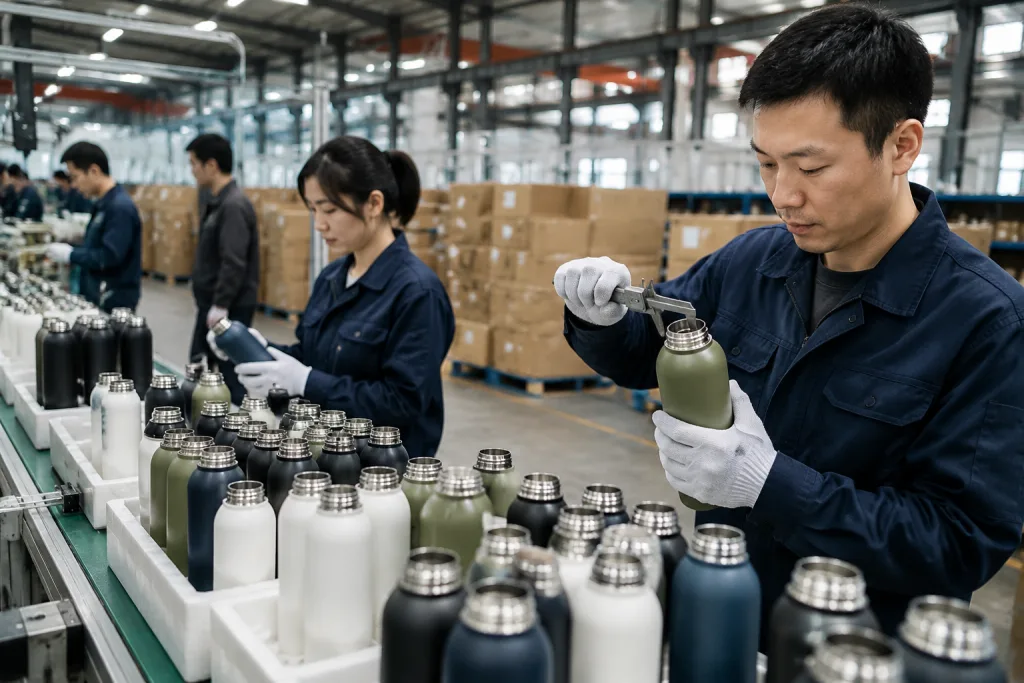
- 304 stainless steel at 0.5-0.6 mm body wall is the normal baseline for retail-grade insulated bottles
- A real vacuum insulated bottle factory should quote MOQ, lead time, AQL level, and FOB port clearly
- Powder coating usually adds USD 0.25-0.55 per unit depending on bottle size and color complexity
- Plan 30-45 days for mass production after artwork, PP sample, and deposit approval
A spec sheet looks boring until one line eats your margin. We’ve seen a 0.1 mm thinner inner wall pass the first quote, then QC pulled the sample and found the cup denting at the shoulder after a 1.2 m drop test. A cheaper cap gasket, a loose thread tolerance, or a lazy “keeps cold 24 hours” claim can turn a clean custom drinkware order into 3% returns, chargebacks, and one bad call with your retail buyer.
If you are choosing a vacuum insulated bottle factory in China, read the quotation like an engineer, not like a catalog. At BottleForge Industrial in Hangzhou, Zhejiang, we produce up to 450,000 stainless steel bottles and tumblers per month, with typical custom MOQ from 1,000 pieces per color. The buyer often asks, “Can you just match this cheaper quote?” Wrong question. The math does not work unless you check wall thickness with a digital caliper, confirm the silicone grade on the BOM, and challenge the spec lines below before you send a deposit.
Start with steel grade
The first useful line on a vacuum bottle spec sheet is not the capacity. It is the steel grade. For most B2B programs, we run SUS304 on the inner wall, also written as 18/8 stainless steel. It has the nickel and chromium needed for daily coffee, tea, juice, and cold water contact, and it is the normal choice for Europe and North America. SUS316 gives stronger corrosion resistance, but the math usually does not work unless the range is marine, medical, or premium outdoor. On our incoming check, QC uses a handheld XRF analyzer and logs the coil tag before the 0.5 mm sheet goes to the forming line.
Do not accept “stainless steel” without the grade written on the quotation and PO. We have seen this go sideways. Some low-end canteen suppliers use 201 stainless steel on the outer shell to shave cost, then describe the whole bottle as stainless steel. It can work for budget promotional orders if the buyer signs off, but I would not use it for a long-life retail bottle. One buyer flagged rust spots after a 72-hour salt spray check on a sample with a 201 outer shell; the saving was less than USD 0.18 per piece, and the complaint took 3 weeks to close.
Wall thickness is the next number. A typical retail bottle uses 0.5-0.6 mm steel for the inner and outer body before forming. Heavy growlers may use 0.6-0.7 mm. Thinner material cuts unit cost and weight, but dents faster and can pull out of shape during polishing or laser welding. Feel the shoulder after polishing. If the line operator can press a small flat spot near the weld seam with a thumb check, the buyer will notice it too. For a custom growler sold through outdoor distributors, the extra 30-60 grams is usually worth paying for.
Ask your canteen factory to state the inner steel grade, outer steel grade, wall thickness, and food-contact compliance to FDA, LFGB, or relevant EU rules. Export factories in China should already have material declarations and migration test reports on file. In Zhejiang, we keep batch steel records tied to production lots because overseas buyers ask for traceability after shipment, not only before deposit. Last month QC pulled the sample carton for lot HZ2409-18 because the PO typed “304 inside / stainless outside”; we corrected it to “304 inside / 304 outside” before mass production started.
Capacity is not just volume
Capacity looks simple on a spec sheet: 500 ml, 750 ml, 1 liter, 64 oz. On the line, it is where buyers get caught. Different markets read capacity by habit, and a bottle marked 20 oz might measure 590 ml at the shoulder, 600 ml brimful, or 620 ml if the lab fills it until the meniscus breaks. Last month QC pulled a 20 oz sample with a 600 ml base stamp, while the buyer’s PO said 590 ml; that typo would have shown up again on the color box. For retail packaging, that gap brings compliance questions and customer returns.
Tell your canteen manufacturer exactly how capacity must be measured. We recommend nominal capacity to the practical fill line for most distributor drinkware orders, not absolute brimful capacity. This is the wrong question to ask: “Can it hold 32 oz if filled to the top?” If your carton, barcode listing, and bottle base all say 32 oz, the bottle should hold 32 oz with 6-8 mm clearance below the cap thread, checked with a measuring cylinder before the pre-production sample is sealed.
Capacity also changes tooling choice. A canteen customizable by color and logo can often run on an existing mold, keeping MOQ at 1,000-3,000 pieces and sample time around 7-10 days. A new silhouette with a steeper shoulder angle or a proprietary cap fit may need tooling of USD 1,500-6,000 depending on size and complexity. We’ve seen this go sideways on customized growler projects: the mouth looks fine in 3D drawings, then the handle fails a 10 kg hang test after welding because the lid and neck need more structure.
Packaging dimensions matter as much as bottle dimensions. A 750 ml bottle at 78 mm wide will usually sit in standard cup holders; at 85 mm, the buyer flagged it as “too fat” after checking a Honda console with calipers. A 1,200 ml bottle may look stronger online, but the math doesn’t work if the master carton jumps into dimensional weight. For a canteen distributor shipping mixed cases across North America, a 3-5% freight difference can wipe out the savings from a cheaper FOB price. Before approving the shape, ask for unit weight, product dimensions, inner box size, master carton size, gross weight, and carton CBM.
Vacuum performance needs numbers
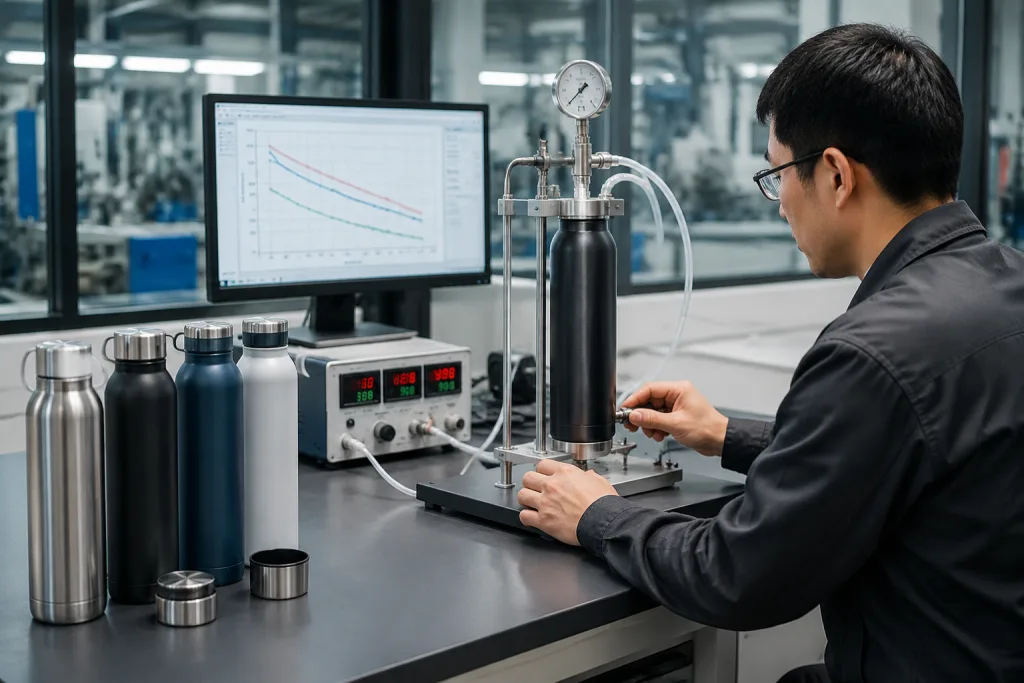
“Keeps hot and cold” is sales talk. Your spec sheet needs test conditions. On our Hangzhou line, a normal double-wall vacuum insulated bottle should hold hot water above 60°C for 6-12 hours, but the result moves with capacity, lid design, starting water temperature, room temperature, and neck opening. QC pulled a 500 ml wide-mouth sample last month that passed at 6 hours but missed the 12-hour claim by 4°C. Cold retention is often printed as 24 hours; if the lab adds 120 g of ice, the number looks better than real use.
Ask the vacuum insulated bottle factory to write the test method, not just the claim. A clean spec reads like this: fill with 95°C water, close lid, hold at 20°C ambient, measure water temperature after 6 hours. For cold: fill with 4°C water without ice, close lid, hold at 20°C ambient, measure after 12 or 24 hours. We run this with a calibrated probe, and the buyer once flagged a PO typo where “95°C” became “90°C”; that 5°C difference changes the result. If you sell through canteen distributors, fixed wording keeps the factory, importer, and distributor from arguing after delivery.
The big drivers are vacuum quality, copper plating, bottle volume, mouth diameter, and lid insulation. Better to price them one by one than ask, “How long does it keep hot?” That is the wrong question. Copper plating between the walls improves radiant heat resistance, often adding about USD 0.08-0.18 per unit, and we check the coating before the outer shell is welded. A wide-mouth customized canteen loses heat faster than a narrow-mouth bottle because the cap area acts like a thermal bridge; 58 mm mouth vs 38 mm mouth is not a small difference. A straw lid sells well, but it usually performs worse than a sealed screw lid.
We test vacuum failure by temperature decay and, for some orders, by automated vacuum detection before packing. For retail-grade customized drinkware, we normally recommend 100% vacuum performance screening before packing, then final random inspection under AQL 2.5 for major defects and AQL 4.0 for minor defects. The line can lose 2 days vs 0 days if we screen every piece, but the math still works. If your order is a canteen promotional campaign with a fixed launch date, do not skip the vacuum test to save those 2 days. We have seen this go sideways: one leaking batch means credit notes, rework labels, and cartons opened with a blade on the warehouse floor.
Lids decide leak complaints
About 7 out of 10 lid complaints we see from buyers start after sampling, not during color approval. The body color gets three rounds of Pantone comments, then the lid gets one quick “OK” on the PI, and that is where the trouble starts. Leaks in a backpack. Broken hinge pins. Gasket smell. Loose straw fit. Gritty cap threads. We run a 0.8 N·m torque check on threaded lids because a pretty bottle still fails if the cap feels rough or backs off in a school bag. A good canteen supplier should show lid material, gasket material, thread design, and whether extra lids can ship 6 months after the main order.
PP is the safe workhorse for flip and screw lids, Tritan is used when the buyer wants a clear insert or straw window, stainless steel works for premium caps with metal contact surfaces, and ABS should stay on exterior trim where it does not touch drinks. For Europe, ask for REACH and LFGB-related documentation where applicable. For the United States, FDA food-contact compliance is the usual baseline. Silicone gaskets should be food grade, removable for cleaning, and firm enough to recover after compression. QC pulled one sample last month where the gasket groove measured 1.6 mm instead of the drawing’s 1.9 mm; it sealed on day one, then loosened after 200 open-close cycles. The math doesn’t work if the groove is wrong.
If you are building a customizable canteen range for retail, plan lid families before you approve body tooling. One bottle body that accepts a screw lid, straw lid, and sports spout can turn 1 mold into 3 retail SKUs without cutting another body tool. We ship programs like this for distributors because spare lids cut warranty waste and make replenishment easier at 500 pcs MOQ per lid color. The buyer flagged it once when a PO said “black lid” but the artwork showed a charcoal lid with a red button; that kind of small mismatch becomes a warehouse argument later. A canteen vendor that cannot supply extra lids after the main order is leaving your after-sales team exposed.
Leak testing should be written into the purchase order, not left to a product photo. Our common method is to fill the bottle, close the lid, invert for 30 minutes, then shake or place horizontally depending on the lid type. For straw lids, we also check the vent hole with a 0.8 mm pin gauge because one blocked vent can make the buyer think the whole design is defective. Carbonated beverage claims need separate caution. Most vacuum bottles are not designed for pressure buildup unless specifically engineered and tested. For a customized growler intended for beer, you need a different lid seal standard than a daily water bottle. This is the wrong question to ask from a catalog image; ask for the test method and the failed-sample handling rule.
Surface finish changes failure rate
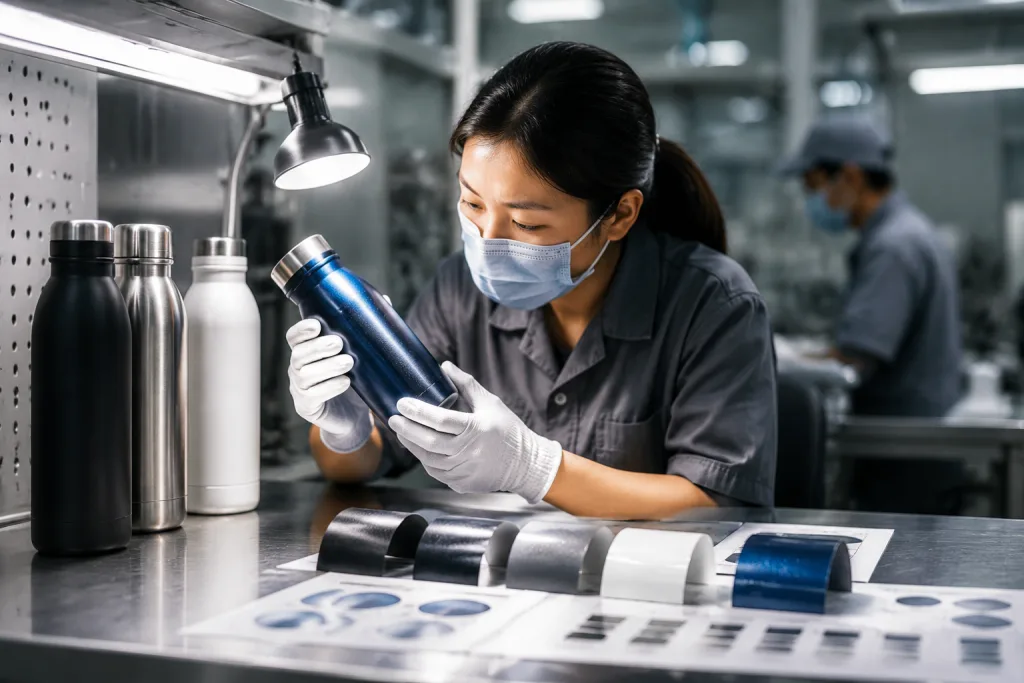
Finishing is where the bottle starts to look like your brand, and it is also where our defect rate moves first. Plain brushed 304 stainless is the safest finish; on our line, cosmetic rejects often stay around 1.5%-2% after final wipe-down with a 3M pad. Powder coating gives better grip and stronger shelf color, but QC pulled samples last month for five issues: ΔE color drift over 1.0, orange peel, dust nibs, weak tape pull, and cap-ring scratches after assembly. Spray paint can cut cost on some solid colors. For outdoor growlers and distributor programs, I still push buyers toward powder coat because the math works better after returns.
For powder coating, ask for the color standard by Pantone, RAL, or a physical swatch. Do not approve color from a phone screen. We run the first panel against a light box at D65, then keep the signed swatch beside the coating booth for the operator. A fair tolerance should be agreed before mass production, usually ΔE 1.0-1.5 for retail orders. Matte black, white, and dark green are common and efficient; our MOQ for these stock powders is usually 1,000 pcs. Metallic and gradient finishes cost more because the line speed drops and the second pass adds handling marks. Depending on size and finish, coating can add USD 0.25-0.55 per unit, while complex gradients may add more.
Adhesion testing should be written on the PO, not discussed after defects appear. Cross-cut tape testing, boiling water resistance, dishwasher simulation if claimed, and abrasion testing are workable checks. We use a 1 mm cross-cut blade and 3M 600 tape; if more than one square lifts, the batch gets stopped. If the bottle is not dishwasher safe, print it on the insert or bottom label. This is the wrong question to ask: “Will it survive a dishwasher?” Ask which coating system, which temperature, and how many cycles. A canteen customized for outdoor retail may handle hand washing for 3 years, then fail in 70°C dishwasher cycles within 12 days vs 18 days on a higher-grade powder. Claims must match the coating system.
Logo method also changes the finish risk. Laser engraving on powder coat exposes stainless steel and holds up well, usually with low setup cost after artwork; the buyer flagged one PO typo last season where “laser logo 35 mm” became “75 mm,” and the sample looked like a billboard. Silkscreen handles larger graphics, but it can scratch if the ink and coating are not matched, so we run a fingernail rub and alcohol wipe before approving bulk. Heat transfer supports full-color designs, with abrasion limits. For canteen promotional orders, a one-color silkscreen is enough most of the time. For premium customized drinkware, laser plus debossed packaging looks cleaner and gives fewer complaints after shipping.
Customization has hidden checkpoints
Custom drinkware is not “slap a logo on a bottle.” We control the approval path in 6 checkpoints: artwork file, digital mockup, pre-production sample, packaging proof, carton mark, and final inspection criteria. Skip one, and the line may still ship on time, but the buyer opens 86 cartons and finds the logo version from an old PDF. We’ve seen this go sideways. Last month QC pulled the sample because the PO said matte black, while the approved mockup showed PMS 426C gloss.
For logo artwork, vector files in AI, PDF, or EPS are best. Minimum line width matters. Laser engraving can hold fine detail, but 0.15 mm strokes often vanish on textured powder coating after the bottle comes off the rotary laser fixture. Silkscreen usually needs at least 0.2-0.3 mm line width depending on ink and surface. Curved bottles are less forgiving; a 70 mm wide logo can stretch at the edges if the print jig is set like a flat panel. A good canteen manufacturer should flag that before production. After defects appear, the math doesn’t work.
Packaging is customization too. Retail buyers ask for kraft boxes, color boxes, hang tags, instruction sheets, barcode labels, FNSKU labels for marketplace fulfillment, or warning labels, but each one needs a separate proof. If you are an Amazon-focused distributor drinkware buyer, check FNSKU placement and scannability before carton sealing; we run a handheld scanner on 10 random boxes before the master carton is taped. Club retail and corporate gifting buyers often push harder on carton drop tests, sometimes 1.2 m on 3 edges and 6 faces, not standard export packing. Small label mistakes cost days.
At BottleForge in Zhejiang, a typical custom canteen order follows this rhythm: 2-3 days for artwork confirmation, 7-10 days for sample, 30-45 days for mass production after deposit and sample approval, then vessel booking from Ningbo or Shanghai. Rush orders are possible, but rushing custom packaging, coating, and inspection together is the wrong question to ask. If the powder coating line needs 18 days and color box printing needs 12 days, promising a 20-day ship date leaves no room for AQL 2.5 recheck or a carton mark typo. China supply chains move fast. They are not magic.
Commercial terms reveal factory discipline
A serious quotation from a vacuum insulated bottle factory should never be one lonely FOB price. We list product code, capacity, 304 stainless steel grade, finish, logo method, lid type, packaging, MOQ, sample cost, production lead time, payment term, FOB port, carton size, gross weight, and validity date. On our line, one 500 ml bottle might ship 24 pcs/carton at about 12.5 kg, and that carton data matters when the buyer checks container loading. If a canteen vendor leaves these lines blank, this is the wrong question to ask: you are not comparing factories, you are comparing guesses.
MOQ depends on what you change. Existing bottle shape with standard color often starts at 1,000 pieces per color. Custom powder color usually needs 2,000-3,000 pieces because the coating line loses powder during booth cleaning, and the powder supplier will not open a small batch for fun. Fully customized canteen tooling can require 5,000 pieces or more before the math works. We have seen a buyer ask for 300 pieces with custom color, custom lid, custom box, and rock-bottom price; QC pulled the sample later and found stock bodies mixed with outsourced lids. The math doesn't work.
Inspection terms matter. Use AQL, define critical defects, and agree who pays for rework if failure exceeds the limit. Critical defects include leaking, sharp edges, wrong material, unsafe odor, and severe contamination; we run the leak test with warm water and check random units on a flat glass plate for base wobble over 1 mm. Major defects include coating peel, wrong logo position, poor lid fit, and visible dents. Minor defects include small dust points or slight carton scuffs within agreed tolerance. Canteen manufacturers shipping regularly to Europe and North America should not get nervous when a third-party inspector opens 80 cartons under AQL 2.5.
Check audit and compliance status before the PO, not after the deposit lands. BSCI, ISO 9001, Sedex, REACH, LFGB, FDA, and ASTM-related requirements may apply depending on channel and age grade. Kids bottles get stricter review than adult bottles; the buyer may flag a 6 mm straw tip, a silicone odor note, or a missing tracking label on the artwork file. A canteen supplier in China does not need every certificate for every buyer, but the factory should say what is current, what is product-specific, and what needs new testing. A clean answer beats a fat certificate folder.
Send your bottle spec sheet for factory review
We will check steel, lid, coating, MOQ, packaging, and FOB assumptions before you lock the custom drinkware order.
Frequently asked questions
What MOQ should I expect from a vacuum insulated bottle factory?
For an existing stainless steel bottle shape with your logo, a realistic MOQ is usually 1,000 pieces per color. If you need a custom powder coating color, many canteen suppliers will ask for 2,000-3,000 pieces because of coating setup and powder waste. New tooling for a fully customized canteen or custom growler often needs 5,000 pieces or a tooling charge of roughly USD 1,500-6,000. Very low MOQ offers can work for stock goods, but they rarely support stable color, packaging, and inspection control.
How long does custom drinkware production take in China?
A normal timeline is 2-3 days for artwork confirmation, 7-10 days for pre-production sample, and 30-45 days for mass production after deposit and sample approval. Add time for third-party inspection and vessel booking from Ningbo or Shanghai. During peak season, especially before summer launches or Q4 promotional orders, allow another 7-14 days. If your canteen distributor program needs retail packaging, barcode labels, or FNSKU labels, approve those files before the sample stage.
Is 304 stainless steel always required for insulated bottles?
For the inner wall, yes, 304 stainless steel is the normal baseline for food-contact vacuum bottles sold in Europe and North America. The outer wall may be 304 or sometimes 201 on budget promotional items, but that should be clearly disclosed. For retail customized drinkware, we recommend 304 inside and outside because it reduces rust complaints and gives better long-term brand value. Ask for steel grade, wall thickness, and food-contact test reports rather than accepting the phrase “stainless steel.”
Which logo method is best for a customized canteen order?
Laser engraving is the most durable choice on powder-coated bottles and works well for one-color brand marks. Silkscreen is better for larger logos and simple promotional graphics, but ink adhesion must be tested on the chosen coating. Heat transfer can produce full-color artwork, though abrasion resistance is usually weaker than laser. For canteen promotional orders under tight budgets, one-color silkscreen is common. For premium distributor canteen lines, laser engraving plus a quality retail box gives a cleaner finish.
How do I compare FOB prices from different canteen vendors?
Make each canteen vendor quote the same specification: capacity, 304 steel grade, wall thickness, lid material, coating, logo method, packaging, MOQ, carton size, and AQL inspection level. A USD 0.30 cheaper bottle may use thinner steel, no copper plating, lower-grade outer shell, or a cheaper gasket. Also compare FOB port, usually Ningbo or Shanghai for Zhejiang-area factories. Without carton CBM and gross weight, you cannot calculate landed cost accurately, especially for bulky distributor drinkware orders.