Key Takeaways
- A realistic MOQ for custom vacuum bottles is usually 1,000-3,000 units per SKU and color
- 304 stainless steel, 0.4-0.5 mm outer wall, and copper plating affect both price and insulation
- Normal lead time is 30-45 days after artwork approval, longer for new molds or PMS coating
- Use AQL 2.5/4.0 inspections, FDA/LFGB/REACH checks, and carton drop tests before shipment
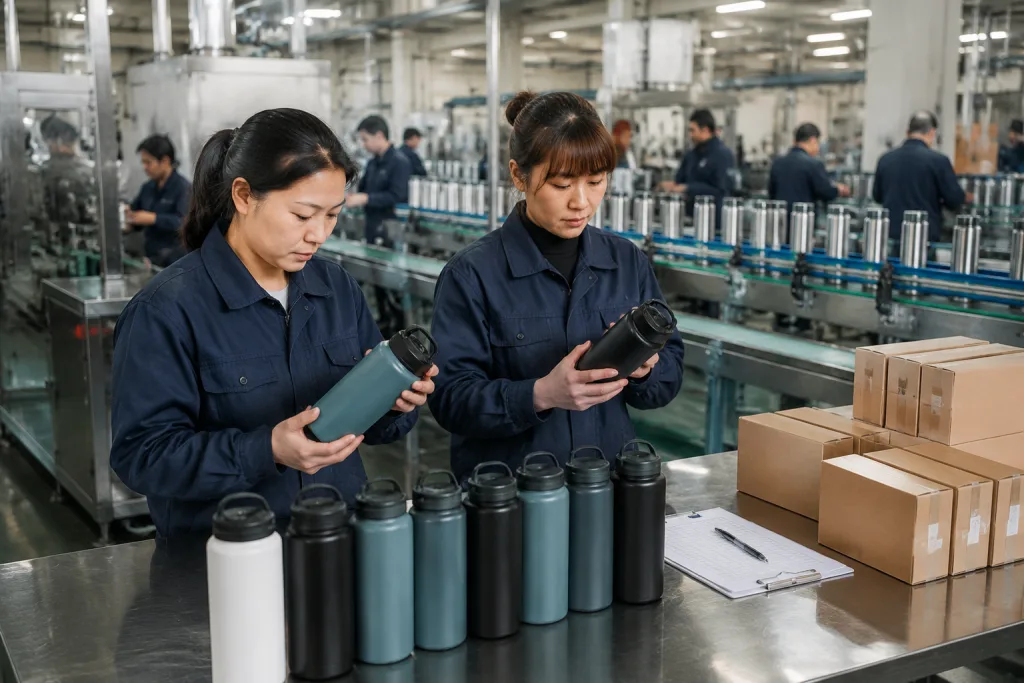
If you sell to outdoor retailers, corporate gift programs, schools, or Amazon resellers, your problem is not the bottle photo. It is getting the same canteen we signed off: same 312 g body weight, same powder-coat texture, same laser logo depth, same lid fit after the second shipment. QC pulled a sample last month where the approved black was 18 gloss units, but bulk came out at 31. The buyer flagged it fast. Vacuum insulated bottle distributors live or die on repeatability.
From our factory base in Hangzhou, Zhejiang, we see Europe and North America buyers repeat 3 early mistakes: chasing a USD 0.20 lower FOB price without checking steel thickness, skipping a 1.2 m carton drop test, and approving a custom canteen before anyone puts a torque meter on the lid. This is where orders go sideways. China can manufacture excellent custom drinkware, but the line needs clear specs, not a PO that says “same as sample” with the color code typed wrong.
Start with the distributor problem
Vacuum insulated bottle distributors are not buying one nice sample. You are buying stock that gets dropped in a warehouse, opened during retailer audits, thrown into parcel vans, and blamed when an end user says the lid leaks. Different game. That changes how you brief a canteen factory in China; last month QC pulled 32 bottles from a packed carton test after the outer box corner crushed at 9 kg stacking pressure.
The first question is channel. Outdoor shops need packaging that survives shelf handling and a coating that passes a 3M tape pull after logo printing. A canteen promotional order for a bank event usually cares more about gift-box presentation and a clean logo position, often within 0.5 mm on the pad-printing jig. A custom growler for breweries may need 64 oz capacity, a beer-friendly wide mouth, and a swing handle that does not rattle. School programs are different again: 350 ml or 500 ml bottles, leakproof straw lids, CPSIA-aware documentation, and no sharp burrs around the mouth thread. We have seen this go sideways when the buyer only wrote “kids bottle” on the PO.
Do not send only a photo and ask for “best price.” That is the wrong question to ask. A canteen manufacturer will quote the cheapest interpretation unless you define the commercial job. Give capacity, shape, lid type, coating, logo method, carton requirement, target FOB port, and annual forecast, with the logo file in AI or CDR so the laser room is not tracing a blurry JPEG at 10 p.m. If you expect repeat orders, say so. A responsible canteen supplier prices tooling, coating line setup, and stainless steel purchase differently for a one-time 1,000-piece order versus a 60,000-piece annual program.
At BottleForge Industrial in Zhejiang, our monthly output is about 600,000 stainless drinkware units across bottles, tumblers, growlers, and food jars. For distributor canteen projects, our practical MOQ is 1,000 units per color for existing molds and 3,000 units when you need a new lid color or special coating. That is not a sales trick; coating, welding, polishing, and logo fixtures all create setup loss. On the line, a color change can burn 18 kg of powder before the finish reads clean under the light box. Small orders are possible, but the math does not work the same, and the unit price and defect risk usually rise.
The specification questions buyers skip
A vacuum bottle quote only means something when the construction is written on the spec sheet. We see 7 out of 10 canteen distributor RFQs ask for capacity and FOB price only. That is the wrong question to ask. Better buyers lock steel grade, wall thickness, vacuum process, lid material, sealing ring, coating spec, and test method before we open the sample mold; last month QC pulled a 750 ml sample where the PO said “same as last order” but the old order used a different lid gasket.
For mainstream customized drinkware, 304 stainless steel is the normal inner and outer body material. Some budget canteen vendors switch the outer shell to 201 stainless to shave about USD 0.18-0.35 per bottle at 3,000 pcs MOQ. It passes for low-cost promo jobs, but the math doesn't work for humid coastal regions; we have seen orange rust spots show up after a 48-hour salt spray check on a 201 outer shell. For European and North American retail, we recommend 304/304 unless the buyer has a hard shelf-price target and accepts the risk in writing.
- Wall thickness: 0.4 mm outer wall and 0.5 mm inner wall is common for 500-750 ml bottles. Dropping to 0.35 mm saves cost, but the line sees more dent marks during carton drop testing.
- Vacuum layer: copper plating improves heat reflection and can add 2-4 hours to insulation performance in controlled testing. We run the hot-water test at 95°C fill temperature, then log readings at 6 hours and 12 hours.
- Lid plastic: PP is common for hot-water contact. Tritan is used for transparent parts, and silicone rings should be food-grade; QC checks ring odor and fit with a 0.02 mm feeler gauge when leakage complaints are sensitive.
- Coating: powder coating is tougher than basic spray paint, but color matching can vary by ΔE 1.0-2.0 unless controlled. Ask for the Pantone code and a signed color chip, not a phone photo from the coating room.
For a canteen customized with laser engraving, make sure the outer coating thickness is consistent. If the powder coat runs 55 μm on one side and 85 μm near the shoulder, the engraving shade will look patchy under retail lighting. For silk screen printing, ask for adhesion testing after 3M tape pull and dishwasher simulation if you will make dishwasher-safe claims. For a customizable canteen with multiple logo areas, request a print position tolerance such as ±1.5 mm, not “centered nicely”; we have seen this go sideways when a buyer flagged a logo 2 mm off-center after goods were packed.
A custom canteen should also include actual capacity tolerance. A bottle sold as 750 ml may hold 735-760 ml depending on shoulder shape and fill line. That is fine if declared internally, but it becomes a customer complaint if your catalog promises exact volume. Put the tolerance on the artwork approval sheet; one PO typo, “750 ml net” instead of “750 ml nominal,” cost a distributor 12 days of relabeling before we could ship.
What should pricing include
FOB pricing for vacuum insulated bottle distributors should be dull, line-by-line, and easy to check. If a canteen vendor sends one clean number with no breakdown, the wrong question is “why so cheap?”; ask what they cut. We have seen quotes lose the 0.8 mm inner wall, swap the carton to 5-layer thin board, or remove the barcode sticker, then QC pulls the sample and the buyer flags it after the PO is already signed.
For an existing 500 ml stainless bottle, a normal FOB Ningbo or Shanghai price from a China canteen manufacturer may sit around USD 3.20-5.80 depending on steel grade, powder coating thickness, lid build, logo process, and packaging. A 1,000 ml bottle may run USD 5.20-8.50. A customized growler, especially 1.9 L or 64 oz, can range from USD 9.00-16.00 when it uses heavier gauge steel, a handle lid, and retail color box. These are working ranges, not promises, because 304 stainless coil and USD/RMB rates move; last April we rechecked coil pricing on a 2,400 pc growler order and the math changed by USD 0.18 per unit before deposit.
Ask whether the price includes logo setup, PMS color matching, inner polybag, instruction sheet, barcode sticker, master carton, and export carton marks. For Amazon or 3PL shipping, ask about FNSKU labeling, suffocation warning on polybags, carton weight under 15 kg where possible, and ISTA-style drop expectations. Small stuff matters. We once had a PO typo showing “FNSK” instead of “FNSKU,” and the line packed 38 cartons before QC caught the missing label field on the packing bench.
Tooling is where new buyers get caught. Existing mold customization is usually cheap: logo, color, lid color, sleeve, and packaging can run on the same body mold and vacuum line. A new bottle body may need USD 3,000-8,000 in tooling. A new lid with moving parts can be USD 5,000-15,000 and take 35-50 days before mass production starts. If you need canteen custom work but your launch quantity is 1,000 units, use an existing mold first; the tooling math does not work when the first run only fills 42 cartons on a pallet.
Cheap unit price only counts when the same factory can repeat it for your second and third purchase order without changing steel, carton spec, or inspection standard.
Checklist before sample approval
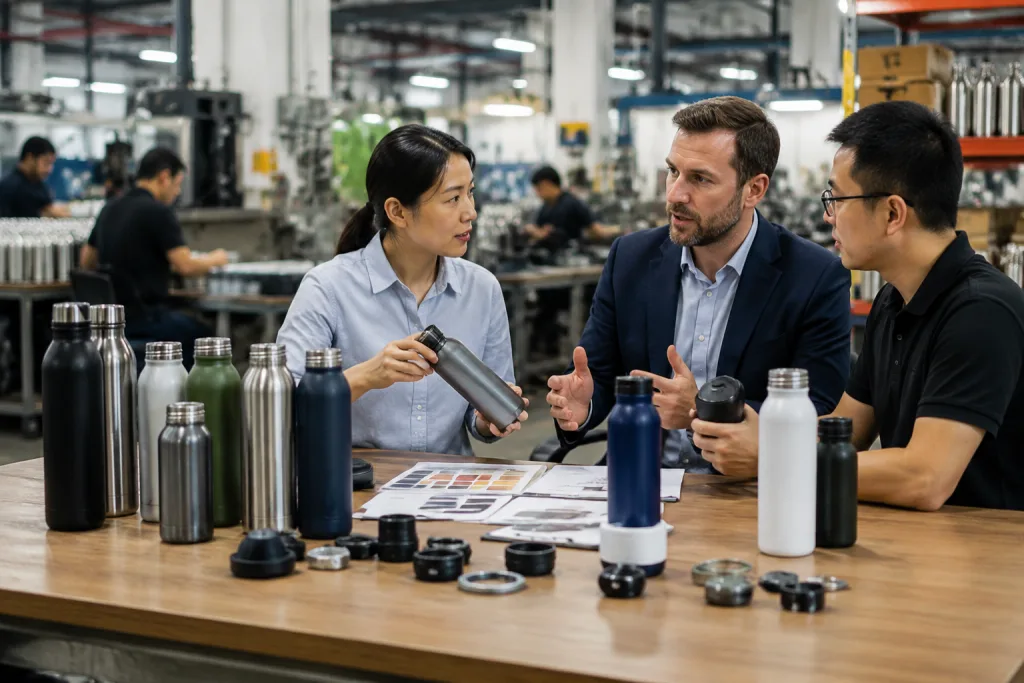
Sample approval is where 7 out of 10 distributor drinkware projects start drifting. A polished hand-made sample from the sample room does not prove the line can repeat it at 5,000 pcs. We run into this often: QC pulled the sample, the logo looked clean, then mass production showed a 2 mm print shift because the jig was not locked. The checklist has to force the canteen factory to confirm items you can measure.
Before approving a pre-production sample, check these points:
- Actual filled capacity, measured to the practical fill line with a graduated cylinder, not brim-only marketing capacity.
- Empty bottle weight on a digital scale, with an acceptable tolerance such as ±5% for mass production.
- Insulation test, for example 95°C water, 20°C room temperature, measured after 6, 12, and 24 hours, with the thermometer probe logged by QC.
- Leak test with bottle inverted for 30 minutes and shaken for 30 seconds after lid tightening; we usually check 3 samples, not 1.
- Lid torque and thread feel, checked by hand and torque meter, especially for wide-mouth bottles and custom growler caps.
- Logo size, print position, Pantone color, engraving depth, and adhesion test result, with 3M tape pull photos kept in the sample file.
- Coating surface: no obvious orange peel, pinholes, dust points, or color mismatch under D65 light; one dust point near the base is different from 12 on the front body.
- Packaging drop test from 76 cm on one corner, three edges, and six faces for export cartons, using the actual 12 kg master carton if that is what we ship.
If you are buying canteen customizable products in 4 colors, approve every color. Do not approve black and assume sage green will behave the same. Wrong question. Ask which color is hardest to run. Light powder coating shows dirt and welding shadows faster, and QC often flags the seam area under D65 light. Metallic coatings need tighter batch control; we have seen champagne gold pass on Monday and look warmer by Friday after a powder change.
For customized canteen packaging, ask for a blank dieline before artwork starts. North American buyers often need UPC or FNSKU labels, and one missing digit on a PO can stop warehouse receiving. European buyers may need language blocks, recycling marks, country of origin, and importer details. Zhejiang factories handle these requirements every week, but put them in the purchase order and attach the label position in mm. Verbal packaging instructions go sideways.
Compliance is not optional paperwork
For Europe and North America, compliance is built into the bottle, not a PDF you chase 7 days before ETD. We check food-contact requirements, 304 stainless declarations, coating specs, and gasket material before we take the deposit; if a canteen manufacturer says “test later,” the buyer should push back hard. We had one PO last year where “LFGB” was typed as “LFGD,” and QC caught it only because the sales order review used a 12-point compliance checklist.
For the EU, buyers usually ask for LFGB or EU 1935/2004 food-contact testing, plus REACH screening for powder coating, spray paint, silicone rings, and plastic lids. For the United States, FDA food-contact expectations apply, and California buyers often send Prop 65 questions before artwork approval. For children’s bottles, ASTM F963 and CPSIA-related checks may apply depending on age grading, decoration, and small parts. If your product is not a toy, do not market it like one. The line needs to know this too; a 6 mm loose straw stopper is a different risk from a welded handle on an adult 750 ml bottle.
Factory audits matter, but don’t treat them like magic paper. BSCI, Sedex, ISO 9001, and similar systems do not guarantee a clean shipment, but they show whether the canteen supplier runs basic process control. Ask for the audit scope and date. A three-year-old audit for another site is weak evidence. If you sell to major retailers, confirm the actual production workshop in China is covered, not just a trading office in Ningbo. We have seen this go sideways when the audit listed Workshop A, while the order was packed in Workshop C beside a different packing line.
For inspections, we run AQL General Inspection Level II with critical defects at 0, major at 2.5, and minor at 4.0 for most distributor canteen orders. Critical defects include sharp edges, leakage, unsafe contamination, and wrong material. Major defects include deep coating scratches, wrong logo, weak insulation, and carton marking errors. Minor defects include small cosmetic marks inside the approved limit sample. QC pulled a sample from a 120-carton lot last month and found 3 cartons with the shipping mark printed 5 mm too low; not dangerous, but the retailer’s warehouse scanner flagged it.
Do not let any canteen vendors ship before inspection if this is your first order. A USD 300 inspection is cheaper than sorting 2,000 leaking bottles in a warehouse in Germany or Illinois. Simple math. Once the container leaves Ningbo or Shanghai, a loose lid gasket that costs USD 0.03 becomes a chargeback, a rework crew, and 18 days of emails nobody wants.
How to manage repeat orders
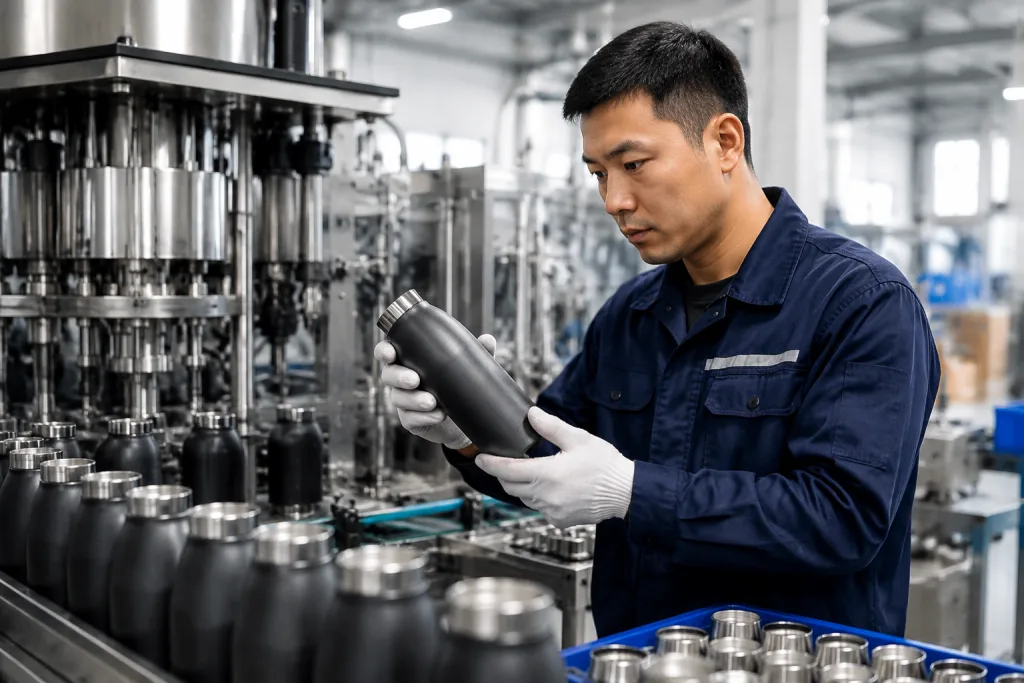
The best vacuum insulated bottle distributors keep a repeat spec file, not a loose chat history. First order, QC learns what the buyer will reject: a 0.3 mm logo shift, a lid that squeaks, or a carton mark printed from the wrong PDF. Second order should start from that file.
Create one master specification sheet for each SKU. Include mold number, capacity, bottle weight, steel grade, coating code, Pantone reference, logo file version, packaging dieline, carton dimensions, gross weight, test standards, and approved sample photos. We run this as a one-page control sheet plus 6-10 photos from the signed sample. If your canteen distributor program uses seasonal colors, split color approval from structural approval. The mold, lid fit, and gasket groove stay locked; only the powder chip moves. That cuts two DHL sample rounds in most repeat jobs.
Lead time depends on the work sitting on the line. For existing molds with standard colors, 30-35 days after deposit and artwork approval is realistic. For PMS powder coating, 40-45 days is safer because coating sample approval and line scheduling take time. We once had a buyer approve PMS 5535C on screen, then reject the sprayed panel under a D65 light box. That cost 6 days. For new molds, allow 60-90 days including design, tooling, pilot samples, correction, and mass production. During peak China export periods before summer and Q4, add 7-10 days of buffer.
Repeat orders should still be inspected. Tooling wears, coating powder batches change, and lid gasket suppliers sometimes update material. Keep a golden sample at your office and at the factory, with the sample code written on the bottom label. QC pulled a repeat-order sample last month and found the silicone ring was 0.4 mm thinner than the approved lid. Small part, big leak risk. When a canteen supplier says “same as last time,” ask them to confirm the exact sample code and production date.
If you are comparing canteen manufacturers, look beyond the first quote. Ask how they handle spare lids, replacement gaskets, mixed container loading, and partial shipments. A practical Zhejiang supplier should be able to ship 1,000 units by LCL, 8,000-12,000 units in a 20 ft container depending on size, or combine bottles and tumblers in one 40 HQ container with carton mapping. The buyer often flags this late, after the PO says “ship all together” but sales wants 300 cartons released early. We’ve seen this go sideways. Distribution is logistics, not just product sourcing.
Send your bottle spec and target landed cost
We will review mold options, MOQ, packaging, compliance needs, and FOB pricing before you commit to a production order.
Frequently asked questions
What MOQ should vacuum insulated bottle distributors expect?
For existing molds, expect 1,000 pieces per SKU and color as a practical starting point. Some canteen suppliers quote 500 pieces, but the unit price is usually higher and color consistency is harder because the coating line still needs setup. For PMS powder coating, 1,500-3,000 pieces is more realistic. For a new custom canteen body or lid, plan for 3,000-5,000 pieces per first run, plus tooling. If you are testing a new distributor canteen program, start with an existing 500 ml, 750 ml, or 1,000 ml mold and invest in packaging and logo quality first.
Which logo method is best for customized drinkware?
Laser engraving is the safest for long-term durability because it removes coating and exposes stainless steel. It works well for outdoor, corporate, and retail customized canteen orders, but it is usually single-color. Silk screen printing is better for simple one- or two-color logos and can cost USD 0.08-0.25 per position depending on size. Heat transfer supports full-color artwork but needs careful adhesion testing. For premium custom drinkware, debossed metal badges or 3D silicone patches are possible, but MOQ and setup cost rise. Always test logo adhesion after tape pull, abrasion, and warm-water exposure.
How do I compare two canteen factory quotations fairly?
Put both quotes into the same spec table. Compare steel grade, bottle weight, wall thickness, lid material, coating type, logo method, packaging, testing, MOQ, payment terms, and FOB port. A USD 4.10 bottle and a USD 4.45 bottle may not be the same product if one uses 201 outer steel, thinner walls, or a cheaper carton. Ask each canteen manufacturer for measured weight and insulation data, not only catalog claims. Also check whether sample cost, logo setup, color matching, FNSKU labeling, and export carton marks are included. The cheapest canteen vendor often becomes expensive when you add missing requirements.
Can I order a customized growler and matching bottles together?
Yes, if you use existing molds and align the coating color, logo method, and packaging style. A customized growler may have a 1.9 L capacity and heavier carton, while matching 500 ml or 750 ml bottles pack more densely. Mixed production is normal, but each item usually has its own MOQ, often 1,000 pieces per style and color. For a distributor growler set, confirm carton dimensions early because freight cost can change the landed price by 8-15%. If you want one gift box containing a growler and cups, ask for a drop test before mass production packaging is approved.
What lead time should I promise my retail customers?
For a repeat order with an approved bottle, standard color, and existing packaging, promise 35-45 days production plus ocean or air freight. For a new customizable drinkware project with color sampling, logo testing, and retail packaging, 50-65 days is safer. New molds can push the timeline to 90 days before goods leave China. Add time for inspection, customs, and local delivery. If your retailer has a fixed launch date, do not use the factory production date as your customer promise. Build in at least 10 days of buffer for coating rework, vessel delays, or carton label corrections.