Key Takeaways
- A realistic MOQ for OEM vacuum bottles is 1,000-3,000 units per color and size
- 304 stainless steel is standard; 316 steel is useful for salt, sports, or premium outdoor lines
- Powder coating plus laser engraving is safer for long-life retail branding than low-cost decal work
- Normal production lead time is 35-45 days after artwork, deposit, and pre-production sample approval
A vacuum insulated bottle customizable enough for retail, promotion, or distributor programs is not one SKU on a price sheet. You are choosing capacity, 304 stainless steel thickness, lid structure, logo process, test reports, carton layout, and shipment timing in one go. Miss one point and the pre-production sample can still photograph well, while the order loses margin, leaks at 3%, or arrives with mixed color shades on the same retail shelf. QC pulled a 500 ml sample last month where the silicone ring sat 0.6 mm proud; it looked fine until the tilt leak test.
From our Hangzhou, Zhejiang line, we run it this way: confirm the use case first, then fix the bottle construction, decoration, compliance, and packing details. Cheap bottles are easy to quote. Reorderable bottles are harder. The lowest FOB price is often the wrong question to ask if your buyer expects the same lid fit, powder coating, barcode position, and 24 pcs carton packing on the second order. We have seen this go sideways when a PO typo changed “matte black” to “metal black,” and nobody caught it until cartons were already stacked by the loading door.
Start with the buying job
Before you ask a canteen supplier for a price list, pin down the job first. This is the wrong question to ask if the bottle has no channel yet. A retail bottle, a corporate gift, a school bottle, and a distributor drinkware line behave like four different orders on our line. We run the same 750 ml body with different lids, coating thickness, logo method, and carton packing; QC once pulled a sample because the PO said “mat black” instead of “matte black,” and that typo changed the whole finish check.
For retail, consistency beats saving USD 0.20. You need stable powder coating, repeatable color, barcode position, display cartons, and defect control under AQL inspection. We check coating with a 3M tape test and a 500 g cross-hatch pull before cartons are sealed. For a canteen promotional campaign, a simpler lid and lighter gift box can work if the event date is fixed and the order is used once. For a canteen distributor or distributor canteen program, reorderability is the asset: the same lid, gasket, coating, and carton size need to be available six months later, not replaced by a “similar” part from another mold.
The first decision is capacity. In Europe and North America, 500 ml, 600 ml, 750 ml, and 1,000 ml cover most bottle programs. Simple enough. A custom growler or customizable growler is a different build; 1.9 L and 2 L formats need stronger handles, wider mouths, and tougher carton testing because filled weight is higher. We drop-test growler export cartons at 76 cm, and the corner crush tells the truth fast. A customized growler with a weak swing handle is a warranty problem waiting to happen.
Then decide the sales channel. Amazon FBA needs FNSKU labels, polybag warnings where applicable, and carton weights warehouse staff will tolerate; our cutoff is usually under 15 kg per master carton unless the buyer signs off. Retail chains usually ask for GS1 barcodes, carton marks, and sometimes BSCI audit documentation. Promotional buyers mostly care about logo accuracy, delivery date, and clean unit cost. Do not let a canteen vendor quote one generic bottle before you tell them the channel; we have seen this go sideways when the buyer flagged missing FNSKU labels after 128 cartons were already packed.
Choose steel and insulation honestly
The steel decision starts with what touches the drink and what the buyer wants to claim on the shelf. We run inner 304 stainless steel for most vacuum bottles, with outer 201 or 304 stainless steel depending on target price. For acidic drinks, saltwater use, or a premium outdoor line, I would not argue over pennies: use 304 inner and 304 outer. 316 stainless steel costs more, usually adding USD 0.40-0.90 per unit depending on size, but it gives better corrosion resistance for marine, fitness, and high-end customized drinkware ranges. QC once pulled a 304/201 sample from a 600 ml order after the buyer’s PO said “full 304” in one line and “201 outer OK” in another. Fix the wording before sampling.
Wall thickness decides dent resistance as much as weight. Most vacuum bottles we ship use about 0.4-0.5 mm stainless sheet before forming; after stretching, the shoulder and bottom radius are the spots QC checks with a micrometer. Going lighter can cut FOB cost, but the math does not work if 3 cartons arrive with side dents and your distributor deducts from the invoice. We have seen this go sideways with canteen distributors. Dents become chargebacks, not factory theory. Ask your canteen manufacturer for finished bottle weight tolerance in grams, not just steel grade.
Vacuum insulation claims need a test boundary. A 750 ml double-wall bottle can often keep water hot for 12 hours and cold for 24 hours under controlled tests, but we need the starting temperature, room temperature, lid position, and fill volume written down. Small details move the result. A wide-mouth bottle loses heat faster than a narrow-mouth bottle because the opening area is larger. A straw lid sells well for gym programs, but it will not hold heat like a sealed screw cap. If a canteen factory promises “all-day hot” without a test method, ask for the internal test report and the infrared thermometer log from the line.
Lid choice is where buyers under-spec. Screw lids are simple and reliable. Flip lids sell well for sports, but the hinge pin, spring, button, and silicone plug need cycle testing, not just a nice photo. Straw lids need spare straws and cleaning instructions; one buyer flagged this after the carton artwork was already approved, and changing the insert added 4 days. For kids or school programs, check relevant food contact and child-use requirements. A good canteen manufacturer will discuss gasket material, thread fit, torque feel, and leak testing at 100% inline inspection, not only the bottle body.
Match decoration to reorder risk
A vacuum insulated bottle customizable for brand work usually lands on one of five decoration methods: silk screen printing, laser engraving, heat transfer, water transfer, or full-color UV printing. They do not carry the same reorder risk. Silk screen is the safe, cheap choice for a 1-color logo and can be around USD 0.08-0.25 per color per unit at volume; on our line, the screen frame and ink viscosity check take about 20 minutes before first-pass approval. Laser engraving costs more, but it is permanent and looks clean on powder coating or 304 stainless. Heat transfer gives wider artwork coverage, but QC pulled samples last month with a 0.7 mm lifted edge after the tape test, so artwork edge design matters.
If you are building customizable drinkware for retail, do not approve decoration from a rendered mockup only. Wrong question. Ask for a physical pre-production sample under the actual finish, then check it under D65 light with the bottle held next to the approved Pantone chip. Pantone matching on powder coating is possible, but write the color tolerance on the PI before mass production; we usually discuss ΔE 1.5-2.0 for solid colors. Metallic, neon, and matte colors are harder to hold than black, white, navy, and army green. The buyer flagged this once after 3,000 pcs were coated, and the math did not work for re-coating.
For a custom canteen or customizable canteen program, decide whether the logo must survive daily use or just look sharp when the carton opens. Canteen promotional orders often choose silk screen because cost and deadline dominate; we ship those on tighter schedules when the artwork is 1-position and under 60 mm wide. Premium customized canteen programs usually use powder coating with laser engraving because the branding stays legible after abrasion. If the buyer wants a canteen customized with names or variable artwork, laser or UV digital printing supports personalization, but unit cost and production speed change fast. We have seen this go sideways when a PO says “individual names attached” but the Excel file arrives with 27 spelling typos.
One practical rule: decoration complexity should follow order size. At 1,000 units, keep artwork simple and reduce process risk; a single silk screen logo with AQL 2.5 inspection is easier to control than a wrap print with tight registration. At 10,000 units, custom molds, gradient coating, retail packaging, and multi-position decoration become easier to justify because setup loss spreads across more cartons. A canteen vendor may say yes to every artwork file. A better canteen supplier will tell you which decoration method creates the fewest rejects for your design, even if that answer kills a fancy idea from the deck.
Price the full landed order
FOB unit price is one line on the cost sheet, not the buying decision. For a 750 ml stainless vacuum bottle from China, we usually see a practical FOB range from USD 3.20 to USD 7.50, depending on steel grade, lid type, coating, logo method, packaging, and inspection level. A custom growler sits higher, often USD 8.00-15.00 FOB, because the body uses more 304 stainless, the handle needs pull testing, and the carton needs thicker protection. Last month QC pulled a 64 oz growler sample after the handle rivet opened 1.8 mm under load. Cheap quote. Bad math.
MOQ is where 7 out of 10 new buyers misread the order. A stock-shape vacuum insulated bottle customizable with your logo may start at 500-1,000 units if you accept existing colors and standard packaging. Custom powder coating usually pushes MOQ to 1,000 units per color because the line must clean the spray booth and reset the curing oven. Private mold lids, unique body shapes, and customized growler projects can require 3,000-5,000 units, plus mold charges from USD 800 to USD 6,000 depending on complexity. We had one PO typo last quarter: 500 pcs written for a new flip lid mold. The math doesn't work.
Our Zhejiang production line can handle about 600,000 stainless drinkware units per month across bottles, tumblers, and growlers, but capacity does not erase sequencing. Normal lead time is 35-45 days after deposit and sample approval. Peak season before summer retail and Q4 gifting can stretch this by 10-15 days if components are not reserved. We run welding, vacuuming, polishing, coating, and packing in fixed slots; if a buyer changes Pantone after deposit, the line waits for new powder and a fresh color plate. China exports move fast when specs are locked. They crawl when artwork, color, and packaging shift mid-order.
Build your landed cost with inspection, domestic trucking, ocean freight, duty, warehouse handling, and defect allowance. AQL 2.5 for major defects and 4.0 for minor defects is a common inspection setup. If your canteen distributors require carton drop testing or REACH paperwork, budget time and money for it. We ship from Ningbo, and a 40HQ can look profitable until the forwarder adds local charges and the warehouse flags 23 crushed master cartons. The cheapest quotation often cuts the boring items that protect your margin.
Check compliance before artwork
Compliance is not paperwork to chase after the line has packed 3,000 bottles. It should decide the 304 stainless grade, lid plastic, gasket material, coating, and carton label before artwork approval. For Europe, buyers usually ask for LFGB or EU food contact testing, REACH screening for coatings and plastics, and sometimes BSCI or Sedex audit records. For North America, FDA food contact expectations apply, and children’s bottles may need CPSIA or ASTM-related checks based on product type and age grading. We once had QC pull a powder-coated sample because the buyer’s artwork added a kids’ straw lid after the PO was already stamped.
Ask the canteen manufacturers you shortlist for recent test reports on the same material family, not a random certificate from 2019. A valid report should show the tested item, material, test standard, laboratory, date, and conclusion. If your lid uses PP, Tritan-type plastic, silicone gasket, and stainless body, each food-contact material matters. Coating compliance matters too because the user holds it every day, and retail buyers now check chemical risk line by line. We run this check against the BOM, not the sales catalog, because one 0.8 mm silicone gasket swap can change the report match.
Factory audits are separate from product tests. BSCI, ISO 9001, or other audits show process control, labor management, and documentation discipline. They do not prove your specific customized drinkware order passes food contact testing. For distributor drinkware programs, agree on a compliance pack before production: material declaration, test report list, audit documents if available, inspection checklist, and packaging specs with barcode position in mm. This is where we have seen orders go sideways: the buyer approved AQL 2.5 inspection terms but forgot to list the LFGB report in the PO attachment.
If a canteen factory in Zhejiang or elsewhere in China refuses to discuss testing until after shipment, walk away or switch the order to a low-risk stock item. The math does not work. A pre-shipment lab test might take 7 to 10 working days, while a port hold or retail onboarding delay can burn 18 days and storage fees on a 40HQ. Buyers do not need to become chemists, but you do need written proof tied to the exact bottle, lid, coating, and packaging you are buying.
Control samples and inspection
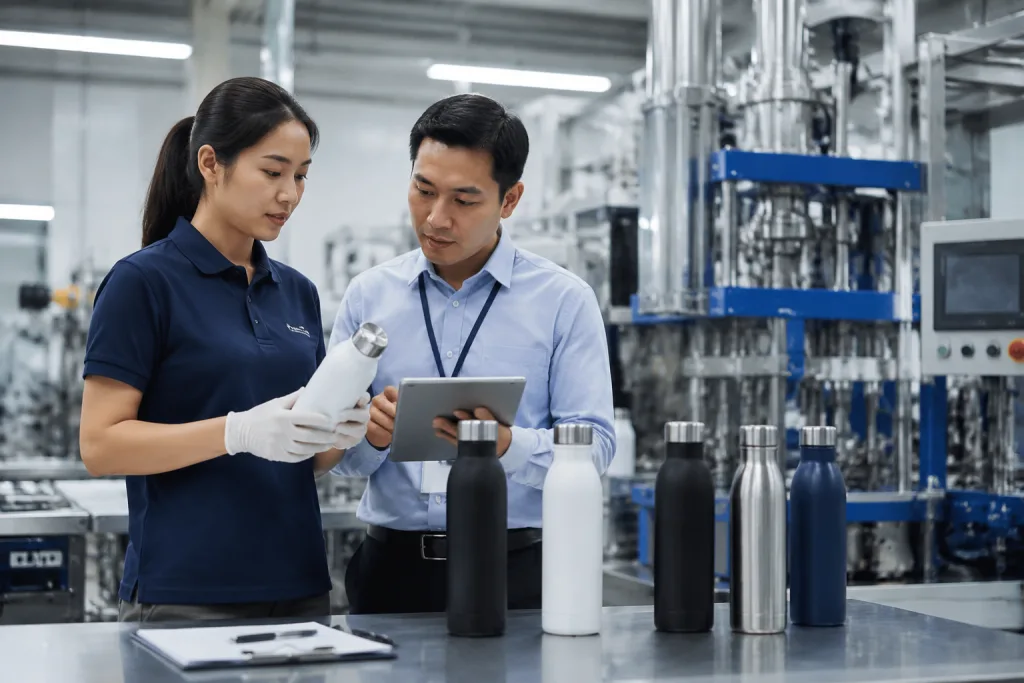
Sampling is where the buyer plan hits the bench. We start with a reference sample to check the curve, grip, mouth opening, and how the lid threads by hand. Then we run a pre-production sample with the real powder coat, approved logo, production lid, silicone gasket, retail box, barcode, and carton mark printed exactly as the PO says. QC pulled one sample last month where the blank bottle looked fine, but the laser logo sat 2 mm too low after coating. Do not release mass production from a blank bottle when coating or branding drives the order. For a vacuum insulated bottle customizable order, the decoration is part of the product.
A clean approval path looks like this: quote sheet → specification sheet → artwork proof → pre-production sample → mass production → inline check → final inspection → shipment release. Keep the spec sheet tight: capacity tolerance in ml, 304 stainless steel grade if required, finish code, logo size with position in mm, lid material, thermal test target, carton quantity, gross weight, and spare gaskets or straws if included. We run this sheet beside the line, not just in the sales folder. If you are buying from multiple canteen suppliers, make every factory quote against the same sheet. Otherwise the math does not work; you are comparing different bottles.
Final inspection needs more than a quick look at the carton. Check appearance under a light box, logo alignment with a ruler, color against the Pantone chip, capacity by fill weight, leak test after 30 seconds inverted, odor after hot-water rinse, lid fit with a torque gauge, carton drop condition, barcode scan, and packing count. AQL sampling does not mean every unit is perfect. It means the lot is accepted or rejected against an agreed statistical limit, such as AQL 2.5 if your program uses it. For high-value distributor growler or retailer programs, we recommend 100% leak testing at the factory plus third-party final inspection.
Communication needs discipline. Lock one artwork file, one Pantone reference, and one packing file before the coating room starts. We have seen 6-day delays from a buyer changing “matte black” to “soft-touch black” after the powder was mixed; the line stopped, QC rechecked adhesion, and the ship date moved. A good canteen vendor will tell you when a change resets the clock. A weak vendor says yes, misses the vessel date, then blames production.
Select suppliers by behavior
About 70% of canteen vendors can send a catalog within 10 minutes. Fewer ask the questions that protect your margin before they quote. When you evaluate a canteen supplier, watch the behavior: do they confirm the sales channel, target FOB, compliance market, MOQ, packaging, and lead time, or do they only send photos from last year’s booth? A real canteen manufacturer should be ready to talk tooling, AQL, material tests, daily line capacity, and defect history. Ask for specifics. Last month QC pulled a 750 ml sample with a 0.35 mm rim dent after drop testing, and that detail told the buyer more than 12 polished catalog pages.
For distributor growler and distributor drinkware programs, stability beats charm. Ask how many units per month they run, what percentage is stainless vacuum, which markets they ship to, and how they handle repeat orders. If the factory cannot keep the same lid available for 12 months, your reorder program becomes a new product launch every season. The math doesn't work. Canteen distributors should ask for spare gasket policy and component continuity, especially for straw lids and flip lids, because we have seen a buyer flag a 2 mm height change on a flip-lid button after the second PO.
Trading companies make sense when orders are mixed and small. Direct factories are stronger when the program is repeatable, technical, or compliance-heavy. This is the wrong question to ask if the debate is only “factory or trader.” If you need five SKUs at 500 units each, a capable trading partner may consolidate cartons and color boxes better. If you need 20,000 units of a customized canteen with controlled coating, direct factory communication saves time and cuts interpretation errors. We have seen this go sideways when a PO said “matte black” but the approved sample was rubber paint, and the line had already booked powder coating for 18,000 bodies.
At BottleForge Industrial in Hangzhou, Zhejiang, we prefer to challenge weak specs early. If your requested coating, logo, carton, or delivery date is risky, you should hear that before paying a deposit. That is not being difficult. It is how a B2B buyer avoids air freight, rejected lots, and awkward calls with retail accounts. On our side, we check this with a coating adhesion grid cutter, carton drop plan, logo position tolerance in mm, and a real production calendar, not a nice promise in a WeChat message.
Send your bottle spec and target landed cost
We will review capacity, finish, logo, packing, MOQ, compliance, and realistic lead time before quoting your custom drinkware program.
Frequently asked questions
What MOQ should I expect for a vacuum insulated bottle customizable order?
For existing bottle shapes, expect 1,000 units per color for custom powder coating and logo work. If you accept stock colors and simple laser engraving or silk screen printing, some programs can start around 500 units, but the unit price will be higher. Private mold projects, special lids, or a fully customized growler normally require 3,000-5,000 units because tooling, component sourcing, and line setup need scale. For mixed distributor canteen orders, it is better to reduce colors and keep capacity consistent. Five colors at 500 units each are usually harder and less efficient than two colors at 1,250 units each.
How long does production usually take after sample approval?
A normal production window is 35-45 days after deposit, final artwork, and pre-production sample approval. Add 7-10 days for sample making if the color or logo is new. If the order uses a private mold, custom lid, or special packaging, tooling and pilot samples can add 20-35 days before mass production starts. Peak season in China, especially before summer and Q4 promotional shipping, can add another 10-15 days. Buyers often lose more time in artwork revisions than in welding or coating, so approve Pantone color, logo size, barcode, and carton marks before the factory books production.
Which logo method is best for a premium custom canteen?
For a premium custom canteen, powder coating with laser engraving is usually the safest choice. It costs more than one-color silk screen, but it is permanent, clean, and less likely to peel during daily use. Silk screen is fine for canteen promotional orders where budget is tight and the logo is simple. UV printing works for multi-color artwork, but abrasion testing is important. Heat transfer gives larger coverage but needs careful edge checking. For retail or distributor drinkware, ask for a decorated pre-production sample and run a basic tape test, rub test, and dishwasher-position discussion before mass production.
What compliance documents should European and North American buyers request?
For Europe, request food contact testing such as LFGB or EU 1935/2004-related reports where applicable, plus REACH information for coating and plastic components. For North America, ask for FDA food contact material information, and check CPSIA or ASTM requirements if the item is marketed for children. A factory audit such as BSCI or ISO 9001 is useful, but it is not a substitute for product testing. Make sure reports match the actual material family: stainless steel body, PP or other plastic lid, silicone gasket, coating, and any straw. For larger orders, budget third-party lab testing before shipment.
How do I compare quotes from different canteen manufacturers fairly?
Use one specification sheet and force every canteen manufacturer to quote against it. Include capacity, steel grade, wall thickness target, lid type, coating, logo method, packaging, carton quantity, compliance documents, inspection level, MOQ, lead time, and Incoterm such as FOB Ningbo or FOB Shanghai. A USD 4.20 quote may be worse than a USD 4.60 quote if it uses lighter steel, weaker packaging, no REACH support, or excludes logo cost. Also ask whether the quoted lid and color are available for repeat orders. For canteen distributors, reorder stability can matter more than saving USD 0.10 on the first shipment.