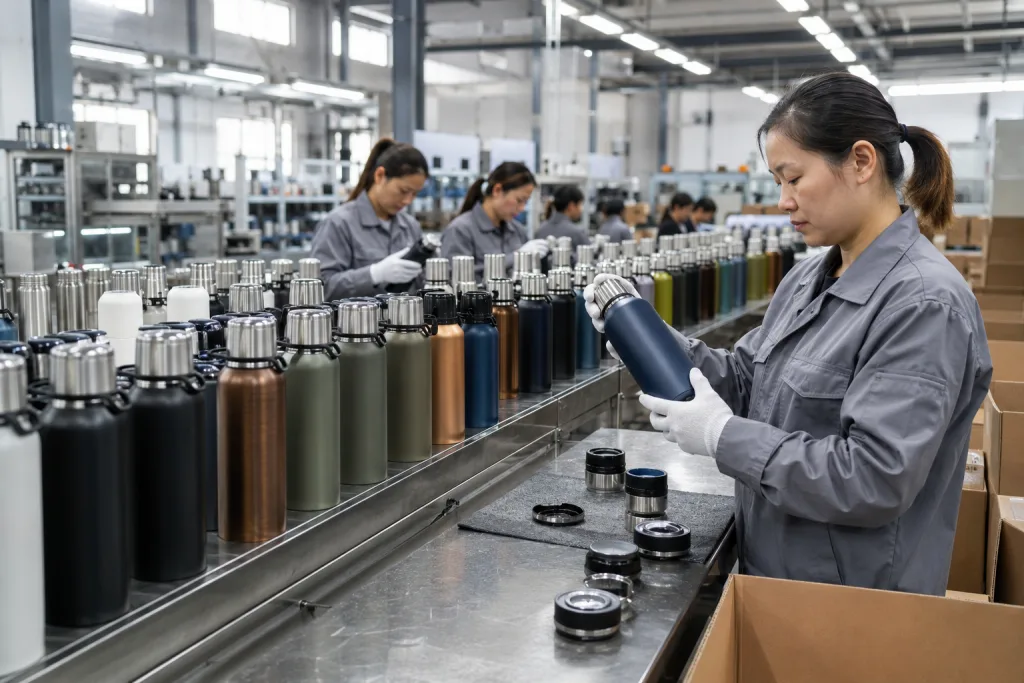
Key Takeaways
- Start with capacity, lid, steel grade, finish, and logo method before asking for a USD price
- Typical MOQ is 1,000 pieces per SKU, with 25-35 days production after sample approval
- 304 stainless steel with 0.45-0.55 mm wall thickness is the practical baseline for B2B orders
- Use AQL 2.5 for major defects and AQL 4.0 for minor defects before shipment
A vacuum insulated bottle custom project usually fails before the line opens the first coil of 304 stainless. The bottle is not the hard part. The hard part is locking the choices that move the quote by USD 0.18 to 0.65 per piece: capacity, steel grade, lid system, decoration method, carton setup, and inspection level. We’ve seen this go sideways when a buyer approved a 500 ml sample, then changed to 750 ml after the mold deposit. The math doesn’t work.
If you are comparing canteen manufacturers or canteen suppliers in China, a catalog PDF is not enough. Ask for the spec sheet, the packing drawing, and the AQL 2.5 inspection plan before you chase the lowest FOB line. BottleForge Industrial is based in Hangzhou, Zhejiang, and our factory network can handle 450,000 stainless steel units per month with typical export MOQ from 1,000 pieces per SKU. Last month QC pulled a sample with a 0.4 mm rim burr after polishing, and the buyer flagged it before shipment. Good. That is where problems should be caught.
Decide the bottle job first
Start with the job, not the Pantone number. A vacuum insulated bottle custom order for outdoor retail usually needs stronger lids, thicker powder coating, and a hang-tag that survives peg display. A university canteen promotional order is a different animal: lower price target, fast logo approval, and cartons that stack cleanly in the campus warehouse. Last month QC pulled 12 samples from a distributor canteen program because the buyer wanted the same SKU to work for hiking shops and freshmen welcome kits. The math did not work.
For everyday custom drinkware, 500 ml works for commuter bags, 750 ml sits well in most side pockets, and 1,000 ml is the size buyers choose when they want a higher retail ticket. On our line, the 750 ml body runs smoother because the mouth rolling tool and base press are already set for that diameter. For a custom growler or customizable growler, 1.5 L and 1.9 L are common, but freight starts to bite. A 1.9 L growler carton can take nearly twice the warehouse space of a 750 ml bottle, even when the stainless steel cost is not double. We have seen buyers save USD 0.18 on material and lose USD 0.42 on cube.
Decide how people will drink from it. A screw cap is cheaper and seals better because there are fewer parts. A straw lid adds silicone parts, a straw tube, and 3 more QC checks before packing. A chug lid feels premium for sports use, but the hinge pin and gasket groove need tighter tooling control, usually within 0.2 mm on the parts we run. If you are a canteen distributor selling into outdoor channels, do not choose a lid only because it looks good in renderings. Ask for leak testing at 45 degrees and inverted for 30 minutes. QC should write the result on the inspection sheet, not just say “passed” in WeChat.
The trade-off is simple: more functions mean more parts, more assembly time, and more after-sales risk. A plain double-wall bottle with a screw cap may cost USD 3.20-4.80 FOB Ningbo at 3,000 pieces, depending on size and finish. A multi-lid set can push the same bottle above USD 5.50, especially after we add inner bags, spare straws, and a printed instruction card. The buyer often asks, “Can we include three lids and keep the old price?” No. For most distributor drinkware programs, one reliable lid beats three average lids.
Choose steel and insulation honestly
Most serious vacuum insulated bottles use 304 stainless steel for the inner wall. Buyers ask us for 316 stainless because it sounds premium on a spec sheet, and sometimes it earns its place: salt-heavy outdoor ranges, marine gifts, or acidic beverage positioning. For normal water, coffee, tea, and sports bottles, the math often does not work. We run 304 inner with 201 or 304 outer on plenty of export orders, depending on the price point and the compliance promise printed on the carton. Last month QC pulled 32 inner-wall samples with an XRF gun before polishing because one PO typed “306 stainless” by mistake.
For Europe and North America, we usually recommend 304 inner and 304 outer for retail-grade customized drinkware. Wall thickness around 0.45-0.55 mm is a practical range for many bottles. Go thinner and the body can pick up dents during drop testing or even after carton compression. Go thicker and the bottle gains weight before insulation improves enough to justify the cost. Simple choice. On our line, a 750 ml straight bottle at 0.50 mm already feels different in hand than the same shape at 0.42 mm, and buyers flag that during pre-shipment samples.
Vacuum performance is not just steel grade. It comes from welding consistency, vacuum pumping time, copper coating if used, and cap sealing. Asking “How many hours hot and cold?” is the wrong question to ask unless the test condition is written down. A fair test might use 95°C water, 20-25°C room temperature, bottle filled to capacity, and temperature checked after 6, 12, and 24 hours. Cold retention claims change again when ice is included. We log this on a temperature recorder, not by touching the bottle shell after lunch.
If you are sourcing from a canteen manufacturer in Zhejiang or another China production base, ask for the actual test report format, not only marketing claims. A 750 ml bottle may hold water above 55°C after 12 hours under controlled conditions, while a wider-mouth model may perform lower because the cap area loses more heat. We have seen this go sideways when a buyer approved a catalog claim first and asked for lab-style proof after the 3,000 pcs order was already in welding. Get the report template before deposit.
The honest trade-off is simple: slim bottles look clean on shelf but dent more easily, while wide-mouth bottles are easier to clean and often lose heat faster through the lid. Copper-coated vacuum layers can improve performance, but they add cost and slow the line if the coating supplier misses the slot. Do not over-spec insulation if your customer uses the bottle during a 2-hour commute. We ship plenty of bottles where a stable powder coat, a leakproof cap, and a clean logo matter more than chasing one extra hour in a lab test.
Match decoration to brand risk
Logo method is where custom canteen projects get messy fast. We see it in about 4 out of 10 RFQs from new buyers: the PO says “logo as artwork,” but the AI file has 0.3 mm hairlines that won’t print cleanly on a curved bottle. Cheapest is the wrong question to ask. Match the decoration to the sales channel, artwork detail, and how long the branding has to survive in a backpack, cup holder, or retail return bin.
Silkscreen printing works for simple one- or two-color logos, especially canteen promotional orders, events, and corporate giveaways. At 3,000 pieces, a one-color print setup is usually manageable; we run a curved screen jig and check the first 20 pcs before the line opens up. Powder coating texture and bottle radius still matter. A 55 mm wide logo may look fine on the proof, then lose edge sharpness near the shoulder. Laser engraving gives a cleaner retail feel on powder-coated stainless steel and handles scratches better. It is slower than printing, but it cuts out the usual ink adhesion complaints.
Full-wrap heat transfer and water transfer are for complex artwork, gradients, and lifestyle graphics. They fit customizable drinkware programs where shelf impact sells the bottle. The math does not work for every launch. Setup cost is higher, color matching takes more back-and-forth, and sampling can move from 7 days to 14 days if the artwork has skin tones or soft gradients. If you need Pantone matching, expect one to two sample rounds. A realistic pre-production sample timeline is 7-10 days after artwork confirmation, assuming the buyer does not change the logo size after QC pulled the sample.
Powder coating is the standard finish for distributor growler and bottle programs. It feels better than plain paint and usually holds up better in adhesion tests. For North American retail, we often test with cross-cut adhesion, 3M tape pull, and dishwasher simulation if the buyer requires it; our QC team records the cut grid under a 10x magnifier before packing approval. Be careful with “dishwasher safe” claims. We’ve seen this go sideways. A bottle may survive hand washing for years but fail aggressive dishwasher cycles because heat, detergent, and rack impact attack the coating from different angles.
If your brand is still testing demand, start with 2-3 colors and one logo method. For a first run, 1,000 pcs per color is easier to control than six colors at 500 pcs each, and it keeps cartons from piling up beside the packing table. If you are a canteen vendor managing several customer accounts, keep a shared bottle body and change decoration only. That reduces tooling pressure, sample delays, and spare lid confusion when the warehouse team is picking black flip lids next to straw lids.
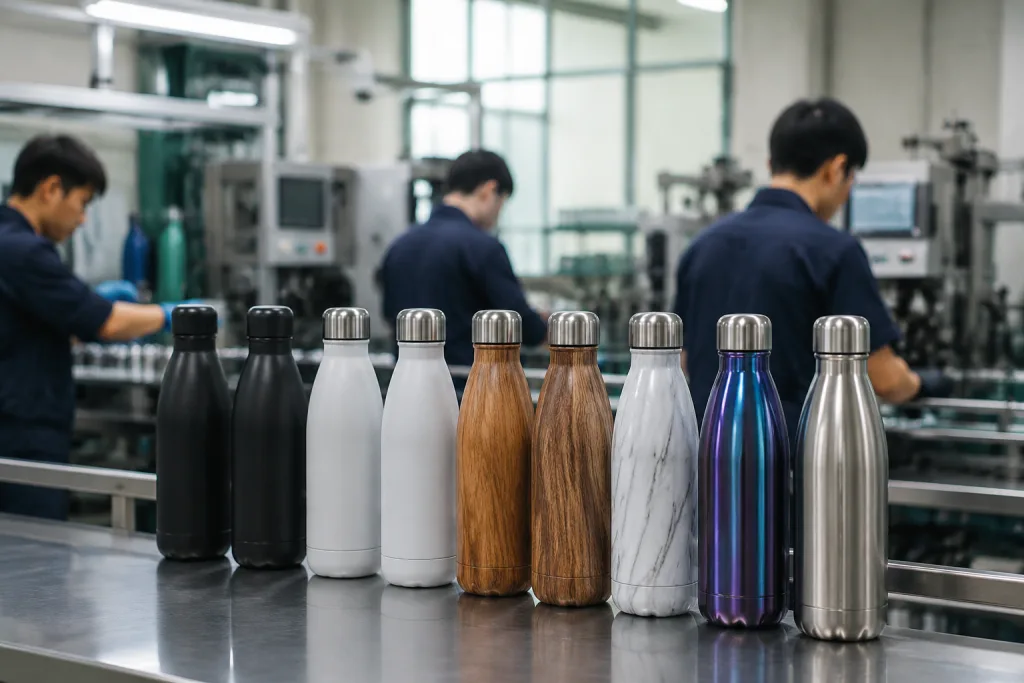
Price by landed cost, not quote
A FOB unit price is one line on the cost sheet, not the buying decision. For B2B custom drinkware, we price from landed cost: bottle price, logo setup charge, inner box spec, export carton strength, inspection fee, ocean or air freight, duty, warehouse handling, plus FNSKU labeling for Amazon or retailer routing labels when the buyer’s PO calls for it. Last month QC pulled 32 cartons from a 3,000-piece run because the routing label was 8 mm too low for the customer’s warehouse scanner.
As a working reference, a 750 ml vacuum bottle with 304 inner steel, powder coating, one-color logo, and standard individual white box may quote around USD 3.60-5.20 FOB Ningbo at 3,000 pieces. A 1,000 ml customized canteen may sit around USD 4.50-6.50. A custom growler with handle lid and heavier body can move higher. These are not promises. Steel price, USD/RMB rate, lid mold choice, and box paper weight can move the number; we have seen 350 gsm color box paper add USD 0.11 per unit after the buyer changed the artwork dieline.
MOQ changes the math. A canteen supplier may accept 500 pieces, but the unit price often jumps because coating, printing, carton setup, and line changeover eat too much time on the line. For BottleForge Industrial in Hangzhou, Zhejiang, normal MOQ is 1,000 pieces per SKU, with better pricing at 3,000 and 5,000 pieces. Production lead time is usually 25-35 days after pre-production sample approval, not after the first email; if the buyer approves the PPS on April 3, we count from April 4, not from the inquiry date. We run it that way because the powder coating booth and pad-printing plate are not booked until the sample is signed.
Do not compare quotes unless the specifications match. This is where we’ve seen it go sideways. One canteen manufacturer may quote 201 outer steel while another quotes 304 outer. One may include individual color boxes; another may quote bulk pack. One may include logo setup; another may add it later as a USD 80 plate charge. Ask every canteen vendor to confirm the same sheet: capacity, steel grade, wall thickness in mm, coating type, logo size, lid type, packaging, carton quantity, Incoterm, and validity period. If the quote says “500 ml” but the drawing shows 530 ml to brim, the buyer flagged it for a reason.
If you are a distributor drinkware buyer, protect your margin by locking carton dimensions early. A nice bottle that fits only 12 pieces per oversized carton can damage your freight economics more than a USD 0.20 factory price difference. We ship plenty of cases where a 46 x 34 x 28 cm carton works, but one fat carry loop pushed the carton to 52 cm and killed the pallet count. Ask this before chasing the last five cents.
Check compliance before artwork
Do not leave compliance as a file chase after the logo is approved. For EU orders, we ask for LFGB food-contact scope on the liner, REACH coverage for the powder coat and plastic parts, plus the packaging marks before our artwork team opens the AI file. For U.S. programs, FDA food-contact expectations and California Proposition 65 risk need a check at the quotation stage. For children’s bottles, ASTM and CPSIA can touch paint, accessible parts, and small components; QC once pulled a straw-cap sample because the 7 mm silicone plug looked like a detachable small part under the gauge.
A responsible canteen factory can tell you which tests already exist and which ones must be run for your order. A report for a matte black bottle does not cover a new metallic coating, a fresh silicone color, or a different UV ink. We have seen this go sideways: the buyer approved rose-gold artwork, then the lab asked for the exact coating batch code from the spray line. If the order is 3,000 pcs or more, test the final production materials, not a clean stock sample from the showroom shelf.
Factory audits matter when your customer asks about social responsibility. BSCI, ISO 9001, or similar audit documents have value, but read the dates and the factory address. Some canteen suppliers show a 2022 report from a related workshop 40 km away, while the actual welding and polishing happen elsewhere. Ask whether the audited site is the same site making your order; if the name on the PO has one typo, your customer’s compliance team may reject the file before shipment booking.
Write quality control into the purchase order. For vacuum insulated bottle custom production, we run incoming material checks on 304 stainless coils, in-process inspection after forming and welding, 100% vacuum performance screening where the spec requires it, plus final random inspection before cartons are sealed. AQL 2.5 for major defects and AQL 4.0 for minor defects is a common export baseline. Critical defects such as leaking, unsafe burrs, wrong material, or contaminated interiors need zero tolerance; the math does not work if 12 leaking bottles enter a 1,200 pcs promo order.
Buyers often push hard on logo color and miss the stuff that causes returns: gasket smell, thread smoothness, rim polishing, and carton drop strength. QC pulled the sample last month because the lid thread felt gritty after 20 open-close cycles on the torque jig. Your checklist needs odor check, leak test, coating adhesion, print rub test, capacity verification, barcode scan, carton drop test, and master carton weight. We ship fewer headaches when the carton is checked at 13.5 kg, not guessed at the loading door.

Build a supplier comparison sheet
Compare canteen distributors, canteen vendors, and direct canteen manufacturers in China with a spreadsheet, not memory. Memory gets expensive. In one RFQ last month, a buyer picked a quote that was USD 0.18 lower per piece, then QC pulled the pre-shipment sample and found the flip lid was quoted separately and the 5-layer export carton was downgraded to 3-layer. Put every included item in a cell: lid type, spare gasket, carton spec, barcode sticker, FDA or LFGB report, and who pays for the lab test.
Your sheet should include factory location, export experience, monthly capacity, MOQ, sample time, production lead time, steel grade, insulation test method, decoration options, packaging options, audit status, payment terms, and Incoterm. Add a column for communication quality with a simple score from 1 to 5. We run into this weekly: if a canteen supplier cannot explain 304 stainless thickness, vacuum loss testing, or laser logo limits before the PO, the answers will not get sharper after the 30% deposit lands. The buyer flagged one PO typo as “matte black,” while the artwork file said “powder coated black PMS Black C”; that kind of mismatch belongs in the sheet before the line starts.
For a canteen customizable range, check whether the supplier can keep the same bottle body available for repeat orders. Distributors need continuity. If your 750 ml bottle changes shoulder shape between batches, your photos, inserts, and retail listings stop matching. Ask whether tooling is private, shared, or open stock. Open stock is faster and cheaper, often with samples in 3-5 days, but other brands can use the same silhouette. Private tooling protects shape but can cost USD 2,000-8,000 or more depending on structure. We measure shoulder height with a digital caliper during incoming body checks; a 2 mm change is enough for a sleeve label to sit wrong.
Payment terms are another decision point. A common China export structure is 30% deposit and 70% balance before shipment, sometimes after inspection. For established buyers, terms can improve after 3-5 clean orders with no late balance payment or carton rework. Do not ask for 60-day credit on the first customized canteen project unless the order volume and credit profile support it. The math doesn't work for a factory buying 1.2 tons of 304 stainless, silicone gaskets, and printed gift boxes before shipment.
The best supplier is not always the cheapest canteen vendor. It is the one that gives you stable specifications, honest lead times, clean documentation, and fewer surprises when the container is already booked. We have seen this go sideways when the forwarder cut-off was 16:00 Friday and the inspection report still showed 8 cartons with crushed corners under AQL 2.5. Cheap looks good until the booking rolls to next week.
Approve samples with production in mind
Samples are not souvenirs. They are production controls. Before you approve a vacuum insulated bottle custom sample, treat it like a customer return waiting to happen. Fill it to 10 mm below the mouth, shake it 20 times, lay it on its side for 30 minutes, drop it into a backpack, wash it, then check the logo against the approved artwork under normal office light. QC pulled one sample last month with a perfect photo, but the silicone gasket wept after the side-lay test. That matters.
A golden sample should be signed off for dimensions, color, logo position, logo size, lid fit, gasket color, packaging, barcode, and instruction sheet. Do not leave this to email memory. We keep one approved sample with the buyer and one sealed at the China factory, usually in a carton marked with the PO number, item code, and approval date. If final inspection finds a 2 mm logo shift or a lid that feels loose on the thread gauge, both sides need the same physical reference on the table.
For color, Pantone matching on powder coating is not exact like printing on paper. This is the wrong question to ask if the buyer only sends a screen shot. For larger orders, we can agree on a Delta E tolerance, but about 8 out of 10 B2B buyers approve a physical color chip or coated bottle sample instead. Metallic, matte, and textured finishes throw light in different ways, so approve the actual finish under a light box or daylight, not a PDF rendering.
Packaging also needs sample approval. A custom canteen can pass the leak test and still arrive with crushed retail boxes if the paper is too thin. For export cartons, 5-ply corrugated board is common for heavier bottles and growlers; we normally check carton edge crush, gross weight, and inner dividers before mass packing. If you sell through ecommerce, confirm individual drop protection, FNSKU labels, suffocation warnings for polybags, and carton labels that match the warehouse requirements. The buyer flagged this twice for Amazon shipments.
Once the sample is approved, avoid changing details casually. A late change from laser engraving to full-color print can reset artwork, sampling, and the line schedule by 7 to 12 days. A late lid change can affect leak testing and carton fit, especially when the new cap adds 6 mm to bottle height. We have seen this go sideways. Good custom drinkware production is controlled repetition, not magic. Give the canteen manufacturer a stable target, then inspect against it.
Send your bottle spec and target landed cost
BottleForge will review capacity, lid, finish, MOQ, packaging, and compliance needs, then return a practical China factory quotation.
Frequently asked questions
What MOQ should I expect for a vacuum insulated bottle custom order?
For most export B2B orders, expect 1,000 pieces per SKU as a practical MOQ. Some canteen suppliers may accept 500 pieces, but the unit price is usually higher because coating, printing, and line setup costs are spread across fewer bottles. At BottleForge Industrial in Zhejiang, normal MOQ starts at 1,000 pieces, with better pricing at 3,000 and 5,000 pieces. If you need 4 colors, remember that MOQ may apply per color, not only per total order. A mixed-color order of 1,000 pieces can be possible, but it depends on coating schedule and logo method.
How long does a customized canteen project take from sample to shipment?
A realistic timeline is 7-10 days for a pre-production sample after artwork confirmation, then 25-35 days for mass production after sample approval and deposit. Ocean freight to North America or Europe can add 25-45 days depending on port, season, and routing. If you need private tooling, add roughly 20-35 days before sampling. China holidays also matter. Orders placed close to Chinese New Year can face 2-4 weeks of disruption. For a firm launch date, work backward from warehouse arrival, not factory completion.
Is laser engraving better than silkscreen printing for custom drinkware?
Laser engraving is usually more durable because it removes the coating surface rather than adding ink. It is a good choice for retail bottles, corporate gifts, and distributor drinkware programs where the logo must survive long use. Silkscreen printing is cheaper and better for larger, colorful, simple artwork, especially on canteen promotional orders. At 3,000 pieces, one-color silkscreen is often the most economical. For complex gradients, use heat transfer or water transfer. The right method depends on artwork size, color count, surface finish, budget, and whether your customer expects dishwasher resistance.
What quality inspection standard should I use before shipment?
For vacuum insulated bottle custom orders, use final random inspection with AQL 2.5 for major defects and AQL 4.0 for minor defects. Critical defects should be zero tolerance. Critical issues include leakage, sharp burrs, contamination inside the bottle, wrong material, unsafe coating, and seriously wrong logo. The inspection checklist should cover capacity, weight, dimensions, odor, lid torque, gasket fit, coating adhesion, print rub, barcode scanning, carton drop strength, and insulation spot checks. For higher-risk retail launches, add in-process inspection at 30-50% production so problems are found before all units are packed.
Should I buy from a trading company or direct canteen factory in China?
A direct canteen factory can offer better technical control and sometimes sharper pricing, but only if it has export experience, stable QC, and clear communication. A trading company may be useful if you need many product categories, smaller quantities, or consolidated shipments. For a serious canteen distributor or distributor growler program, ask who controls tooling, who performs inspection, and which factory name appears on audit and compliance documents. The important point is accountability. Whether you work with a canteen manufacturer, canteen supplier, or sourcing partner in China, specifications, samples, AQL terms, and shipment documents must be written clearly.