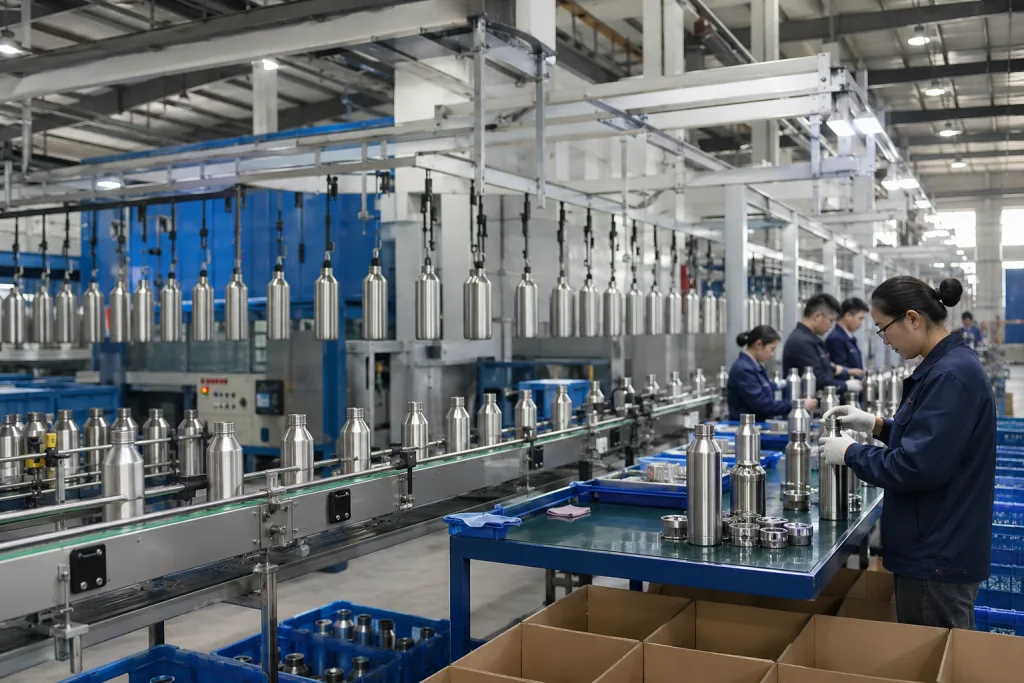
Key Takeaways
- A realistic MOQ for custom vacuum insulated bottle bulk is 1,000-3,000 pcs per SKU, with lower MOQs costing 8-18% more
- Typical FOB China pricing for 500 ml double-wall stainless bottles runs USD 3.20-6.80 depending on steel, coating, lid, and packaging
- Normal production lead time is 30-45 days after deposit and artwork approval; new mold or custom cap can add 20-35 days
- QC should use AQL 2.5 for major defects and 4.0 for minor defects, with vacuum retention and leak tests included
If you buy vacuum insulated bottle bulk orders for a retail brand, promo program, or distributor catalog, the hard part is not finding a supplier. The hard part is knowing whether a USD 3.20 quote can survive a caliper check on wall thickness, a salt-spray test on coating, and a vessel booking cut-off. We see quotes stripped down to hit a target: thinner inner wall, lighter lid, single-wall gift box, no spare gasket. The math doesn't work if the buyer expects retail-grade finish at promo-grade costing.
We manufacture stainless steel drinkware in Hangzhou, Zhejiang, and we see the same mistake on 7 out of 10 new inquiries: buyers compare drinkware wholesale quotes as if every bottle has the same steel grade, wall thickness, coating, lid spec, carton strength, and AQL plan. It does not. A 10,000-piece wholesale drinkware order can run clean in 45 days, or sit 20 extra days because the Pantone logo was still “close enough” and QC pulled the sample for a cap leak at 0.6 bar. Lock the logo, lid, box, and inspection plan early. The line needs clear specs.
Start with landed cost reality
For vacuum insulated bottle bulk sourcing, FOB unit price is just the first row in your costing sheet. Build landed cost from the bottle outward: product, decoration, packaging, inspection, inland trucking in China, ocean or air freight, duty, customs handling, warehouse intake, plus FBA or retail labeling work. We run this on a 14-line cost sheet before sampling, because buyers often flag a USD 0.18 “surprise” label charge after the PO is already typed.
A common 500 ml stainless steel bottle may quote at USD 3.20-4.20 FOB Ningbo for a simple powder-coated body, PP lid, single-color silk screen logo, and brown box packaging at 3,000 pcs. The same bottle can become USD 5.20-6.80 when you add 316 inner steel, copper plating, leakproof push-button lid, laser engraving, color box, instruction leaflet, barcode sticker, and stricter packing drop-test requirements. Last month QC pulled the sample after a 76 cm carton drop test; the bottle passed, but the color box corner crushed, so the buyer had to choose thicker E-flute or accept the mark.
China export pricing also shifts with steel. 304 stainless steel coil can move 5-12% over a quarter. That matters because a vacuum bottle is mostly metal, not branding magic. Wall thickness also matters: 6 out of 10 mid-market RFQs we see use about 0.4 mm outer wall and 0.3 mm inner wall. Thinner material saves USD 0.06-0.10 per pc, but the math doesn't work if the line ships 18,000 pcs and 240 arrive with side-wall dents after sea freight.
Do not ask only, “What is your best wholesale drink bottle price?” That is the wrong question to ask. Ask what the price includes. Is it FOB Ningbo or FOB Shanghai? Is the carton 5-ply K=A, or a lighter carton? Are the inner polybags recyclable? Is the lid food-contact tested to LFGB, FDA, or REACH expectations? In Zhejiang, we quote these items line by line because hiding cost creates the dispute later; we have seen one PO list “FOB Ningbo” in the header and “Shanghai delivery” in the remarks, and nobody enjoyed fixing that typo at 9 p.m.
MOQ tiers change the quote
MOQ is not a punishment; it is how the line pays for setup. On a drinkware bulk order, our operators still change the forming fixture, flush the powder booth, burn a logo screen, confirm carton artwork, and open QC files whether the PO says 800 pcs or 8,000 pcs. Last month QC pulled the first 12 bottles after a black powder-coat change and found 2 with dust nibs near the shoulder. Small orders carry that cleanup time, so the unit price goes up.
As a working guide, a custom vacuum insulated bottle bulk order usually prices in these bands: 1,000 pcs per SKU for a stocked body with a one-color logo; 3,000 pcs per SKU when we run a custom PMS powder color with a standard lid; 5,000-10,000 pcs per SKU when the job adds custom lid color, ceramic-feel coating, or a retail color box; 20,000 pcs and above when the buyer wants sharper pricing and a cleaner slot on the production schedule. At BottleForge Industrial, our monthly drinkware capacity is about 850,000 units, but we still group 500 ml and 750 ml bodies by coating to avoid wasting 3-4 hours on booth cleaning. The math doesn't work if every small SKU asks for its own color.
The same pricing logic applies to bulk canteen, canteen bulk, canteen wholesale, wholesale canteen, bulk growler, growler bulk, growler wholesale, and wholesale growler programs. A 64 oz beer growler bulk order uses heavier 304 stainless, and we run vacuum testing at 18 hours instead of the 12 hours we use for a 350 ml coffee bottle. A beer tumbler bulk or beer tumbler wholesale bulk order looks easier on paper. Then the buyer flags lid wobble at 0.6 mm, and QC time climbs.
For alcohol flask bulk, alcohol flask in bulk, alcohol flask wholesale, and alcohol flask wholesale bulk orders, MOQ is often set by packaging rather than the steel body. Gift boxes may start at 2,000 pcs, while funnels, EVA inserts, and printed retail sleeves often sit at 3,000-5,000 pcs with our outside packing suppliers. We have seen this go sideways when a buyer sends a 1,000 pcs PO with “custom gift box” typed in the remarks line but no box dieline attached. In that case, we ship standard packaging or quote the surcharge clearly.
Materials drive hidden cost
Steel choice, vacuum build, coating yield, lid tooling, and lab scope decide the hidden cost. We run most wholesale drinkware orders with 304 stainless on the inner wall and outer wall, checked by XRF gun before the coils go to cutting. Some buyers ask for 201 outer steel to save about USD 0.12-0.22 per 500 ml bottle. For premium retail, the math does not work. Salt-spray marks and weak magnet complaints hurt the brand faster than the saving helps. For acidic drinks or stricter EU shelves, 316 inner steel can add roughly USD 0.25-0.60 per bottle depending on size.
Vacuum performance gets underquoted. A real double-wall vacuum bottle needs clean TIG welding, vacuum pumping, copper tail sealing, base cap pressing, and thermal testing. For a 500 ml bottle, a reasonable target is keeping hot water above 50-55°C after 12 hours when tested from 95°C starting temperature at 20°C room temperature. We log this on 12 sample bottles per lot with probe thermometers, not by touching the shell for 10 seconds. Cheap products may pass that quick touch test, then fail the 12-hour retention test when QC pulls the sample.
Surface finish changes the yield. Single-color powder coating is the safest choice for bulk drinkware because the line can hold color within about ΔE 1.0-1.5 if the powder batch is stable. Matte coating shows scratches fast when the powder film is under 60 μm. Rubberized coating feels premium, but we have seen carton rub marks after a 6 kg drop test if the bottle has no polybag or divider. Gradient spray, full-wrap print, water transfer, and UV print all add setup loss, masking time, and more AQL 2.5 rejects. Laser engraving costs more than one-color silk screen, but it avoids ink adhesion claims after 300 dishwasher-style rub cycles and fits long-term wholesale drinkware programs better.
Lids are not minor. A basic screw lid may cost USD 0.35-0.60. A flip lid, straw lid, chug lid, or carry-loop lid can cost USD 0.70-1.40, and the buyer often flags leakage only after the pre-shipment sample sits upside down for 30 minutes. For kids bottles, ASTM and CPSIA-related checks may apply. For EU buyers, LFGB food-contact testing and REACH screening need to be fixed before mass production, not after 5,000 pieces are packed and the PO still says “black lid” while the approved sample is charcoal gray.
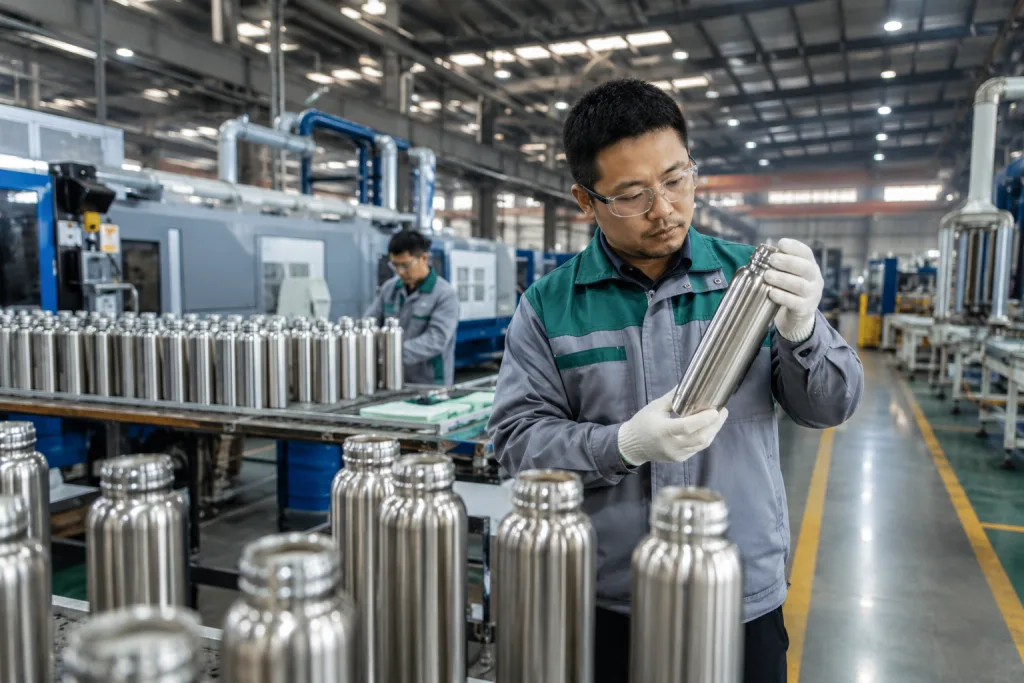
Decoration and packaging math
Decoration and packaging choices can hold the order 5-10 days after the bottle spec is already frozen. We see it weekly. For simple drinkware wholesale programs, one-color silk screen printing is still the clean math: usually USD 0.05-0.15 per print position depending on print area and ink coverage. On our Hangzhou line, a 70 mm logo on a 360-degree screen jig runs faster than a tall vertical mark near the curve of the bottle. Laser engraving often lands around USD 0.12-0.35 per position, and QC pulled the sample last month because the buyer’s 0.3 mm font filled in after coating. Full-wrap UV printing can move above USD 0.50 per bottle because the rejection rate is higher and color matching takes longer.
If you need exact brand color, send Pantone C or U references, not a screenshot from a buyer deck. Powder coating color matching normally needs 3-7 days for lab dips, and mass production should allow a Delta E tolerance measured by spectrophotometer, not someone’s phone camera. For strict retail brands, we suggest approving a physical color chip and one golden sample tagged with date, PO number, and coating batch. A photo under office lighting is not enough. We have seen this go sideways when the PO said Pantone 186C, but the artwork file was named 185C_final.ai.
Packaging has its own cost ladder, and “cheapest box” is the wrong question to ask. Brown box is the lowest-cost choice and works for distributors or industrial buyers where shelf display does not matter. White box adds a cleaner shelf appearance. Four-color retail box can add USD 0.25-0.80 per unit depending on 250 gsm vs 350 gsm paper, matte or gloss lamination, molded insert style, and whether the carton run hits the printer’s MOQ. For Amazon-style projects, we run FNSKU labels, suffocation warning bags where needed, carton labels with scannable barcodes, and carton weight limits under the 15 kg target when the buyer asks. If you skip those details, your warehouse or 3PL will charge you later.
For beer growler wholesale, beer growler in bulk, beer growler wholesale bulk, beer tumbler in bulk, and beer tumbler wholesale orders, packaging must protect larger painted surfaces and handles. Growlers need tighter packing. For growlers, we often use thicker dividers or individual boxes because a dented 64 oz body is expensive to replace, and our drop-test bench will show the weak corner before the forwarder does. Saving USD 0.12 on cartons can cost 3-5% in claims if the shipment is handled roughly. The math does not work.
Timeline from sample to vessel
Build the lead-time chart before the 30% deposit hits our account. For an in-stock shape, we run 5-10 days for a plain bottle sample and 7-14 days when the buyer wants logo, coating, or a printed box mockup. DHL, FedEx, or UPS usually adds 3-6 days to Europe or North America. If the PO calls for a new mold, custom cap, or a new bottle profile, add 20-35 days before production-sample approval; our tooling room still checks the neck thread with a 0.02 mm caliper before we sign off.
After sample approval and 30% deposit, mass production normally takes 30-45 days for 3,000-20,000 pcs. Simple canteen wholesale or wholesale canteen orders can move faster when 304 stainless sheet and standard lids are already in our Zhejiang warehouse; we ship those lines in 28-35 days if the color is black, white, or raw steel. Mixed-SKU orders with 6 colors and 3 box artworks need 45-60 days, and this is where the math doesn't work when a buyer asks for “20 days, please.” Before Lunar New Year, capacity tightens and lead times can stretch by 10-20 days because polishing, powder coating, and packing teams all lose workers at different dates.
Book inspection when goods are 80-100% packed, not when the line is still chasing lids. A third-party inspection normally needs 1 day on site and 1 day for reporting. Use AQL 2.5 for major defects and 4.0 for minor defects unless your retail channel sets tighter limits. We ask inspectors to run a leak test, vacuum retention check, coating adhesion cross-cut, barcode scan, carton drop, lid torque reading, capacity check, and random weight check; last month QC pulled the sample after one 500 ml bottle weighed 18 g under spec.
Ocean freight sits outside factory lead time. Ningbo to Los Angeles may be 16-25 days port to port in normal conditions; Ningbo to Rotterdam often runs 30-40 days. Add customs clearance, container pickup, and domestic trucking, and watch the vessel cut-off because one wrong HS code or a typo in the consignee name can push sailing by 7 days. If your retail launch date is fixed, factory lead time alone is the wrong question to ask.
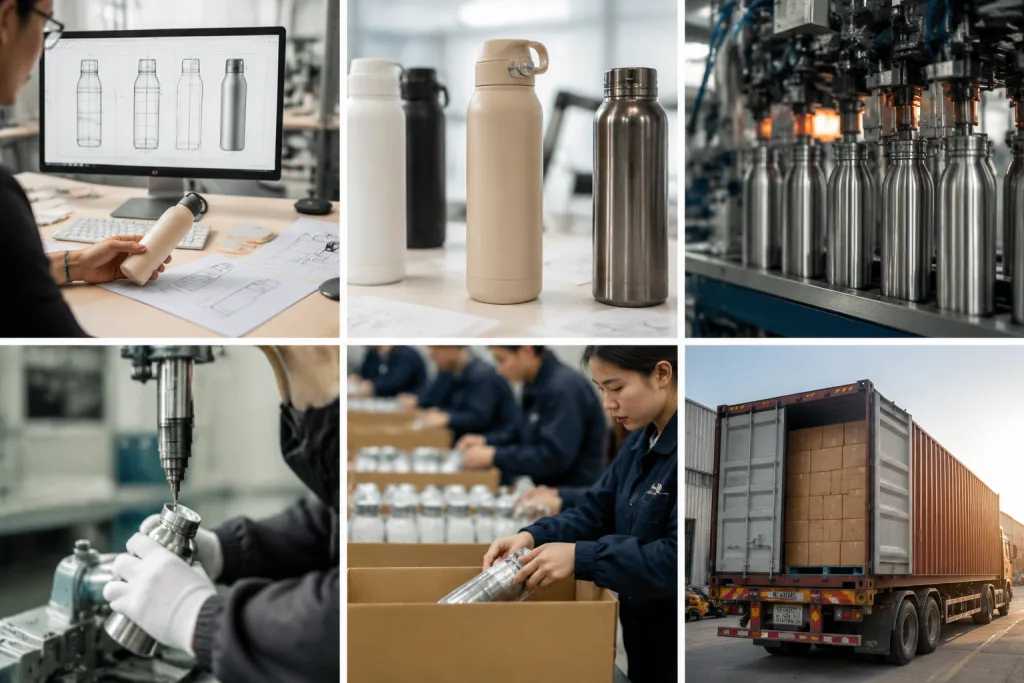
How to compare factory quotes
For vacuum insulated bottle bulk quotes, force every factory to price the same spec sheet. This is the wrong question to ask: “What is your best price?” Ask what steel, what lid, what coating, what carton, what test basis. Otherwise one quote is a 304 stainless bottle with 0.45 mm inner wall, and the next is a thin-wall sample with a cheaper PP lid. Your RFQ should include capacity, dimensions, 304 or 316 steel requirement, wall thickness target, lid type, coating type, logo method, packaging, test standards, destination port, Incoterm, and annual forecast. We run this as a one-page RFQ, because one buyer once sent a PO with “mat black” instead of “matt black,” and QC pulled the sample before mass coating.
Ask for a costed option table, not one flat number. For example: 500 ml bottle with 304/304 steel at 3,000 pcs, 5,000 pcs, and 10,000 pcs; silk screen versus laser; brown box versus retail box; FOB Ningbo versus EXW. Simple table. No drama. A factory that will not break out options may still know how to make the bottle, but your procurement team then has to guess whether the 0.18 USD gap is from steel grade, logo setup, or a 5-layer export carton. We ship enough mixed-logo orders to know this goes sideways when the buyer flags the tooling charge after deposit.
Factory audit status matters too. BSCI, ISO 9001, Sedex, and retailer-specific audits do not guarantee a clean shipment, but they cut basic compliance risk before you wire money. For EU and North American buyers, request recent food-contact test reports for the same material family. If the report is for a different lid resin or a two-year-old coating, ask for updated testing. We have seen LFGB paperwork rejected because the test report covered Tritan lid parts while the production lid used PP with a silicone ring, and the lab caught it at sample submission.
Check communication speed before you place the order. During production, a good export sales engineer confirms artwork, pre-production sample, raw material arrival, line start, in-process photos, packing status, inspection booking, and vessel cut-off. If a supplier cannot answer these before the order, the deposit will not make them organized. Zhejiang has strong factories, but the disciplined ones document details early. On our line, we send the first welding photo, vacuum test record, carton mark proof, and AQL 2.5 booking date because buyers hate surprises more than they hate a 0.03 USD price difference.
Build a safer first order
If this is your first order with a new China supplier, do not open with 12 colors and four lid types. We’ve seen this go sideways. Start with 2-3 SKUs that prove both the market and the line: one 500 ml bottle, one 750 ml bottle, one 1 L canteen. Keep them on the same powder coating family and the same lid thread if the design allows it. On our line, a color change means cleaning the spray booth and checking film thickness again with a coating gauge, usually 60-80 μm. Fewer setups give you sharper pricing, fewer spare-part mistakes, and QC reports with less noise.
A safer first PO might be 3,000 pcs per SKU, two colors per size, laser logo, white box, and AQL inspection. That is enough volume for stable drinkware bulk production without locking too much cash in slow-moving stock. If your forecast is 30,000 pcs per year, say it early. The math changes. Annual volume can support better tooling backup, reserved lid inventory, and tighter wholesale drinkware pricing even when the first PO is only 9,000 pcs. Last month, one buyer sent a PO with “mat black” instead of “matte black”; QC pulled the pre-production sample before packing text was printed, so we caught it before 3,000 boxes were wrong.
For specialty categories such as bulk growler, beer growler bulk, beer tumbler wholesale, or alcohol flask wholesale, ask for spare lids or accessories at 1-2% of order quantity. Make it a PO line, not a WeChat note. Lids, gaskets, straws, and silicone seals are the parts that trigger most after-sales claims; in our returns log, 7 out of 10 small complaints are lid or seal related, not the stainless body. Keeping spares in your warehouse beats air-shipping 0.3 kg cartons one by one.
Protect your timeline with decision discipline. Approve artwork within 48 hours, confirm Pantone colors once, and lock packaging text before the pre-production sample. Most delays are not from welding machines; they come from unclear approvals. A good factory can run production. You still need to run decisions. If the buyer flags logo position after the laser jig is set, that can turn a 12-day sampling window into 18 days, and nobody likes explaining that to sales.
Send your bottle spec and target landed cost
We will quote MOQ tiers, FOB pricing, sample timing, packaging options, and QC checkpoints within 2 working days.
Frequently asked questions
What is the normal MOQ for vacuum insulated bottle bulk orders?
For a standard stainless steel bottle shape, a realistic MOQ is 1,000 pcs per SKU if you accept existing body tooling and a standard lid. For custom powder coating, most factories prefer 3,000 pcs per SKU because coating setup and color loss become more efficient. For custom retail boxes, special lids, or mixed color programs, 5,000 pcs is a safer planning number. At our Hangzhou, Zhejiang facility, we can discuss trial orders below 1,000 pcs, but the unit price is usually 8-18% higher and color options are limited. If you need canteen wholesale or growler wholesale lines, larger capacities often need higher MOQs because steel usage and packing materials are heavier.
How much should I budget per bottle FOB China?
For a 500 ml double-wall vacuum bottle, budget roughly USD 3.20-6.80 FOB China depending on specification. A basic 304 stainless steel bottle with powder coating, simple lid, one-color logo, and brown box may sit near USD 3.20-4.20 at 3,000 pcs. Add a premium lid, 316 inner steel, copper insulation layer, retail box, laser engraving, or stricter inspection, and the range moves closer to USD 5.20-6.80. Larger 1 L canteens, beer growlers, and bulk growler items can cost more because steel weight and carton protection increase. Always ask whether the quote includes logo, packaging, inner carton, export carton, and FOB port charges.
How long does production take after I approve the sample?
For existing molds and standard components, mass production normally takes 30-45 days after deposit and final artwork approval. Sampling usually adds 7-14 days, plus 3-6 days for courier delivery to Europe or North America. If you require a new cap, new bottle mold, custom handle, or special coating development, add 20-35 days before production begins. Orders placed before Lunar New Year in China need extra caution because steel suppliers, coating lines, and assembly workers all face peak demand. For retail launch planning, add inspection, vessel booking, ocean transit, customs clearance, and domestic trucking. Factory lead time is not the full supply-chain lead time.
What quality checks should I require before shipment?
Use an AQL inspection plan, typically 2.5 for major defects and 4.0 for minor defects, unless your retailer requires stricter limits. The checklist should include leak testing, vacuum heat retention, lid torque, capacity, coating adhesion by cross-hatch or tape test, logo position, barcode scan, carton drop test, and random weight check. For food-contact compliance, EU buyers should discuss LFGB and REACH, while North American buyers often request FDA-related material confirmation and, for kids items, ASTM or CPSIA-related checks. Inspection should happen when at least 80% of goods are packed. Do not wait until the container is booked to discover a lid gasket problem.
Can one supplier handle bottles, canteens, tumblers, growlers, and flasks?
Yes, if the supplier has the right forming, welding, vacuum, coating, and assembly network. Many buyers prefer one source for wholesale drinkware because color matching, carton labels, compliance files, and shipping consolidation become easier. The risk is assuming every category behaves the same. A beer growler wholesale bulk project needs heavier carton protection. Beer tumbler in bulk orders need lid fit and splash testing. Alcohol flask wholesale bulk programs often depend on gift box and accessory quality. Canteen bulk orders may need carry straps or wide-mouth lids. Ask for category-specific samples and test reports, not only a general factory brochure.