Key Takeaways
- A practical vacuum flask wholesale MOQ starts at 1,000 units per color for standard models
- 304 stainless steel is normal for inner walls; 316 is usually a paid upgrade
- Laser engraving lasts longer than pad print, but costs about USD 0.12-0.35 more per unit
- Normal production lead time is 25-35 days after sample approval and deposit
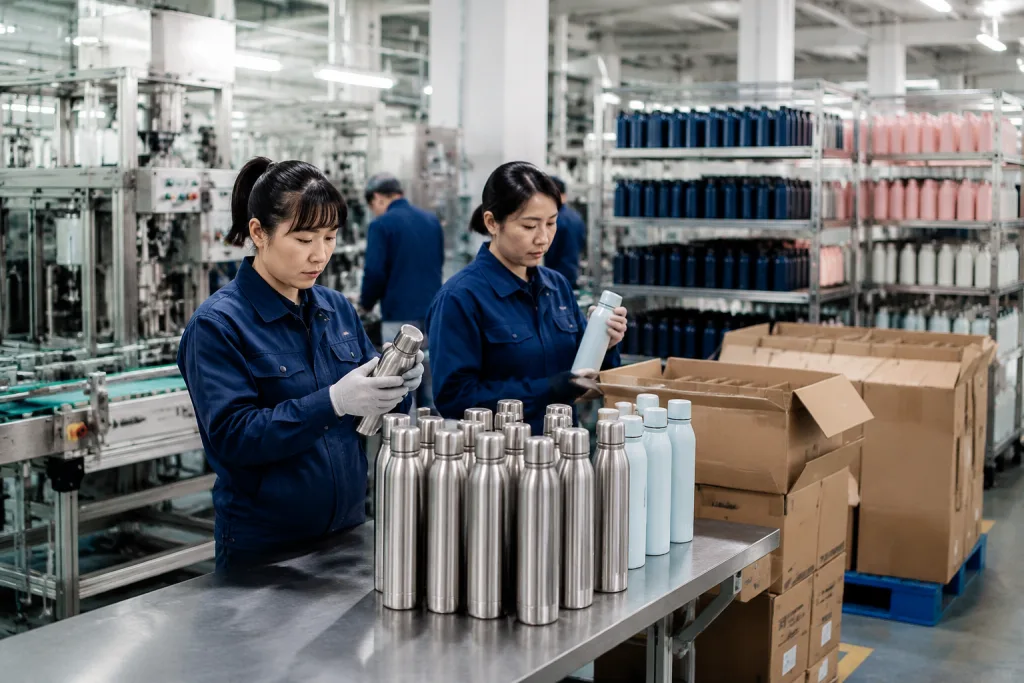
Buying a vacuum flask is not just buying a bottle. The line has to survive freight, store handling, outdoor use, and a coffee buyer who will complain if it drops below 60°C after 8 hours. On our Hangzhou floor, QC pulls a sample from the line and checks lid torque, seam finish, and the 24-hour leak test before we pack a case.
We see the same issue every season: buyers ask for a custom thermos quote, but the spec is too loose to price cleanly. A 500 ml flask can land at USD 3.20 or USD 6.80 FOB China once you change 0.4 mm versus 0.5 mm steel, powder coat, lid tooling, or carton drop-test requirements. The wrong question is “what is your best price?” Better ask the details first, because one PO typo on lid color or logo position can change the whole order.
Start With The Real Use Case
The first question is not “What is your cheapest 500 ml flask?” It is “Where will this vacuum flask be sold or handed out?” A camping store, staff-gift program, trade show booth, and subscription box each need a different spec. For example, a distributor thermos for outdoor retail needs a tougher coating, a lid that holds water in a 24-hour shake test, and carton art that still looks sharp on a shelf. A one-day conference giveaway can live with a simpler lid and a plain white box if the logo is clean and the ship date does not move. Chasing the lowest unit price first is the wrong question.
For vacuum flask wholesale, we split projects into three lanes. First is stock thermos models with a custom logo, usually 1,000 units MOQ per color. Second is an existing body with custom lid color, powder coating, gift box, or sleeve, often 2,000-3,000 units. Third is new tooling for a fully custom thermos shape, where tooling can run from USD 1,500 to USD 8,000 depending on lid count and mold complexity. On the line, the buyer often says they want “small change”; the math does not work if they also want a new PP lid and a special box.
If you are an outdoor retailer, do not cut the finish too thin. We run powder coating at 60-80 micron thickness for trail use because thin spray paint starts to show scuffs after carton rub tests and sample handling. If you are a promo brand, decide early whether speed matters more than a unique build. A standard manufacturer thermos with laser engraving can ship faster than a thermos custom project with new molded accessories. QC pulled the sample last week after a buyer flagged a lid ring mark that would have turned into a return claim.
Good sourcing starts with the sales channel, not the bottle capacity.
When you send an RFQ to a China thermos supplier, include the target market, order quantity, delivery date, packing style, logo method, and any compliance need. That cuts 2-3 email rounds and avoids a quote that later grows by USD 0.40 per unit. We also check PO details like “304 stainless” versus “304 stainess” because one typo can slow the whole line when the carton label and spec sheet do not match.
Steel Grade And Wall Thickness
Most stainless vacuum flasks we ship use 304 stainless steel on the inner wall, with 201 or 304 stainless steel on the outer wall. For Europe and North America, 304 inside is our floor, not an upgrade. Coffee, black tea, electrolyte drinks, and lemon water punish cheaper inner steel; QC pulled a 201-inner sample last year after a 24-hour salt spray check showed pin-point staining near the laser weld. 316 stainless steel is available, but the math doesn't work unless the buyer is selling marine-grade, fishing, or premium outdoor gear.
Wall thickness gets missed on too many RFQs. We run a common inner wall at 0.4-0.5 mm, with the outer wall around 0.5 mm, checked by a digital micrometer before forming. Thinner material can cut USD 0.10-0.25 per unit on thermos bulk orders, but it raises dent risk in 1.2 m drop testing and carton compression during sea freight. For retail outdoor programs, chasing the lightest gauge is the wrong question to ask. One dented-bottle return costs more than the saved steel.
Vacuum performance comes from welding, vacuum pumping, copper plating if used, and final inspection. On the line, we check the weld bead, run the vacuum furnace, then QC tests retention with a probe thermometer and timed water fill. A decent 500 ml stainless flask should keep water above 60°C after 6 hours when tested from 95°C initial temperature at 20°C room temperature. Higher-end models can claim 12-24 hours, but write the test method on the purchase order; we once had a PO typo showing “12h cold” while the buyer’s artwork said “24h hot,” and that went sideways fast. “Keeps hot all day” is not an engineering spec.
- Entry retail: 304 inner, 201 outer, standard vacuum, basic lid; good for supermarket programs where target cost matters and MOQ usually starts around 3,000 pcs per color.
- Outdoor retail: 304 inner and outer, powder coat, stronger lid gasket; better for 1.2 m drop checks, backpack use, and buyers who flag coating chips during AQL 2.5 inspection.
- Premium custom thermos: 304 or 316 inner, copper plating, upgraded cap system; use this when the shelf price can carry the extra material and the claim needs 12-24 hour support.
Our Zhejiang production partners can output about 450,000 stainless drinkware units per month across bottle, tumbler, and flask lines. Capacity helps. Stable quality still comes from locking steel grade, wall thickness, AQL 2.5, and the retention test before mass production starts in China; after the coils are cut and the bodies are drawn, changing from 201 outer to 304 outer is not a small correction.
Logo Choices That Survive Use
For a customizable thermos, the logo method is not just decoration. It changes unit cost, scratch resistance, lead time, and what the buyer thinks the bottle is worth. Outdoor buyers usually ask us for laser engraving because it will not peel, and it looks clean on powder-coated 304 stainless. Promotional buyers usually go with silk screen or pad printing for 1-color event orders, especially when the PO says “delivery before Friday” and the artwork is only a simple white logo.
Laser engraving normally adds USD 0.12-0.35 per unit depending on logo size, position, and quantity. Silk screen can be USD 0.05-0.18 per color per position, but 2-color printing needs tighter artwork control, one more screen, and extra setup time on the line. Heat transfer handles gradients and big wraparound artwork better, but we do not like it for hard outdoor use unless the coating and clear protection are tested. The math does not work if a buyer wants strict Pantone matching and skips samples. For a thermos promotional campaign, approve print samples under daylight and indoor light; QC pulled a red logo last month because it looked correct at 10:00 a.m. but turned orange under warehouse LEDs.
Do not assume the same artwork works on every flask. A tall curved 750 ml body can stretch a horizontal logo by 2-3 mm at the edge, and the buyer flagged it only after seeing photos from the rotary fixture. A matte black powder coat engraves differently from a gloss blue coating. If you need a customized thermos for retail shelves, ask for a pre-production sample with the final surface finish, not a blank bottle or a clean digital mockup.
Checklist before approving logo work
- Confirm Pantone code or engraving finish.
- Confirm logo size in millimeters, not “medium.”
- Confirm position from base or shoulder, using a drawing.
- Test adhesion with 3M tape for printed logos.
- Approve one physical sample before bulk thermos production.
A good thermos manufacturer should push back if your logo sits too close to a weld line, curve, or silicone grip. We run into this around 6-8 mm from the bottom seam on some flask bodies. That is not being difficult. It prevents ugly mass production.
Lids, Leakage, And User Complaints
About 70% of serious after-sale complaints we see start at the lid, not the stainless body. The body can pass vacuum, wall thickness, and polishing checks, then the order still gets hit because the stopper leaks, the gasket carries a rubber smell, the button sticks, or the water flow feels wrong. On the line, QC pulled 12 samples last month where the 304 stainless body was fine but the silicone ring sat 0.6 mm proud of the groove. For vacuum flask wholesale orders, lid structure deserves the same review as the bottle body.
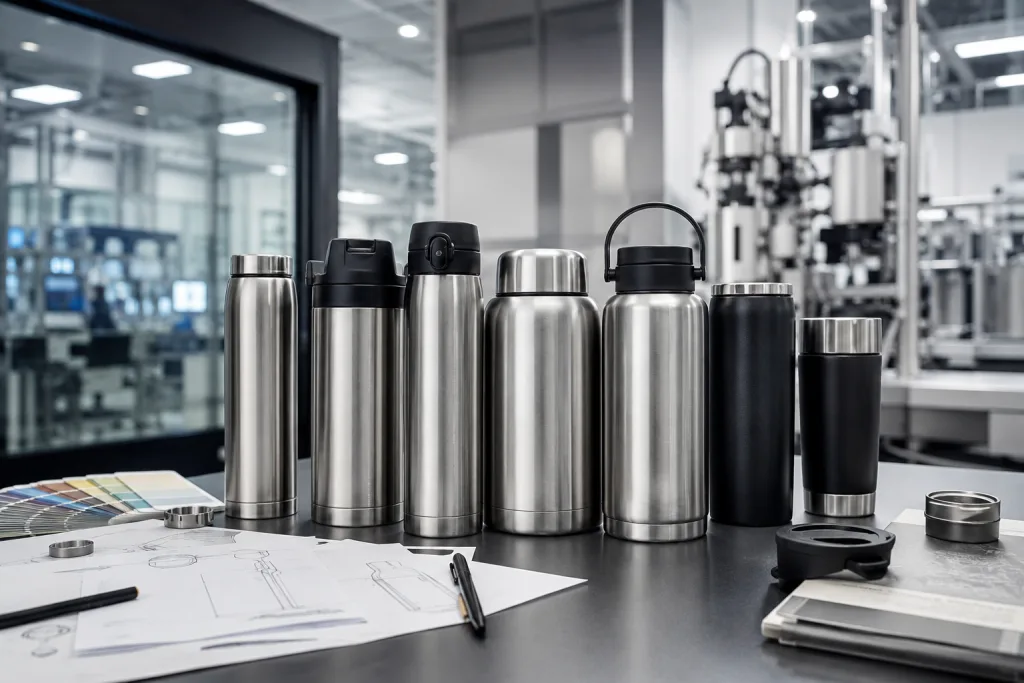
Common lid types include screw caps with 2-start or 3-start threads, cup caps with inner stoppers, push-button stoppers with springs, flip lids with hinge pins, and straw lids with silicone bite valves. For hot drinks, we stay cautious on straw lids; pressure and heat are not a good mix, and we have seen this go sideways in user complaints. For outdoor retailers, a screw stopper with a cup cap still does the job. For office and promotional use, a push-button lid feels convenient, but it has more small parts, and the line needs tighter checks with a torque meter and a simple open-close cycle test.
Ask your thermos suppliers what gasket material they run, not just whether it is “food safe.” Food-grade silicone is standard. For EU and North America, request LFGB or FDA-grade material declarations where required, plus REACH compliance for coatings if applicable. If the lid includes plastic food-contact parts, PP is common; Tritan or other copolyester materials work for transparent parts, but the math changes fast when the buyer asks for clear lids on a 3,000 pcs MOQ. We once caught a PO typo that changed “PP lid” to “PC lid,” and that would have delayed shipment by 12 days.
Leak testing needs a written method. At BottleForge Industrial, a normal final QC plan includes 100% vacuum check and sampling leak test, with AQL 2.5 for major defects and AQL 4.0 for minor cosmetic defects unless the buyer specifies stricter terms. For a distributor thermos program going into retail chains, we recommend a tilted or inverted leak test after hot-water filling, not only cold-water testing. Cold water hides problems. In our Hangzhou workshop, QC marks failed lids with a red paint pen after a 45° tilt test, then the lid team checks gasket fit with a 0.05 mm feeler gauge.
- Hot fill: test at 90-95°C water for thermal performance, then recheck lid pressure after 10 minutes.
- Leak check: invert for 30-60 minutes depending on lid type, with tissue paper under the cap to catch slow seepage.
- Drop test: packed carton drop from 76 cm for export cartons, then inspect cup-cap cracks and thread damage.
- Torque check: confirm cap tightening is usable, not excessive; buyers flag this fast when older users cannot open the flask.
If a thermos vendor says every lid is “100% leakproof,” ask for the test setup. This is the wrong promise to trust without details. We ship better orders when the spec says water temperature, test angle, time, and sample size, instead of leaving the lid factory to guess.
MOQ, Pricing, And FOB Terms
MOQ starts with the artwork and parts list, not with the bottle size. For a standard stainless model with one laser logo, 1,000 units per color is workable; we run that on the regular line without stopping the jig setup. For custom powder coating, 2,000 units is the number we quote most often because the coating booth loses too much time when the batch is only 600 or 800 pcs. New lid colors, special silicone rings, or retail gift boxes usually push the plan to 3,000 units or more. For new molds, 5,000-10,000 units is a safer starting point, and QC will ask for a 2D drawing with lid thread tolerance in mm before the tooling quote moves.
FOB China pricing for a 500 ml stainless vacuum flask typically ranges from USD 3.20 to USD 6.80 for mainstream B2B orders. A 750 ml outdoor-grade model may run USD 4.80 to USD 9.50 depending on steel, coating, lid, and packaging. These are planning ranges, not a blank check. We have seen this go sideways when a buyer chased a USD 2.90 quote and later found 201 outer steel, thin coating, and a 3-ply carton that failed the drop test. If a quote sits far below the range, check steel grade, coating thickness in microns, carton strength in kg, and whether logo, AQL 2.5 inspection, export packing, and Ningbo local charges are included.
Payment terms are usually 30% deposit and 70% balance before shipment for first orders. Regular distributor buyers may negotiate better terms after 3-5 clean shipments with no late artwork, no PO typo, and no unpaid balance sitting past ETD. Lead time is usually 25-35 days after sample approval and deposit; for Q3 holiday retail, the safer booking window is 45-60 days because coating, packing, and gift-box printing all queue up. The buyer often asks, “Can you ship 12 days earlier?” Sometimes yes. If the powder coat line is full and the color box supplier is already at 18 days, the math doesn't work.
RFQ checklist for accurate pricing
- Capacity: 350 ml, 500 ml, 750 ml, 1 L, or other; tell us the target carton weight if your warehouse has a limit.
- Steel grade: 304/201 or 304/304, with test report request if your market asks for FDA or LFGB paperwork.
- Finish: powder coat, spray paint, polish, or matte stainless; note Pantone code and scratch-test expectation.
- Logo: laser, silk screen, pad print, heat transfer, or no logo; send AI or PDF artwork, not a blurry JPG from the PO.
- Packing: white box, kraft box, color box, gift box, or bulk carton; confirm barcode, manual, and inner bag requirements.
- Terms: FOB Ningbo, FOB Shanghai, EXW, or DDP quotation request; list destination port or ZIP code for DDP.
A solid thermos supplier will not just send one number. They should show what is included, what is excluded, and which change moves the unit price by USD 0.10, USD 0.30, or USD 1.00. Last month QC pulled the sample because the buyer changed from laser logo to heat transfer after approval; that small-looking change added a film charge, one extra curing step, and 4 days on the line.

Compliance And Inspection Questions
For Europe and North America, stainless thermos compliance is not paperwork you skip. The bottle may touch food, carry a brand claim, and go through retail gates that ask for files. On the line, QC pulled the silicone gasket sample and the lab wanted test reports for the stainless body, the lid plastic, and every food-contact part. For the EU, LFGB and REACH come up fast. For the US, FDA food-contact material compliance and a California Proposition 65 review may be needed, depending on the program.
If the product is for children, the bar moves up. ASTM and CPSIA checks can apply, especially for coatings, small parts, and lead or cadmium limits. A kids' flask is not a smaller adult bottle. We have seen a buyer flag a 3 mm lid bead because it looked easy to bite off. For school and promo orders, lock the age grade early and drop child-oriented claims unless the bottle was built and tested for that use.
Factory audits matter just as much. Some promotional brands and retailers ask for BSCI, Sedex, ISO 9001, or similar files. Not every thermos factory has all of them, and a trading company may not control the line the way you expect. Ask who owns production, who signs off QC, and whether a third party can inspect before shipment. If they dodge that question, the math does not work.
We recommend pre-shipment inspection on first orders above USD 10,000. We run AQL 2.5 on quantity, workmanship, function, logo, packing, carton marks, barcode scan, and the drop test. For Amazon or e-commerce programs, add FNSKU labels, carton weight limits, and master carton size to the checklist. If your thermos distributor network takes mixed SKUs, the carton marks need to read clean at the warehouse, not just clear customs.
Talk compliance before sample approval. If you wait until the goods are packed, you are left with delay, rework, discount, or a fight. We have seen that go sideways on a 12,000-unit PO because the artwork proof missed the test mark callout. None of those outcomes help procurement.
Sampling And Production Timeline
A normal custom thermos project goes through two sample stages. First, we make a reference sample to lock the body, lid, capacity, and hand feel; last week QC pulled one at 500 ml with a caliper because the buyer flagged a 1.5 mm wall difference. Then we send a pre-production sample with final color, logo, and packing. Skipping that second round may save 5-7 days, but the math does not work for retail or promo brands.
Standard sample lead time is 3-7 days for blank stock and 7-12 days for logo samples. Custom coating adds 5-10 days because the powder booth runs by batch, not by wish list. New tooling takes longer: 20-35 days for mold and first article samples is normal, and each revision can add 7-15 days. We have seen buyers push for a same-week redraw on a lid insert; that usually goes sideways.
Once the pre-production sample is approved, mass production usually takes 25-35 days for standard vacuum flask wholesale orders. Add 3-5 days for final inspection and export documents. On the line, we run vacuum leak testing and a 24-hour hot-water hold before carton close. Ocean freight to North America can take 25-40 days port to port, while Europe is often 30-45 days depending on route and season. Air freight is faster, but stainless steel is bulky and the freight bill eats the margin.
For promotional campaigns with a fixed event date, count backward from delivery, not from production start. If you need goods in a US warehouse on May 1, samples usually need approval by mid-March for ocean freight. We had a buyer once ask to move that to late March; the barcode labels were not even in the system yet. For outdoor retail launches, leave room for photography samples, carton artwork, and buyer sign-off.
A capable China thermos manufacturer can move fast, but it cannot squeeze coating, vacuum testing, inspection, and freight into a fantasy schedule. If a supplier quotes 12-day mass production during peak season, ask which step is being skipped. On our side, the line can run, but the coating oven and leak test rack still need real time.
Send Your Vacuum Flask Wholesale RFQ Today
Share capacity, quantity, logo, packing, target price, and delivery date. We will reply with practical FOB options and sample timing.
Frequently asked questions
What is the normal MOQ for vacuum flask wholesale orders?
For standard stainless flask models, a practical MOQ is 1,000 units per color with one logo. If you need custom powder coating, special lid colors, or retail gift boxes, 2,000-3,000 units is more realistic. New mold projects usually start at 5,000-10,000 units because tooling, setup, and trial production must be spread across enough volume. Some thermos suppliers advertise 300-unit orders, but the unit cost is higher and color options are limited. For outdoor retailers and promotional brands, 1,000 units is usually the point where FOB China pricing, logo setup, and carton packing begin to make commercial sense.
How much should a custom stainless thermos cost FOB China?
For a mainstream 500 ml custom thermos, expect roughly USD 3.20-6.80 FOB China depending on steel grade, lid, coating, and logo. A 750 ml outdoor-grade flask can be USD 4.80-9.50. Laser engraving may add USD 0.12-0.35 per unit, while a color box can add USD 0.20-0.70 depending on paper weight and print finish. Very low quotes often hide 201 stainless outer walls, thinner steel, weak cartons, or no proper inspection. Ask your thermos manufacturer to separate body cost, logo cost, packing cost, and testing cost so you can compare fairly.
Is 304 stainless steel enough for outdoor thermos products?
Yes, 304 stainless steel is enough for most outdoor and promotional thermos programs, especially for the inner wall. It resists normal coffee, tea, water, and sports drink use better than lower-grade steel. For stronger retail positioning, many buyers choose 304 inner and 304 outer construction. 316 stainless steel is possible, but it usually adds cost without being necessary for standard camping, hiking, or corporate gift use. More important than upgrading to 316 is confirming wall thickness around 0.4-0.5 mm, reliable vacuum testing, food-grade silicone gaskets, and a coating that can survive abrasion and carton handling.
Can you pack customized thermos orders for Amazon or retail distribution?
Yes, but packing must be specified before production. For Amazon FBA-style shipments, you may need FNSKU labels, suffocation warnings for polybags, carton weight limits, scannable barcodes, and master carton dimensions that match warehouse rules. For retail distribution, you may need color boxes, hang tags, retail barcodes, inner cartons, and carton marks by SKU. A thermos distributor should also confirm pallet requirements, carton drop test expectations, and mixed SKU rules. Adding these details after production can delay shipment by 3-7 days and create rework charges. Put all labeling and packing rules into the purchase order.
How do I reduce defects on a thermos bulk order?
Start with an approved pre-production sample and a written QC checklist. Define acceptable cosmetic defects, logo position tolerance, leak testing, thermal performance, carton drop testing, and AQL level before mass production. For first orders, use AQL 2.5 for major defects and AQL 4.0 for minor defects as a practical baseline. Require 100% vacuum checking from the factory and sampling inspection by your team or a third party before shipment. Do not approve mass production from a digital mockup only. A physical sample with final coating, final logo, and final packaging prevents most expensive misunderstandings.