Key Takeaways
- A 750 ml 304 stainless custom thermos usually lands at USD 4.20-6.80 FOB Ningbo at 3,000-10,000 pcs
- Powder coating, laser engraving, color box, and spare lid parts can add USD 0.35-1.20 per unit
- AQL 2.5/4.0 inspection should include vacuum retention, leak testing, coating adhesion, and carton drop checks
- BottleForge Industrial runs 450,000 stainless drinkware units/month in Zhejiang, China, with MOQ from 1,000 pcs
You are buying 5,000 stainless vacuum flasks for an outdoor retail launch or a promotional thermos campaign. On the RFQ sheet it looks like one line item. On the factory floor, the price moves once we add 0.28 mm powder coating, laser logo setup, E-flute retail boxes, 1.2 m drop tests, and 5-side carton marks. QC pulled the sample last month because the PO said “matte black,” but the buyer’s artwork file showed Pantone 426C. Small mismatch. Big delay.
Here is how we walk a new buyer through one live-style order at BottleForge Industrial in Hangzhou, Zhejiang. Not theory. We run a 750 ml double-wall stainless steel bulk thermos order from spec sheet to quotation, pre-production sample, AQL 2.5 inspection, inner bag, master carton, and China shipment. The wrong question is “what is your cheapest vacuum flask wholesale price?” The better question is what finish, packing, test standard, and delivery window the line must hit without rework.
Start with the selling channel
The first mistake is asking a thermos supplier for the cheapest 750 ml flask before you define the selling channel. Wrong question. An outdoor retailer, a ski event sponsor, and a corporate gift distributor all push different specs, even when the body capacity is identical; last month our costing sheet showed a 0.7 kg carton weight gap between two “same” 750 ml RFQs.
For an outdoor retail order, we run a tougher powder coating, tighter lid fit, and a color box that can take warehouse drops without crushed corners. QC pulled one matte black sample from the line with a 0.35 mm lid wobble, and the buyer flagged it before talking price. For a promotional thermos, logo size, PMS color match, and delivery date can beat 24-hour heat retention. A distributors thermos order may sit in a catalog for 12 months, so repeatability matters more than cutting USD 0.08 from the first PO.
Our buyer scenario starts with 5,000 pcs of a 750 ml stainless vacuum flask, matte black and forest green, with a one-position laser logo, individual color box, and master carton for export. The target buyer is an outdoor retailer using the product as shelf merchandise and branded field gear. That pushes the specification above a basic thermos promotional giveaway but below a premium retail line with copper coating and custom mold parts; we’d check the laser logo on a 20 W fiber machine before locking the artwork.
For this setup, a realistic vacuum flask wholesale price from a China thermos factory sits around USD 4.60-5.90 FOB Ningbo, assuming 304 stainless steel inside and outside, 0.45-0.50 mm outer wall thickness, PP lid components, silicone sealing ring, and standard carton packing. If a thermos vendor quotes USD 3.20 for the same order, ask what was removed. The math doesn’t work. We’ve seen this go sideways: thinner steel, weak coating adhesion, poor vacuum yield control, or a master carton that splits at 14 kg during loading.
Build the quote line by line
A workable quote should not read “750 ml customized thermos, USD 5.10” and stop there. That is the wrong way to buy. You need the cost drivers split out, or every price discussion turns into guessing. For a manufacturer thermos order, we run the quote by base bottle, decoration, packaging, compliance, spare parts, and logistics terms; our sales sheet even has separate columns for lid gasket, carton spec, and FOB port because buyers flagged those missing on 7 POs last quarter.
For the 5,000 pcs scenario, the base vacuum flask with 304/304 stainless steel may be USD 4.35 FOB. Matte powder coating adds USD 0.28-0.45 depending on color and surface rejection rate; on the line, the gloss meter and cross-cut tape test usually tell us fast if a color is going to waste money. Laser engraving is often USD 0.08-0.18 per unit for one position under 40 x 60 mm. A retail color box with 350 gsm paper may add USD 0.22-0.38. A printed instruction leaflet plus reinforced master carton may add another USD 0.08-0.15, and QC still checks the leaflet version because one buyer once sent a PO with “750 m1” instead of “750 ml.”
That puts the working vacuum flask wholesale price around USD 5.10-5.45 before special tests. If you need LFGB food-contact testing, REACH screening for coating, or a full third-party inspection report, budget USD 250-900 per project depending on scope. We usually amortize those costs across the order, not bury them inside the unit price; hiding them looks neat on page one, then the math goes sideways when the buyer asks for a repeat order at 2,000 pcs.
MOQ matters. At BottleForge Industrial in Zhejiang, our normal MOQ for this type of custom thermos is 1,000 pcs per model, with 500 pcs per color if the coating line is already running a standard color. For a fully customizable thermos with private mold lid, embossing, or unique silicone grip, MOQ can move to 3,000-5,000 pcs because tooling and line setup become real costs. The mold shop does not care about nice forecasts; a lid insert still needs steel, CNC time, and trial shots before QC pulled the sample for leak testing.
Ask your thermos manufacturers for a price ladder at 1,000, 3,000, 5,000, and 10,000 pcs. A proper thermos supplier should show where scale actually helps, such as carton printing, coating setup, or assembly labor. If the 10,000 pcs price is only USD 0.04 lower, the factory thermos cost is already tight or the quote is padded. We have seen buyers push for 10,000 pcs expecting a big drop, then accept 5,000 pcs once the packing line timing and 62 x 42 x 28 cm master carton cost are shown line by line.
Specify steel before decoration
Logo talks are easy. Steel decides whether the buyer sends back photos from the warehouse floor. For a stainless thermos bulk order, lock the material grade, wall thickness, vacuum test target, lid build, and coating method before artwork approval; last month QC pulled 32 samples from a 3,000 pcs run because the PO said “304 inside” but the spec sheet did not mention the outer shell.
For the inner wall, use SUS304 for Europe and North America unless your compliance consultant gives a clear reason to choose another grade. Some suppliers thermos quotes use 201 stainless steel outside to shave USD 0.18-0.35 per bottle. That can pass for low-cost promotional use, but the math doesn't work for outdoor retail after scratches, dishwashing, and wet backpacks. We usually run 304 inner wall and 304 outer wall for outdoor retailers, with 0.40-0.50 mm outer wall thickness and 0.35-0.40 mm inner wall thickness, checked by micrometer before the line starts.
Vacuum performance should be written as a test condition, not a slogan. For a 750 ml double-wall flask, a fair target is hot water starting at 95°C, measured after 6 hours at room temperature, with final water temperature above 65°C. Better builds can hold above 72°C after 6 hours, but that needs cleaner vacuum control, tighter welding, and sometimes copper lining. It adds cost. On our floor, the vacuum station log and the 6-hour test rack tell the truth faster than any sales sheet.
The lid is where we see custom thermos projects go sideways. Ask whether the cap is screw lid, push-button, cup lid, or straw lid, then confirm PP grade and silicone ring hardness separately. Thread tolerance needs a number, not “fits well”; our gauge check usually flags bad lids before water testing does. Spare gasket availability matters too. A USD 0.12 cheaper lid can create a 2% leak defect rate, and that gets expensive once the order lands in a distributor thermos warehouse.
Decoration comes after this. Laser engraving is clean and durable for outdoor brands. Silkscreen handles larger color logos, but we still run tape testing and scratch testing because buyers flag missing ink faster than they flag steel grade. Powder coating should pass a 3M tape adhesion test and at least a basic cross-hatch check. A thermos custom order is only custom if the decoration survives normal use.
Sample like you mean it
Sampling is not photo approval. It is a short production rehearsal. For a 5,000 pcs customized thermos order, we run one blank sample for structure confirmation, then 2-3 pre-production samples with final coating, logo, packaging, and carton label. Standard sample lead time is 7-10 days for existing molds, or 12-18 days when Pantone color matching or packaging printing is involved. Last month QC pulled a PP sample from the line because the carton label said “750ML” while the buyer’s PO said “720 ml practical capacity.” Small typo. Big delay.
Check the blank sample first. Fill it with 95°C hot water, weigh the bottle on a 0.1 g bench scale if you need freight estimates, test the lid through 30 opening cycles, and measure capacity to the practical fill line, not just brim capacity. A bottle sold as 750 ml may hold 720 ml comfortably. That is not automatically wrong, but it must match your product page and retail claims. We have seen this go sideways when the buyer only checked the outside shape.
For the logo sample, send vector artwork and a clear size in millimeters. “Make logo visible” is not a production instruction. On a curved bottle, a 70 mm wide laser logo usually sits clean; a 110 mm logo can stretch near the shoulder radius and look cheap after polishing. If you need a promotional thermos for an event sponsor, confirm whether the logo faces the drinking side or lines up with the lid seam. The buyer flagged this once after we had already jigged the laser machine.
For packaging, approve dielines and carton marks before mass production. Outdoor retailers often need barcode labels, country of origin, SKU, item name, and sometimes FNSKU if the goods will also move through marketplace fulfillment. A thermos distributors shipment can sit 3 extra days at the forwarder because one carton mark is missing, even when the bottle itself passes inspection. The math does not work if a USD 40 label fix holds a full pallet.
Do not approve mass production from a digital mockup alone. Ask your thermos manufacturer in China for a physical PP sample or signed pre-production sample with color, logo, and box checked against the PO. We ship smoother when the buyer signs one sample card with Pantone code, logo position in mm, carton mark layout, and lid direction all written down.
Put QC into the purchase order
Write QC into the purchase order before the deposit goes out. After the goods are finished, every defect turns into a price argument, and we have seen this go sideways on mixed-color runs. For a 5,000 pcs thermos bulk order, put the sampling rule on the PO: AQL 2.5 for major defects and AQL 4.0 for minor defects. Critical defects such as leakage, unsafe sharp edges, or wrong material should be zero tolerance. QC pulled one sample last March with a 0.4 mm burr inside the drinking lip; if that line is not written on the PO, the factory will call it “acceptable polishing.”
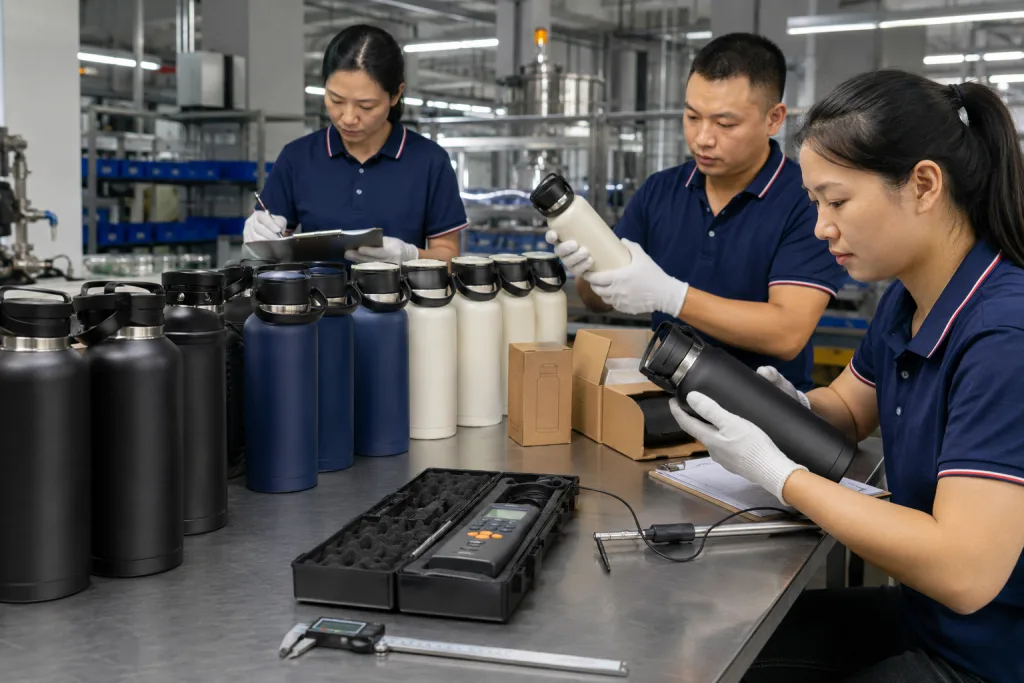
Our usual QC checklist for a stainless vacuum flask covers appearance inspection with a 600 lux light box, capacity check on a digital scale, lid torque with a torque meter, leak test, vacuum retention test, coating adhesion, logo position, barcode scan, carton drop, and packaging count. For leak testing, samples should be filled, closed, inverted, and shaken for at least 30 seconds. Simple. No shortcut. For vacuum testing, we run hot water at 95°C, record temperature after 3-6 hours, and isolate units outside the agreed threshold on a red-tag table beside the line.
Coating defects need their own grading, not a loose “surface must be good” sentence. Powder coating can show orange peel, pinholes, dust spots, thin coverage near the bottom edge, or scratches from handling. Two tiny dust points under 0.5 mm on the back side may be minor. Exposed steel on the shoulder is major. Logo defects also need grading: a 1 mm offset may pass, but broken letters or incorrect logo orientation should be major. The buyer flagged this once because the artwork file said PMS 286C, while the PO typo said PMS 268C; the math does not work when 5,000 lids are already printed.
For packaging, test one full export carton, not an empty box from the sample room. If the bottle has a retail box, confirm box crush resistance and divider fit with the actual 750 ml flask inside. A common master carton for 750 ml flasks may hold 24 pcs and weigh 12-15 kg gross. Use 5-ply corrugated board for export, not a weak domestic carton. We ship these by sea from Ningbo, so carton strength matters after 18 days on the water, not just 12 minutes on a clean packing table. At BottleForge Industrial, our stainless thermos lines in Zhejiang run around 450,000 units/month, but volume means nothing unless QC rejects are caught before the container leaves China.
Plan freight and payment timing
The FOB number is only the factory gate math. You still need to choose FOB Ningbo, FOB Shanghai, CIF, DDP, or EXW. For European and North American buyers with their own forwarder, we usually quote FOB Ningbo because it keeps the handover clean. Our cartons leave Hangzhou by 9.6 m truck, then the forwarder takes over at Ningbo port. You control ocean freight, insurance, and destination charges. CIF looks easier on paper, but we have seen buyers get angry later when destination handling charges were higher than the flask margin.
A 5,000 pcs order of 750 ml stainless flasks with retail boxes usually takes about 18-24 cubic meters, depending on the box height, insert tray, and master carton layout. QC checks this with a tape measure before we book space, not after the cartons are sealed. That volume is often LCL or part of a consolidated container, not a full 20 ft container. If the goods ship to an outdoor retailer DC, ask for pallet rules before mass production. Pallets add cost and volume, but they cut crushed retail boxes and receiving claims. We had one buyer flag 37 dented color boxes because the PO forgot “palletized delivery.”
For a first custom thermos order, payment is normally 30% deposit and 70% balance before shipment after inspection. Established buyers sometimes get 30/70 against copy of bill of lading or credit terms, but the math does not work on a first PO with custom logo, custom box, and factory-paid materials. Production lead time is normally 25-35 days after deposit and sample approval for existing models. Add 7-14 days during peak season or before major China holidays. On the line, we do not start powder coating until the deposit lands and the approved sample is signed off with color code, logo size in mm, and carton mark.
If your promotional brand has a fixed event date, work backward from the arrival date, not the factory completion date. This is the wrong question to ask: “Can you finish in 35 days?” Ask when the goods can reach your door. Ocean freight to the US West Coast may take 18-28 days port to port, while Europe can be 30-40 days depending on routing. Add customs clearance and truck delivery. A thermos vendor who promises “35 days delivery” may mean 35 days production, not door delivery. We have seen this go sideways when the buyer booked a launch on June 10, while the cartons were still waiting for AMS filing at Ningbo.
Approve the order without surprises
Before you release the 70% balance, match the finished goods against the signed sample and PO line by line, not by memory. Check model number, capacity, material claim, color code, logo method, packaging, quantity, carton marks, inspection report, and shipping documents. We once saw a PO write “500ml” on page 1 and “550ml” in the packing list; the buyer flagged it before shipment, and that small typo saved a claim.
For a custom thermos buyer, the clean approval set is a signed pre-production sample, final artwork file, packaging dieline, AQL standard, inspection photos, packing list, commercial invoice, and HS code confirmation. If the order goes into the EU, keep food-contact documents and REACH coating data in the file. For the US, confirm retailer rules, and if kids are in the line, check ASTM and CPSIA. A stainless thermos for adults is simpler, but “simple” is the wrong question to ask when a chain store wants its own carton warning text.
When you compare thermos suppliers, watch the wording. “Factory direct” does not guarantee control, and “trading company” does not mean weak control. What matters is whether the thermos factory or sourcing partner can track welding, polishing, vacuum testing, coating, assembly, and inspection with records you can pull in 10 minutes. On our line, QC pulled a 12 pcs sample from one lot and caught a 0.2 mm lid gap; that is the kind of miss that turns into a leak claim later.
The best vacuum flask wholesale price is not the lowest number on the quote. It is the lowest landed cost that still gives you sellable goods, stable repeat orders, and a complaint rate you can live with. If you buy 5,000 pcs at USD 0.30 too cheap and 300 units leak or come with thin coating, the math does not work. We have seen buyers chase the lowest quote, then rework cartons, relabel shipments, and pay air freight on the replacement batch.
Send your thermos spec for a factory quote
Share capacity, quantity, logo method, packaging, and destination. We will return a practical FOB price and production timeline.
Frequently asked questions
What is a realistic vacuum flask wholesale price for 750 ml stainless bottles?
For a 750 ml double-wall stainless vacuum flask, a realistic FOB China wholesale price is usually USD 4.20-6.80 at 3,000-10,000 pcs. The lower end is for standard molds, simple finish, plain box, and one-color logo. The higher end may include 304/304 stainless steel, powder coating, laser engraving, retail packaging, better vacuum retention, and stricter QC. At 1,000 pcs, expect the unit price to be USD 0.25-0.70 higher because setup, coating, and printing losses are spread across fewer units. If a supplier thermos quote is far below USD 4.00, ask for wall thickness, steel grade, lid material, and test standard in writing.
What MOQ should outdoor retailers expect for a custom thermos?
For existing stainless thermos models, a practical MOQ is 1,000 pcs per model, often with 500 pcs per color if you use standard coating colors. For a thermos custom order with custom PMS powder coating, private color box, and laser logo, 2,000-3,000 pcs is more comfortable. If you want a new lid, special handle, molded silicone boot, or unique bottle shape, MOQ can rise to 5,000 pcs or more because tooling and trial production are involved. A promotional thermos order can sometimes run lower if decoration is simple, but the unit price will usually increase.
How long does a customized thermos order take from China?
For an existing model, plan 7-10 days for blank or logo samples and 25-35 days for mass production after sample approval and deposit. Add 3-7 days for third-party inspection and booking space. Ocean freight may take about 18-28 days to the US West Coast and 30-40 days to many European ports, depending on route and season. Around Chinese New Year or peak autumn promotional season, add 10-20 days of safety buffer. A reliable thermos manufacturer should give you a timeline with sample, production, inspection, vessel ETD, and ETA separated.
Which logo method is best for bulk thermos orders?
Laser engraving is usually the safest choice for outdoor retail because it is durable, clean, and does not peel. The cost is commonly USD 0.08-0.18 per unit for one position, depending on logo size and production speed. Silkscreen printing works well for larger colored logos and lower-cost promotional thermos programs, but it should pass adhesion and scratch checks. Heat transfer or full-wrap graphics can look strong on shelf, but the cost and rejection rate are higher. For a 5,000 pcs bulk thermos order, approve a physical logo sample, not only a mockup.
What QC tests should I require before shipping?
Use AQL 2.5 for major defects and AQL 4.0 for minor defects, with zero tolerance for critical issues such as leakage, sharp edges, unsafe contamination, or wrong material. Require leak testing, vacuum retention testing, coating adhesion, logo position check, capacity verification, barcode scan, carton count, and export carton drop check. For vacuum retention, specify the condition, such as 95°C starting water temperature and final reading after 6 hours. For coating, include cross-hatch or 3M tape testing. A thermos manufacturers inspection report should include photos, defect counts, sample size, and pass/fail decision.