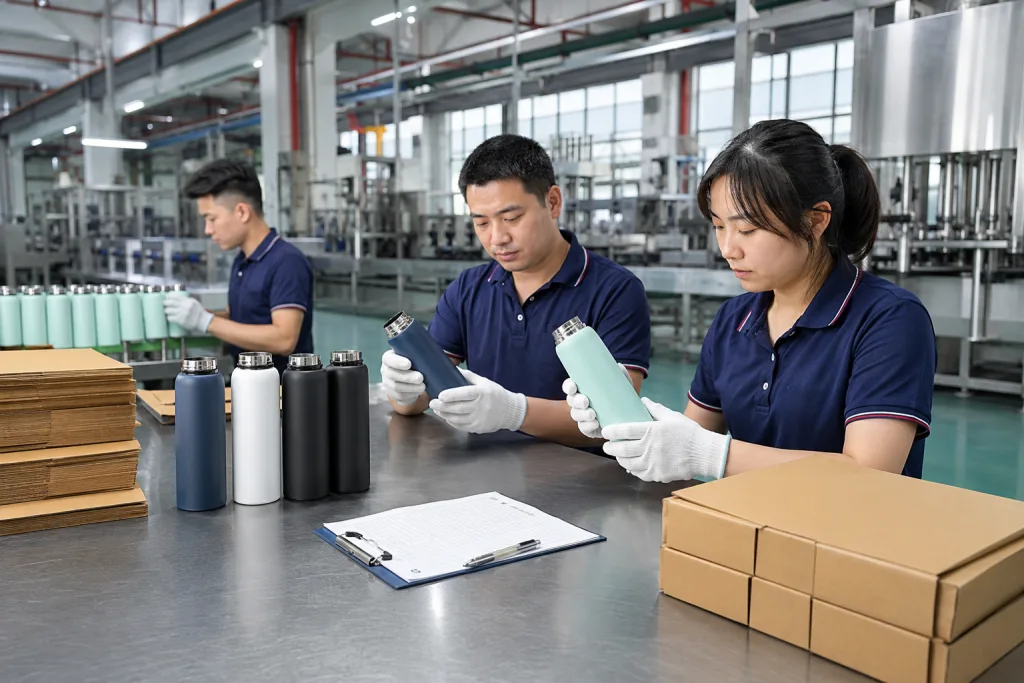
Key Takeaways
- A realistic vacuum flask wholesale bulk MOQ starts at 1,000 units for stock shape with custom logo
- 304 stainless steel flasks usually land between USD 3.20 and USD 7.80 FOB Ningbo or Shanghai depending on size and finish
- Sampling normally takes 7-12 days; mass production runs 25-35 days after approved artwork and deposit
- AQL 2.5/4.0 inspection, LFGB or FDA food-contact testing, and carton drop tests should be priced before ordering
If you buy vacuum flask wholesale bulk for an outdoor retail line or a promo campaign, finding a thermos supplier is the easy part. The wrong question is, “Who is cheaper?” We’ve seen a USD 3.20 flask quoted with 0.35 mm body steel, loose lid threads, and a carton that failed a 1.2 m drop test; a USD 5.80 flask with 304 stainless, tighter vacuum time, and cleaner powder coating is not the same product.
At BottleForge Industrial in Hangzhou, Zhejiang, we quote stainless vacuum flasks every week for distributors, outdoor brands, and promotional thermos programs. We run most custom thermos orders at 1,000-5,000 units, with 25-35 days mass production after sample approval; if the buyer signs the color chip on day 6 instead of day 1, the ship date moves. QC pulled the sample on one recent 2,000 pcs order because the PO said matte black, but the artwork file showed gloss black. Below is the cost and lead-time breakdown you should ask for before paying a deposit in China.
Start with the real landed cost
For vacuum flask wholesale bulk buying, FOB unit price is one line in the spreadsheet. Buyers still fight that line first. Wrong question. A stainless vacuum flask at USD 3.45 FOB can cost more on arrival than a USD 4.10 flask when the low quote uses 0.38 mm outer steel, weak paint, lids that fail the torque test, 9 kg cartons that crush, or packing that leaves 14% empty space in the container.
For a standard 500 ml double-wall stainless vacuum flask, we usually see these China FOB ranges on the line:
- USD 3.20-4.20 for a stock shape with 304 inner wall, 201 outer wall, single-color logo, and a simple white box; MOQ is often 3,000 pcs, and QC should still pull 80 samples for logo rub testing.
- USD 4.30-5.80 for 304 inner and outer steel, powder coating, laser engraving or full-color print, and a better lid seal; we run the lid on a torque meter because buyers flag leaks before they flag color shade.
- USD 6.00-7.80 for retail-grade finish, custom lid, premium gift box, tested coating, and tighter inspection; one buyer once typed “mat black” on the PO, and the pre-production sample saved a full black vs matte black dispute.
The biggest hidden cost is not steel. It is rework. If 4% of your bulk thermos order has coating scratches, crooked logos, or vacuum failure, the math does not work. QC pulled a sample last month with a 2 mm logo shift and three pinholes in the powder coat; that looks small in the workshop, but it becomes chargebacks after delivery. Outdoor retailers pay for returns months later. Promotional brands can lose the next order from one bad event shipment.
Ask every thermos manufacturer to split cost into body, cap, logo, packaging, testing, and inspection. A proper factory thermos quote should show what stays fixed and what drops when volume moves from 3,000 pcs to 10,000 pcs. In Zhejiang, China, we’ve seen this go sideways when buyers specify a 1.5 mm thicker gift box but accept a loose PP lid gasket. Backwards. The lid gets touched 1,000 times; the box gets touched once.
MOQ tiers that change pricing
MOQ is where 7 out of 10 vacuum flask wholesale bulk projects start to get fuzzy. A factory can quote 500 units, but this is the wrong question to ask. Ask whether 500 units get the same powder-coating line slot, logo jig setup, and carton cube efficiency as 3,000 units. They don’t. Last month QC pulled a 500-piece sample run where the laser logo was 1.5 mm off center because the line changed fixtures twice in one shift.
For a customizable thermos based on an existing BottleForge mold, we run these practical tiers:
- 500 units: workable for trial orders with stock colors and a simple laser logo; unit cost is usually 15-25% higher because setup time gets spread across fewer pieces.
- 1,000 units: normal MOQ for one size, one body color, and one logo position; a clean starting point for distributor thermos testing when the PO has no mixed SKUs.
- 3,000 units: better price break with stable powder coating batch control, wider color choice, and lower carton cost per unit; the line can hold one color through a full shift.
- 5,000-10,000 units: best tier for retail launch with custom box, inserts, barcode labels, and container planning; we can plan pallet height and CBM before the buyer books space.
For a fully customized thermos with a new body shape, new lid tooling, or private mold, MOQ moves up fast. A new lid can require USD 1,200-3,500 tooling and 3,000-5,000 units to make the math work. A new stainless body shape can run USD 4,000-12,000 in tooling, depending on diameter, shoulder curve, and cap interface. If a thermos vendor promises new mold development at 500 units with no tooling fee, be careful. We’ve seen this go sideways: the buyer flagged “exclusive mold” on the PO, then the same cap showed up in another brand’s booth 6 months later.
For promotional thermos orders, 1,000 units is usually enough. For outdoor retailers, 3,000 units is healthier because you need shelf stock, online stock, replacements, and sometimes split delivery to 2 warehouses. A serious thermos factory should calculate MOQ around sell-through, not just production convenience. The math is simple: if the first shipment sells in 12 days but replenishment takes 18 days, you are out of stock before the second batch leaves Hangzhou.
Materials that move the price
Buyers often write “stainless steel” on the RFQ like it is one grade. Wrong question. For food-contact vacuum flasks, we run 304 stainless steel, also called 18/8, on the inner wall. The outer wall can be 304 or 201, depending on shelf price and corrosion risk. If your customers are coastal hikers, fishing shops, or ski retailers where salt and wet gloves are normal, 304 outer wall is worth the extra USD 0.25-0.60 per unit. Last month QC pulled 30 pcs from a 201 outer-wall trial, and 4 showed early rust dots after a 24-hour salt-spray check.
Wall thickness moves the quote fast. A typical 500 ml manufacturer thermos may use 0.4 mm inner wall and 0.5 mm outer wall. A cheaper flask may shave material down to 0.35 mm. That saves a few cents, but the math breaks after carton drop, retail shelf handling, and FBA-style parcel delivery. Dents get expensive. For outdoor retail, we usually set 0.4/0.5 mm as the floor. For a lightweight promotional giveaway, thinner steel can pass if the bottle sits on office desks and event tables, not in backpacks. We check this with a digital thickness gauge on the line before polishing, because once the body is painted, nobody wants that argument.
Vacuum performance is another price lever. A fair spec for a 500 ml stainless vacuum flask is 6 hours above 65°C and 12 hours above 45°C, tested with boiling water in a 20°C room. Copper coating between walls can push heat retention up and add about USD 0.20-0.45 per unit. Not every order needs it. We have seen this go sideways when a promo buyer pays for 18-hour claims but sells the flask with a big logo sticker and a loose gift-box insert. For a winter campaign, logo impact and clean printing registration may beat heat data; our test bench records water temperature at 2, 6, and 12 hours before we sign off the sample.
Check the small plastic and silicone parts early. PP lids, food-grade silicone gaskets, and optional tea filters all affect compliance. For Europe, ask about LFGB, REACH for coating, and migration testing. For North America, FDA food-contact documentation and ASTM-related drop or lead/cadmium checks may matter by channel. Cheap suppliers thermos quotes often skip this until the order is already late. We once caught a PO typo that said “silicon ring” instead of “silicone gasket,” and the buyer flagged it during document review 9 days before shipment.
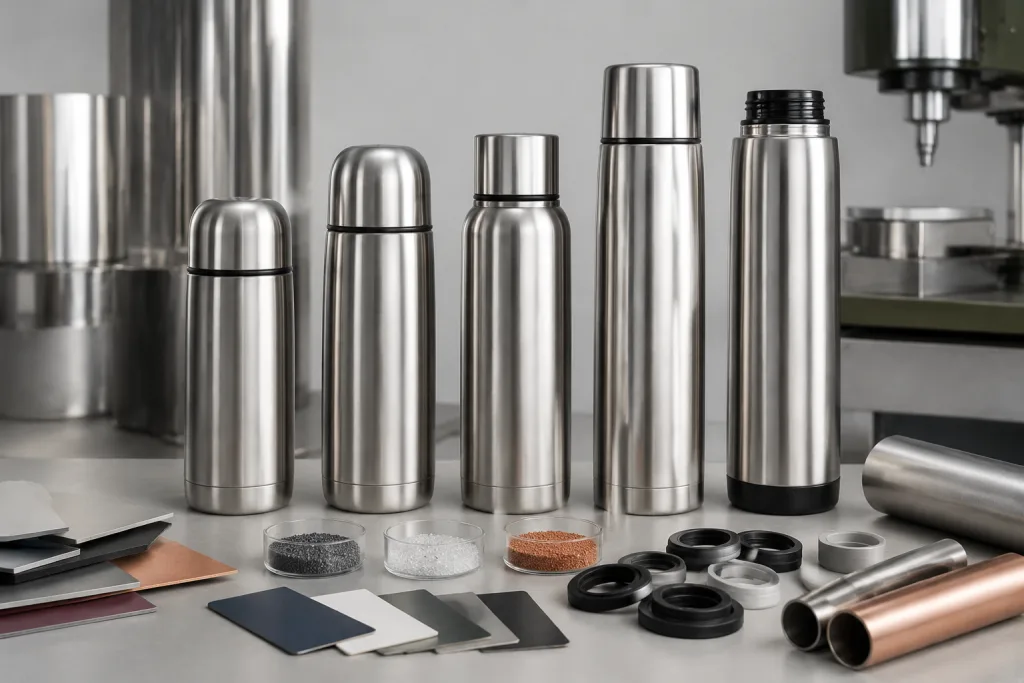
Logo and finish cost ranges
Logo method changes the quote and the reject rate. A retail custom thermos gets checked twice: from 1 meter on the shelf, then from 10 cm in the buyer’s hand. If the logo sits 2 mm off center or the engraving has a burr you can feel with a fingernail, QC pulled the sample for a reason. The vacuum body can pass, and the flask still looks cheap.
For thermos custom orders, we usually quote decoration in these working ranges:
- Laser engraving: USD 0.08-0.20 per position. Clean on 304 stainless and most powder coats; we run this on a rotary laser fixture, so curved-body alignment matters.
- Silkscreen print: USD 0.06-0.18 per color per position. Good for 1-color promo logos; the buyer often flags thin 0.3 mm lines after the first strike-off.
- Heat transfer: USD 0.25-0.60 per unit. Better for gradient artwork and mascot graphics; ask to see the seam area before approving mass packing.
- UV print: USD 0.20-0.50 per position. Fine detail is strong, but we still run a 3M tape pull on coated surfaces before release.
- Full wrap print: USD 0.80-1.80 per unit. Setup takes more line time, and scrap can jump from 2% to 6% if the film registration drifts.
Powder coating costs more than standard spray paint, and for outdoor retail it is usually the right spend. The hand feel is drier and tougher; on our coating line, a 500 g abrasion wheel test tells more than a nice showroom photo. A single matte powder color may add USD 0.30-0.70 per unit compared with basic paint. Pantone-matched coating can require a 50-100 unit color trial or a coating setup fee of USD 80-200, and the math doesn’t work for a 300 pcs order unless the buyer accepts a close stock color.
For a thermos promotional order, do not chase the cheapest print by habit. We’ve seen this go sideways: cartons arrived fine, but the logo picked up hairline scratches because the PO said “bulk pack” and nobody added PE bags. If the bottle will be handed out at a paid conference, laser engraving may be better value because it avoids print scratches in transit. For a thermos distributor selling through regional outdoor shops, ask for tape test, cross-hatch adhesion test, and 3-5 sample units from the actual coating batch before full packing. Zhejiang factories with stable coating lines should provide this without drama.
Packaging, cartons, and freight math
Packaging is where vacuum flask wholesale bulk orders quietly eat the margin. A white box runs USD 0.12-0.25. A printed retail box runs USD 0.35-0.90. A rigid gift box can hit USD 1.20-2.80, and we’ve seen it add 8-18 mm to the outer box height, which changes the carton count fast. For e-commerce or outdoor retail, the box has to protect the flask and look shelf-ready. For a one-day promotional thermos event, this is the wrong question to ask; it only needs to arrive clean, straight, and without lid scratches. Last month QC pulled the sample after a 70 cm bench drop because the insert left a dent ring near the shoulder.
A typical 500 ml flask packed in a color box may fit 24 units per export carton. Gross weight is usually 10-13 kg per carton depending on steel thickness and lid type. If your box is too large by 15%, your sea freight cost per unit climbs, and the warehouse team starts complaining because the cartons no longer stack cleanly on a 1.1 m pallet. We run this check with a tape measure before the PO is signed. For North America, confirm FNSKU labels, carton labels, suffocation warnings on polybags, and master carton routing marks before the purchase order. Adding labels after packing can cost USD 0.04-0.12 per unit and 2-4 extra days; we had one PO typo where “FNSKU” was written as “FNSK,” and the buyer flagged it after 180 cartons were sealed.
FOB Ningbo or FOB Shanghai is common from Hangzhou, Zhejiang. For LCL shipments, carton strength matters more because cargo gets touched at the warehouse, CFS, port, and destination depot. We recommend 5-ply export cartons for heavier thermos bulk shipments and carton drop tests at 60-80 cm depending on carton weight. The line usually uses 48 mm BOPP tape, but tape does not save a weak carton. For full container orders, palletizing may protect cartons but reduces loading quantity. Do the math. We’ve seen this go sideways when a buyer asked for pallets after production, and the load dropped by 9 CBM against the original booking.
Ask your thermos suppliers for carton dimensions, gross weight, and units per CBM before confirming price. If a suppliers thermos quote does not include packing details, you cannot compare it properly. Freight is not a small afterthought anymore; on low-margin promotional orders, it can decide whether the project is profitable. Our sales sheet lists carton L×W×H in mm, GW/NW in kg, and units per carton, because one missing 62×45×38 cm carton spec can turn a good USD price into bad freight math.
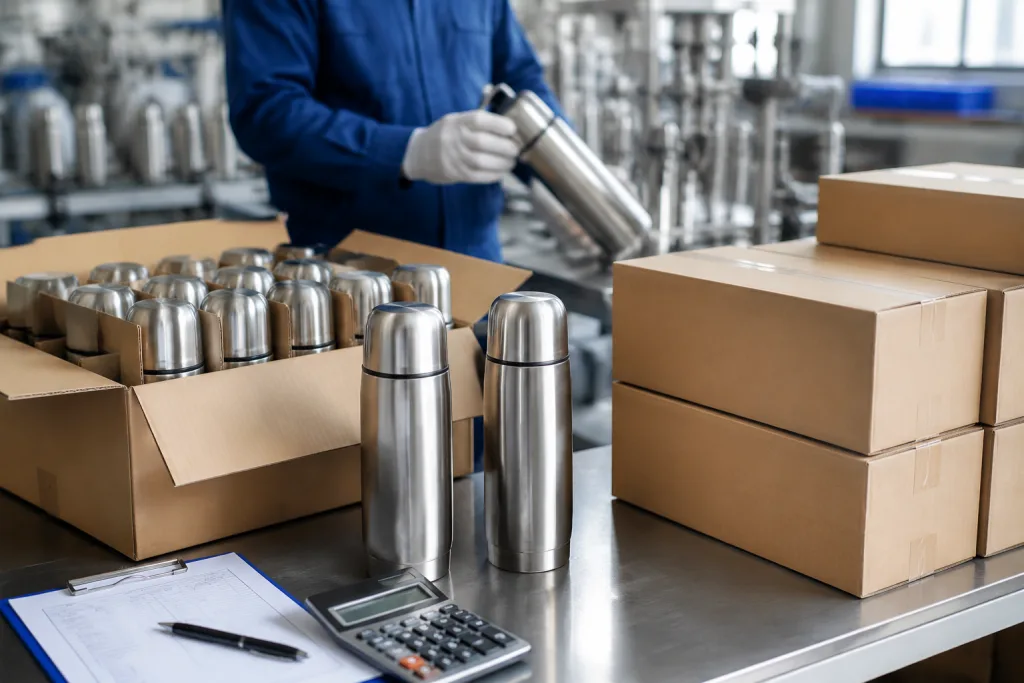
A realistic production calendar
Lead time starts after we have usable artwork, signed specs, deposit, and packaging files. It does not start when someone sends a first email asking for a customized thermos, or when the PO still has the logo spelled wrong. For a normal vacuum flask wholesale bulk order on an existing mold, the calendar usually runs like this:
- Day 1-2: confirm the spec sheet, target price, color, logo position, Incoterm, and compliance needs. We check the PO against the packing list line by line.
- Day 3-7: make the digital mockup, confirm artwork, and prepare a sample or pre-production sample. QC pulled the sample on the bench, then the buyer flagged the lid color by 1 shade.
- Day 8-12: sample review, logo adjustment, and packaging dieline approval. This is where a missing barcode or a 2 mm logo shift gets fixed.
- Day 13-18: material buying, steel cutting, body forming, welding, and vacuum processing. The welding line does not wait for late artwork.
- Day 19-28: polishing, coating, logo decoration, lid assembly, and in-line QC. Our coating oven runs by rack count, so one delay backs up the next batch.
- Day 29-35: final inspection, packing, carton marks, booking, and delivery to port. If the carton mark is off, the warehouse will stop it cold.
At BottleForge Industrial, our stainless thermos capacity is about 450,000 units per month across standard bottle and flask lines, but capacity does not erase calendar reality. Coating ovens, vacuum machines, and print fixtures run in sequence, not all at once. If you approve artwork five days late, the ship date moves five days. The math does not lie.
Peak season in China matters too. March to June is busy for summer outdoor retail. August to October fills up fast for Q4 promotional thermos and holiday gift sets. Before Chinese New Year, we stop taking risky customized thermos work 30-45 days before the holiday, because the line gets packed and nobody wants a half-finished order sitting on the floor. If your distributor thermos program has a fixed event date, build in 10-14 days for inspection, customs, and vessel changes.
Air freight can save days, but it usually does not save the project. A 500 ml stainless flask is bulky and heavy, and the freight bill can outrun the product value fast. If you need a launch cushion, ship 5-10% by air and move the balance by sea. A practical thermos manufacturer should say that on day one, not after the vessel is already missed.
Inspection before the balance payment
For vacuum flask wholesale bulk orders, run final inspection before the balance payment and before the cartons leave the factory gate. We usually set AQL 2.5 for major defects and 4.0 for minor defects. Critical defects should be zero. For drinkware, QC pulls critical items hard: leakage at the silicone ring, sharp burrs on the cup mouth, oil or dust inside the liner, wrong material, failed vacuum, or a logo printed on the wrong side. We once caught 37 pcs with weak vacuum in a 3,000 unit lot after the infrared thermometer showed a 9°C faster temperature drop than the approved sample.
A solid inspection checklist should cover heat retention, leak test, lid torque, coating scratches, logo position tolerance, color comparison against the signed Pantone card, carton drop condition, barcode scan, carton mark accuracy, and quantity count. Make the list practical. On the line, QC uses a torque meter for lids, a 3M tape pull for printing adhesion, and a caliper to check logo offset in mm. For retail and distributor thermos programs, inspect packaging as hard as the flask. A perfect bottle in a crushed color box still becomes a customer complaint, and the buyer will not care that the stainless body passed.
Separate factory routine tests from third-party lab tests. Factory QC can check leakage on 100% of units and run sampling heat tests, usually 8 pcs from mass production plus 2 retained samples in our QC room. Lab testing for LFGB, FDA food contact, REACH coating elements, or California Proposition 65-related screening costs money and takes calendar time. Budget 5-10 working days for formal lab reports, depending on the test scope. If the PO says “FDA report before shipment” but the artwork approval came 6 days late, the math does not work unless the buyer accepts split shipping.
Our honest view: do not waive inspection to save USD 180-350 on a 3,000 unit order. That cost is smaller than one pallet of bad thermos customized product. We have seen this go sideways: the buyer flagged logo color after arrival, and the carton mark even had a PO digit typed wrong. A professional thermos supplier in China should welcome clear inspection standards because it protects both sides. If a thermos manufacturers team resists AQL or refuses to show production photos, treat that as a warning, not a negotiation tactic.
Send your thermos brief for a costed quote
Share capacity, logo method, MOQ, packaging, destination, and deadline. We will return a practical FOB quote with lead time and options.
Frequently asked questions
What is the best MOQ for a first vacuum flask wholesale bulk order?
For most outdoor retailers and promotional brands, 1,000 units is the practical starting MOQ for one 500 ml or 750 ml stainless flask with one body color and one logo. Below 1,000 units, the unit price often rises 15-25% because coating, printing, carton setup, and QC time are spread over fewer pieces. If you need a custom color, retail box, barcode labels, or multiple logo positions, 3,000 units is a cleaner tier. For private mold work, plan for 3,000-5,000 units plus tooling. A small 500-unit order can work for a market test, but keep the specification simple: stock color, laser logo, standard lid, and plain packaging.
How much should I budget for a custom stainless thermos?
A realistic FOB China budget for a custom stainless thermos is USD 3.20-7.80 per unit, depending on capacity, steel grade, finish, lid, and packaging. A simple promotional thermos with 304 inner wall, 201 outer wall, silkscreen logo, and white box may sit around USD 3.20-4.20 at 3,000 units. A retail-grade outdoor flask with 304 inner and outer walls, powder coating, laser engraving, stronger lid, and printed box is more often USD 4.80-6.50. Add USD 0.20-0.45 for copper coating, USD 0.35-0.90 for color box packaging, and USD 180-350 for third-party inspection. Tooling is extra if you change the mold or lid design.
Can you make thermos bulk orders with our exact Pantone color?
Yes, but exact Pantone matching is not the same as choosing a stock color. For powder coating or spray paint, the coating supplier usually prepares a color swatch first. Expect 5-7 days for color sampling and a setup cost of about USD 80-200 if the color is not already available. On stainless drinkware, color can look different under warehouse light, outdoor sun, and retail LED lighting, so approve a physical sample, not only a screen mockup. For thermos bulk orders below 1,000 units, stock colors are usually more cost-effective. For 3,000 units and above, custom Pantone coating becomes much more reasonable.
What lead time should a thermos distributor plan for?
For an existing factory thermos shape with custom logo, plan 7-12 days for sample and artwork approval, then 25-35 days for mass production after deposit. Add 3-7 days for final inspection, booking, and port delivery. Sea freight to Europe or North America depends on route, but production planning should not assume a perfect vessel schedule. If your thermos distributor launch date is fixed, build in at least 10-14 days of buffer. During China peak seasons, especially August to October and before Chinese New Year, confirm capacity earlier. A rushed order can be done, but coating curing, vacuum testing, and packing still need proper time.
What quality documents should I request from thermos suppliers?
Ask for a written specification sheet, material declaration for 304 stainless steel, food-grade silicone confirmation, coating information, and previous test reports relevant to your market. For Europe, LFGB and REACH are common requests. For North America, FDA food-contact documentation and heavy metal screening may be needed by your retailer or distributor. Also request the factory’s QC checklist, AQL standard, carton drop test method, and pre-shipment inspection photos. If the order is 3,000 units or more, a third-party inspection under AQL 2.5/4.0 is worth the cost. If your channel requires BSCI, ISO 9001, or social audit documents, confirm before sampling, not after production.