Key Takeaways
- For most custom stainless thermos projects, a realistic MOQ is 1,000-3,000 units per color and capacity
- 304 stainless steel at 0.4-0.5 mm wall thickness is the normal choice for retail-grade vacuum flasks
- Laser engraving usually adds USD 0.08-0.18 per unit; full-color heat transfer can add USD 0.25-0.60
- Plan 7-10 days for pre-production samples and 30-45 days for mass production after approval
You are not just buying a bottle. You are buying margin, a ship date, cartons that survive a 1.2 m drop test, and a thermos your customer will carry for 900 mornings. Choosing vacuum flask vendors by FOB price alone is the wrong question to ask; we have seen the math fail when QC pulled 32 dented samples from one “cheap” trial order.
Outdoor retailers and promotional brands usually ask the same practical questions: which steel passes food-contact checks, what MOQ we can run without slowing the line, which logo method survives 500 dishwasher cycles, and whether 3 pre-production samples are enough before mass production. From Zhejiang, China, we see these questions on almost every custom thermos order, often right after the buyer flags a 0.3 mm lid gap or a typo on the PO color code.
What kind of vendor are you buying from?
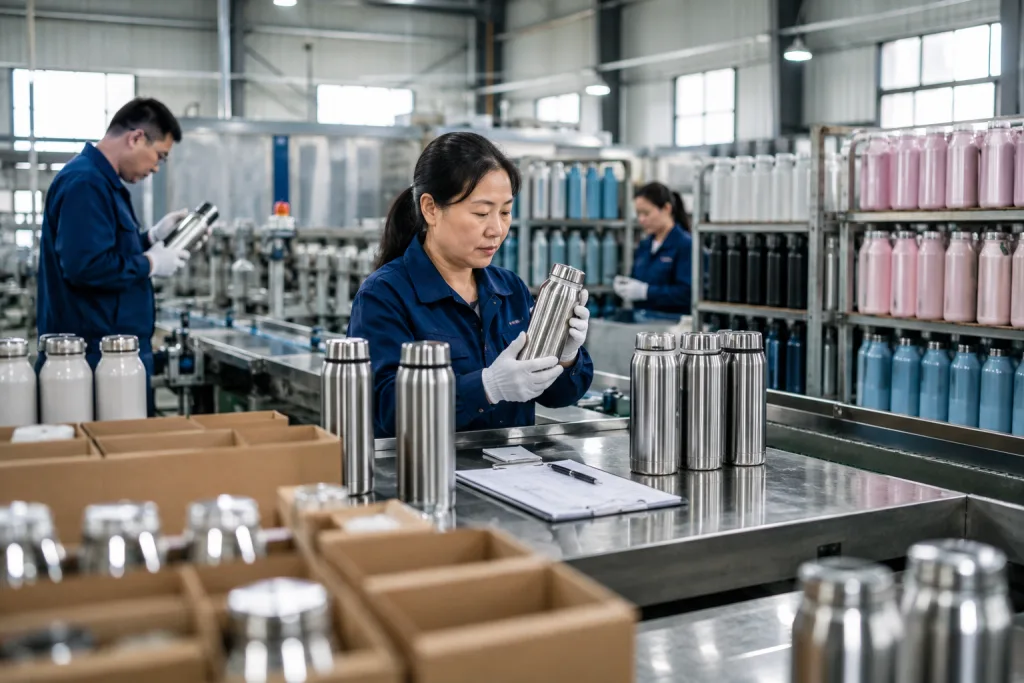
Buyers looking for vacuum flask vendors often put 3 supplier types in the same bucket. Don’t. A trading company fits small mixed orders, say 300 pcs each across 6 colors. A thermos distributor may ship stock in 3 days, but logo position, coating color, and lid choice are usually locked. A thermos factory controls tooling, welding, vacuum testing, polishing, powder coating, and packing. On the line, that means we can check a 0.6 mm wall body, pull a vacuum-test report, and see which station caused the defect. For a serious bulk thermos program, first confirm who is quoting you.
Ask it plainly: are you the manufacturer thermos plant making the body, or are you buying the bottle elsewhere and only handling decoration? If the answer circles around “we have partner factories,” the math doesn’t work. Vacuum insulation is not decoration. It comes from stainless tube forming, bottom welding, vacuuming, copper plating when specified, and leak testing. QC pulled the sample last month on a 750 ml flask because the bottom weld had a pinhole under 0.3 mm, and no logo print could save that batch. A pretty logo cannot fix a weak vacuum layer.
For outdoor retail, a factory thermos supplier is usually the safer route because you need repeatable color, stable thermal performance, and spare lids for after-sales service. The buyer will flag a 1.5 mm height difference between lids if the shelf display looks uneven. For promotional thermos campaigns with a fixed event date, a supplier thermos partner with stock components may move faster, maybe 12 days vs 18 days, but get written confirmation on capacity, carton size, and logo lead time. We’ve seen this go sideways when the PO says laser logo and the artwork file says silk screen.
At BottleForge Industrial in Hangzhou, Zhejiang, our monthly drinkware output is about 480,000 units across stainless bottles, travel tumblers, and vacuum flasks. That number matters because a vendor claiming 15-day production for 80,000 customized thermos units should be able to explain machine lines, coating capacity, and inspection manpower. We run body forming, weld checks, vacuum testing, and powder coating with daily output boards at each line. If they cannot tell you whether 80,000 pcs need 4 coating shifts or 7, the lead time is probably a sales promise, not a production plan.
Which thermos specification actually matters?
The first checklist is not color. It is the build you can defend when QC opens the carton. For a stainless custom thermos, we normally run food-contact 304 stainless steel inside and outside, 0.4-0.5 mm body wall thickness checked with a digital caliper, double-wall vacuum insulation, silicone sealing rings, and a PP or stainless cap depending on the model. For price-sensitive promotional thermos orders, buyers sometimes accept 201 stainless outside and 304 inside. Put that on the quotation and test documents. We have seen this go sideways when a PO says “SS304 body” but the approved sample was 201 outer.
Capacity changes the drinking feel and the freight bill. A 500 ml flask works for commuting and event giveaways; 24 pcs usually fit a standard export carton around 47 × 32 × 28 cm, depending on the cap. A 750 ml or 1,000 ml model suits outdoor retailers selling hiking, camping, or field work products. Bigger is not always better. The wrong question is “which size looks more premium?” Ask what carton size and chargeable weight do to your landed cost, especially for air freight or Amazon FBA.
Use this specification checklist before comparing quotes:
- Steel grade: 304 inner wall, preferably 304 outer wall for premium retail; ask the factory to mark 201 outer / 304 inner clearly if you choose the cheaper build.
- Insulation: request test data after 6 hours and 12 hours, with starting water temperature shown; “keeps hot all day” is not a test report.
- Surface: powder coating gives better grip, spray paint cuts cost, and polishing gives a classic retail look; QC should check coating chips around the bottom rim.
- Lid system: screw cap and cup cap are safer for leakage, while push button or straw lid adds parts, springs, and gasket risk.
- Compliance: LFGB or REACH for Europe, FDA food-contact expectations for the US, and California Prop 65 review if selling in that market.
A capable thermos manufacturer will not argue with this level of detail. We ship based on drawings, approved samples, and AQL 2.5 inspection notes, not a pretty catalog photo. A weak thermos vendor will push you back to a generic catalog line and ask for a fast deposit. Bad signal.
How should customization be specified?
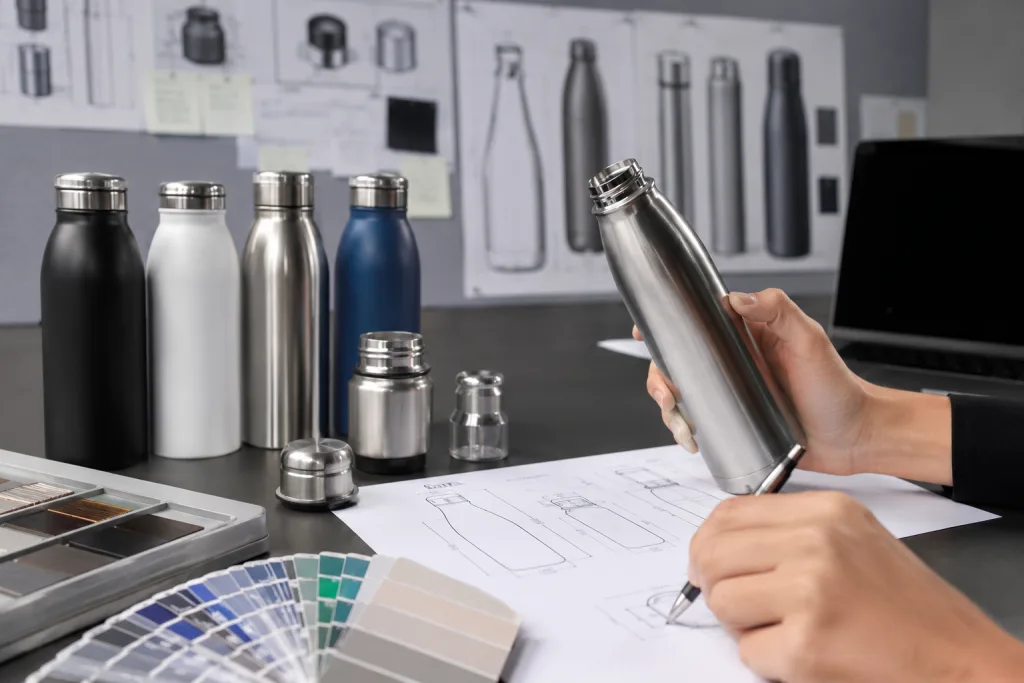
Customizable thermos sounds simple until the artwork hits the line. We see this on roughly 7 out of 10 new logo projects: the buyer sends a JPG, the PO says “thermos custom with logo,” and nobody defines the tolerance. That is the wrong question to ask. For a branded retail run, specify the decoration method and logo size in millimeters, then lock the Pantone color, print area, and alignment point, such as 18 mm below the lid shoulder or centered 90° from the front seam. Our fixture plate has a 1 mm locating pin; if the lid thread position matters, say it before sampling.
Laser engraving is the safest method for outdoor retailers because it will not peel and it takes rough use. It works best on powder-coated bottles, showing the stainless steel below. Normal cost is USD 0.08-0.18 per unit depending on logo area and machine time; a 45 mm wide logo usually runs faster than a wrap mark. Silk screen printing is cheaper for simple one-color artwork, usually USD 0.05-0.12 per position, but curved surfaces and rough coatings can blur small text under 1.2 mm. QC pulled one sample last month where the buyer flagged a registered ® mark that filled in after curing. Heat transfer or water transfer fits full-color promotional branding, often USD 0.25-0.60 per unit.
For a customized thermos with retail packaging, do not approve only the bottle sample. Ask for the full sales set: bottle, lid, instruction insert, color box, barcode, master carton, and pallet layout if needed. Promotional buyers should confirm individual polybag requirements and gift box crush strength; the math does not work if a thin 300 gsm box saves USD 0.03 but dents in transit. We run carton checks with a 60 cm drop test when the buyer asks, and one PO typo on an EAN code has delayed shipment by 4 days vs 1 day for a normal barcode reprint.
If you sell through distributors thermos channels, keep decoration repeatable. A distributor thermos line may need replenishment every quarter. A one-off special coating may look impressive on the first 2,000 units but become painful if the next batch varies by Delta E 3 or more. We have seen this go sideways when a buyer approved a champagne powder from a small paint lot, then needed 8,000 more pieces after 5 months. For repeat programs, standard powder colors and laser engraving are boring in the best possible way; we ship them with fewer arguments at incoming inspection.
What MOQ and pricing are realistic?
MOQ starts with the body model, finish, color, and logo process. For a stock-shape custom thermos, we usually run 1,000 units per color and capacity. If the buyer asks for a special powder coat, PMS-matched silicone part, or a private mold lid, the line normally needs 3,000-5,000 units to make the setup worth it. A new body mold is a different budget: USD 2,000-8,000 tooling cost and 45-60 days before mass production, depending on wall curve, lid thread, and whether the 2D drawing still has missing tolerance marks in mm.
FOB China pricing for stainless vacuum flasks moves a lot, but procurement managers still need a working range. A 500 ml double-wall 304 stainless flask with powder coating and laser logo may land around USD 3.20-5.20 FOB Ningbo or Shanghai, depending on lid design, coating grade, and packing. A 750 ml outdoor-style model may run USD 4.20-6.80. Retail gift packaging can add USD 0.25-0.70 per unit. These are not magic numbers. They help you catch fantasy quotes, like the USD 2.85 offer we saw last month that left out the tea strainer, barcode sticker, and 1.2 m drop-test carton spec.
Ask for a line-item quotation before you compare thermos suppliers. One-page quotes look neat, but the math goes sideways when QC pulled the sample and found the logo setup, color box, and inner carton were all priced as “optional.”
- Base bottle price, with capacity and material grade stated
- Logo charge by method and position, such as laser on body or silk print on lid
- Color box or kraft box cost, including paper gsm if gift retail matters
- Inner carton and master carton specification, with carton size and gross weight
- FOB port, usually Ningbo or Shanghai for Zhejiang and nearby production
- Sample cost and refund policy, including whether the charge returns after bulk PO
Be careful with the cheapest manufacturers thermos quotation if it hides basic items. A supplier thermos quote that excludes logo setup, color box, barcode label, or inspection allowance is not cheaper; it is incomplete. For thermos bulk sourcing, the cleanest comparison is landed cost per sellable unit after defect allowance, not just FOB price. We push back on this because buyers often compare USD 4.10 against USD 4.35, then lose USD 0.38 per unit after repacking 6 cartons with scratched lids found under AQL 2.5 inspection.
How do you control quality risk?
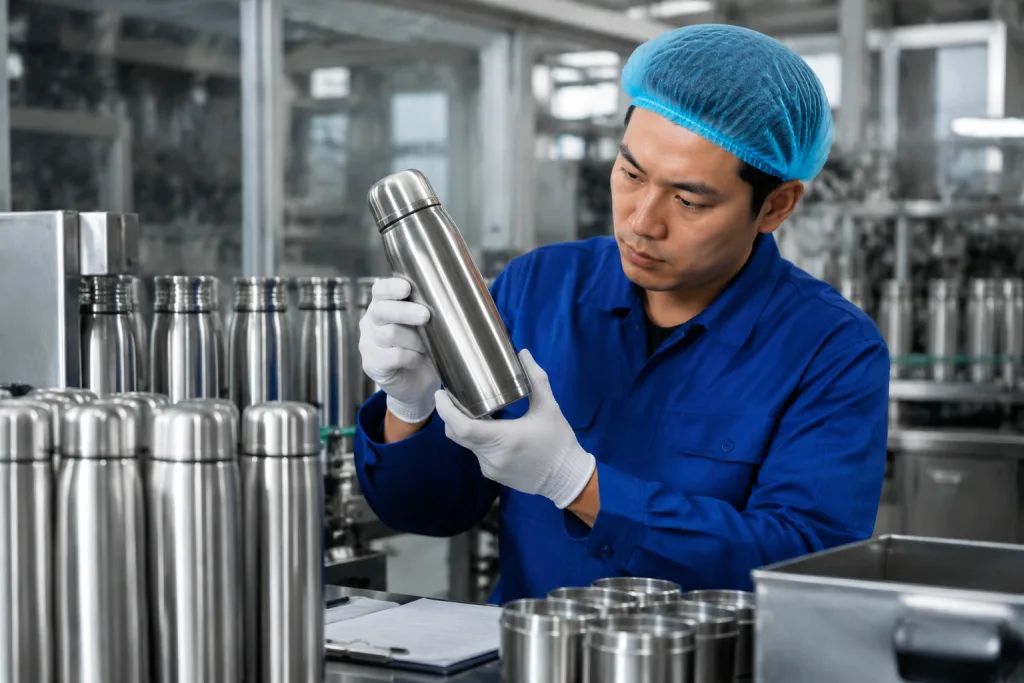
A quick showroom check misses the failures that cost money. We have seen bottles pass a visual check, then drop heat after 60 days, seep at the silicone ring, or show coating chips after a 1.2 m carton drop test. QC pulled the sample, looked fine, then the buyer flagged wet cartons at arrival. That is the wrong time to learn the lid torque was loose. For export orders from China, we run incoming material checks, line checks at welding and coating, then final inspection. We normally recommend AQL 2.5 for major defects and AQL 4.0 for minor defects unless your retailer contract sets tighter limits.
For stainless vacuum flasks, the final inspection sheet should not be a 1-page tick box. We check capacity with a measuring cylinder; weight on a 0.1 g scale; appearance under a 600 mm light box distance; coating adhesion by 3M tape; logo position against the approved artwork; leak testing with the bottle inverted for 30 minutes; lid fit by thread feel; odor after hot water rinse; barcode scan; carton marking; insulation performance. For insulation, we fill with boiling water at a set room temperature and measure after 6 hours. A typical 500 ml flask should hold roughly 65-70°C after 6 hours under controlled conditions, but the target changes with body shape, opening diameter, and lid structure.
Ask your thermos manufacturer for batch records, not just “passed QC” in an email. The useful file pack includes stainless steel material declaration, food-contact test reports, coating report if required, production inspection photos, and carton packing list with the same SKU spelling as the PO. We once had a buyer’s PO say “matte balck,” and that typo followed the carton mark until pre-shipment inspection caught it. If your channel needs BSCI, Sedex, ISO 9001, REACH, LFGB, or ASTM-related documentation, raise it before deposit. After the line starts, the paperwork takes 12 days instead of 3 days, and the math does not work on a tight vessel date.
Good vendors do not promise zero defects. They define defect categories, inspect against AQL, and state how replacements or credit notes are handled.
For high-value outdoor retail orders, third-party inspection costs USD 250-350 per man-day in many China sourcing programs. We ship plenty without third-party QC, but for a 10,000 pcs order with a new lid mold, skipping inspection is false savings. One inspector with a caliper, barcode scanner, and leak-test basin can catch the kind of issue that turns into 40 pallets of leaking flasks in your warehouse.
What timeline should you plan?
A workable schedule protects both sides. For a standard customizable thermos on an existing mold, we usually need 2-3 days to quote after the artwork and spec sheet are complete, 7-10 days for a pre-production sample, 3-5 days for courier delivery, and 30-45 days for mass production after written approval and deposit. Add 3-7 days for custom color matching; our line checks the Pantone chip under a D65 light box before spraying. Packaging with a new insert or gift box needs structural proofing too. Do not squeeze that part.
Sea freight from Ningbo or Shanghai to major European ports often takes 28-40 days port to port, and to the US West Coast around 16-25 days depending on route and season. Inland trucking, customs, and warehouse receiving can add another 7-14 days. If your promotional thermos campaign is tied to a trade show or holiday launch, build the calendar backward and leave 2 days for final inspection. We have seen this go sideways when a buyer booked ads first, then QC pulled the sample for a 1.5 mm logo shift.
Amazon and distributor channels add their own details. FNSKU labels, carton weight limits, suffocation warnings on polybags, and master carton dimensions must be confirmed before packing. A thermos distributor selling into 5 or 6 countries may need multilingual instructions, recycling marks, and country-specific importer details. The work is not hard. Late changes cause rework, especially when the PO says 24 pcs/carton but the FBA routing sheet says 20 pcs/carton.
The best buying rhythm is simple: approve the physical sample, freeze artwork and packaging, pay deposit, inspect during production if the order is large, run final AQL inspection, then release balance. For orders above 3,000 pcs, we like an in-line check when the line reaches 20% completion, because that is when coating scratches and lid-fit issues show up early. If a vendor pushes you to skip the pre-production sample on a new thermos customized order, push back. That risk belongs in the sample room, not in your warehouse.
Send your thermos brief for a factory quote
Share capacity, logo method, target MOQ, and market. We will reply with practical options, FOB pricing, and sample timing.
Frequently asked questions
What MOQ should I expect from vacuum flask vendors?
For an existing stainless flask mold, expect 1,000 units per color and capacity as a normal starting MOQ. If you want a special powder coating, a new lid color, or full retail packaging, 2,000-3,000 units is more realistic. A private mold body or custom cap usually pushes the project to 5,000 units or more, plus tooling. Some vendors offer 300-500 units, but they are usually using available stock and limiting your logo options.
Is 304 stainless steel necessary for a bulk thermos order?
For the inner wall, yes, use 304 stainless steel for normal food-contact export orders. For the outer wall, 304 is preferred for retail quality, while 201 may be used for lower-cost promotional thermos projects if disclosed. Do not accept vague terms like food grade steel without a material declaration. For Europe, ask about LFGB and REACH. For North America, confirm food-contact expectations and any Prop 65 review needed for your sales channel.
Which logo method is best for an outdoor custom thermos?
Laser engraving is usually the best choice for outdoor retail because it resists scratches, washing, and sun exposure better than most printed methods. It normally adds USD 0.08-0.18 per unit. Silk screen printing is cheaper for simple one-color promotional jobs, often USD 0.05-0.12 per position. Full-color heat transfer gives stronger shelf impact but costs more and needs better artwork control. Always approve a physical logo sample before mass production.
How long does a customized thermos order take from China?
For a standard model from China, allow 7-10 days for pre-production samples and 30-45 days for mass production after approval. Custom color matching can add 3-7 days. Ocean freight from Zhejiang-area ports such as Ningbo or nearby Shanghai often takes 16-40 days depending on destination. If you need delivery for a fixed promotional event, build in final inspection, customs clearance, and warehouse receiving time instead of planning only factory days.
How do I compare thermos suppliers beyond price?
Compare specification, not just FOB price. Ask each thermos supplier to quote the same steel grade, capacity, wall thickness, lid type, coating, logo method, packaging, AQL level, and FOB port. Then check sample quality, communication speed, and whether the vendor can provide test reports and batch inspection photos. A USD 0.25 cheaper flask can become expensive if the coating chips, cartons collapse, or 4% of lids leak during your first distributor shipment.