Key Takeaways
- A 0.5L vacuum flask often lands at USD 2.20-3.40 FOB, while 1.0L models usually run USD 3.10-5.20 depending on lid and finish.
- For most custom thermos programs, MOQ starts at 3,000 pieces and lead time is 35-45 days after sample approval.
- Double-wall 304 stainless with 0.35-0.45 mm inner and outer shell is the practical baseline for retail-grade thermos bulk orders.
- A Zhejiang thermos factory with 300,000 units/month capacity can handle both distributor thermos and promotional thermos programs if artwork is locked early.
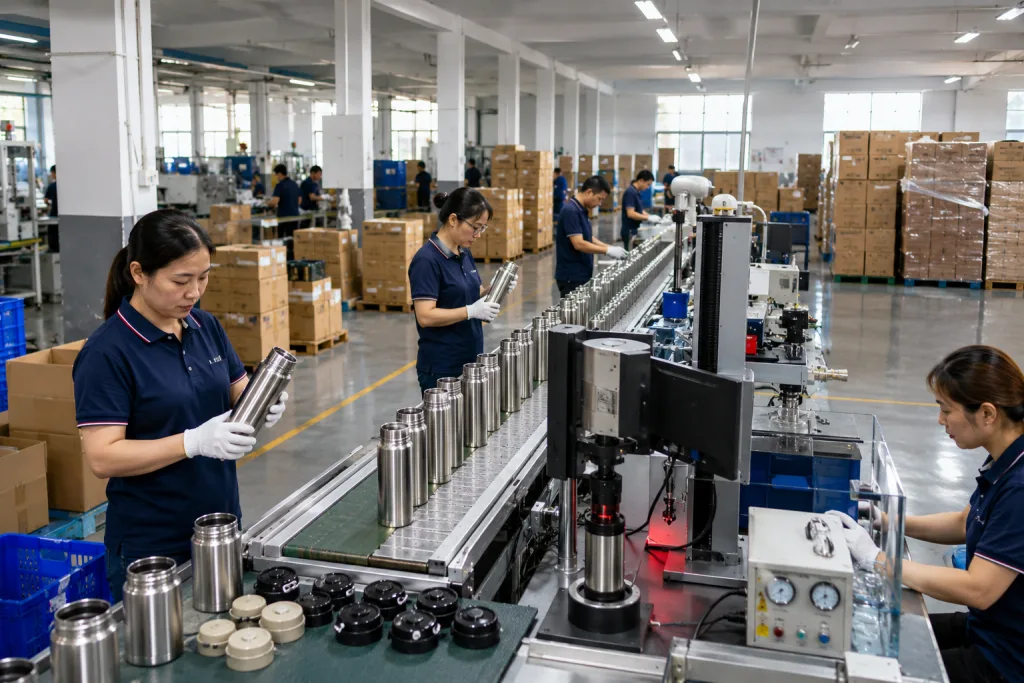
If you are sourcing a stainless thermos for outdoor retail or a promotional campaign, choosing from a photo is the wrong question to ask. A shiny custom thermos with a clean lid can still leak at the silicone gasket, dent at 0.38 mm body thickness, or miss your FOB target by USD 0.42. In our Zhejiang line, QC pulled 32 samples last month where the buyer liked the render first, then flagged lid seepage after a 45-degree tilt test. We see this every season: buyers ask for the custom logo first, then find out the wall thickness, vacuum retention, or packing standard does not fit the sales channel.
Start with use case, then lock the spec. A bulk thermos for a campground chain needs stronger carton packing and a 1.2 m drop test; a promotional thermos for a trade show usually fights for MOQ 1,000 pcs and a tight imprint budget. We ship distributor thermos orders to North America with different carton loading, drop resistance, and FDA paperwork than a gift item, because the math does not work if 18 pcs per carton becomes 12 pcs after the buyer changes the box. China has plenty of factories. The useful question is which thermos factory can hit your spec, 30-day lead time, and repeat-order consistency without making the unit cost ugly.
Use Case First, Not Pretty Photos
The fastest way to choose a stainless thermos is to put the rendering aside and ask what work the bottle must handle. This is the wrong question to ask: “Which one looks best?” An outdoor retailer needs a factory thermos that survives 40 open-close cycles in sample testing, wet backpacks, and shoppers dropping it back on the shelf. A promotional brand usually fights over logo size, unit cost, and how many pieces fit in a 58 x 38 x 42 cm export carton. A thermos distributor selling both channels needs the same SKU to reorder for 12 months with no color drift, no surprise lid change, and no PO typo turning matte black into “mate black.”
Here is the practical split we use when quoting a vacuum flask vendor program. We run this before opening the sample room cabinet:
| Use case | Typical size | Target FOB | Fit |
|---|---|---|---|
| Retail shelf | 500-750 ml | USD 2.80-4.50 | Works when the buyer needs shelf margin and a bottle that feels worth the price in hand |
| Promo campaign | 350-500 ml | USD 2.20-3.40 | Fits bulk thermos giveaways, gift sets, and 3,000-10,000 pc event runs |
| Distributor program | 750 ml-1 L | USD 3.10-5.20 | Better when repeat orders, stable lids, and channel consistency matter more than one cheap shipment |
That table matters more than catalog copy. A customizable thermos with a nice matte powder coat can still be the wrong pick if the lid adds USD 0.38 and the buyer only left USD 0.20 room in the target. The math doesn't work. A thermos customizable for retail can also go sideways in promo when the decoration zone is only 55 mm wide and the buyer’s logo needs 70 mm to stay readable. In China, we see 7 out of 10 suppliers quote the same bottle three ways; a serious supplier thermos partner separates retail, promotional, and distributor thermos needs before samples are cut. QC pulled one sample last month where the coating passed, but the logo sat 4 mm off center. That is exactly the kind of problem you catch before paying for features your customer will never notice.
Spec Table: What Actually Changes
Compare the bottle by hard numbers, not catalogue words. For a customized thermos that performs, start with two specs buyers can verify: 304 stainless inner/outer shell and wall thickness measured by digital caliper. We run 0.35-0.45 mm on most travel bodies, with a vacuum layer tuned so the bottle does not feel like a brick in a backpack. Hot-filled coffee is where we’ve seen this go sideways: the buyer approves the body, then flags steam pressure, rough threads, or a lid that spits drops during carton drop testing.
For a head-to-head view, our sales sheet usually breaks buyer decisions into these lines after the first 3 samples come off the pilot run:
- Thermal retention: 12 hours hot / 24 hours cold for mainstream retail; 18/36 hours if the body is heavier and the lid seals tightly, checked with a probe thermometer after preheating.
- Leak control: one-piece silicone seal is safer than loose gasket designs for promotional thermos shipments, especially when cartons sit on a truck for 12 days vs 18 days.
- Decoration: silkscreen keeps thermos custom cost down at 1,000 pcs MOQ; laser engraving lasts better when a distributor wants a premium feel and fewer logo complaints.
- Compliance: ask for REACH, LFGB where needed, and food-contact declarations before you approve mass production; QC should match the report name to the PO, not just the SKU.
We run factory samples against a simple rule: if the lid opens too stiffly after 50 cycles on the torque jig, it will feel cheap in real use. Same with coating. If QC pulled the sample and the finish scratches after a basic 3M rub test, your shelf returns will show it. A good thermos manufacturer does not hide those failures. In Zhejiang, the better lines document them, adjust the sprayer or lid mold, and retest before production. That is what separates a dependable thermos factory from a low-cost quote that looks nice for 2 emails. For related decoration choices, see silkscreen vs laser engraving for stainless drinkware and custom logo drinkware options.
Lids, Caps, and Daily Abuse
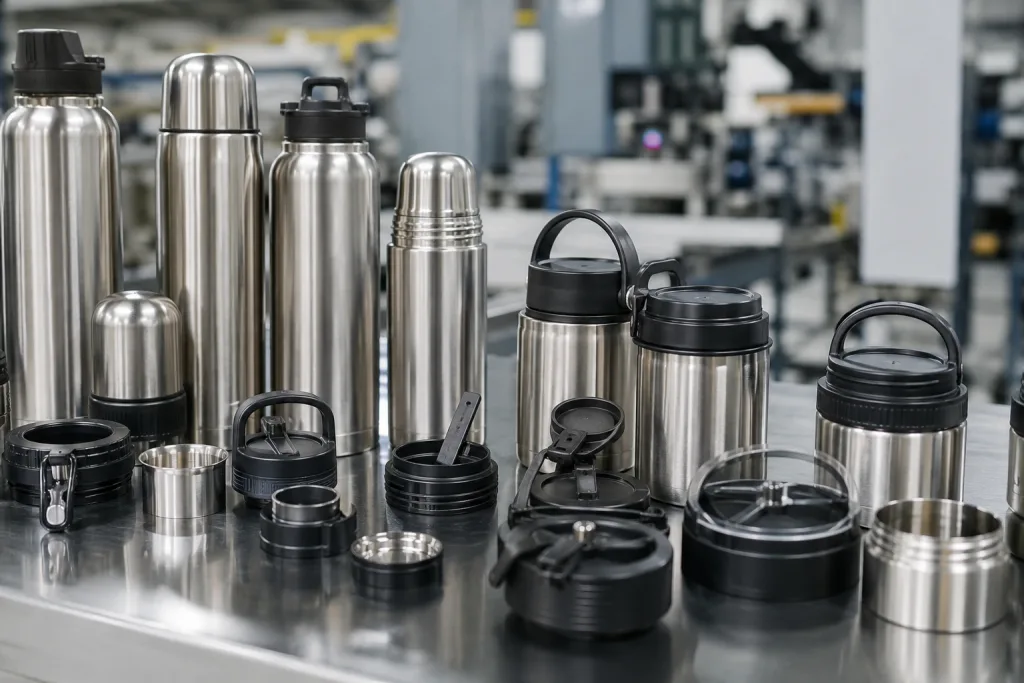
The lid decides whether your bulk thermos turns into a repeat PO or a claims file. Buyers like to argue over insulation hours; this is the wrong question to ask first. In daily use, the cap gets opened with ski gloves, jammed into backpacks, dropped from 1.2 m onto concrete, and run through dishwashers hotter than the care label allows. We spec the lid as its own part, not as decoration. On our line, QC pulled 20 lid samples last month and ran them on the hinge-cycle jig before packing approval. Ask your thermos vendor how many open-close cycles the closure passed. For a retail line, 3,000 cycles is a decent floor. For higher-end programs, 5,000 cycles is safer.
There are two lid styles we quote most often, plus one classic option buyers still ask for:
- Push-button lid: works for one-hand drinking, but the spring, lock slider, silicone plug, and hinge pin add cost and give QC more places to find trouble.
- Twist-and-pour cap: simple and durable; for thermos bulk orders above 3,000 pcs, this is usually where the math works best.
- Cup-lid combo: fits classic travel use and hotel gift sets, but it slows drinking and adds about 18-25 mm to the packed height.
For outdoor retailers, a push-button custom thermos can sell well if the lock mechanism is stiff enough and spare gaskets are listed on the BOM. We have seen this go sideways: one buyer flagged leakage after the gasket groove measured 0.4 mm shallow on the first T1 sample. For promotional brands, we usually push back and recommend a twist cap because it cuts breakage and reduces claim risk. Lid height matters too. A taller lid improves grip, but it can reduce carton load from 24 pcs to 20 pcs. Freight notices that. A manufacturer thermos quote should show carton count, gross weight, and pallet pattern, not just unit price. A supplier thermos partner in China should give you those numbers before you chase the lowest FOB. If not, they are selling a bottle, not a program. See also stainless thermos product options and MOQ basics for custom drinkware.
Pricing That Matches Margin
Price only works after you map it to the buyer’s margin. For an event brand, we often see a thermos promotional order capped at a landed cost under USD 4.00; for an outdoor retail distributor, USD 5.50 can still pass if the shelf price sits around USD 14.99-16.99. The gap usually comes from powder coating thickness, lid parts, box style, and logo process, not 304 stainless alone. On our Hangzhou quoting sheet, the line item for a flip lid can move USD 0.18-0.42, and QC pulled one sample last month because the silicone ring sat 0.6 mm proud after assembly. That small part killed the margin. Zhejiang factories that know export orders quote by configuration, because a low price on the wrong spec wastes the buyer’s sample fee and our tooling time.
For practical budgeting, we run these rough FOB bands before artwork and carton marks:
- Basic 350-500 ml: USD 2.20-3.00, suitable for thermos custom giveaways when MOQ is 1,000-3,000 pcs and the buyer accepts a standard lid.
- Mid-range 500-750 ml: USD 2.80-4.50, a clean fit for outdoor retail if powder coating passes the 3M tape test and the carton stays under 14 kg.
- Premium 750 ml-1 L: USD 4.20-5.80, better for customized thermos sets and seasonal launches where gift box print, spare straw, and color matching are already in the PO.
If you need printing, add about USD 0.10-0.35 per color for silkscreen, or USD 0.20-0.60 for laser engraving depending on logo size and position. Gift box packaging can add USD 0.25-0.90, and a color mailer may add more once the paper reaches 350 gsm. We check this on a digital caliper and carton scale, not by guessing. A serious vacuum flask vendor should tell you whether the cost sits in the bottle body, cap mold, or outer carton. Ask only “what is your best price?” and the math goes sideways. If your buyer asks for a thermos manufacturer quote without a target landed cost, send three options: factory thermos for tighter spec control, distributor thermos for shelf-ready packaging, and lower-cost bulk thermos for volume promotions.
“The cheapest bottle is rarely the cheapest program. The useful quote is the one that survives freight, decoration, and claims; we’ve seen one USD 0.12 carton saving turn into 37 crushed boxes at inbound inspection.”
Quality Checks You Should Demand
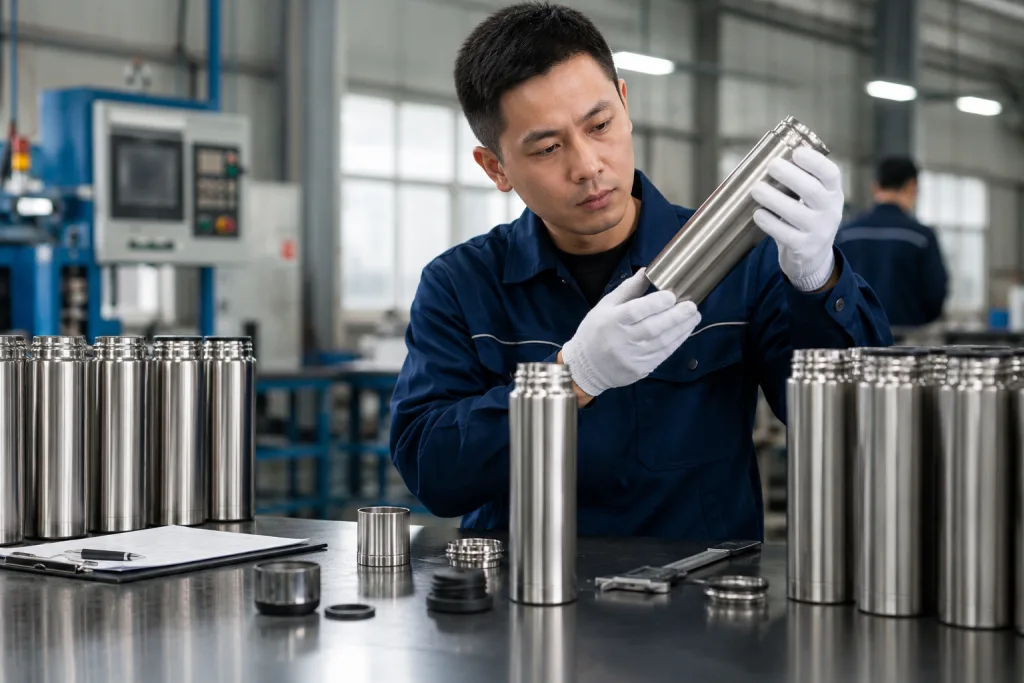
Do not treat a clean sample as supplier proof. One hand-polished sample can hide a bad laser weld or a lid gasket that loosens after 40 minutes on the vibration table. We run incoming checks with a digital caliper, vacuum leak tester, and 0.01 g scale before the line signs off. A reliable thermos manufacturer should be able to talk through AQL 2.5 for major defects and AQL 4.0 for minor defects, plus the exact stations checking leaks, coating pinholes, and mouth-diameter drift in mm. If they cannot answer that, the math does not work for a real order.
Ask for these checks before mass production; QC should record results from the first 32 pcs off the line, not just the showroom sample:
- Heat retention test: hot water fill at 95°C, measure at 6, 12, and 24 hours with a probe thermometer logged by cup SKU.
- Leak test: inverted bottle shake for 30 seconds, then pressure hold with the silicone ring checked for roll-over.
- Drop test: 1 meter, 3 faces, on concrete or steel plate, with cap crack and base dent photos kept in the QC file.
- Coating test: cross-hatch and rub resistance for painted or powder-coated bodies, using 3M tape and a 500 g rub block.
For Europe, REACH and food-contact paperwork are not optional. For North America, match labeling and carton marks to retailer requirements and the marketplace rules tied to your sales channel. A good vacuum flask vendor in China will know when a 0.2 mm print layer, epoxy badge, or powder-coated surface changes the compliance file. We have seen this go sideways: the bottle passed, but the buyer flagged a carton barcode mismatch after the PO had “matte black” typed as “matt black.” If you sell through 2 channels, lock artwork, carton spec, and barcode plan before tooling. That is how you avoid the classic thermos distributors problem: the product is fine, but the packaging fails at the next warehouse scan. If you need factory capability details, check our manufacturing capabilities and quality control standards.
How To Match Channel Fit
The right stainless thermos starts with the checkout counter. Outdoor retail buyers usually push for a bottle with real hand weight, clean powder coating, and a shelf price that does not get laughed out of the store. Promo buyers ask the opposite: “Can we hit 3,000 pcs and still keep the gift looking proper?” We hear that weekly. A thermos distributor has a different headache: repeat orders, ΔE color control under 1.5 on the color meter, and enough margin to sell both retail and promo accounts. Same silhouette on the catalog page. Different risk on the PO.
If you are choosing between a custom thermos and a thermos customizable standard model, we run the channel check like this:
- Outdoor retail: 500-750 ml with a heavier body feel, matte powder coat checked by tape test, laser logo, and individual color box packing.
- Corporate promo: 350-500 ml with a simpler cap, one-color silkscreen using a fixed Pantone number, and bulk carton pack to keep freight down.
- Distributor program: 750 ml-1 L with neutral colorways, repeatable tooling, lid gaskets kept in stock, and spare parts support for repeat SKUs.
For thermos suppliers handling 5 or 6 active accounts, the wrong question is “Which bottle looks fanciest?” Ask whether we can ship the same bottle six months later without changing the touch, body weight, or lid seal compression. QC pulled a 750 ml sample last month because the lid gasket was 0.4 mm softer than the approved sample. Small issue, big complaint later. A manufacturer thermos line in Zhejiang can hold the spec if the drawing, packaging die-line, and approved sample are locked before mass production. If you are comparing thermos manufacturers, ask which parts are stock, which parts need private tooling, and which lids are shared across SKUs. That tells you whether the quote will survive production or only looks good in Excel. For more sourcing context, review sourcing custom drinkware from China and common sourcing questions.
Get a tighter thermos quote today
Send your target size, logo, and channel. We will map the right factory thermos spec, price, and lead time without guesswork.
Frequently asked questions
What MOQ should I expect from a vacuum flask vendor?
For a standard stainless thermos, expect 3,000 pieces per SKU if you want real customization on color, logo, or packaging. Some thermos suppliers will quote 1,000 pieces, but that usually means a stock body with limited decoration. If you need a custom thermos with a special lid or pantone color, 5,000 pieces is more realistic. For mixed SKUs, ask whether the vendor can combine colors under one tooling run. A clean MOQ discussion saves you from false savings later, especially when freight and packaging are included.
How long does custom thermos production take?
Typical lead time is 35-45 days after sample approval and deposit for a thermos custom order. If you add new tooling, special packaging, or a decorated gift box, budget 50-60 days. For repeat orders from the same thermos factory, production can drop to 25-35 days if materials are already in stock. In Zhejiang, the better lines keep shell and lid components moving so reorders do not stall. Always ask whether the clock starts from artwork approval, sample sign-off, or deposit receipt, because that changes the schedule.
What insulation performance should I ask for?
For most outdoor and promotional thermos programs, a useful target is 12 hours hot and 24 hours cold. If you are sourcing a premium insulated bottle, 18 hours hot and 36 hours cold is a better benchmark, but it usually means more weight and higher cost. Ask the manufacturer thermos supplier how they test: hot water at 95°C, closed lid, room temperature environment, then readings at set intervals. Do not accept a vague claim without a test method. Performance numbers only matter when they are measured the same way every time.
Which decoration method is best for bulk thermos orders?
For volume orders, silkscreen is the cheapest and fastest option, especially for a promotional thermos with one or two colors. Laser engraving costs more, but it gives a cleaner permanent mark for a retail or distributor thermos program. If your artwork is complex, consider pad print only on flat zones. The best method depends on your target price and the bottle finish. On powder-coated bodies, laser often looks more premium; on polished steel, print can be more visible. Ask for a decorated pre-production sample before mass production.
What certifications and checks do buyers usually require?
For Europe, REACH and food-contact declarations are commonly requested, and some buyers also ask for LFGB depending on their channel. For North America, you will usually need clear material declarations, carton labels, and sometimes marketplace-specific compliance paperwork. A serious vacuum flask vendor should also provide inspection reports, leak tests, and AQL details. Many buyers ask for AQL 2.5 major and 4.0 minor as a baseline. If your thermos distributor program goes into retail, keep packaging, barcode, and origin marking aligned from the start to avoid warehouse issues.