Key Takeaways
- A practical MOQ for custom stainless thermos orders is 1,000-3,000 units per color
- 304 stainless steel at 0.45-0.55 mm wall thickness is the usual retail-grade baseline
- AQL 2.5/4.0 inspection should be written into the purchase order before deposit
- Normal production lead time from Zhejiang, China is 25-35 days after sample approval
If you sell to outdoor retailers or promo programs, picking vacuum flask suppliers by unit price is the wrong question to ask. We have seen a USD 0.18 saving disappear fast when QC pulled the sample and found 0.38 mm outer steel instead of 0.45 mm, weak vacuum after a 6-hour hot water test, logo drift over 2 mm on the pad-print jig, or color box corners crushed before the master carton left the line.
You need a custom thermos that looks shelf-ready, clears basic compliance, and ships on a date your warehouse can plan around. From Hangzhou, Zhejiang, we run into the same 4 buyer questions every week: real MOQ at 1,000 pcs or 3,000 pcs, decoration that survives dishwasher complaints, bulk inspection under AQL 2.5, and whether a customized thermos needs new tooling. One buyer flagged a PO last month because PMS 186C became 186U in the artwork file. Small typo. Big delay.
Start With The Real Use Case
The first question is not, What is your cheapest thermos? It is, Where will the bottle be used, and what failure would embarrass your brand? This is the wrong question to ask if the buyer only sends “500 ml bottle, quote best price” on the PO. Outdoor retailers care about leak resistance, one-hand opening with gloves, powder coating that passes a 3M tape pull test, and heat retention after 4 hours in a cold vehicle. Promotional brands care about a 45 mm logo window, Pantone matching, unit cost, carton marks, and the ship date. Different brief. Different bottle.
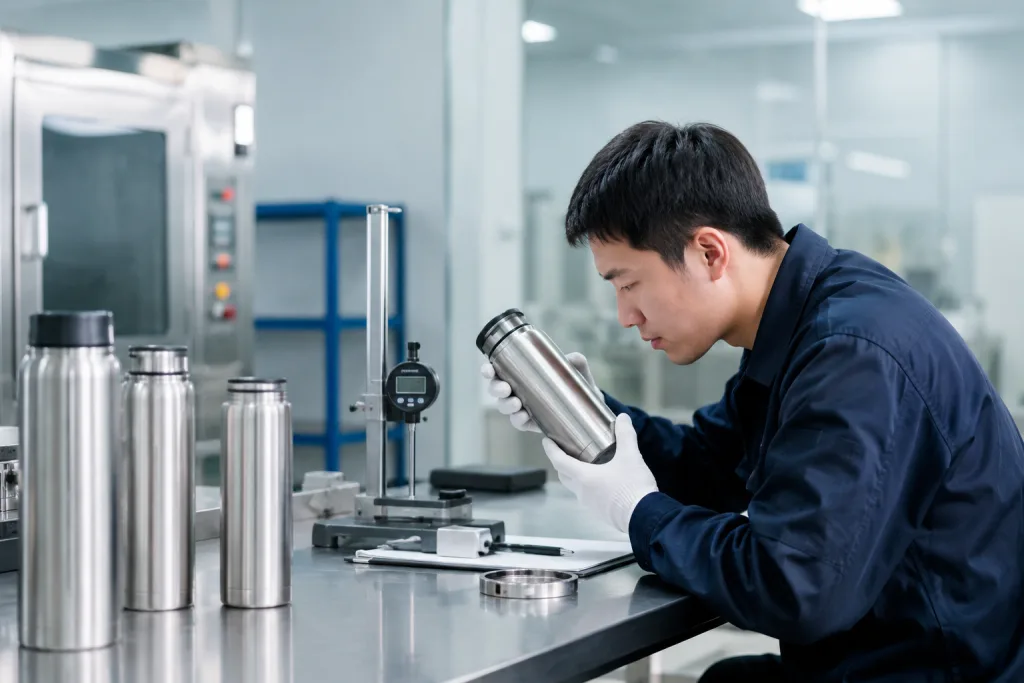
For a hiking or camping line, we run 18/8 food-grade 304 stainless steel on the inner and outer body, check wall thickness with a digital caliper, and add copper coating in the vacuum gap when the claim needs to hold closer to 12 hours instead of 6 hours. The lid matters more than buyers expect. QC pulled a sample last month where the body passed, but the flip lid cracked after 1,200 open-close cycles. For a trade-show promotional thermos, the math often works better with a simpler lid and more budget on finish, logo position, and gift box fit.
Use this quick sourcing checklist before you ask any vacuum flask suppliers for pricing. Send it as a one-page spec sheet, not six loose WhatsApp messages; we have seen “matte black” turn into “metalic black” on a PO typo and delay artwork approval by 2 days.
- Capacity: 350 ml for giveaways, 500 ml for daily carry, 750 ml for outdoor retail, 1,000 ml for camping, or mixed set with carton loading checked.
- Target channel: outdoor retail with drop testing, corporate gifting with logo approval, loyalty program with strict carton marks, or e-commerce with mailer box packing.
- Temperature claim: 6 hours, 12 hours, or 24 hours hot/cold performance, tested with 95°C water and recorded at room temperature.
- Logo method: laser engraving for stainless finish, silkscreen for low MOQ color jobs, heat transfer for full-color artwork, UV print for sharp logos, or embossed part with a new mold.
- Packaging: white box for basic wholesale, kraft box for gift programs, retail color box with barcode space, sleeve for shelf display, or mailer box for single-piece shipping.
- Market: EU, UK, US, Canada, or mixed compliance route, with FDA, LFGB, or other test reports matched to the lid plastic and silicone ring.
A supplier thermos quote without these details is guesswork. If you compare a thermos factory in China with a trading company, force both to quote the same specification sheet, including body weight in grams, lid material, MOQ, packing method, and AQL 2.5 inspection level. The cheaper offer often hides a lighter gauge body, lower grade lid plastic, or no 1.2 m drop test. We’ve seen this go sideways.
What Specifications Actually Change Price
Buyers usually point at capacity and logo first. Fair, they affect cost. The bigger swings often come from steel thickness, lid parts count, coating yield, retail packaging, and the AQL level written on the PO. On our line, a 0.45 mm outer shell and a 0.35 mm outer shell pass through the same water-expansion station, but they do not feel the same after the drop tester hits 80 cm. Photos hide that. Hands don’t.
For a 500 ml custom thermos, realistic FOB China pricing often falls around USD 3.20-6.80 depending on finish, lid, packaging, and volume. A simple promotional thermos with silkscreen logo and white box sits near USD 3.20-3.90 when the MOQ is 3,000 pcs. A retail customized thermos with powder coating, laser logo, copper lining, leakproof lid, and color box moves higher because QC rejects more pieces for pinholes and lid seepage. For 750 ml or 1,000 ml outdoor bottles, expect the steel weight to push pricing up by USD 0.60-1.80 per unit; we see the scale jump by 42-95 g before packing.
Ask your manufacturer thermos partner to quote with a visible bill-of-material structure. You do not need every factory cost, but you should know the main assumptions. This is where the math gets ugly if the quote says “same as sample” and the sample room used 304 stainless while the PO typo says 201 outside.
- Inner and outer steel grade: 304/304, 304/201, or another combination.
- Wall thickness: preferably stated in mm, not just “strong body.”
- Lid plastic: PP, Tritan, or other food-contact resin.
- Seal material: food-grade silicone, hardness range if relevant.
- Finish: spray paint, powder coating, plating, brushed steel, or matte texture.
- Packaging weight and carton quantity: often 24 or 36 pcs per master carton.
If vacuum flask suppliers refuse to state material structure, pause the order. A thermos supplier can protect its process settings, like vacuum furnace time or polishing wheel sequence, but not basic material facts. We’ve seen this go sideways: the buyer flagged dents after the first 18 cartons landed, and nobody could prove whether the agreed shell was 0.35 mm or 0.45 mm. You cannot defend your margin if you do not know what you bought.
MOQ, Sampling, And Honest Timelines
MOQ is where new buyers burn a week on email. For a catalog stainless flask in an existing color, we usually quote 500-1,000 units. A custom thermos with your logo usually starts at 1,000 units per design. Pantone powder coating is different: 2,000-3,000 units per color is normal because the coating booth needs setup, the line loses powder during purge, and QC still checks color under a D65 light box. Small runs sound attractive. The math doesn’t work. If a thermos vendor says “any quantity is fine,” ask whether they are pad printing on stock goods from the warehouse instead of building to your spec.
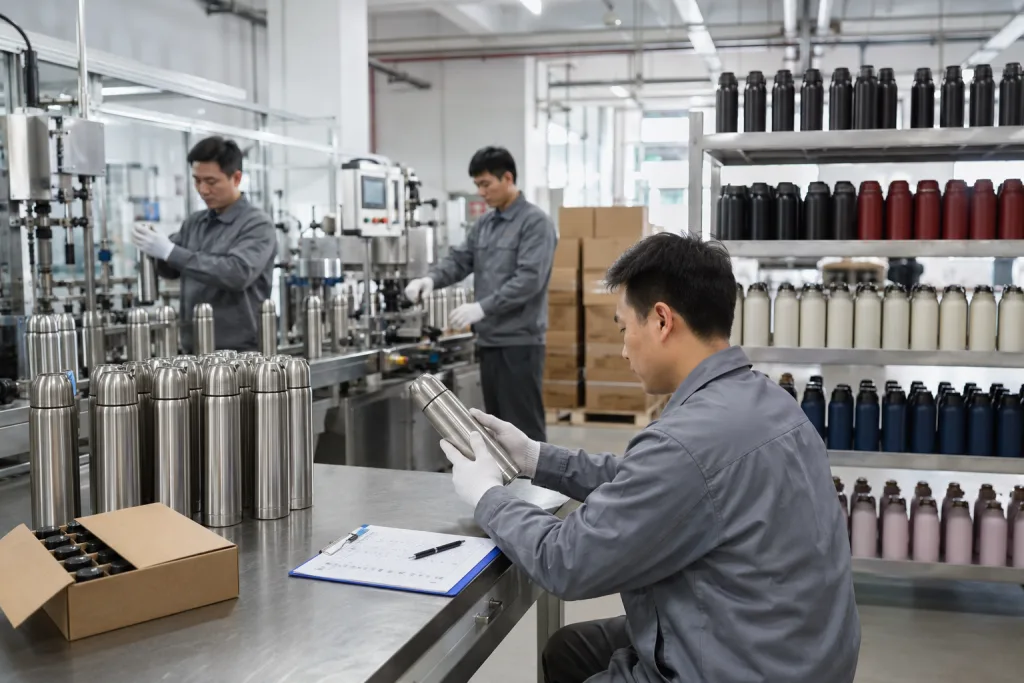
At BottleForge Industrial in Hangzhou, Zhejiang, our stainless thermos line can produce about 280,000 units per month across standard travel, outdoor, and promotional formats. We run 304 stainless bodies through vacuum testing before packing; if the gauge drops outside spec, QC pulls the sample and the carton waits. Normal lead time is 25-35 days after approved pre-production sample and deposit. Before Q4 promotional shipments, lead time often moves to 40-50 days, especially with color boxes, FNSKU labeling, or mixed cartons where one PO typo can stop packing for half a day.
A sane project timeline looks like this:
- Day 1-3: confirm brief, capacity, finish, logo size in mm, packaging, and target price.
- Day 4-7: quotation and artwork proof, including Pantone code and print position.
- Day 8-15: sample production for existing mold and normal decoration; QC checks print adhesion with 3M tape.
- Day 16-18: buyer approval or correction. This is where buyers often flag logo scale.
- Day 19-50: bulk thermos production, inspection under AQL 2.5 if required, and packing.
- Day 51 onward: FOB Ningbo or Shanghai shipment, depending on routing and forwarder cut-off.
New mold projects need more patience. A new lid, handle, or body shape can add 20-35 days for design, tooling, trial shots, and testing. We have seen this go sideways when a buyer approves the 3D drawing but forgets the 2 mm silicone gasket clearance, then the lid feels loose after the first trial shot. For outdoor retailers launching a seasonal range, start talking with vacuum flask suppliers at least 90 days before the shipment date you actually need.

Decoration Choices Buyers Regret Later
Decoration is not just a logo choice. It changes scratch resistance, lead time, rejection rate, and how the flask looks after 6 months in a backpack cup holder. On our line in Hangzhou, laser engraving on powder coating or bare 304 stainless is the safest pick for most distributor thermos programs; one-color silkscreen works for simple promo orders when the artwork is clean and the logo height stays under 65 mm. Full-wrap heat transfer can look sharp, but the math doesn't work if the buyer sends a low-res JPG and expects 0.5 mm seam alignment. QC pulled 32 samples from one wrap job last year because the city skyline shifted at the back seam.
Laser engraving is clean and hard to remove. We run it with a fiber laser, then check the mark under a 10x loupe for burn marks on dark powder coating. It fits outdoor retail, corporate gifts, and premium thermos custom programs where the buyer wants a finish that survives daily use. The tradeoff is color: laser exposes the substrate or coating layer, so it is the wrong choice for gradient artwork or a 6-color mascot. Silkscreen costs less for single-color logos and moves fast at scale, often 8,000 pcs per shift on a straight body, but it will scratch if the coating, ink, or oven curing is weak. UV print handles multiple colors and smaller MOQs, but adhesion testing decides whether we ship it or stop the line.
Use this decoration checklist when comparing thermos manufacturers. Simple list, but it catches problems before a PO typo turns “matte black laser” into “gloss black print” and adds 7 days of rework.
- Ask for a 3M tape test after printing or engraving, and have QC send a close-up photo after 10 pulls.
- Request logo position tolerance, usually +/- 1.5-2.0 mm for cylindrical bodies, measured from the center line with a caliper jig.
- Confirm whether artwork is printed before or after powder coating, because the process changes adhesion and masking risk.
- Check if the factory can match Pantone within a realistic Delta E range, not just “close enough” under office lights.
- Approve a physical sample, not only a digital mockup, then sign the sample tag with date, color code, and logo size.
For a promotional thermos, a lower-cost print is fine if the item runs for a 30-day campaign and the buyer accepts normal wear. For a retail customizable thermos, decoration failure turns into returns, bad photos, and chargebacks. We've seen this go sideways. The end customer will not care whether the fault came from ink, coating, or poor curing; they will blame the brand printed on the bottle.
Compliance, Testing, And Inspection Language
Good vacuum flask suppliers should answer food-contact and inspection questions without eye-rolling. For EU orders, ask for LFGB or EU food contact paperwork tied to the cup model, REACH checks for powder coating, silicone rings, and plastic lid parts, plus migration testing when the structure changes. For US retail programs, cover FDA food-contact expectations and California Proposition 65 review. Kids drinkware brings ASTM or CPSIA into the discussion if the handle, straw, or marketing claim points that way. On our line, QC keeps the lid gasket material code next to the test report; if the gasket changes from silicone batch S-24 to S-31, the old file is not enough.
“We have certificates” is not a complete answer. Certificates expire, sit under another model number, or cover 304 stainless sheet only. Ask for model-linked test reports where possible, with the item number matching the artwork approval and carton label. If you are ordering thermos bulk for a retailer, put the exact standard, report date limit, and retest cost rule on the purchase order. We once saw a PO typo change “LFGB 2024” to “LFG 2024”; the buyer flagged it after deposit, and the math did not work for a free retest.
Inspection needs the same discipline. Write AQL into the order before deposit, not after the goods are packed. A common setup is AQL 2.5 for major defects and AQL 4.0 for minor defects, with critical defects not accepted. Major defects include leakage, failed vacuum, broken lid function, sharp burrs, serious coating damage, wrong logo, or incorrect capacity. Minor defects include 0.5 mm dust points, light scratches inside the agreed limit board, or carton scuffing under 20 mm. QC pulled a sample last month with a 1.2 mm burr on the inner rim; that is not “minor,” no matter how nice the powder coating looks.
A practical pre-shipment inspection should include:
- Carton count against the packing list, barcode scan result, FNSKU readability at 30 cm, plus shipping mark verification.
- Capacity check with a measuring cylinder and net weight spot check on a calibrated bench scale.
- Leakage test with inverted bottles for at least 30 minutes, using room-temperature water filled to the rated line.
- Hot water retention test on sampled units, with start temperature and 6-hour reading written on the QC sheet.
- Logo placement measured from the bottom edge, color checked against the approved Pantone chip, plus adhesion checked by 3M tape pull.
- Drop test for retail box or master carton where relevant, normally 1 corner, 3 edges, and 6 faces for export cartons.
China has 200-plus capable thermos suppliers in Zhejiang, Guangdong, and Anhui, but capability only matters when the pass/fail rules are locked before the deposit. This is the wrong question to ask: “Can you pass inspection?” Ask what they will reject on the line before your inspector arrives.
How To Compare Supplier Types
You will usually meet 3 supplier types: direct thermos factory, export trading company, and mixed manufacturer thermos group with partner workshops for coating or printing. None is automatically good or bad. The right choice comes down to order size, SKU count, drawing changes, and how much control you want over the line. We run into this often in Hangzhou: one buyer asks for 500 pcs per color across 9 models, then expects factory-level price and daily production photos. The math doesn't work.
A direct factory thermos supplier fits stable repeat orders, customized thermos development, tighter material control, and faster feedback from welding, vacuuming, and polishing teams. If QC pulled the sample and found the mouth diameter off by 0.35 mm, the production manager can check the expanding tool the same afternoon. The tradeoff is small mixed orders. A trading company makes sense when you need 18 SKUs, low quantities across categories, or one consolidated shipment. The risk is control: wall thickness, vacuum testing, and production schedule can drift if they do not have their own QC staff standing at the workshop with a caliper, vacuum tester, and AQL report.
When you interview vacuum flask suppliers, ask operational questions instead of only asking for a catalog. Catalogs are easy. Production answers are harder. We once had a PO with “matte black” typed as “mate black,” and the buyer flagged it only after the coating sample came back. Good suppliers catch that before the line starts.
- How many stainless thermos units did you ship last month, and how many were repeat orders?
- Which processes are in-house: welding, vacuuming, polishing, coating, printing, packing? Name the outsourced steps.
- Can you provide BSCI, ISO 9001, or retailer audit documents with the factory name matching the PI?
- What is your standard vacuum failure rate before final packing, and who records it on the test sheet?
- Do you keep production samples and inspection records for 12 months?
- Can you support FOB Ningbo, FOB Shanghai, or DDP for smaller distributor orders, such as 30 cartons mixed by SKU?
If the answers are vague, assume the control is vague. For distributors thermos programs in Europe and North America, repeatability matters more than a USD 0.08 saving. We have seen this go sideways: carton burst strength looked fine on paper, then 6 kg master cartons crushed on the bottom layer after 12 days at sea versus the planned 18-day route. A reliable suppliers thermos relationship should cut surprises over time: same finish, same carton strength, same lid fit, and paperwork that does not need 4 rounds of chasing.
Purchase Order Details That Protect You
A purchase order should not just say “500 ml stainless thermos with logo.” We’ve seen that go sideways. That one line lets the factory choose the cheaper liner thickness, move the logo 8 mm to hide a weld mark, or swap the carton when the line is short on stock. For a thermos promotional order, a little tolerance might pass. For an outdoor retail line, write the PO like a control sheet the workshop can tape beside the laser marking machine.
List the model number, capacity tolerance, steel grade, coating type, Pantone color, logo size, logo position, packaging spec, carton quantity, barcode rules, testing requirements, inspection standard, shipment term, and approved sample reference. If you approved sample BF-500-PP-032 on March 14, write that sample code and date into the PO. Small detail, big difference. Our QC once pulled a pre-production sample where the body matched, but the lid supplier had changed the silicone ring from 52 Shore A to 60 Shore A; the buyer in Germany flagged the mouthfeel before shipment. The production team in Zhejiang must build against the same sample your buyer approved in North America or Europe.
Define what happens when something fails. If leakage exceeds AQL, does the supplier rework, replace, or discount? If color sits outside the approved range, who signs off: your merchandiser, your QC agent, or the factory sales rep under shipping pressure? If the forwarder misses the vessel because cartons are not ready, does the supplier pay extra trucking or storage? These questions feel awkward before the deposit. After 20,000 units are packed on 1,000 cartons, the math doesn't work. We had one PO with “matte black” written only in English, no Pantone code, and the line ran a finish closer to charcoal; nobody enjoyed that video call.
For payment, common terms are 30% deposit and 70% balance before shipment after passed inspection. Larger established customers may negotiate different terms after 3 or 4 clean orders, especially if their forecast is stable and the MOQ repeats monthly. For your first thermos manufacturer order in China, keep the structure simple: approve the sample, freeze the specification, inspect before balance payment, and keep one sealed production sample for future comparison. QC should sign across the carton tape and sample bag. It sounds old-school, but it saves arguments 6 months later.
Send Your Stainless Thermos Brief For Factory Review
Share capacity, logo, quantity, market, and target delivery date. We will check feasibility, MOQ, pricing, and sample timing without sales theater.
Frequently asked questions
What MOQ should I expect from vacuum flask suppliers for custom branding?
For existing stainless thermos models, expect 1,000 units as a practical starting MOQ for one logo and one standard color. If you need Pantone powder coating, plan for 2,000-3,000 units per color because coating setup and color waste are not free. For a bulk thermos order using stock colors and laser engraving, some factories in China may accept 500 units, but the unit price will be higher and packaging options may be limited. New molds, custom lids, or exclusive body shapes usually start around 5,000-10,000 units because tooling, testing, and production trials must be recovered. Be careful with very low MOQ offers; they are often stock goods with simple print, not true thermos customized production.
How do I know if a stainless thermos will keep drinks hot long enough?
Ask for a written heat-retention test method, not just a marketing claim. A typical test fills the bottle with water at 95°C, closes the lid, and measures temperature after 6, 12, and 24 hours at room temperature around 20°C. A good 500 ml vacuum flask may remain above 60°C after 12 hours, depending on body size, lid design, and copper coating. Wide-mouth bottles usually lose heat faster than narrow-mouth bottles because the lid area is larger. For outdoor retail, test 3-5 samples from the pre-production run and again during bulk inspection. Your thermos supplier should also check vacuum integrity before packing, because one failed vacuum bottle can look normal but perform badly.
Which logo method is best for a promotional thermos order?
For most promotional thermos orders, one-color silkscreen is the cheapest practical method when the artwork is simple and the campaign does not require premium durability. Laser engraving costs more but looks cleaner and lasts longer, especially on powder-coated stainless steel. UV print works when you need multi-color branding, small details, or short-run thermos custom projects, but adhesion must be tested with tape and abrasion checks. Heat transfer is useful for full-wrap graphics, though it needs careful artwork distortion control on curved bodies. If the bottle will be sold through outdoor retailers, choose laser or tested high-quality print. If it is a short event giveaway, silkscreen may be enough and can save USD 0.10-0.35 per unit.
What should I ask before choosing a thermos factory in China?
Ask where the product is actually made, which processes are in-house, and how many units the line can produce per month. A serious thermos factory should explain welding, vacuuming, polishing, coating, decoration, and packing control. Ask for recent test reports, BSCI or ISO 9001 documents if your customer requires them, and photos or videos of the actual production line. Confirm MOQ, lead time, sample cost, mold ownership, payment terms, and FOB port. For Zhejiang and nearby manufacturing clusters, FOB Ningbo and FOB Shanghai are common. Also ask how long they keep golden samples and inspection records. If a thermos vendor cannot answer these questions clearly, your risk is not only quality; it is communication discipline.
Can I mix several colors or capacities in one distributor thermos order?
Yes, but it depends on the model, finish, and total quantity. For a distributor thermos order of 3,000 units, splitting into three stock colors may be workable if the base bottles are already in production. Splitting into three custom Pantone colors is harder because each color needs coating setup, color approval, and separate QC. Mixed capacities are possible, but each capacity usually has its own MOQ and carton configuration. If you need 500 ml and 750 ml bottles with the same logo, ask for a combined quote but expect separate production lines and possibly separate lead times. For thermos distributors serving multiple accounts, the cleanest route is to standardize one body, two or three colors, and one packaging format for the first order.