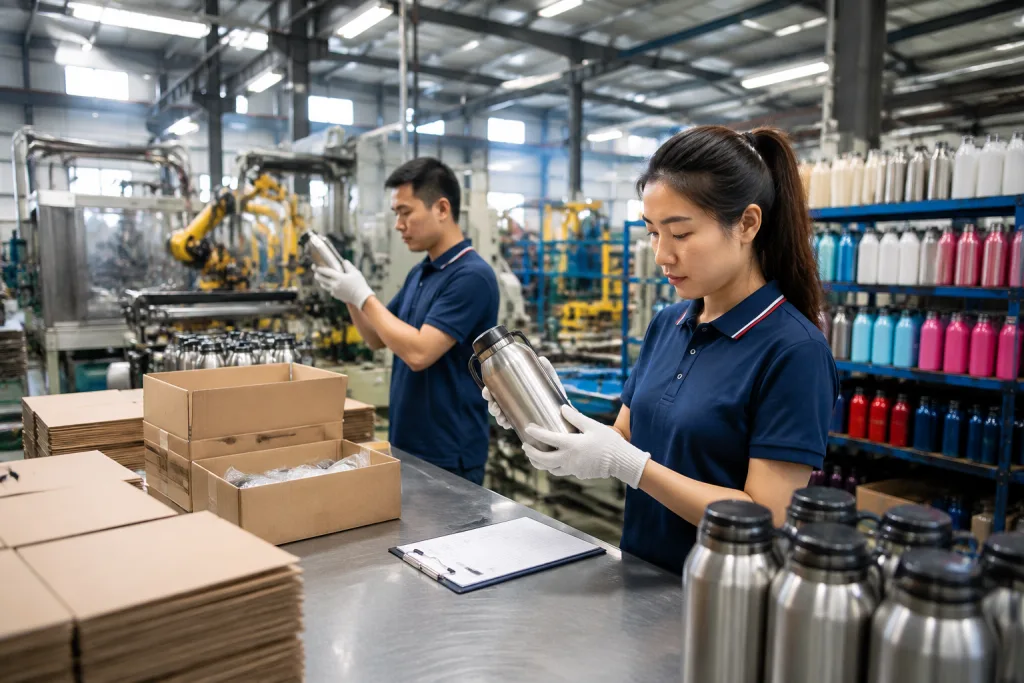
Key Takeaways
- For custom stainless thermos orders, practical MOQ usually starts at 1,000-3,000 units per color or logo design
- A reliable vacuum flask supplier should quote steel grade, wall thickness, insulation test method, and AQL level before deposit
- Logo method affects cost: laser engraving is often USD 0.15-0.35 per unit, while full-wrap printing needs higher setup control
- Normal production lead time is 30-45 days after sample approval, plus 25-38 days ocean freight to Europe or North America
If you sell outdoor gear or run promotional drinkware programs, a stainless thermos is not just a bottle with a logo. It has to hold heat for 12 hours, survive a 15 kg export carton stack, pass chemical checks, and land before your retail window or event date. A low quote from the wrong vacuum flask supplier gets expensive fast when QC pulls 80 samples and finds leaking lids, chipped powder coating, or 201 steel used where the PO said 304 stainless.
We manufacture in Hangzhou, Zhejiang, and we get these questions every week from buyers in Europe and North America. The real question is not “who is cheapest?” The math doesn’t work if you save USD 0.18 per unit and lose 12 days on rework. You need a custom thermos that looks retail-ready, meets compliance, and can be reordered from the same tooling without teaching a new line in China every season.
What Are You Really Buying?
Buyers asking for a bulk thermos quote often send 3 things: capacity, color, and logo size. This is the wrong question to ask. A vacuum flask is a pressure-formed, welded, evacuated stainless product, not a blank cup with printing. On the line, a 0.1 mm wall change or a loose rolling seam shows up fast; QC pulled one 500 ml sample last month because the shoulder dented after a 76 cm carton drop test.
A serious vacuum flask supplier should put the spec in writing: inner steel grade, outer steel grade, capacity tolerance, lid material, gasket material, coating type, logo process, carton spec, and test standard. For most export programs, we recommend 304 stainless steel for the inner wall and either 304 or 201 stainless steel for the outer wall depending on budget. Inner wall thickness is commonly 0.4-0.5 mm. Outer wall is often 0.45-0.6 mm for retail-grade products. Thin walls may save USD 0.20 per unit, but the math doesn't work if 2 cartons arrive with corner dents and the buyer flags it before shelf loading.
For outdoor retailers, insulation performance matters more than a catalog claim. We run the test with 95°C water, a calibrated probe, and room temperature around 20°C. A typical 500 ml stainless vacuum flask should keep water above 60°C after 6-8 hours. Larger 750 ml and 1,000 ml models usually perform better because the volume-to-surface ratio is higher. Promotional thermos projects can accept lower performance if the campaign is price-driven, but approve that on the spec sheet, not after the buyer’s lab report lands in your inbox.
Our Zhejiang production network can output about 450,000 stainless drinkware units per month across thermos, travel tumbler, and sports bottle lines. Capacity only helps when the spec is locked early. If you change lid type, finish, or packaging after pre-production sample approval, the timeline resets; we’ve seen a matte powder coating switch push shipment from 12 days to 18 days because the spray line and carton insert knife mold both had to be rebooked.
Questions To Ask Before Quoting
Most buyers start with “What is your best price?” We answer with questions first. If a thermos quote lands in 30 minutes and nobody asked about lid type, print method, or carton size, we treat it as a rough number. That quote is often based on the cheapest shell, a generic lid, and no export test file. On the line, QC pulled a sample and found a 0.8 mm lid gap on a low-cost version before it ever reached packing.
Use this short checklist before you accept a quotation:
- Capacity: 350 ml, 500 ml, 750 ml, and 1,000 ml use different tooling, carton counts, and gross weight.
- Finish: powder coating, spray painting, electro-polish, brushed steel, or full-color wrap.
- Logo: laser engraving, silk screen, pad print, heat transfer, UV print, or embossing.
- Packaging: white box, kraft box, color gift box, insert card, hang tag, barcode, or FNSKU label.
- Compliance: LFGB, FDA food-contact, REACH, Prop 65 review, or retailer-specific chemical list.
- Inspection: AQL 2.5 for major defects and AQL 4.0 for minor defects is common for drinkware.
For a custom thermos order, our usual MOQ is 1,000 units for laser logo on existing stock color, 2,000-3,000 units for custom powder-coated colors, and 5,000 units or more for new molded lid parts. A fully customized thermos with new shape tooling can require 10,000 units or a tooling charge in the range of USD 2,000-8,000 depending on mold complexity. One buyer once pushed for 800 units on a new lid; the math did not work, and we stopped that quote at the drawing stage.
If you are buying thermos bulk for a distributor thermos program, ask for carton dimensions and gross weight at quotation stage. Freight can change the landed cost by USD 0.35-1.20 per unit, depending on volume, port, and season. FOB Ningbo or FOB Shanghai are common for Zhejiang and eastern China shipments. We once caught a PO typo on carton count, and the buyer’s freight estimate was off by 12 days versus the original sailing plan.
How Custom Can It Be?
“Customizable thermos” gets used too loosely. We usually split it into 3 jobs: logo on a ready factory model, cosmetic work on the same body, or tooling-level changes to the structure. Logo-only means laser engraving or silk screen on our stock 500 ml or 750 ml body. Cosmetic work covers Pantone powder coating, finish, packaging, and accessory set. Structural work means a new body shape, lid, handle, tea filter, or retail box format. Big difference. On the line, QC checks the sample with a 0.02 mm caliper and a leak tester before we even talk about mass production.
For most outdoor retailers and promotional brands, the better starting point is an existing stainless thermos body with controlled customization. You keep proven vacuum performance, known leak testing, and faster delivery. A 500 ml or 750 ml manufacturer thermos body can be adjusted with Pantone-matched powder coating, laser logo, printed retail box, and instruction leaflet. That covers plenty of private-label launches. We’ve seen buyers ask for a new lid to “look more premium,” then push back when the tooling cost and 35-day sampling calendar land on the PO. The math doesn’t work for a 1,000 pcs trial order.
Logo choice should match the sales channel. Laser engraving is durable and clean, especially on powder coating and brushed stainless steel, but it is the wrong process for multi-color artwork. Silk screen works for simple one- or two-color logos, then we run abrasion testing on curved surfaces because weak ink shows up fast near the grip area. Heat transfer and UV printing give better color, but setup, curing time, and fixture alignment need tighter control. For promotional thermos orders going into corporate events, logo placement consistency usually matters more than maximum insulation. For retail outdoor shelves, finish durability and leak rate matter more. Last month QC pulled the sample after a 1.5 mm logo drift on the front face; the buyer flagged it before discussing carton marks.
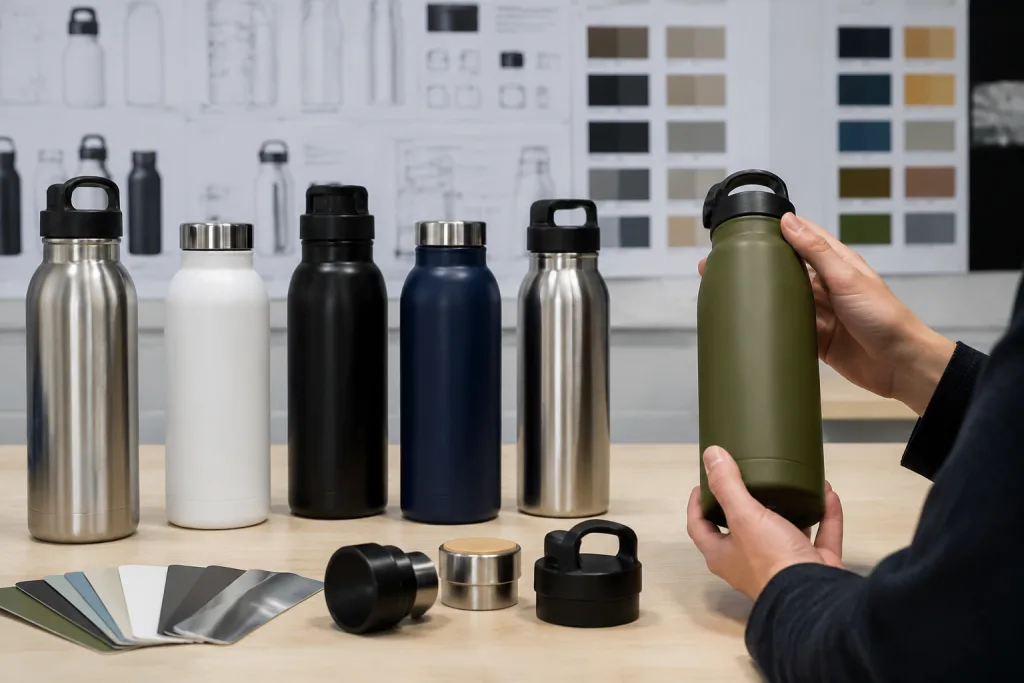
Color changes the cost sheet. Standard black, white, navy, or stainless finish is easier to schedule because we run those colors 4-5 times a month. Pantone powder coating usually adds about USD 0.20-0.45 per unit depending on order volume and coating type. Metallic, gradient, rubberized, or matte textured finishes cost more and need tighter incoming paint checks, including gloss reading and cross-hatch tape testing. A thermos custom project with four colors and three logos is not one order operationally; it is twelve SKUs. Plan QC and cartons accordingly. We’ve seen this go sideways from one typo on a PO: “matte navy” became “matte black,” and 36 master cartons had to be held before shipment.
What Quality Checks Matter Most?
Drinkware QC is not magic. It is repetition. A vacuum flask supplier should check function and appearance before packing, not after the buyer’s warehouse finds the problem. On the line, QC pulled 32 pieces from one 3,000 pcs batch last month and found 2 lids with silicone rings sitting 1 mm proud; that is exactly the kind of small miss that turns into leakage claims. The checks that matter are vacuum insulation, leak resistance, lid fit, coating adhesion, capacity, odor, sharp edges, and carton drop performance.
At our Hangzhou, Zhejiang facility, we run random sampling during assembly and final inspection before carton sealing. For export orders, we recommend a written inspection plan based on ISO 2859-1. AQL 2.5 major and AQL 4.0 minor is a practical baseline. Critical defects such as leaking, rust inside the cup, broken lid threads, or unsafe burrs should be rejected at 0 tolerance. No debate there. If a buyer asks us to “just check the top layer of cartons,” we push back because the math does not work on a 240-carton shipment.
For insulation, the test should list starting water temperature, fill level, ambient temperature, test duration, and pass threshold. Without those numbers, “keeps hot for 12 hours” is a sales line, not a QC standard. We normally record 6-hour and 12-hour results for pre-production and mass production samples, with the thermometer probe kept off the inner wall so the reading is not skewed. For leak testing, we fill the flask, invert it, shake it 30 times, then check screw-lid thread torque with a torque meter.
Chemical compliance depends on market. Food-contact stainless steel and plastic parts for North America usually need FDA-oriented material declarations. EU buyers often ask for LFGB and REACH documentation. If the product is for children or school campaigns, ASTM, CPSIA, and small-parts review may be relevant depending on design. For a kids lid with straw or silicone parts, this is the wrong question to ask: do not ask whether the adult flask file is “close enough.” We have seen this go sideways when a PO says “sports bottle” but the artwork clearly targets 6-year-old students.
Cheap inspection is checking ten pretty samples. Useful inspection is opening cartons, filling units with hot water, testing lids, rubbing print, and documenting defect rates by SKU.
Pricing And MOQ Reality Check
Buyers sometimes compare thermos suppliers by unit price alone. Wrong question. On our quote sheet, the low number often misses inner 304 stainless steel, custom packaging, logo setup, 5-layer export carton, or final AQL 2.5 inspection. A realistic FOB China price for a 500 ml stainless vacuum flask can range from about USD 3.20 to USD 6.80 depending on steel gauge, lid structure, finish, and packaging. A 750 ml outdoor-style bottle commonly sits around USD 4.50-8.50 FOB. Premium lids, handles, tea filters, and retail boxes push the price up fast; last month QC pulled a sample where the “304” inner wall was 0.38 mm instead of the 0.42 mm spec on the PO.
MOQ is not factory mood. The line needs enough paint for one clean powder-coating run, printing fixtures take setup time, and gift box suppliers will not start the Heidelberg press for 300 sheets. That is why a thermos supplier may accept 1,000 units for a laser logo but ask for 3,000 units for a Pantone finish and printed box. We run into this weekly: the buyer wants 4 colors at 500 pcs each, then the coating room flags 8 kg of wasted powder per color. The math doesn't work.
If you are a thermos distributor testing a new line, ask for a staged plan. Start with 1,000 units in two colors using existing molds, then move to 5,000 units after sell-through data confirms demand. For distributors thermos programs with multiple regional customers, consolidate body shapes and vary only logo or packaging. Simple sells. It also keeps spare lids, silicone rings, and master carton sizes under control; we have seen a program go sideways because one regional buyer changed only the cap thread by 1.5 mm and the warehouse mixed the parts.
Payment terms for new customers are usually 30% deposit and 70% before shipment after inspection. For larger recurring orders, some manufacturers thermos partners may discuss payment against bill of lading or credit insurance, but not on the first order. Be careful with quotes that promise 15-day production, low MOQ, full custom color, custom box, and the lowest price at the same time. In China manufacturing, one of those promises usually breaks. We ship Hangzhou-Ningbo containers every week, and even a clean repeat order needs about 12 days for coating, assembly, leak testing, and carton drop checks—not 15 days for full custom unless the factory is gambling.
Sampling Timeline Buyers Should Expect
A sample is not a souvenir. It is the control item we run against on the line. For existing thermos factory models, plain samples can usually ship in 3-5 working days if stock shells are on the rack. Logo samples usually take 7-10 days, including artwork setup and one tape test after printing. Custom color samples need about 10-15 days because powder coating or painting must get a slot in the spray room; last month a buyer pushed for 8 days on a matte olive 750 ml flask, and the math did not work. New lid or body tooling can take 25-45 days before a real functional sample exists, especially when the first CNC insert needs gasket compression checked to 0.2 mm.
Do not approve a customized thermos sample only from photos. Ask for three physical samples: one for your office, one for your testing lab or buyer, and one signed control sample kept at the factory. QC pulls that factory sample into a sealed bag, signs across the label, and stores it near the caliper and color light box, because a phone photo will not catch a logo sitting 3 mm too high. The approved sample should include final color, logo size, logo position, lid, gasket, packaging, and any insert card. If the box is not ready yet, approve it separately before mass production packing begins. We have seen this go sideways when a PO said “black gift box” but the buyer meant black sleeve over a white E-flute box.
A normal bulk production lead time is 30-45 days after deposit and sample approval. In peak seasons before summer outdoor launches and Q4 promotional gifting, plan 45-60 days. Ocean freight to Los Angeles may take roughly 18-28 days port to port, while shipments to Hamburg, Rotterdam, or Felixstowe often take 28-38 days. Add 3-7 days for customs clearance, inland trucking, and retailer DC booking if the forwarder is already holding the SO. We ship faster when the buyer approves the pre-production sample on day 2, not day 12; one delayed lid color approval can leave 6,000 pcs waiting beside the leak-test machine.
For Amazon or marketplace programs, carton labeling must be handled before shipment. FNSKU labels, carton marks, suffocation warnings for polybags, and master carton dimensions should be confirmed early. Send the exact label file, not a screenshot. Our packing team checks barcode scan rate with a handheld scanner before cartons close, and QC flags labels if the code prints under 80% contrast or lands across the carton seam. A thermos vendor that understands only factory packing but not channel requirements can create extra repacking cost after arrival; we have seen USD 0.35 per unit charged just to relabel cartons in a US warehouse.
Supplier Red Flags And Better Signals
You do not need a perfect supplier. You need a supplier who will show the paperwork before the deposit. Red flags: “304 stainless” with no grade on the material report, no written AQL standard, carton dimensions missing from the PI, a logo method changed from laser to silk print without approval, or EXW quoted after you asked for FOB Ningbo. We saw one PO with “matte black” typed as “matt back”; QC pulled the pre-production sample before the line opened, because that typo would have turned into 3,000 wrong cartons. A bigger warning is the supplier who says every compliance certificate is ready, then cannot match the report to the exact steel, lid PP, powder coating, or production date.
Better signals are practical and a bit boring. A solid thermos suppliers team sends a spec sheet, asks whether you sell through Amazon, retail stores, or corporate gifting, explains MOQ by finish, confirms inspection method, and gives a lead time they can defend. We run different numbers for powder coating and UV print; 1,000 pcs is not the same job as 5,000 pcs once the jig and curing oven schedule are booked. They should also push back when your target price is too low for the finish you want. That honesty saves money. The math does not work if a buyer asks for mirror polish, gift box, spare lid, and 18-day delivery at the price of a plain bulk flask.
For outdoor retailers, ask whether the supplier has run carton drop tests, barcode labeling, retail shelf packaging, and a spare gasket policy. Ask for the carton size in cm and gross weight in kg, not just “standard export carton.” For promotional brands, ask how they control logo alignment across 2,000 or 10,000 units. On the line, we use a positioning jig and check the first 20 pcs before mass printing. For a thermos promotional order, a 3 mm logo shift becomes a customer complaint when the artwork sits near a seam or handle. We have seen this go sideways.
BottleForge Industrial is based in Hangzhou, Zhejiang, close to stainless drinkware production clusters and Ningbo port. That helps when we need a material supplier visit in the morning and export consolidation before the truck cutoff at 16:30. It also makes factory audits easier; buyers can check the welding area, vacuum test bench, and packing line in one visit. We are not the right fit for a buyer who wants 100 pieces at trading-platform pricing. We are a better fit when you need a repeatable supplier thermos program with MOQ, lead time, QC, and documentation clear before money changes hands.
Send Your Thermos Spec For A Factory Quote
Share capacity, logo, color, market, and target quantity. We will return a practical FOB quote with MOQ, lead time, and QC notes.
Frequently asked questions
What MOQ should I expect from a vacuum flask supplier?
For existing stainless vacuum flask models, expect 1,000 units for a simple laser logo if the color is already available. For custom powder coating, MOQ is usually 2,000-3,000 units per color because the coating line and paint supplier need minimum volume. Printed gift boxes often add another MOQ layer, commonly 1,000-3,000 boxes depending on paper and finish. New molded lids or body shapes can require 5,000-10,000 units or tooling charges. If a supplier offers 300 units with custom color, custom box, and low FOB pricing, ask whether they are using overstock shells or subcontracting without stable QC.
How do I compare two thermos supplier quotes fairly?
Put both quotes into the same spec table. Compare inner steel grade, outer steel grade, wall thickness, lid material, gasket material, coating type, logo process, packaging, AQL level, compliance documents, and Incoterm. A USD 4.10 FOB quote may be cheaper than USD 4.60 only because it uses 201 stainless inside, thinner carton board, or excludes logo setup. Ask each thermos manufacturer for gross weight, carton size, production lead time, and sample cost. You should also compare defect policy: whether the supplier replaces confirmed leaking units or only gives a discount on the next order.
Which logo method is best for a promotional thermos?
For most promotional thermos orders, laser engraving is the safest if the artwork is one color and the bottle has powder coating or stainless finish. It is durable, clean, and usually costs about USD 0.15-0.35 per unit depending on size. Silk screen is cheaper for simple logos at volume but needs rub testing and careful curing. UV print or heat transfer is better for multi-color artwork, gradients, or retail graphics, but setup cost and rejection risk are higher. If the order is for 5,000 units or more, request a printed pre-production sample and a 3M tape adhesion test before mass production.
What compliance documents do EU and North American buyers need?
For EU buyers, LFGB food-contact testing and REACH review are common requests, especially for stainless steel, plastic lids, silicone gaskets, coatings, and inks. For North America, FDA food-contact declarations are typical, and California-focused programs may require Prop 65 review. If the flask is marketed for children, CPSIA and ASTM-related checks may apply depending on parts and age grading. Ask for reports tied to the actual material and component, not a generic certificate from another bottle. A responsible China supplier should tell you which documents already exist and which need fresh testing, usually taking 7-12 working days.
How long does a customized thermos order take from China?
For an existing model with logo, plan 7-10 days for sampling and 30-45 days for production after approval and deposit. Custom Pantone coating usually adds several days to sampling. New tooling can add 25-45 days before production even starts. Ocean freight from Ningbo or Shanghai to the US West Coast often takes 18-28 days port to port, while major European ports usually take 28-38 days. Air freight is possible for urgent promotional deadlines, but it can add USD 2.00-5.00 per unit depending on bottle weight. Build your timeline around sample approval, not inquiry date.