Key Takeaways
- A practical MOQ for customized thermos orders is 1,000 units per color, with pilot runs from 500 units on selected models
- 304 stainless steel at 0.45-0.55 mm wall thickness is the safest baseline for outdoor retail programs
- Normal custom thermos lead time is 25-35 days after deposit and artwork approval
- AQL 2.5/4.0 inspection should cover vacuum retention, coating adhesion, leakage, barcode, and carton drop checks
A vacuum flask supplier list looks simple until you ask for numbers that match the order sheet. Outdoor retailers need bottles that pass a 1.2 m drop test, hold heat through a 6 a.m. shelf check, and avoid warranty returns after the first season. Promotional buyers care about Pantone drift, logo position within 1.5 mm, 5-layer carton strength, and a ship date that stays put after artwork approval. QC pulled one 500 ml sample last month because the laser logo sat 3 mm low. Small miss. Big argument.
Finding a thermos supplier in China is not the hard part. The hard part is comparing a bulk thermos offer, a custom thermos sample, and a factory thermos quotation on the same basis. At BottleForge Industrial in Hangzhou, Zhejiang, we see this mistake about 8 times a month: the buyer picks the lowest FOB price first, then finds out the lid seal, powder coating thickness, or AQL 2.5 inspection level was different. We run into this on the line when one PO says “matte black” and the approved sample is actually Pantone Black 6 C. The math does not work if the specs are not equal.
Compare Suppliers By The Same Spec
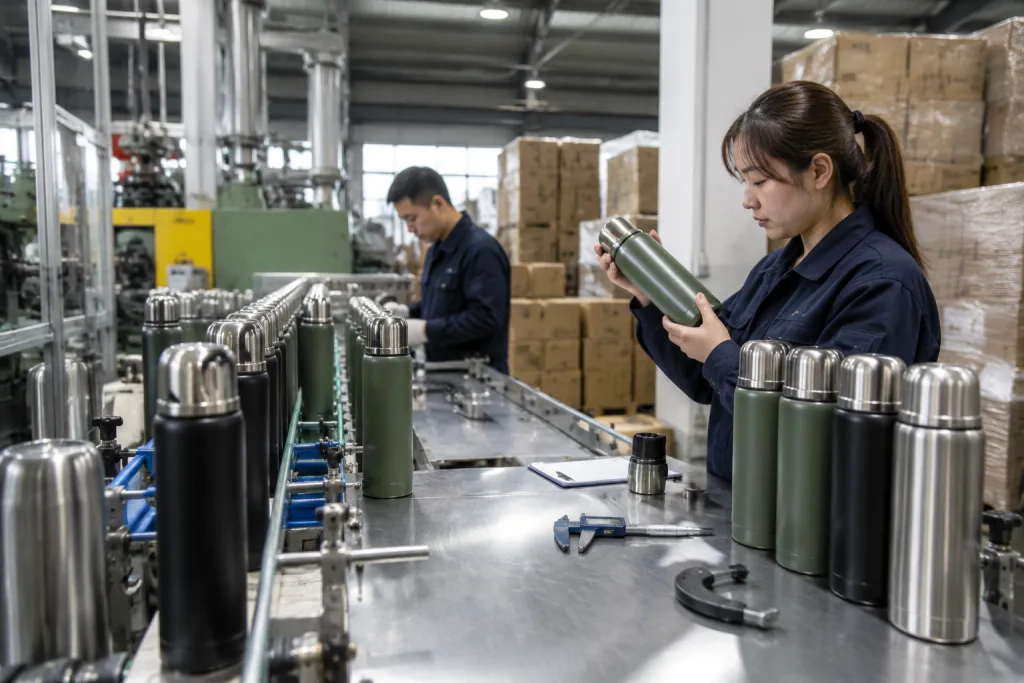
If you are building a vacuum flask supplier list, start with the same spec sheet for every factory. Do not compare introductions first. A quote at USD 4.20 and another at USD 5.10 can still point to the same thermos, or they can hide different steel grades, lid tooling, coating steps, and carton strength. We run this check on the line with a caliper and a lid torque gauge before anyone talks discounts, because the wrong question is “who is cheapest?”
| Item | Outdoor retail fit | Promotional brand fit | Risk if unclear |
|---|---|---|---|
| Steel grade | 304 inside, 304 or 201 outside | 304 inside, 201 outside acceptable for budget | Rust complaints and failed REACH review |
| Wall thickness | 0.50-0.55 mm preferred | 0.40-0.50 mm depending on price | Denting, poor hand feel |
| Vacuum performance | 6 hours above 65°C for 500 ml | 6 hours above 60°C often enough | Return claims after launch |
| Logo method | Laser or powder-coated print | Silkscreen, UV print, laser | Logo scratches during transport |
| MOQ | 1,000-3,000 units per SKU | 500-1,000 units per color | Hidden setup fees |
This table makes a thermos vendor answer like a factory partner, not a brochure writer. In Zhejiang, China, plenty of plants can send a quote in 2 hours, but the shortlist only works when the supplier puts tolerances, test method, packaging, and delivery terms in writing. We have seen a PO lose a digit on carton count and the whole shipment went sideways, so we ask for the spec sheet first and the discount second.
Outdoor Retail Versus Promotion Programs
An outdoor retailer and a promotional thermos buyer are not buying the same risk. A retailer gets product reviews for 12 months, sometimes 18 months if the SKU stays on the shelf. A promo buyer usually fights the event date, logo position, and a landed-cost ceiling the purchasing team will not move by USD 0.10. Your vacuum flask supplier list should separate hiking-grade suppliers from campaign suppliers, not just list anyone with a stainless bottle line. We run this check at quotation stage after QC pulls one sample from the aging rack.
For outdoor shelves, I would push for 304 stainless steel inner and outer, a 0.50 mm minimum body wall, powder coating with cross-hatch adhesion at 4B or 5B, and a lid that survives 3,000 open-close cycles. A 750 ml customized thermos for hiking should not feel tinny when you press the shoulder with a thumb gauge. If the target FOB Ningbo price is below USD 5.00, the math does not work unless someone thins the steel, coating, stopper material, or QC time. We have seen this go sideways after salt-spray testing, where QC found rust dots around the laser-welded bottom seam.
For promotional brands, the cleaner fit is often a thermos customizable platform model. Keep the mold unchanged, then adjust color, logo, sleeve, insert card, and gift box after artwork approval. A 500 ml promotional thermos can land at USD 3.20-4.80 FOB China depending on lid and finish. That range is workable for thermos bulk campaigns of 3,000-10,000 units, especially when the brief is brand exposure, not weekend mountain use. On our line, the buyer usually flags logo height first; 2 mm off-center on a silk-screen print gets noticed faster than a heavier cup body.
Be careful with the phrase distributors thermos or thermos distributors in search results. Some distributors are good for 300-piece replenishment orders, but they may not control welding, vacuum testing, or spare lid production. If you need repeatable thermos custom orders, factory access matters. Ask who owns the vacuum tester, who keeps the lid mold, and who signs off the AQL 2.5 inspection report. One PO typo on “matte black” versus “gloss black” can waste 6 days if the distributor has to ask three parties before the line can restart.
Where Price Differences Really Come From
Two suppliers quote the same 500 ml shape, and one is USD 0.70 lower. That does not prove cheating. It often means the BOM is not the same. The better question is where the cost was cut. Ask the factory to break out body cost and lid cost, then show separate lines for surface finish, logo method, inner box, export carton, testing, and inland freight. We run quotes like this in Hangzhou every week; if the PI only says “vacuum flask 500 ml” and nothing else, QC has no target when the first sample lands on the bench with a loose gasket.
Steel is usually the first lever. 304 stainless inner with 201 outer can save about USD 0.15-0.35 per unit versus full 304, depending on nickel price. For a promotional order of 3,000 pcs, that can work if the outside coating passes cross-cut tape testing and the compliance file is clean. For premium outdoor retail, full 304 is easier to defend when the buyer asks for the material declaration. Some thermos manufacturers also drop wall thickness from 0.50 mm to 0.38 mm. The math looks nice on paper, but we have seen this go sideways: QC pulled the sample, pressed the shoulder with a 5 kg hand gauge, and the dent showed before the meeting ended.
The lid is the second lever. A simple screw cap is cheap and stable. A push-button lid adds a spring, silicone seal, hinge pin, and one more place for leakage. A tea infuser or carry handle means new mold inserts, not just a different accessory in the carton. If a thermos factory quotes a low price with a complicated lid, ask for a 24 hours inverted leakage test and a dishwasher exposure statement, even if you do not sell it as dishwasher safe. We had one buyer flag 18 leaked lids out of 200 pcs during pre-shipment inspection; the lid drawing looked fine, but the silicone ring was 0.4 mm under spec.
Printing is the third lever. Silkscreen is economical for 1-2 colors, especially above 1,000 pcs per artwork. Laser engraving looks cleaner on stainless and powder-coated surfaces, but the line runs slower; 500 pcs can take 12 hours instead of 6 hours for one-color silkscreen. UV print gives color detail, but abrasion resistance has to be checked with a 3M tape pull and rub test before mass production. A reliable supplier thermos partner in Zhejiang should say this before taking the artwork, not after the buyer spots a logo scratch on the approval sample.
Customization Without Losing Control
A customizable thermos does not always need a new mold. For most outdoor retailers and promo brands, the smarter first order is a platform body with tight changes: color, logo, lid choice, and packing spec. New tooling has its place, but it adds 25-45 days, USD 2,000-8,000 in mold cost, and 3-4 rounds of fit checks with calipers on the lid thread, stopper seal, and bottom cup. If your launch date is locked, start with a stable manufacturer thermos body. Asking for a new shape on order one is often the wrong question to ask.
The safest customization stack is plain: existing body, selected Pantone powder coat, one logo method, standard lid, and upgraded packaging. For 1,000 units, we keep the customized thermos order to one body and one print setup, so the line is not stopping every 30 minutes for color change. For 5,000 units, a printed gift box, instruction leaflet, barcode sticker, and color carton make sense because the carton MOQ and plate cost spread out. For 10,000 units or more, custom lid color and silicone ring color start to pay off; retail display trays also work if your warehouse accepts the extra CBM.
For promotional brands, ask the thermos supplier to show a logo tolerance drawing before you sign the PI. A 45 mm wide laser logo on a curved 500 ml bottle is not the same as a flat digital proof, and we have seen buyers flag this after QC pulled the sample under a 6000K inspection lamp. For outdoor retail, ask for coating thickness and salt spray expectations. Powder coat is usually around 60-90 microns. Too thin scratches after a 3M tape test; too thick can chip around threads or lid contact areas.
At BottleForge Industrial in Hangzhou, Zhejiang, our standard MOQ is 1,000 units per color for most stainless thermos custom programs, with sample approval in 7-10 days when the base model is available. We run artwork check, pre-production sample, and carton mark review before mass production; one buyer once sent a PO with “matte balck,” and that typo still stopped the order for 1 day. That is the rhythm you should expect from serious thermos suppliers in China: not instant, but controlled.
Quality Checks Buyers Should Require
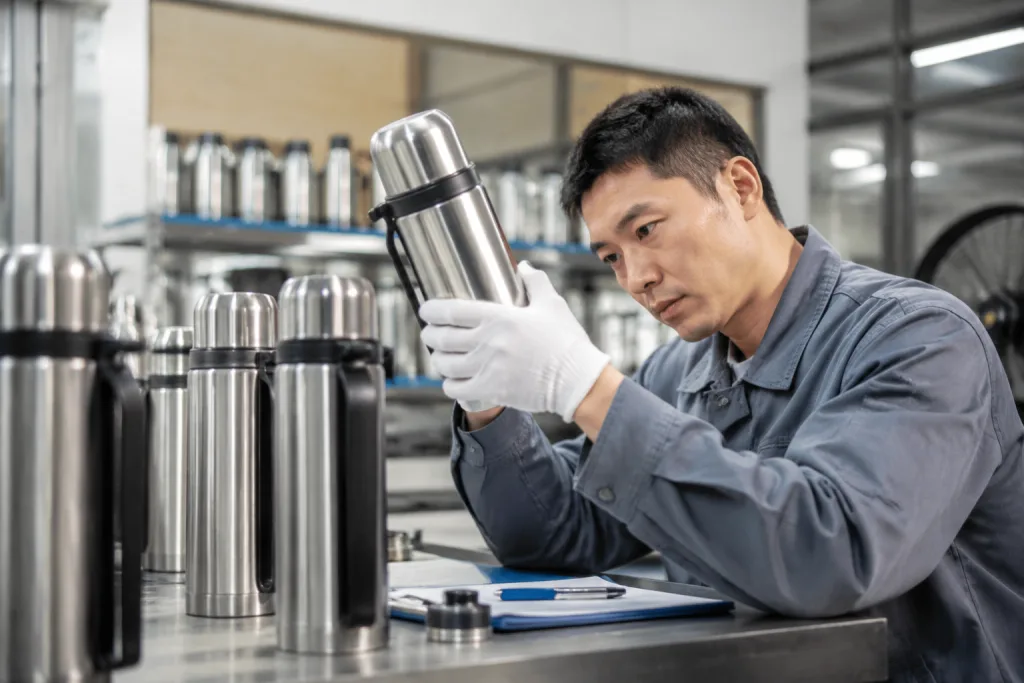
A supplier list earns its keep before a single cup is welded. Ask each thermos vendor for the inspection plan they run on the line, not a PDF bundle sent by sales. BSCI, ISO 9001, LFGB, FDA food-contact documentation, REACH declarations, and ASTM-related packaging checks still matter, but we have seen clean certificates paired with loose daily controls. On our floor, QC signs the first-piece sheet with calipers, a torque meter, and a sample pulled from the first 30 units.
For stainless vacuum flasks, the factory should run vacuum performance checks after welding and again before packing. The basic shop-floor test is simple: fill with hot water, record the start temperature, measure again after 6 hours, then reject weak insulation units. For a 500 ml flask, 8 out of 10 buyers we quote set the limit above 60-65°C after 6 hours at room temperature. Premium outdoor programs sometimes ask for 12-hour and 24-hour data. Fair request, but the math does not work if the buyer also wants approval in 2 days and no testing charge.
Leakage testing should cover upright, horizontal, and inverted positions, each held for a defined time. Do not accept “no leak” in an email. Define water temperature, test time, and lid torque, for example 80°C water, 30 minutes, and 1.2 N·m on the cap. Coating needs cross-hatch tape testing plus rub testing, then visual checking under the same light box each shift. Cartons need a drop test for Amazon-style parcel handling or distributor thermos replenishment; QC pulled one 12 kg master carton last month with crushed corners after a 76 cm edge drop.
Use AQL. For normal thermos bulk orders, AQL 2.5 for major defects and 4.0 for minor defects is common. Critical defects should be zero tolerance: sharp edges, contamination, broken glass liner if applicable, bad odor, or leakage. If your suppliers thermos shortlist refuses third-party inspection, remove it. Good factories may push back on timing when the line is still packing, but they should not fear an inspector with a carton cutter, a barcode scanner, and a clear checklist.
Build A Shortlist That Can Deliver
A good vacuum flask supplier list should finish with three names, not thirty. Pick one main thermos manufacturer for retail-grade orders, with stable 304 stainless sourcing and carton drop-test records. Keep one promotional thermos factory that lives on logo work, gift boxes, barcode stickers, and mixed-color packing. Keep one backup vendor for rush distributor orders or 500-1,000 pcs MOQ projects. Any more becomes spreadsheet noise unless you have 4 people chasing samples. We have seen buyers lose 12 days just because nobody knew which supplier held the latest Pantone card.
Score each supplier on points you can check: sample accuracy against the approved bottle, written specification with steel grade and coating notes, reply speed within 24 hours, real line capacity, and how they handle defects. Capacity needs a number. BottleForge Industrial runs about 650,000 stainless drinkware units per month across thermos, tumblers, and sports bottles in Zhejiang, China. Your supplier does not need the same number, but it should state monthly capacity by product type and explain peak-season limits before September production gets crowded. Ask for the welding line count. QC pulled one sample last month where the PO said matte black, but the box artwork still read gloss black.
Pin down lead time before you pay the deposit. A normal factory thermos order is 25-35 days after deposit and artwork approval. Add 7-10 days for custom sample approval, 3-5 days for pre-shipment inspection scheduling, and ocean freight time based on destination. If the supplier promises 15 days for a new color, new logo, new box, and 5,000 units during peak season, this is the wrong question to ask: do not ask if they can ship fast, ask which order gets pushed off the line. We run coating trials with a wet film gauge, and a rushed new powder color can fail adhesion on the first cross-cut test.
The final choice is not the cheapest thermos supplier. It is the factory that can repeat your approved sample, document the materials, hit the ship date, and answer when a lid issue appears six months later. Small detail, big cost. A 0.3 mm gasket mismatch can turn into 2,000 leaking lids after the container lands, and the math does not work if the supplier disappears after shipment. That is the difference between a name on a spreadsheet and a supplier thermos partner you can keep.
Send Your Thermos Spec For A Factory Quote
Share capacity, quantity, logo method, and target market. We will return a practical FOB quote, MOQ, sample plan, and lead time.
Frequently asked questions
What MOQ should I expect for a custom stainless thermos order?
For most custom thermos programs, expect 1,000 units per color as a realistic MOQ. Some factory thermos models can run 500 units if the body, lid, and coating color are already in production, but unit cost will be higher. New Pantone powder coating, retail box printing, and custom silicone colors usually push the MOQ back to 1,000-3,000 units. For thermos bulk orders above 5,000 units, you gain better FOB pricing and more room for packaging changes. If a supplier offers 100 units with full customization, it is usually trading from stock or using local print after production, not running a true manufacturer thermos order.
How much should a 500 ml promotional thermos cost FOB China?
A standard 500 ml promotional thermos usually sits around USD 3.20-4.80 FOB China, depending on steel grade, lid type, coating, logo method, and packaging. A simple 304 inner and 201 outer bottle with silkscreen logo and white box may be near the lower end. Full 304, powder coating, laser engraving, and color gift box can move the price above USD 5.00. Be careful comparing thermos suppliers only by price. Ask for wall thickness, vacuum test result, lid material, carton size, and AQL standard. Those details often explain a USD 0.50 difference.
Is 304 stainless steel always required for outdoor retail?
For the inner wall, yes, 304 stainless steel is the safe baseline for outdoor retail and food-contact confidence. For the outer wall, 304 is preferred for premium positioning, but 201 can be acceptable on some mid-price customized thermos programs if the coating is stable and compliance documents are clear. For outdoor retailers, I recommend 304 inner and outer, 0.50-0.55 mm wall thickness, and a powder coat tested for adhesion. For short-run promotional use, 304 inner and 201 outer may be a practical cost balance. Your vacuum flask supplier list should state this clearly, not hide it inside a generic “stainless steel” line.
What files should I send to a thermos manufacturer for quotation?
Send capacity, target quantity, destination market, preferred steel grade, coating color, logo artwork in AI or PDF format, packaging request, barcode or FNSKU needs, and target ship date. If you have a price target, say it directly. A thermos manufacturer can then suggest the right model instead of guessing. For retail, include compliance needs such as LFGB, FDA, REACH, Prop 65, or carton drop requirements. For promotional brands, include event date and logo color count. Good thermos suppliers can quote within 24-48 hours if those details are complete.
Should I buy through a distributor or directly from a factory?
Use a distributor thermos source when you need small quantity, fast domestic delivery, or mixed SKUs from stock. Use a thermos factory when you need repeatable color, private logo, controlled packaging, and stable cost over several orders. Distributors thermos programs are convenient, but they may not control welding, vacuum testing, or lid spare parts. Direct factory orders normally need 500-1,000 units MOQ and 25-35 days production, but you get better control over specifications and QA. Many brands use both: distributor for urgent replenishment, factory for planned custom thermos launches.