Key Takeaways
- A serious custom thermos RFQ should specify steel grade, capacity tolerance, lid material, coating, logo method, and AQL level
- Typical MOQ is 1,000 pieces per color for powder-coated stainless thermos bulk orders
- 304 stainless steel inner walls at 0.4–0.5 mm are common for retail-grade vacuum flasks
- Plan 7–10 days for pre-production samples and 35–45 days for mass production after approval
A vacuum flask supplier directory looks useful until every listing says “premium stainless steel,” “fast delivery,” and “OEM available.” That copy does not help a buyer place a PO. You need proof: a 1.2 m drop test result, tape test on the powder coating after carton vibration, and logo placement held within ±1 mm across 10,000 units. QC pulled a sample last month where the logo drifted 2.4 mm after the fixture screw loosened. The buyer flagged it before shipment, and they were right.
At BottleForge Industrial in Hangzhou, Zhejiang, we quote stainless thermos projects every week for Europe and North America. We run projects through Zhejiang production partners with about 450,000 stainless drinkware units/month capacity, typical MOQ from 1,000 pieces per color, and 35–45 day mass production after sample approval. A supplier directory is only a starting list. The spec sheet is where sourcing actually starts: 304 stainless, lid material, coating thickness in μm, carton drop standard, barcode position, and even the PO typo that says “mat black” instead of “matte black.”
Directory listing is not a specification
A vacuum flask supplier directory is a lead sheet, not a buy sheet. Most listings give you 4 basics: product photo, capacity, MOQ, and a contact button. Good enough for a first sort. Not good enough to decide whether the supplier thermos can sit on a paid retail shelf, support a distributor thermos program, or survive a 30,000 pcs promotional thermos campaign. We’ve seen this go sideways when the buyer flagged a “500 ml” listing that measured 470 ml on our digital scale.
The first request should be the full build spec: inner steel grade, outer steel grade, wall thickness, vacuum process, lid material, gasket material, coating system, and packing method. A normal retail stainless flask might use 304 stainless steel inside, 201 or 304 outside, 0.4–0.5 mm inner wall, 0.5–0.6 mm outer wall, PP lid parts, and food-grade silicone gaskets. Ask for it in writing. QC pulled one sample last month where the PO said 304 outside, but the XRF gun read 201. If a thermos vendor cannot confirm these details, the low FOB price does not mean much.
You also need to separate factory thermos capability from trading-company polish. A thermos factory should be able to talk through tube cutting, water expansion, welding, vacuuming, polishing, coating, and leak testing without hiding behind catalog text. On our line, the vacuum test fixture catches weak bodies before packing, and the leak tester runs each lid set with a pressure hold. A thermos supplier that only forwards photos still works for small mixed orders, but it is not the same as a manufacturer thermos source controlling tooling, inspection, and corrective action.
For outdoor retailers, the real issue is warranty risk. For promotional brands, it is campaign risk. If 5% of lids leak or the printed logo rubs off after dishwasher exposure, your customer will not care that the suppliers thermos listing looked clean in China. They will ask why the purchase spec was vague. This is the wrong question to ask: “Which directory supplier is cheapest?” Ask which one can pass your logo adhesion test, carton drop test, and AQL 2.5 inspection without excuses.
Steel grade, gauge, and weight
The steel line on the spec sheet is where custom thermos projects either stay under control or start leaking margin. For food-contact interiors, 304 stainless steel is our normal baseline for Europe and North America; we run incoming PMI checks with an XRF gun before the coil goes to deep drawing. Some buyers ask for 316 stainless steel for premium outdoor positioning or higher corrosion resistance. Fair request, but for coffee, tea, and water, good 304 usually does the job without adding USD 0.25–0.45 per 500 ml bottle.
Outer shells give more room to play. 201 stainless steel can cut cost on a customized thermos, especially for promotional thermos bulk orders, but 304 outer shells are safer for marine shops, ski channels, and humid Southeast Asia retail programs. We had one buyer flag rust spots after 14 days in a salt-spray display cabinet; the sample was 201 outside, although the PO only said “stainless steel.” Ask the thermos manufacturer to quote both options if the target price is tight. Do not let the factory switch steel grade after sample approval. Put it on the purchase order.
Wall thickness matters because it changes dent resistance, unit weight, and forming scrap. A 500 ml flask with a 0.4 mm inner wall and 0.5 mm outer wall is common; QC checks cut pieces with a digital micrometer before welding. Going thinner may save USD 0.08–0.18 per unit, but dents show up faster and the bottle feels cheap in hand. Going thicker feels better, but the math doesn't work if the retail price is already fixed. On a 10,000-piece bulk thermos order, even 35 g extra unit weight adds 350 kg, which changes sea freight and pallet planning.
Weight tolerance needs a line item, not a handshake. For a 500 ml factory thermos, ±5% is usually workable; tighter tolerances can slow the line by 2–3 days because operators sort more bodies after polishing. Capacity tolerance should also be written, usually ±3%. If you sell a 750 ml outdoor flask, the actual fill volume should not be 705 ml. A good thermos manufacturers thermos quotation will show nominal capacity, brimful capacity, net weight, and carton gross weight. If you only receive a pretty photo and “stainless steel, 500 ml,” push back.
Vacuum performance and heat claims
Thermal performance is the claim your customer remembers. It is also the claim we see inflated on spec sheets. Writing “keeps hot 24 hours” on a customizable thermos is the wrong question to ask unless the test method is locked. We run the test with 95°C water from a calibrated kettle, 20°C room temperature, full fill volume, preheated body for 3 minutes, then record the water temperature at 6, 12, and 24 hours. QC pulled one sample last month where the carton said 24 hours, but the PO test line only said “hot test OK.” That wording will cause an argument.
A practical benchmark for a 500 ml double-wall stainless vacuum flask is hot water above 60°C after 6 hours when filled with 95°C water and tested at 20°C ambient. For 750 ml and 1,000 ml sizes, we usually see better retention because the volume-to-surface-area ratio improves; 350 ml flasks lose heat faster, especially with a slim body and a wide lid. The line checks this with a digital probe inserted 30 mm below the water surface, not just a quick hand-feel test. If a thermos custom project needs outdoor winter performance, ask for data at 5°C or 0°C ambient, not only office-room testing.
The vacuum process needs vacuum leak detection and insulation testing, not trust. Common failure points are weak bottom sealing, micro-leaks around welded seams, and dust or oil left on the inner wall before vacuuming. On our line, the operator checks the bottom plug area after welding, then QC runs leak inspection before packing; AQL 2.5 alone is not enough for thermal claims. A serious manufacturers thermos supplier should test every unit for leaks and sample-check heat retention during production. For retail programs, we recommend batch-level thermal records and retained samples for 12 months.
Be careful with copper lining claims. Copper coating inside the vacuum gap can improve radiant heat retention, but the math does not work if the vacuum is weak or the lid leaks. The bigger drivers are stable vacuum quality, correct wall geometry, lid insulation, and gasket fit; we have seen a 0.3 mm gasket mismatch drop performance enough for the buyer to flag it. A poorly fitted lid can ruin a good bottle. For distributor thermos orders, specify replacement lid availability for at least 12–18 months. Shipping 2% spare lids is cheaper than losing a distributor over minor parts.
Lids, threads, and leak testing
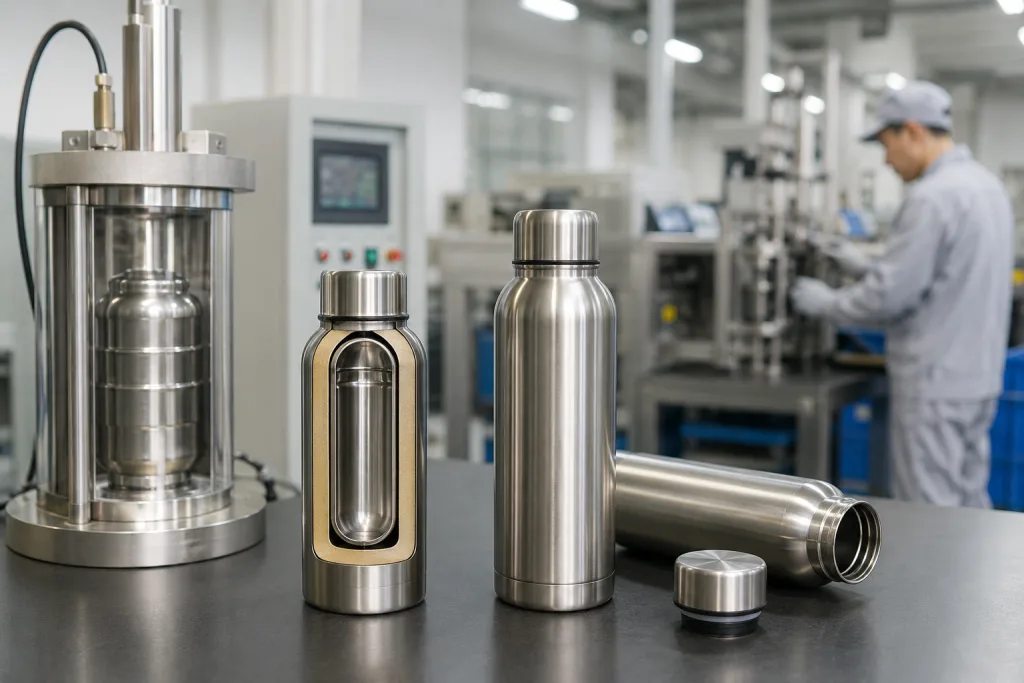
The lid is usually the weak line on a supplier thermos spec. Buyers stare at the bottle body because 304 stainless and copper coating sound expensive, but in our complaint log 7 out of 10 field issues come from lids: leaking, cross-threading, odor, cracked hinges, loose carry loops, or gaskets falling into the sink after washing. QC pulled one 500 ml sample last month where the silicone ring was 0.4 mm undersize. It leaked before the body even mattered.
Start with lid type. A screw cap is plain, but it survives outdoor retail because there are fewer parts to fail on the line. A push-button lid sells well in photos, then the buyer asks why the spring rusted after 3 dishwasher cycles; that is the wrong question to ask if the BOM used a cheap spring from the start. Cup-cap designs work for classic hiking flasks, as long as the cup wall stays around 0.8–1.0 mm and the thread engagement is checked with a go/no-go gauge. For promotional thermos programs, we run simpler lids when the MOQ is 3,000 pcs because fewer moving parts usually means fewer after-sales emails.
Name the material on the spec sheet. PP is common for hot beverage contact because it handles heat better than low-cost plastics we still see quoted at trading-company level. Tritan is fine for transparent parts, but not every clear insert needs it; the math doesn't work if the buyer is chasing a USD 0.18 lid saving. Silicone gaskets should be food-grade and pass LFGB or FDA food-contact requirements depending on market. For Europe, we also watch REACH and SVHC declarations on coatings, plastics, and colored parts, and we have seen a PO typo list “SVHC 224” when the buyer meant the current declaration count.
Leak testing needs a number, not a sentence saying “no leakage.” We fill the flask with water, tighten the lid to the defined torque, place it upside down or horizontal for 30 minutes, then check tissue paper under the cap seam. For travel and outdoor products, we also run shake testing plus 1.0–1.2 m drop testing on packed and unpacked units. If you are buying thermos bulk for e-commerce, carton drop testing under ISTA-style conditions matters more than a perfect showroom sample; we have seen this go sideways when 12 master cartons passed the sample room but corner-crushed after courier handling.
Thread fit is not glamorous. It decides whether your thermos distributor order feels premium in the customer’s hand. Ask for thread gauge control, or at least production inspection for smooth opening and closing every 200 pcs on the line. A lid that squeaks, grinds, or needs two attempts will hurt repeat purchase, even if the bottle keeps water hot for 12 hours. The buyer flagged one matte black run because the cap needed 1.8 turns on the golden sample but 2.5 turns in mass production.
Coating, color, and logo tolerance
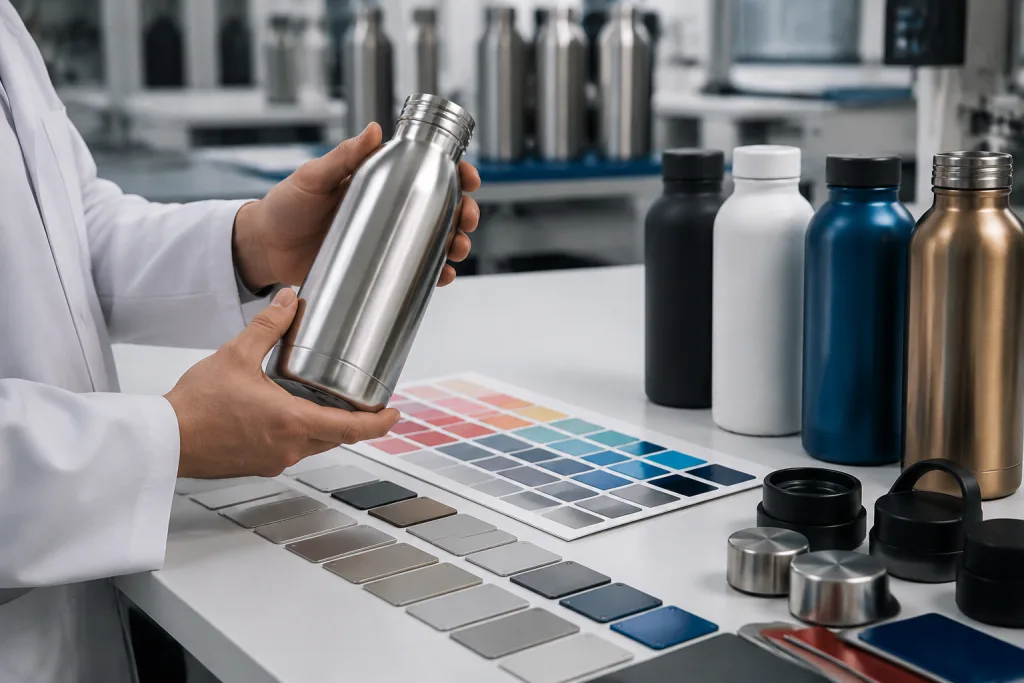
Customization is where a plain bottle becomes your SKU, and it is where orders slip if the spec is loose. For a thermos customizable program, we write the coating type, Pantone target, gloss level, logo method, logo size, placement tolerance, and abrasion requirement on the PI before deposit payment. Small line, big risk. Last month a buyer sent a PO with “logo: same as sample” but no position drawing, so our pre-press guy had to stop the pad-print fixture setup for 6 hours.
Powder coating is common for outdoor flasks because it gives better grip and chip resistance than basic spray paint. For retail-grade bottles, we run coating thickness around 60–90 microns, then QC pulled the sample for a 3M cross-hatch adhesion test and a 500-cycle rub test on the approved surface. Glossy spray paint looks clean in photos, but it scratches faster when cartons rub on the warehouse belt or bottles sit loose in backpacks. If the bottle is for hunting, camping, or mountain retail, performance beats shine. The math doesn't work after 2,000 complaints.
Logo method depends on quantity and brand position. Laser engraving is clean and durable on powder-coated stainless steel, but it shows the metal or base layer instead of a full-color logo. Silk screen printing works for simple one- or two-color logos and is cost-efficient, often around USD 0.05–0.12 per position depending on size; our line usually asks for MOQ 1,000 pcs per artwork to avoid ink-change waste. Heat transfer or UV printing can handle multicolor graphics, but ask for adhesion testing, dishwasher guidance, and color tolerance before mass production. For promotional thermos orders, the cheapest logo method is not always cheapest after the buyer flags peeling at receiving inspection.
Placement tolerance should be written as a number. For a front logo, ±1.5 mm is realistic on curved bottles; ±1.0 mm can pass if we run a tighter aluminum fixture and slower loading speed. Color should be approved by physical sample, not only screen display. Zhejiang factories can match Pantone references well, but coating batches still vary; we’ve seen Pantone 186C drift half a shade after the powder supplier changed lots. For a 20,000-piece thermos promotional campaign, approve a golden sample and keep one sealed at the factory in China and one in your office.
MOQ, pricing, and lead time
MOQ is not a number the sales desk invents. It ties back to 304 stainless coil buying, powder-coating line changeover, laser logo jig setup, printed carton MOQ, and AQL 2.5 inspection cost. For most stainless custom thermos orders from China, 1,000 pieces per color is the first workable MOQ. We run some stock-shape thermos jobs at 500 pieces with one laser logo, but once the buyer asks for Pantone coating, a private-mold lid, or a printed gift box, the math does not work at 500. Last month QC pulled a 750 ml sample because the lid thread was 0.3 mm tight after coating, and that small fix still stopped the line for half a shift.
FOB pricing changes with factory capacity, steel grade, lid parts, coating process, logo method, and packaging spec. As a working range, a 500 ml double-wall stainless customized thermos may quote around USD 3.20–5.80 FOB Ningbo or Shanghai for 1,000–5,000 pieces, depending on wall thickness, vacuum pass rate, and cap structure. A 750 ml outdoor flask may land around USD 4.50–7.50 FOB. These are not promises. They are guardrails. If a quote comes in USD 0.60 below the pack, ask what changed: 201 stainless instead of 304 stainless, thinner inner wall, cheaper silicone ring, or no drop test on the packed carton.
Lead time should be split into sample and mass production. Pre-production samples normally take 7–10 days for stock shape with custom logo, or 15–25 days if new tooling or special coating is involved. Mass production is usually 35–45 days after sample approval and deposit. Before Q4, add 10–15 days when coating lines are full; we have seen black powder coating stretch from 12 days to 18 days because 6 export orders shared one spray booth. This is where projects go sideways: buyers approve the sample on Friday, then expect the vessel booking to stay unchanged.
Payment terms for new buyers are commonly 30% deposit and 70% balance before shipment after inspection. Larger distributor thermos programs may get better terms after 3–5 stable orders with no late balance payment. If you are building a supplier directory shortlist, ask each thermos supplier for MOQ by color, sample cost, sample lead time, mass lead time, FOB port, payment terms, and whether they support EXW, FOB, CIF, DDP, or Amazon FBA labeling. Ask it in one table. The buyer once flagged a PO typo where “matte blue” became “metal blue,” and catching that before carton printing saved 2,000 boxes. A clear supplier will answer without drama.
Compliance, inspection, and packing lines
Compliance is not a certificate folder you tick once and forget. For stainless flasks sold in Europe and North America, ask for food-contact test reports covering the cup body, silicone sealing ring, straw, lid plastic, and any painted surface that contacts the mouth. Common references include LFGB for Germany and wider EU retail acceptance, FDA food-contact expectations for the U.S., REACH for chemicals, and California Proposition 65 review when applicable. For children’s products, ASTM and CPSIA concerns may apply, while adult outdoor flasks sit in a different risk bucket. On the line, QC still checks the 304 stainless coil tag against the PO; we once caught a lid gasket listed as “sillicone” on a buyer spec sheet, and that typo delayed approval by 3 days.
Factory audits matter too. BSCI, Sedex, ISO 9001, or similar systems do not promise perfect products, but they tell you whether the thermos factory has worked under structured buyer requirements before. At BottleForge Industrial in Hangzhou, Zhejiang, we prefer factories that can show incoming material checks, welding inspection, vacuum testing records, coating QC, and final AQL reports. China has roughly 2,000 drinkware vendors chasing export orders; the useful 200 document problems instead of acting surprised when QC finds them. We ask to see the vacuum tester log, not just the audit cover page.
Inspection should be agreed before production. For most export orders, AQL Level II with critical 0, major 2.5, minor 4.0 is a common baseline. Critical defects include unsafe sharp edges, severe leakage, wrong material, contamination, or broken glass if the design includes glass components. Major defects include poor coating adhesion, wrong logo, dented body, lid malfunction, and carton shortage. Minor defects include small cosmetic marks inside the agreed limit, such as a 1 mm scratch below the base curve. This is the wrong place to “check later”; QC pulled the sample after powder coating once and found 7 lids out of 80 failed the leak jig at 45 degrees.
Packing deserves its own line. Retail boxes, kraft boxes, egg-crate dividers, polybags, silica gel, master carton strength, barcode labels, FNSKU labels, and pallet height all affect landed performance, so each item needs a spec, not a casual note in WeChat. A thermos distributor shipping to outdoor stores may need shelf-ready packaging with 350 gsm box board and clean hang-tag placement. An e-commerce thermos vendor may need 1.0 m carton drop resistance and scannable labels on five sides. Write these details early. Changing packaging after production starts is slow and expensive; we have seen a 12-day packing schedule turn into 18 days because the buyer flagged the FNSKU position after cartons were sealed.
Send your stainless thermos spec for a factory quote
Share capacity, lid style, logo method, quantity, target market, and packaging needs. We will return practical MOQ, FOB pricing, and lead time.
Frequently asked questions
What should I ask before trusting a vacuum flask supplier directory listing?
Ask for a full spec sheet, not only a catalog photo. At minimum, request inner and outer steel grade, wall thickness, capacity tolerance, lid material, gasket material, coating type, logo method, MOQ, FOB port, sample lead time, mass production lead time, and available test reports. A reliable thermos supplier should also explain AQL inspection standards and show whether they are a thermos factory, trading company, or mixed sourcing office. If they cannot confirm 304 stainless steel for food-contact surfaces or provide basic leak and thermal testing details, do not treat the listing as qualified.
What is a realistic MOQ for custom stainless thermos orders?
For a standard custom thermos using an existing bottle shape, 1,000 pieces per color is the usual MOQ from China. If you only need laser engraving on a stock color, some suppliers thermos programs may accept 500 pieces, but the unit price will be higher. For Pantone powder coating, printed retail boxes, custom lids, or private mold work, expect 1,000–3,000 pieces per SKU. Promotional brands sometimes push for 300 pieces, but below 500 pieces the setup cost per unit becomes unattractive and color control is harder to justify.
How much should a 500 ml customized thermos cost FOB China?
A reasonable 500 ml double-wall stainless thermos customized with powder coating and one logo position often falls around USD 3.20–5.80 FOB Ningbo or Shanghai at 1,000–5,000 pieces. The lower end usually means simpler lid, 201 outer steel, basic packaging, and limited testing. The higher end may include 304 outer steel, better coating, stronger carton, retail box, and tighter inspection. If a quote is USD 2.10 for a retail-grade manufacturer thermos, ask exactly what has been removed: steel thickness, coating quality, lid structure, or QC time.
Can one thermos manufacturer handle both retail and promotional orders?
Yes, but you should separate the spec. A retail outdoor flask needs stronger coating, better lid feel, more consistent packaging, and clearer warranty support. A promotional thermos may prioritize logo area, price, event deadline, and carton labeling. The same thermos manufacturer can run both if the production line, AQL criteria, and packing instructions are written differently. For example, a distributor thermos order might use AQL major 2.5 and retail boxes, while an event order might accept simpler bulk cartons but still require 100% leak testing.
How long does a thermos bulk order take from sample to shipment?
For an existing stainless flask shape, plan 7–10 days for a pre-production sample with logo and 35–45 days for mass production after approval and deposit. Add 5–10 days if you need a special Pantone coating, and 15–25 days if new tooling is involved. Sea freight to Europe or North America often adds 25–40 days depending on port and season. If your promotional thermos deadline is fixed, approve artwork, carton marks, barcode labels, and inspection criteria before the factory starts. Late packaging changes are a common cause of missed ship dates.