Key Takeaways
- A 3,000 pcs custom thermos order usually needs 7-10 days for sampling and 28-35 days for mass production
- For outdoor retail, 304 stainless steel inner wall with 0.4-0.5 mm gauge is the practical baseline
- Powder coating normally costs USD 0.35-0.70 more per unit than basic spray paint but survives handling better
- AQL 2.5/4.0 inspection should include leak, vacuum, coating adhesion, logo position, and carton drop checks
Your buyer signed off on a 500 ml stainless vacuum flask for an outdoor retail campaign. Artwork is ready. The launch date is locked. Now the real work starts: turning one clean product photo into a controlled bulk thermos order that lands without leaking lids, soft powder coating, or a green body color that fails against the Pantone chip under the D65 light box. We have seen this go sideways when a buyer approved a screen image only, then QC pulled the sample and found the lid gasket sitting 0.6 mm proud.
This is how we run a vacuum flask promotional order from RFQ to shipment at BottleForge Industrial in Hangzhou, Zhejiang. No brochure talk. We use factory numbers buyers can plan around: 3,000 pcs MOQ, 28-35 days production after sample approval, AQL inspection, carton drop checks at 76 cm, and the choices that should be settled before you pay a deposit in China. If the first question is only “what is your cheapest price,” the math doesn't work.
Start With The Real Use Case
The first mistake in a vacuum flask promotional project is treating it like a logo job. Wrong question. A flask for a ski shop, fishing tournament, or trail brand has to work as drinkware before it works as merchandise. Before we quote, we ask 3 things: where it will be sold or handed out, what heat-retention claim will be printed, and whether the user carries it in a backpack or a car cup holder. Last month QC pulled a 500 ml sample that looked fine on the desk, then failed the 30-minute inverted leak check because the silicone gasket sat 0.4 mm proud.
For this buyer scenario, assume you need 3,000 pcs of a 500 ml stainless steel flask for outdoor retailers in North America. Target retail price is USD 19.99-24.99, so the FOB Ningbo target should sit around USD 4.20-5.60 depending on lid, coating, and packaging. If this is a promotional thermos program rather than retail stock, we can cut packaging cost with a white box or kraft box. Do not cut the leak test or vacuum test. The math doesn't work when a buyer saves USD 0.08 on testing and then gets 96 wet cartons flagged at warehouse receiving.
A practical spec sheet for a thermos custom order should include capacity tolerance, body diameter, height, mouth diameter, inner and outer steel grade, lid material, gasket material, coating type, logo method, carton pack, and test requirement. Give us numbers. For example, body diameter 68 mm, height 245 mm, mouth 42 mm, 304 stainless inside, powder coating outside, laser logo 35 x 55 mm, 24 pcs per carton. If your RFQ only says “customized thermos with logo,” every thermos supplier will quote a different bottle. We’ve seen this go sideways when the PO said “matte black,” but the approved sample card was actually Pantone Black 6C with a soft-touch finish.
At our Zhejiang facility, current stainless thermos capacity is about 450,000 units/month across standard models. For a new promotional SKU, 3,000 pcs is a normal MOQ; 1,000 pcs can work on selected stock shapes, but the unit price and logo setup cost become less friendly. On the line, we run standard 500 ml shapes through the helium leak tester and vacuum aging rack before packing, so a stock-shape order usually moves faster than a new mold. Think 18 days vs 32 days after artwork approval, assuming the lid and carton artwork are clean.
Lock The Bottle Construction
For a stainless vacuum flask, the body build drives most of the buyer’s experience. We usually quote 304 stainless for the inner wall and 201 or 304 for the outer wall, depending on target cost. For retail launches and brand merch, 304/304 sells cleaner, especially when the buyer asks about food-contact compliance. On the line, 0.4-0.5 mm is a common wall gauge; go thinner and the bottle saves cost, but dents show up faster in transit and in daily carry.
Vacuum performance comes down to weld quality, degassing, copper plating or a reflective layer, and the final vacuum seal. For a 500 ml factory thermos, 6-8 hours hot and 12-18 hours cold is a sensible claim under controlled room-temperature testing. The buyer flagged it before: 24-hour hot claims without a clear test setup are asking for trouble. We need the starting water temperature, ambient temperature, and the end-reading method, or the math does not hold.
The lid is where a lot of promo orders go sideways. A plain screw lid costs less, usually USD 0.25-0.45 below a push-button or cup-lid style, but campers often want the cup function. For a distributor order, ask early whether spare gaskets are needed. QC pulled the sample on one shipment because the silicone ring had odor after heat soak, so we now check food-grade material, fit, and compression after 80°C exposure.
When you compare thermos manufacturers, ask for the finished weight, not just capacity. A 500 ml flask that looks fine in photos can feel flimsy the moment you hold it. A typical 500 ml stainless vacuum flask with powder coating and a cup lid usually lands around 285-340 g, depending on diameter and steel thickness. Weigh the sample on a 0.1 g scale, and you will spot a light build before it becomes a complaint.
Choose Branding Without Guessing
The logo method should start with the body finish, MOQ, artwork size, and how the flask gets abused after delivery. We run laser on 304 stainless and powder-coated shells when the buyer wants a rugged outdoor promotional thermos that still looks clean after 6 months in a backpack. It won’t peel. QC pulled a matte black sample last month after laser marking and measured the logo at 0.18 mm depth on the first pass; stable registration, no color matching headache. The trade-off is simple: laser gives a metal or undercoat effect, not a Pantone badge.
Silkscreen printing works when the logo is one or two colors and the budget is tight. The curve matters. A 60 mm wide logo on a 500 ml flask is safe on our round-body jig; a 180-220 mm wrap print needs better tooling, slower line speed, and closer checking at the seam. We’ve seen this go sideways when a buyer sent a 210 mm wrap file with 4 tiny text lines, then flagged distortion after the first sample. Heat transfer handles gradients and multi-color artwork, but abrasion resistance needs testing. UV printing gives sharp edges, while powder coat still needs adhesion testing before mass production approval.
For this buyer scenario, a customizable thermos in matte forest green with one-position laser logo is the lower-risk choice. If the outdoor retailer wants a full-color badge, ask for a pre-production sample first and run a 3M tape adhesion test, cross-hatch test, and 500-cycle rub test where possible. These tests are not decoration. They stop the ugly WhatsApp photos from store staff after 7 days on a shelf, when a logo corner starts lifting and everyone suddenly checks the PO wording.
Logo setup costs in China are usually modest: laser programming may be USD 30-60, silkscreen film USD 40-80 per color, and heat-transfer plates can be higher. A professional thermos vendor should split unit cost, mold cost if any, logo setup, sample charge, and packaging charge on the quote sheet. Don’t accept one blended number. The math gets messy fast, especially when the buyer later changes from kraft box to 350 gsm color box and the PO still has the old carton mark typo.
Sample Approval Is A Contract
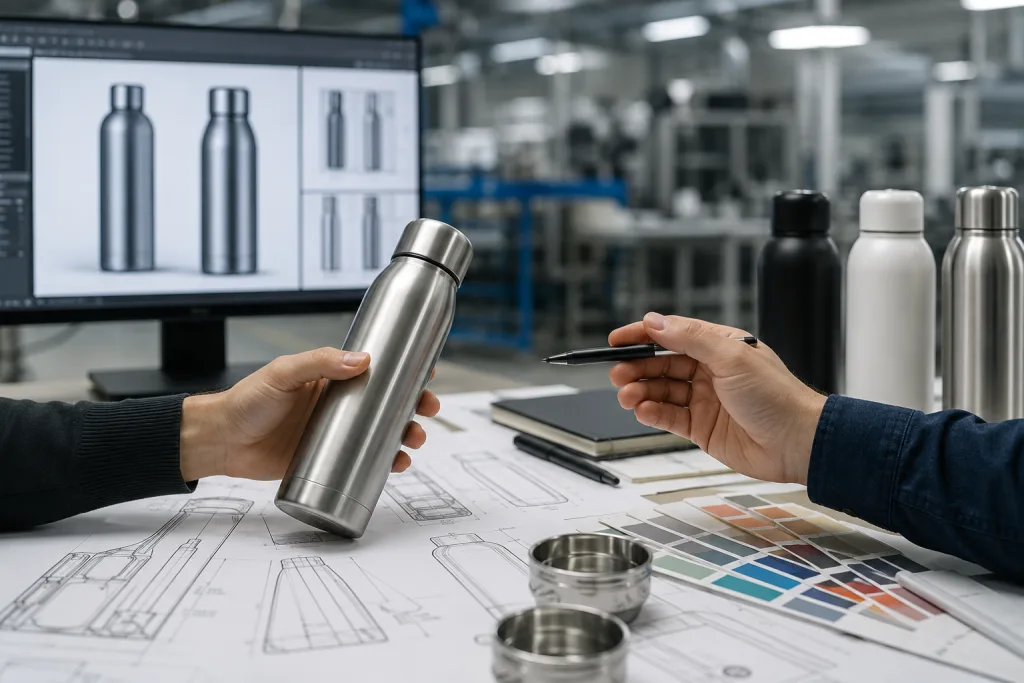
Once the spec is agreed, sampling starts. For a stock body with custom color and logo, we usually quote 7-10 days for a pre-production sample, after the spray card is checked and the laser file is locked. If you need a new lid mold, new body shape, or a special carrying handle, the sample timeline can move to 20-30 days and tooling can range from USD 800 to more than USD 5,000. We run 40 mm and 55 mm mouth stock bodies every month, so 8 out of 10 promotional buyers do not need new tooling. They need the right stock platform and decoration that the line can repeat.
The golden sample is a physical contract. Keep one approved sample at your office and one at the factory, sealed in a PE bag with the buyer name, PO number, and approval date on the label. Confirm Pantone reference under D65 light if color matters; our QC team checks it in a light box before the sample goes out. For powder coat, allow a working tolerance because stainless substrates, curing temperature, and batch size can shift color slightly. A Delta E target under 1.5 is strict; most promotional programs we see accept Delta E 2.0-3.0 if the color stays visually consistent across cartons.
For a thermos bulk order, your approval sheet should list sample weight, capacity by water fill, lid torque feel, logo size in millimeters, logo position from base or seam, coating texture, barcode placement, and carton mark. Put numbers on it. For example, 500 ml by water fill, 318 g sample weight, logo 42 mm wide, logo center 95 mm from the base. If you sell through marketplaces or outdoor chains, confirm FNSKU, UPC, suffocation warning, country of origin, and any hangtag copy before mass production. We have seen a PO typo turn “matte black” into “matt black,” and the buyer flagged it only after carton artwork was printed.
Do not approve from photos only unless the schedule leaves no choice. This is the wrong question to ask when the order is 3,000 pcs and the gift date is fixed. Photos hide lid looseness, odor, coating texture, and hand feel; QC pulled a sample last month where the lid passed in video but felt gritty after 6 turns on the thread gauge. A good thermos manufacturer in Zhejiang or elsewhere in China can send video, but a couriered sample is still cheaper than reworking 3,000 pcs.
Run QC Before Cartons Close
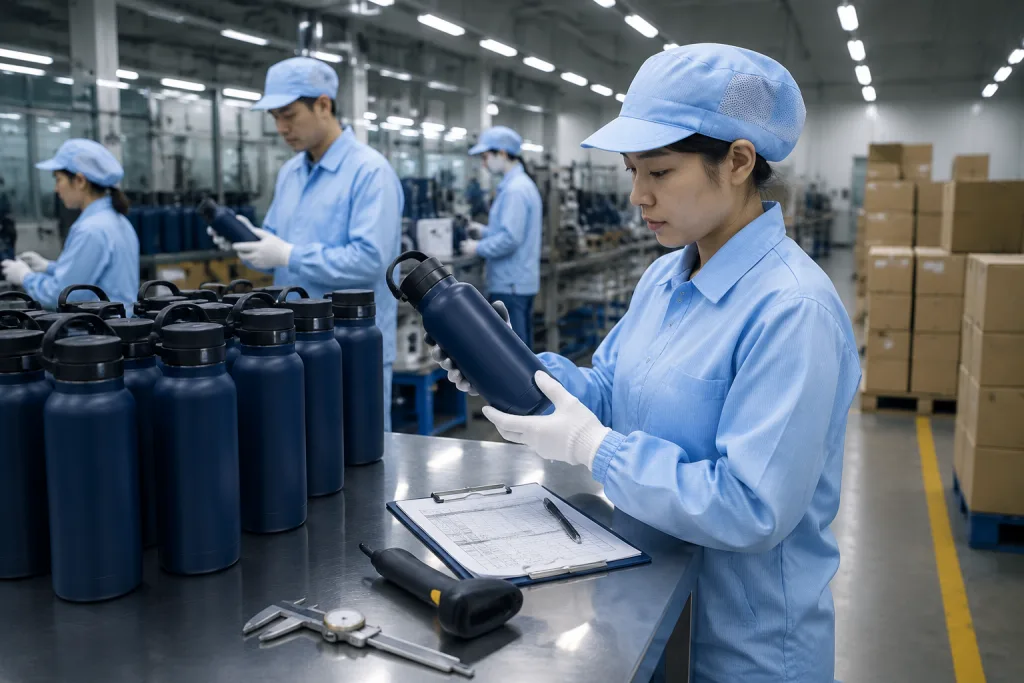
QC has to run while the line is still open, not after 3,000 pcs are already stacked by the loading door. For stainless vacuum flasks, we check incoming 304 stainless sheets with a handheld thickness gauge, then welding, polishing, vacuum sealing, coating, logo, assembly, and packing. The final inspection should follow the agreed AQL level, commonly AQL 2.5 for major defects and 4.0 for minor defects. Critical defects such as leakage, sharp edges, wrong material, or failed food-contact requirement should stay zero tolerance. No debate there.
For this 3,000 pcs order, a third-party or buyer inspection may sample 200 pcs under General Inspection Level II, depending on the selected standard table. The checklist should include visual inspection on every pulled piece, capacity check with a measuring cylinder, lid fit by torque feel, upside-down leak test for 30 minutes, hot water retention spot test, coating adhesion with 3M tape, logo position within a 1.5 mm tolerance, barcode scan, carton weight, and drop test. QC pulled the sample last month on a similar order and found 7 pcs with logo drift near the cup shoulder. For vacuum performance, we run tighter internal checks because a failed vacuum body cannot be repaired after assembly. Scrap it.
Ask your thermos suppliers how they detect vacuum failure. Common methods include temperature decay testing, acoustic checks, and process controls after vacuum sealing; on our floor, rejected bodies go into red bins beside the vacuum station, not back onto the belt. Also ask how they separate rejected bodies. A factory thermos line without clear reject bins is a warning sign. We have seen this go sideways when a buyer only asked for photos of finished cartons.
For regulatory paperwork, outdoor retailers in Europe may ask for LFGB, REACH, and food-contact declarations. North American buyers may request FDA food-contact conformity and ASTM-related packaging or children’s product checks if the item is marketed to kids. If the flask is not for children, do not let the design accidentally look like one; a cartoon bear on a 350 ml lid can trigger the wrong review. Compliance scope affects testing cost and lead time, often 5 working days for a simple declaration package versus 12 days when lab testing is added.
Price The Landed Order Honestly
A quoted FOB price is only one line on the cost sheet. For a 500 ml customized thermos, we might quote USD 4.80 FOB Ningbo for 3,000 pcs with 304 inner, 201 outer, matte powder coat, laser logo, individual kraft box, and 24 pcs per export carton. Change to 304 outer, full-color heat transfer, retail color box, and spare gasket, and the same bottle moves to USD 5.60-6.40. Normal math. Last month QC pulled a 500 ml sample and measured 0.42 mm on the outer wall; the buyer had assumed 0.50 mm because another supplier never wrote the wall thickness on the PI.
Packaging changes both the invoice and the damage claim risk. A white box can cost USD 0.10-0.18, kraft USD 0.15-0.25, and printed retail box USD 0.30-0.60 depending on paper grade and printing. For outdoor retailers, retail box copy should include capacity, material, care instructions, and origin, with barcode position confirmed before plates are made. If your distributor needs a shelf-ready carton, tell the supplier before quotation, because carton size and pallet plan change. We once had a PO typo saying “12 pcs inner carton” instead of “12 pcs display carton”; the line stopped for 4 hours while packing checked the die-cut file.
Payment terms for a new buyer are often 30% deposit and 70% before shipment after inspection. Established distributor thermos programs may get better terms after 3 to 5 clean orders, but the first order should focus on control, not credit. Typical production lead time is 28-35 days after deposit and sample approval, plus 3-7 days for booking and local handling in China. Sea freight to the US West Coast can be around 18-25 days port to port; Europe often runs 30-40 days depending on route. We run the deposit clock from the day the artwork, Pantone number, and approved sample are all locked, not from the first WhatsApp “OK.”
If a thermos supplier quotes 20% below everyone else, ask what changed: steel grade, wall thickness, coating, lid structure, inspection level, or carton packing. This is the wrong question to ask: “Can you match the cheapest price?” Ask for the BOM instead. On one 3,000 pcs order, the buyer flagged a USD 0.72 gap; the cheap sample had a lighter lid, no spare gasket, and carton burst strength 5 kg lower than our export carton. There is always a reason.
Prepare Reorders And Retail Feedback
The first shipment is not the finish line. It is the reorder sheet. Ask each sales channel to send back dent complaints, lid leakage, coating scratches, barcode scan failures, and sell-through by color, with photos when possible. Last quarter QC pulled 32 returned flask samples from a promo order; 19 were carton crush damage, not vacuum failure. Outdoor retailers will accept USD 0.18 more at wholesale if the return rate stays under 1.5% and the bottle feels solid in hand.
For reorders, lock the same approved sample, Pantone reference, logo file, and carton specification. Do not ask only, “Can you make it cheaper?” That is the wrong question if the shelf set must match. We have seen this go sideways when a buyer moved the second run to another thermos factory and forgot the matte black paint code; the new lot was 4 gloss units higher on the BYK gloss meter and looked like a different product under store lighting. Brand owners and thermos distributors notice that fast in a seasonal line.
At BottleForge Industrial in Hangzhou, Zhejiang, we keep a production file for each custom thermos: BOM, artwork, sample photos, inspection report, packaging dieline, shipment marks, and the last PO revision. Small detail, big difference. One buyer once typed “PMS 286C” on the PO while the approved sample used “PMS 268C”; our merchandiser caught it before the line mixed paint. A repeat run of 3,000-5,000 pcs can start without another full sampling cycle when material, finish, logo size, and carton layout stay unchanged.
For a growing promotional brand, the next move might be a 750 ml version, a sports bottle, or a travel tumbler in the same finish, but copy the winning flask standard instead of reinventing the surface. We run the finish board beside the coating line and check logo position in mm, not by eye. A disciplined first order gives you better terms with thermos manufacturers, tighter forecasts, and fewer arguments when the buyer flags delivery 12 days before the next outdoor season catalog closes.
Send Us Your Flask Spec And Launch Date
We will check MOQ, logo method, packaging, compliance needs, and FOB pricing before you commit budget to production.
Frequently asked questions
What MOQ should I expect for a vacuum flask promotional order?
For a standard stainless vacuum flask with custom logo, 3,000 pcs is the practical MOQ at our Zhejiang factory. Some stock models can start at 1,000 pcs, but the unit price is usually higher and Pantone coating options may be limited. If you need custom color, retail packaging, and a specific lid, plan around 3,000-5,000 pcs. New tooling is a different discussion; a new body or lid mold can push the minimum higher because the setup time, fixtures, and trial production have to be absorbed.
How long does a custom thermos order take from sample to shipment?
For a stock stainless flask with custom logo and color, allow 7-10 days for sampling and 28-35 days for mass production after sample approval and deposit. Add 3-7 days for export booking, customs documents, and local trucking in China. If you need third-party lab testing for LFGB, REACH, or FDA food-contact documentation, add 5-10 working days depending on the test scope. New mold projects can add 20-30 days before you even approve a production sample.
Which logo method is best for outdoor promotional thermos programs?
Laser engraving is usually the safest choice for outdoor use because it will not peel and handles abrasion better than many printed methods. It works especially well on powder-coated stainless bodies. Silkscreen is cheaper for simple one-color logos, while heat transfer or UV printing is better for full-color artwork. For any printed logo, ask for adhesion testing before mass production. A simple cross-hatch and 3M tape test can catch weak ink bonding before 3,000 pcs are packed.
Can you support Amazon or retail barcode requirements?
Yes, but you need to provide the requirement before packaging artwork is approved. For Amazon-style projects, we can apply FNSKU labels, carton labels, suffocation warnings for polybags if used, and carton marks by SKU. For retail, we can print UPC, material claims, care instructions, country of origin, and importer details on the box or hangtag. Barcode scanning should be part of final QC. A label that looks correct but fails scanning can delay an entire shipment at the warehouse.
How do I compare quotes from different thermos suppliers fairly?
Ask every supplier thermos quote to use the same spec: capacity, steel grade, wall gauge, finished weight, lid type, coating, logo method, packaging, AQL level, and FOB port. A USD 4.20 flask and a USD 5.20 flask may not be the same product. One may use thinner outer steel, basic spray paint, or a cheaper lid gasket. Request photos of the open lid, bottom mark, carton packing, and a real sample weight in grams. Comparable inputs give you comparable pricing.